

I've watched business owners spend years building something valuable, only to blow the entire sale by picking the wrong asking price. It happens more often than you'd think. And it's almost always avoidable.
The asking price is the single most important decision you'll make when selling your business. Get it right and you attract qualified buyers, create urgency, and close within 6 to 9 months. Get it wrong and your listing sits on the market like a house that's been for sale too long. Everyone starts wondering what's wrong with it.
In this post, I'm going to walk you through exactly how to set a price that's grounded in data, attractive to buyers, and still gets you what your business is actually worth.
Why Your Gut Feeling About Price Is Almost Always Wrong
Here's something I tell every seller during our first conversation: your emotional connection to the business is not a line item on the balance sheet. I know that sounds blunt, but it's true.
Most owners overvalue their businesses by 20% to 40%. I've seen it hundreds of times. They factor in the sleepless nights, the personal sacrifices, and the years of grinding before the business became profitable. Those things matter to you. They don't matter to a buyer doing math on a spreadsheet.
Buyers pay for one thing: cash flow. Specifically, they pay a multiple of the cash flow your business generates. Not the cash flow it could generate if the new owner "just did X." Not the revenue you're projecting for next year. The actual, provable, historical cash flow that shows up in your tax returns and financial statements.
The other trap is pricing based on what you need from the sale rather than what the market will bear. If you need $2 million to retire comfortably but your business only supports a $1.4 million valuation, the market doesn't care about your retirement plan. Pricing at $2 million just means you won't sell.
The Three Valuation Methods That Actually Matter
There are dozens of ways to value a business, but only three matter for most small to mid size transactions. If you want a deeper breakdown, I wrote a full guide on business valuation methods that covers each in detail.
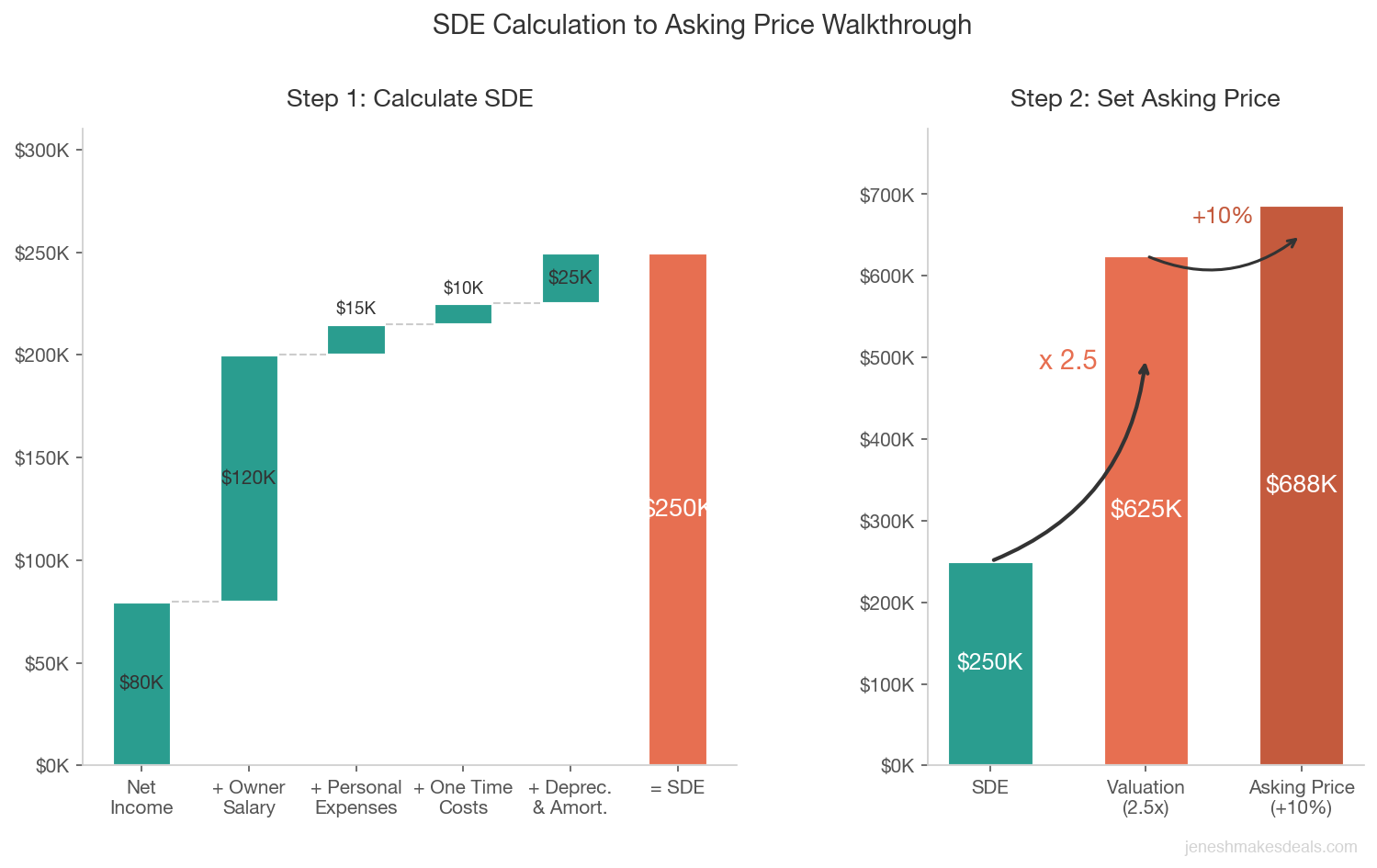
SDE Multiple Method. This is the standard for businesses doing under $1 million in annual revenue. You calculate seller's discretionary earnings (basically, the total financial benefit the owner takes from the business) and multiply it by an industry specific factor. A business with $250,000 in SDE and a 2.5x multiple is worth roughly $625,000.
EBITDA Multiple Method. For businesses above $1 million in revenue, buyers typically use EBITDA instead of SDE. EBITDA strips out the owner's personal compensation and focuses on the business's operating profit before interest, taxes, depreciation, and amortization. EBITDA multiples tend to run higher than SDE multiples because these businesses are typically less owner dependent.
Asset Based Valuation. This method adds up the fair market value of all business assets (equipment, inventory, real estate, vehicles) and subtracts liabilities. It's most useful for capital heavy businesses like manufacturing, trucking, or construction where the assets themselves hold significant value. It also serves as a floor. Your business should be worth at least the value of its tangible assets.
| Method | Best For | Metric | Typical Use Case |
|---|---|---|---|
| SDE Multiple | Businesses under $1M revenue | Seller's Discretionary Earnings | Owner operated small businesses |
| EBITDA Multiple | Businesses over $1M revenue | Operating profit before interest, taxes, depreciation, amortization | Manager run mid market businesses |
| Asset Based | Capital heavy industries | Fair market value of assets minus liabilities | Manufacturing, trucking, construction |
For most service businesses, professional practices, and retail operations, the SDE or EBITDA method is going to be your primary pricing tool.
How to Calculate Your SDE and Pick the Right Multiple
Let me walk through this step by step, because getting your SDE right is the foundation of your asking price.
Start with your net income from your most recent tax return. Then add back the following:
- Owner's salary and payroll taxes (the full compensation you take, including benefits)
- One time expenses that won't recur for the buyer (a lawsuit settlement, a major repair, moving costs)
- Personal expenses run through the business (your car payment, cell phone, health insurance, meals that were more personal than business)
- Depreciation and amortization (non cash expenses)
- Interest expense (the buyer will have their own financing structure)
Let's say your tax return shows $80,000 in net income. You pay yourself a $120,000 salary. You ran $15,000 in personal expenses through the business. You had $10,000 in one time legal fees and $25,000 in depreciation. Your SDE is $250,000.
Now you need the right multiple. Multiples vary by industry, and I publish updated data on 2026 industry multiples each year. Here are the ranges I see most often:
- Restaurants and food service: 1.5x to 2.5x SDE
- Service businesses (HVAC, plumbing, electrical): 2.0x to 3.5x SDE
- Retail and e commerce: 2.0x to 3.0x SDE
- Professional practices (accounting, dental, veterinary): 2.5x to 4.0x SDE
- SaaS and technology: 3.0x to 5.0x+ SDE
- Manufacturing: 2.5x to 4.5x SDE
- Healthcare: 3.0x to 5.0x SDE
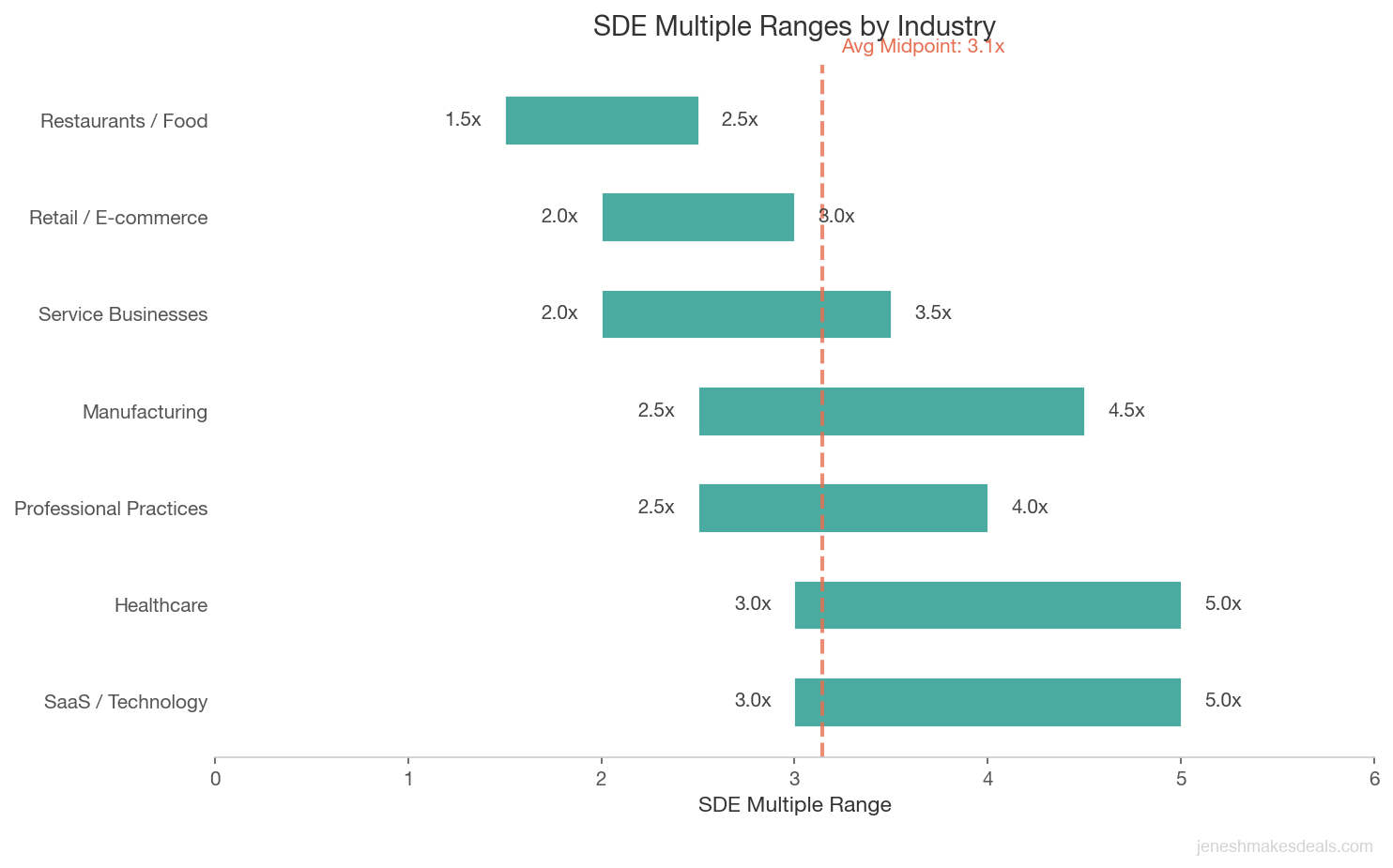
Using our $250,000 SDE example, a plumbing business might be priced at $625,000 (2.5x) to $750,000 (3.0x), while a dental practice might be priced at $750,000 (3.0x) to $1,000,000 (4.0x).
Need help running the numbers on your own business? Use our free business valuation calculator to get a quick estimate based on your industry and financials.
What Makes Your Multiple Higher or Lower
Not every plumbing business gets a 3.0x multiple. Not every restaurant gets a 2.0x. The multiple reflects the risk and attractiveness of your specific business. Here's what moves the needle.
| Factor | Pushes Multiple Higher | Pushes Multiple Lower |
|---|---|---|
| Revenue trends | 10% to 15% annual growth, 3+ year uptrend | Flat or declining revenue |
| Customer concentration | No single client above 5% of revenue | One client is 30%+ of revenue |
| Owner dependency | Strong management team, owner can step away | Owner does everything, business stops without them |
| Recurring revenue | 60%+ from contracts, subscriptions, retainers | Starts from zero every month |
| Lease terms | 3 to 5+ years remaining, below market rent | Expires in 12 months or less |
| Equipment condition | Well maintained, recently upgraded | Needs $100K+ in replacements within 2 years |
| Employee retention | Key staff with 5+ years, committed to staying | High turnover, thin bench |
Revenue trends. Three or more years of consistent growth gets you toward the top of your industry's range. Flat or declining revenue pushes you to the bottom. Buyers will look at your trailing 12 months, your 3 year trend, and your year over year growth rate. A business growing at 10% to 15% annually is significantly more attractive than one growing at 2%.
Customer concentration. If a single customer accounts for more than 15% of your revenue, that's a risk factor. If one customer is 30% or more, it's a serious discount. I've written extensively about customer concentration risk because it kills deals more often than sellers expect. A diversified customer base with no single client above 5% of revenue pushes your multiple higher.
Owner dependency. Can the business run without you for two weeks? A month? If the answer is no, your multiple drops. Buyers don't want to buy a job. They want to buy a business. I covered this in depth in my post on owner dependency and how it affects sale price. A business with a strong management team in place will sell for 0.5x to 1.0x more than an identical business where the owner does everything.
Recurring revenue. Monthly contracts, subscriptions, maintenance agreements, and retainers are gold. A business with 60% or more recurring revenue is far more valuable than one that starts from zero every month. I've seen recurring revenue models add a full 1.0x to the multiple.
Lease terms. If your lease expires in 12 months, that's a red flag for buyers. You want at least 3 to 5 years remaining on a transferable lease at fair market rent. A great location with a long term lease at below market rent can actually increase your valuation.
Equipment condition. Buyers factor in capital expenditures. If they're going to need to replace $100,000 in equipment within the first two years, that comes off your price. Well maintained, recently upgraded equipment supports a higher multiple.
Employee retention. Key employees who have been with you for 5+ years and plan to stay through the transition add value. High turnover and a thin bench are risk factors that push multiples down.
The Difference Between Asking Price and Selling Price
Here's a data point that surprises most sellers: the average small business sells for 87% to 95% of its asking price. That gap depends on deal size, industry, and how well the business was priced to begin with.
For businesses listed under $500,000, the discount from asking to closing price tends to be 10% to 15%. For businesses listed between $500,000 and $2 million, it's typically 5% to 10%. For businesses above $2 million, the gap narrows to 3% to 7% because these deals involve more sophisticated buyers and more rigorous upfront pricing.
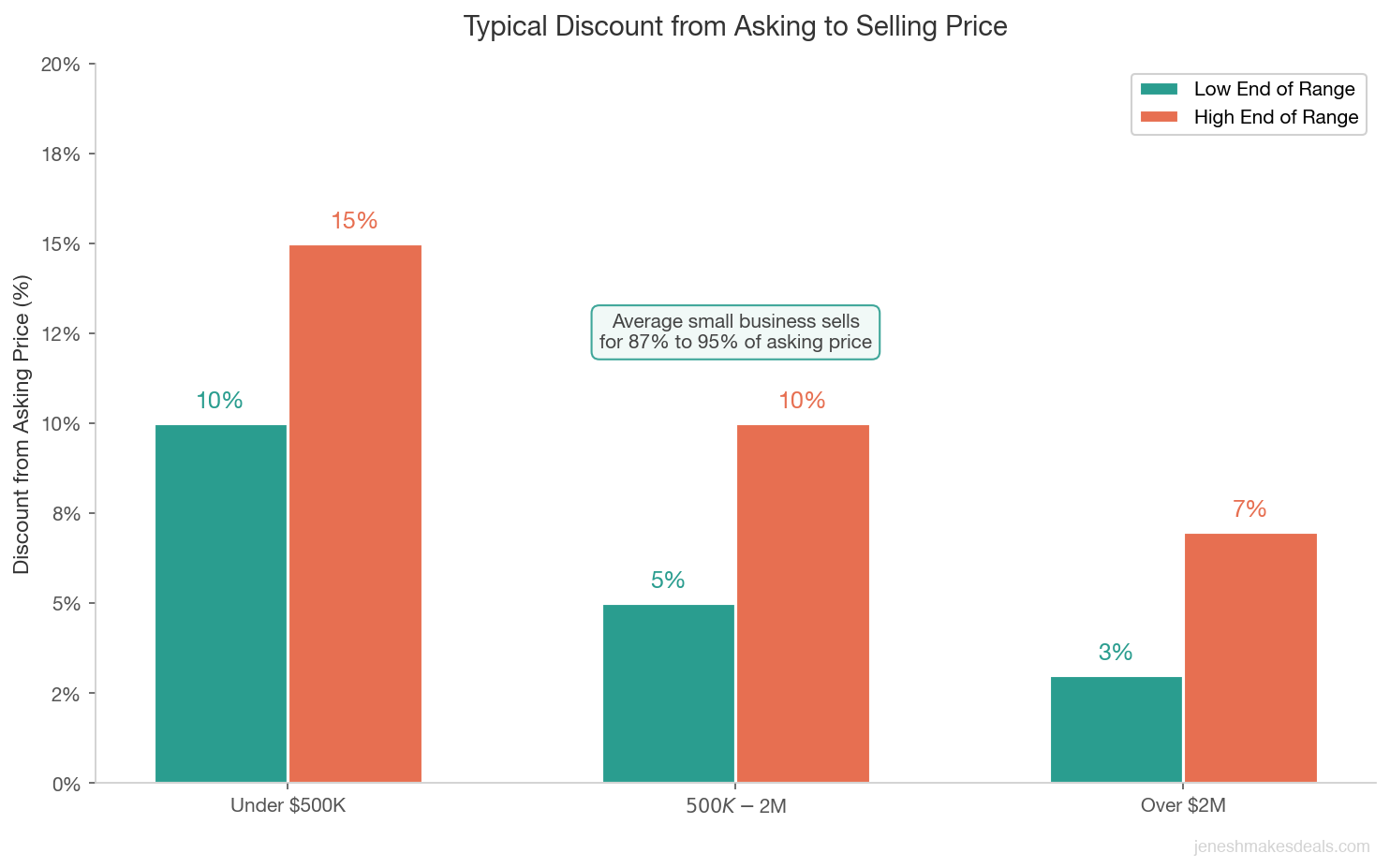
What does this mean for your asking price? You need to build in some negotiation room, but not so much that you scare away buyers.
If you believe your business is worth $800,000 based on your valuation work, pricing at $850,000 to $875,000 gives you room to negotiate while staying credible. Pricing at $1.1 million because "the buyer will negotiate down" is a recipe for your listing going stale.
The smartest sellers I work with price their businesses 5% to 10% above their target number. That's it. Enough room to make the buyer feel like they got a deal, but not so much that serious buyers move on.
Price your business 5% to 10% above your target number. That gives buyers room to negotiate while keeping you in the range of what the business is actually worth.
How to Use Comparable Sales and Market Data
Just like real estate, comparable transactions ("comps") are one of the best ways to validate your asking price. The problem is that business sale data is much harder to find than home sale data.
Here's where to look:
BizBuySell. The largest online marketplace for businesses for sale. Their sold business data includes sale price, revenue, cash flow, and asking price. You can filter by industry and location. The free data is limited, but even the listing prices give you a benchmark.
BizComps. A paid database with over 13,000 actual sale transactions. It includes SDE multiples, industry codes, and transaction details. A single report costs around $150 to $300, and it's worth every penny if you're pricing without a broker.
Broker databases. Experienced business brokers have access to proprietary transaction data from deals they've closed and data shared among broker networks. This is one of the biggest reasons to work with a broker. We've seen what similar businesses actually sold for, not just what they were listed at.
Comps are imperfect because no two businesses are identical. A restaurant in Manhattan and a restaurant in Des Moines might both be "restaurants," but they operate in completely different markets. When using comps, adjust for differences in location, size, growth rate, profitability, and condition. Think of comps as a sanity check, not a precise answer.
If you're learning how to value a business for the first time, comps combined with an SDE multiple analysis will get you 90% of the way to a solid asking price.
The Danger of Pricing Too High
I need to be direct about this: overpricing your business is the number one reason listings fail. Not bad financials. Not a weak market. Overpricing.
Here's what happens when you list at $1.2 million when your business is worth $900,000.
Week 1 to 4: Your broker presents the listing to their buyer database. Experienced buyers and their advisors run their own valuation. They see the disconnect. They pass.
Month 2 to 3: The listing sits on BizBuySell and other platforms. No serious inquiries. The few buyers who call ask tough questions about the valuation, and the conversations go nowhere.
Month 4 to 6: Your broker recommends a price reduction. You resist because you "haven't given it enough time." Meanwhile, buyers who saw the listing early have mentally flagged it as overpriced and moved on.
Month 7 to 12: You finally agree to reduce the price to $975,000. But now the listing has been on the market for months. Buyers who look it up see the price history. They assume either the business has problems or you're a difficult seller. Your negotiating position is weaker than it would have been if you'd priced at $950,000 from the start.
I've seen this pattern play out dozens of times. The data backs it up too. Businesses that are priced correctly from the start sell 40% to 60% faster than those that start high and reduce. And here's the kicker: they often sell for more money because they generate early interest and competitive tension.
Businesses priced correctly from day one sell 40% to 60% faster than those that start high and reduce. They also tend to sell for more money because early interest creates competitive tension among buyers.
The Case for Pricing Slightly Below Market
This is going to sound counterintuitive, but hear me out: pricing your business 5% to 10% below what you think it's worth can actually result in a higher final sale price.
The logic is the same as in real estate. When a house is priced just below market, it generates more showings, more offers, and often a bidding war that pushes the final price above what the seller would have gotten at a higher list price.
With businesses, the same principle applies. A well priced listing generates multiple interested buyers. When two or three qualified buyers are competing for the same business, you have negotiating power. You can choose not just the highest offer but the best offer (strongest financing, fastest timeline, best cultural fit).
This strategy works best when:
- Your business is in a desirable industry (healthcare, SaaS, home services)
- You're in an active market with multiple buyers searching
- Your financials are clean and easy to verify
- You have a broker managing the process and fielding multiple offers simultaneously
It doesn't work as well for niche businesses, businesses in rural markets, or businesses with complicated financials that take months to untangle during due diligence.
Ready to discuss your pricing strategy? Contact us for a free consultation and we'll walk you through your options based on your specific situation.
Getting a Professional Valuation vs. Doing It Yourself
You have three options for determining your asking price, and the right choice depends on your deal size and situation.
DIY valuation. Cost: free. Best for businesses under $300,000 where you're comfortable with the math. Use our valuation calculator, review comps on BizBuySell, and talk to your accountant. The risk is that you miss something or your bias creeps into the numbers. But for simple businesses with clean books, this can work.
Broker's opinion of value. Cost: usually free (included as part of the listing agreement). A good broker will analyze your financials, compare your business to recent transactions, factor in market conditions, and give you a range. This is what most sellers in the $300,000 to $2 million range should do. The broker has market context that a formal appraiser might not.
Formal business appraisal. Cost: $3,000 to $10,000+ depending on business size and complexity. Performed by a certified business appraiser (look for the CVA, ABV, or ASA designation). This produces a detailed written report that holds up in court, in divorce proceedings, in partnership disputes, and in SBA loan applications. You need this if your business is worth over $2 million, if there's a legal reason for the valuation, or if you and a partner disagree on price.
Here's my honest take: for most small business sales between $500,000 and $2 million, a broker's opinion of value combined with your own SDE analysis is sufficient. Save the $5,000 to $10,000 formal appraisal fee for situations where you truly need a defensible, third party number.
One important note on SBA loans. If your buyer is using SBA financing (and about 60% of small business buyers do), the lender will require a third party business valuation anyway. That cost typically falls on the buyer, not you. But your asking price needs to be in the ballpark of what that appraisal will come back at. If you're priced at $1.5 million and the SBA appraisal comes in at $1.1 million, the deal falls apart.
Putting It All Together: A Pricing Checklist
Before you set your asking price, run through this checklist:
-
Calculate your SDE or EBITDA using at least three years of financial data. Use the most recent year as the primary number but show the trend.
-
Identify your industry's multiple range using current market data. Don't rely on what a friend sold their business for in 2019. Multiples change.
-
Honestly assess your business's strengths and weaknesses against the factors that affect your multiple (revenue trends, customer concentration, owner dependency, recurring revenue).
-
Pick a specific multiple within your range based on that assessment. If you're above average on most factors, use a multiple in the top third of the range. If you're average, use the middle. Be honest with yourself.
-
Cross reference your number against comparable sales. Does it make sense relative to what similar businesses actually sold for? If your number is 30% higher than every comp, something is off.
-
Add 5% to 10% for negotiation room. This is your asking price.
-
Stress test the price. If you were a buyer looking at this business for the first time, would you take the meeting? Would the price to earnings ratio make sense? Would you be able to service the debt and still pay yourself?
If your asking price passes all seven checkpoints, you're in solid shape.
Want a second opinion on your asking price? Reach out for a free, no obligation conversation about what your business could sell for in today's market.
Final Thoughts
Pricing your business correctly is not about maximizing the number on the listing. It's about maximizing the number on the closing document. Those are two very different things.
The sellers who get the best outcomes are the ones who lead with data, leave emotion at the door, and price their businesses to attract serious buyers from day one. They understand that a well priced business creates urgency. A poorly priced one creates doubt.
Remember, the asking price is not the same as what you walk away with. Use our seller net proceeds calculator to understand what you'll actually keep after taxes, broker fees, and closing costs.
Spend as much time on pricing as you spent building the business. When you land on a number, make sure you can defend it with facts, not feelings.
If you take one thing from this post, let it be this: spend as much time on pricing as you spent building the business. Talk to a broker. Run the numbers. Look at the comps. And when you land on a number, make sure you can defend it with facts, not feelings.
Ready to figure out your number? Contact me for a free consultation and I'll give you an honest assessment of what your business is worth and what price will get it sold.
Want the full picture? Download our free Complete Guide to Selling Your Business in 2026 covering valuation, financial preparation, negotiation, and more.
Related Articles

April 30, 2026
How Long Does It Really Take to Sell a Business
Most sellers are shocked by how long it takes. Here's the honest timeline from listing to closing, and what actually speeds things up.

April 26, 2026
How to Structure an Earnout That Works for Seller and Buyer
Most earnouts fail because they're poorly structured. Here's how to build earnout terms that protect both sides of the deal.

April 24, 2026
How to Value Intellectual Property in a Business Sale
Your IP could be worth more than your equipment. Learn how patents, trademarks, and trade secrets affect your business valuation.
About the Author
Jenesh Napit is an experienced business broker specializing in business acquisitions, valuations, and exit planning. With a Bachelor's degree in Economics and Finance and years of experience helping clients successfully buy and sell businesses, he provides expert guidance throughout the entire transaction process. As a verified business broker on BizBuySell and member of Hedgestone Business Advisors, he brings deep expertise in business valuation, SBA financing, due diligence, and negotiation strategies.
You might also be interested in
Free Business Calculators
Try our business valuation calculator and ROI calculator to estimate values and returns instantly.
How to Buy a Business Guide
Download our comprehensive free guide covering everything you need to know about buying a business.
Our Services
Explore our professional business brokerage services including valuations and buyer representation.
More Articles
Browse our complete collection of business brokerage insights and expertise.