

I've worked with business owners who spent $200,000 on equipment and obsessed over its depreciation schedule during a sale, while completely ignoring the proprietary software system they built that was generating $80,000 a year in recurring revenue. The equipment mattered. But the software was worth more than every physical asset in the building combined.
Intellectual property is one of the most undervalued assets in small business sales. Sellers either don't realize they have it, don't know how to value it, or fail to document it properly before going to market. Buyers, on the other hand, are willing to pay premium multiples when IP is well protected and clearly tied to revenue.
Here's how IP affects your sale price, how to value it, and what you need to do before listing.
What Counts as Intellectual Property in a Business Sale
Most business owners hear "intellectual property" and think of patents at large tech companies. But IP in a small business sale covers a much wider range of assets. If your business has anything proprietary that gives you a competitive advantage, you probably have IP worth valuing.
Here are the categories that come up most often in deals I work on:
Patents. Exclusive rights to an invention, process, or design for a set period (typically 20 years for utility patents). The most straightforward form of IP because buyers can assess exactly what they're getting and how long the protection lasts.
Trademarks. Your brand name, logo, taglines, and any distinctive marks you've registered or established through use. A landscaping company with 15 years of brand equity in a metro area has a trademark asset even without a formal registration.
Trade secrets. Proprietary formulas, recipes, manufacturing processes, customer pricing strategies, and supplier relationships that aren't publicly known. Trade secrets don't expire as long as they remain secret, which makes them valuable but also fragile.
Proprietary software and technology. Custom built software, internal tools, apps, databases, and algorithms. I've seen HVAC companies with custom scheduling software, auto shops with proprietary diagnostic tools, and marketing agencies with client reporting platforms.
Customer lists and databases. A curated customer database with purchasing history and segmentation data is especially valuable for businesses with recurring revenue models where the list directly translates to future income.
Copyrights. Original content, training materials, manuals, course curricula, and creative works. A fitness studio with 200 proprietary workout videos or a consulting firm with a licensed training program has copyright IP.
Domain names and digital assets. Premium domain names, established websites with organic traffic, and social media accounts with real followings. A domain that ranks on page one for 50 industry keywords is an asset that took years and thousands of dollars to build.
Non compete and non solicitation agreements. Enforceable agreements with key employees or former partners that protect competitive position. They signal to buyers that your advantages are structurally protected.
Why IP Matters for Your Business Valuation
Here's the reality that surprises most sellers: in many industries, intangible assets (including IP) now account for more of a business's total value than tangible assets. A 2024 study by Ocean Tomo found that intangible assets represent roughly 90% of the S&P 500's market value, up from 17% in 1975. While small businesses aren't S&P 500 companies, the trend applies at every level.
IP matters to buyers for three specific reasons.
IP creates defensible revenue. A buyer isn't just purchasing your current cash flow. They're purchasing the ability to maintain and grow that cash flow. IP protections (patents, trade secrets, brand recognition) make it harder for competitors to replicate what you do. That defensibility is worth a premium.
IP reduces risk. When a buyer acquires a business with strong IP, they're acquiring competitive advantages that don't walk out the door with the seller. Physical assets depreciate and employees can leave, but a patented process or proprietary software platform stays with the business. That stability directly affects the multiple buyers are willing to pay.
IP enables growth. Buyers look for assets they can scale. A proprietary software platform can be licensed to new markets, a patented product can expand into new channels, and a strong brand can support new service lines. IP gives buyers a foundation for growth that generic business assets don't provide.
Every piece of equipment on your balance sheet is something a competitor can buy tomorrow. Your proprietary process, your patented product, your ten year old brand, those are the assets a buyer literally cannot get anywhere else. That's what drives premium multiples.
For a broader look at how different factors affect what your business is worth, check out our complete guide to business valuation.
The Three Main IP Valuation Methods
Valuing IP isn't as simple as looking at a depreciation table or pulling industry comps. There are three established approaches, and which one makes sense depends on the type of IP, the data available, and how the IP generates value.
The Cost Approach
The cost approach values IP based on what it would cost to recreate or replace it from scratch. This includes development costs, labor, materials, testing, legal fees, and the time invested.
How it works. Calculate all direct and indirect costs that went into creating the IP asset, then adjust for depreciation or obsolescence.
Example. A manufacturing company spent $150,000 over three years developing a proprietary coating process: $40,000 in R&D materials, $80,000 in engineering labor, and $30,000 in patent filing and legal fees. The IP's baseline value is $150,000, adjusted downward if the patent is partially through its life.
When it works best. Useful when there's no direct market comparable and the IP hasn't yet generated significant revenue. Common for early stage patents, proprietary processes, and custom software.
Limitations. Cost doesn't equal value. You might spend $150,000 developing software that generates $500,000 a year in revenue. The cost approach ignores market demand entirely.
The Market Approach
The market approach values IP based on what similar IP assets have sold for in comparable transactions. It's the same logic behind using revenue or earnings multiples from comparable business sales.
How it works. Identify transactions involving similar IP assets and use the pricing from those deals to estimate your IP's value.
Example. A SaaS company's proprietary analytics platform is being sold. Three comparable SaaS acquisitions valued similar platforms at 4x to 6x annual recurring revenue. The seller's platform generates $200,000 ARR, suggesting a value range of $800,000 to $1.2 million.
When it works best. Strongest when genuine comparable transactions are available. Common for software, brand acquisitions, and franchise IP.
Limitations. Finding true comparables for small business IP is difficult. Most transactions are private, and the IP component of sale price is rarely broken out separately.
The Income Approach
The income approach values IP based on the future economic benefit it's expected to generate, discounted back to present value. This is the most commonly used method in small business sales because it directly ties IP value to revenue.
How it works. Project the income the IP is expected to generate over its useful life, then discount that stream back to present value. The discount rate accounts for the risk that projected income won't materialize.
Example. A service company's proprietary software saves $60,000 per year in labor costs and enables $40,000 per year in additional revenue. Total annual benefit: $100,000. Assuming a 10 year useful life and a 15% discount rate, the present value is approximately $502,000.
When it works best. Ideal when the IP has a clear, measurable impact on revenue or cost savings. Works well for patents with licensing income, software that drives recurring revenue, and trade secrets tied to margin advantages.
Limitations. Small changes in assumptions about growth rates, discount rates, and useful life can produce very different valuations. Buyers will scrutinize every assumption you make.
When you present an income based IP valuation, be ready to defend every assumption with data. Buyers will test your growth rate, your discount rate, and your useful life estimate. The sellers who back their numbers with three years of financial records and clear revenue attribution get taken seriously. The ones who guess get negotiated down fast.
Want to see how your overall business stacks up? Try our free business valuation calculator to get a starting estimate.
IP Types and Valuation Approaches at a Glance
| IP Type | Best Valuation Method | Typical Value Drivers | Useful Life |
|---|---|---|---|
| Patents (utility) | Income or Cost | Remaining patent life, licensing revenue, competitive barrier | Up to 20 years |
| Patents (design) | Market or Cost | Visual differentiation, brand premium | Up to 15 years |
| Trademarks | Income or Market | Brand recognition, customer loyalty, market share | Indefinite (if renewed) |
| Trade secrets | Income | Margin advantage, competitive moat, exclusivity | Indefinite (if protected) |
| Proprietary software | Income or Cost | Recurring revenue, efficiency gains, scalability | 3 to 10 years |
| Customer lists/databases | Income | Retention rates, lifetime value, data quality | 3 to 7 years |
| Copyrights | Income or Market | Licensing potential, content library size | Life of author + 70 years |
| Domain names | Market | Search rankings, traffic, keyword relevance | Indefinite (if renewed) |
| Non competes | Income | Duration, geographic scope, enforceability | Term of agreement |
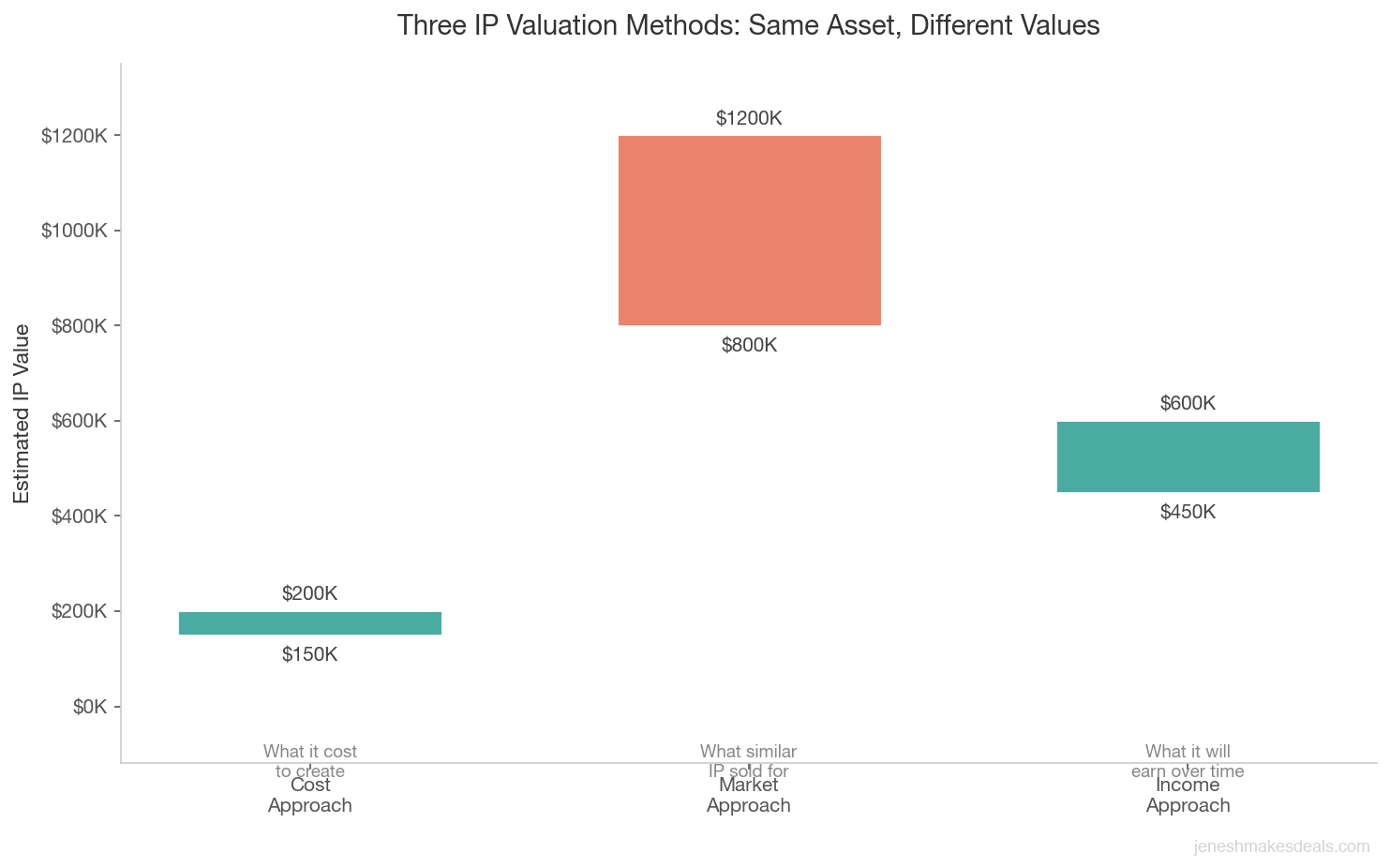
The right method often depends on the buyer. Financial buyers favor the income approach. Strategic buyers might use the market approach because they're comparing your IP to alternatives. Smaller deals often default to the cost approach as a floor value.
How IP Affects the Overall Business Multiple
In most small business sales, IP isn't valued as a separate line item. Instead, it's reflected in the overall business multiple. A business with strong IP commands a higher multiple than a comparable business without it, all else being equal.
Here's how I've seen it play out in practice.
A general contractor with $400,000 in SDE and no significant IP might sell for 2.5x, or $1 million. A similar contractor with the same SDE but with a patented installation method, a recognized regional brand, and proprietary project management software might sell for 3.5x, or $1.4 million. That's a $400,000 difference driven primarily by IP.
The multiple premium varies by industry and the strength of the IP, but here are the ranges I typically see:
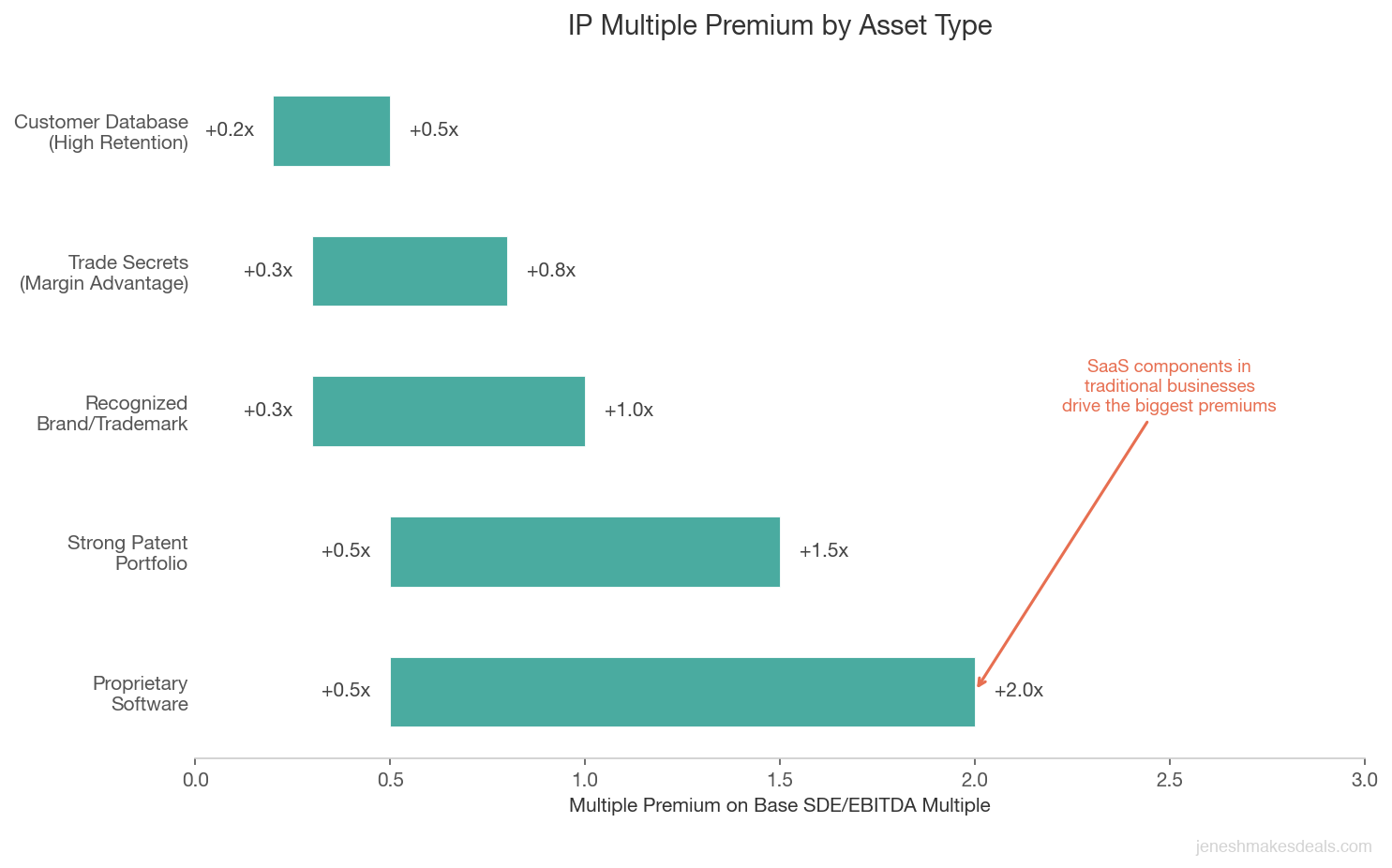
Strong patent portfolio: 0.5x to 1.5x premium on the base multiple. A patent that directly protects the primary revenue stream can push multiples even higher.
Recognized brand/trademark: 0.3x to 1.0x premium. The value depends on measurable brand equity: customer retention rates, ability to charge premium prices, and organic inbound lead volume.
Proprietary software: 0.5x to 2.0x premium, especially if the software generates recurring revenue or creates switching costs. SaaS components in traditional businesses can dramatically shift the multiple upward.
Trade secrets with margin advantage: 0.3x to 0.8x premium. If your proprietary process gives you 15% better margins than competitors, buyers will pay for that advantage.
Customer database with high retention: 0.2x to 0.5x premium. Value depends on data quality, customer lifetime value, and whether the data is in a transferable system.
For detailed information on how multiples work across industries, see our breakdown of 2026 business valuation multiples by industry.
Industries Where IP Matters Most
IP is relevant in every business sale, but in some industries it's the primary value driver. Here are the sectors where I see IP have the biggest impact on deal pricing.
Software and technology. Source code, algorithms, and data pipelines are the product. In SaaS businesses, the software is the business. Multiples for tech businesses with strong IP run 4x to 8x SDE or higher, compared to 2x to 3x for service businesses in the same revenue range.
Manufacturing. Proprietary processes, formulations, and product patents are common and highly valued. Buyers in manufacturing are particularly focused on whether trade secrets are documented and whether key employees with process knowledge are retained.
Healthcare and medical devices. FDA cleared devices, proprietary treatment protocols, and medical software carry enormous IP value. The regulatory moat (competitors need their own FDA clearance) makes healthcare IP especially defensible.
Food and beverage. Proprietary recipes, brewing processes, and established brand identities drive premium multiples. A craft brewery with a flagship beer recipe and strong regional brand recognition has IP that a buyer can't easily replicate.
Professional services. Training programs, methodologies, and proprietary assessment tools differentiate high value service firms from commodity providers. A consulting firm with a licensed assessment tool has sellable IP.
E commerce and digital businesses. Product designs, private label formulations, SEO authority, and content libraries all count. An e commerce brand with 50 proprietary product designs and a domain ranking for 200 keywords has more IP value than most sellers realize.
Franchises. The entire franchise model is built on IP. When a franchisor sells the whole system, the IP is the primary asset.
How to Document and Protect IP Before a Sale
The biggest IP mistake I see sellers make isn't having weak IP. It's failing to document and protect what they already have. Here's your checklist for getting IP sale ready.
Conduct an IP audit. Inventory every piece of IP your business owns. List all patents, trademarks, copyrights, trade secrets, proprietary software, customer databases, and domain names. Include registration numbers, filing dates, and current status. Many sellers discover IP they forgot they had during this process.
Formalize trade secret protections. You need confidentiality agreements with employees who have access, restricted access protocols, and written descriptions of what the trade secrets are. A buyer's attorney will ask for evidence that you've actually protected your trade secrets. If you've been casual about it, the value drops.
Register what you can. File federal registration for unregistered trademarks. Talk to a patent attorney about whether filing makes sense given your sale timeline (patents take 2 to 3 years to issue, but a pending application still has value). Copyright registration is inexpensive and strengthens your legal position.
Document software ownership. Make sure you have written agreements assigning IP rights to the business from any employees or contractors who built proprietary software. The developer who built your system five years ago may technically own the code if there's no written assignment.
Organize your IP files. Create a single folder with all IP documentation: registration certificates, license agreements, assignment agreements, and development records. Having these ready speeds up due diligence and signals professionalism.
Review license agreements. If you license IP to or from third parties, check whether those agreements are transferable in an acquisition. Are there change of control provisions that could terminate a license if the business is sold? Discovering a non transferable license during due diligence can derail a deal.
Thinking about selling and not sure where your IP stands? Let's talk through your situation so we can identify what you have and how to protect it.
Common Mistakes Sellers Make With IP
After working through dozens of deals where IP was a factor, I've seen the same mistakes repeatedly. Here are the ones that cost sellers the most money.
The most expensive IP mistake isn't weak protection or bad valuation. It's walking into a sale without realizing you have intellectual property in the first place. I've watched sellers leave six figures on the table because they never thought of their custom software, their customer database, or their proprietary process as an asset worth naming and pricing.
Not knowing they have IP. The most expensive mistake is not recognizing that your proprietary processes, customer databases, or custom software are valuable intellectual property. If you don't identify it, you can't value it or negotiate for it.
Failing to separate personal and business IP. If you hold IP personally rather than through the business entity, this creates ownership questions that can stall or kill a deal. Make sure all business related IP is properly assigned to the entity being sold.
Letting protections lapse. Patents require maintenance fees. Trademarks require renewal filings. Domain names expire. I've seen sellers lose patent protection because they missed a maintenance fee deadline.
Over relying on informal trade secrets. "Everyone just knows not to share the recipe" is not a protection strategy. Without written confidentiality agreements and documented protocols, a buyer won't value it at premium levels.
Not having clean IP assignment from contractors. A freelance developer built your app. You paid them. But without a written work for hire or IP assignment agreement, the developer may retain rights to the code.
Disclosing trade secrets prematurely. Always use a non disclosure agreement before sharing trade secret information with potential buyers. Once a trade secret is disclosed without protection, it may lose its legal status entirely.
Ignoring IP in the asking price. Some sellers focus entirely on earnings multiples and treat IP as an afterthought. If your IP contributes meaningfully to revenue, it should be reflected in your valuation.
How Buyers Evaluate IP During Due Diligence
Understanding what buyers look for helps you prepare better and negotiate from a stronger position. Here's what sophisticated buyers examine when evaluating your IP.
Ownership verification. Does the business actually own this IP? Buyers review patent assignments, trademark registrations, software development agreements, and employee invention assignments. Any gap in the chain of title is a red flag.
Validity and enforceability. For patents, buyers check whether claims are broad enough to provide meaningful protection. For trademarks, they check for conflicts. For trade secrets, they assess whether you've taken adequate steps to maintain secrecy.
Remaining useful life. A patent with 3 years left is worth less than one with 15 years left. Software built on outdated technology has a shorter useful life than a modern codebase.
Revenue attribution. Buyers want to know how much revenue is directly attributable to your IP. If your patented product accounts for 60% of revenue, the IP has high value. If it accounts for 5%, it's a nice to have.
Transferability. Can the IP actually transfer in the sale? Buyers check every agreement for change of control provisions and consent requirements that could complicate things.
Competitive landscape. Buyers research whether competitors have similar IP and whether your trade secrets could be independently developed. The less replicable your IP, the more valuable it becomes.
Litigation history. Pending litigation or a history of IP disputes can reduce value or scare buyers away entirely. Clean IP with no litigation history commands a premium.
Documentation quality. Well documented IP with organized files and clear ownership chains suggests a business that takes IP seriously. Poorly documented IP creates uncertainty, and uncertainty always reduces price.
Not sure how a buyer would evaluate your business? Get a free valuation estimate to see where you stand before going to market.
What Happens to IP in the Purchase Agreement
The purchase agreement is where IP value gets locked in or lost. Here are the key provisions that affect how IP is handled in a business sale.
IP representations and warranties. The seller represents that they own all listed IP, that it's valid and enforceable, and that it doesn't infringe on anyone else's rights. If a buyer discovers after closing that a representation was false, the seller may owe damages.
IP schedules. The agreement includes a detailed schedule listing every IP asset being transferred: patent numbers, trademark registrations, domain names, software descriptions, and trade secret categories. Anything not on the schedule may not transfer, so completeness is critical.
Assignment provisions. Specific language assigns all listed IP from seller to buyer. For registered IP (patents, trademarks, copyrights), separate assignment documents are filed with government agencies after closing.
Non compete and non solicitation. Most agreements include non compete clauses preventing the seller from using the sold IP to compete. The scope (duration, geography, industry) directly affects how comfortable the buyer is that the IP transfer is real.
Indemnification. The seller typically indemnifies the buyer against IP related claims. If a third party sues for IP infringement related to transferred assets, the seller covers the costs. The scope and duration of this indemnification is a major negotiation point.
Escrow provisions. In deals with significant IP value, buyers sometimes require a portion of the purchase price held in escrow for 12 to 24 months. This protects against post closing IP issues like invalidated patents or previously disclosed trade secrets.
Transition assistance. The agreement often requires IP related knowledge transfer assistance. This is especially important for trade secrets where the knowledge lives in the seller's head. A 90 to 180 day transition period with defined deliverables is common.
Real Dollar Examples: How IP Increased the Sale Price
The numbers below are representative, not from specific transactions, to protect client confidentiality.
Example 1: Manufacturing company with a patented product.
A small manufacturer had $600,000 in SDE. Without IP, comparable businesses in the industry were selling at 2.5x to 3.0x SDE. But this company held two utility patents on a product that represented 40% of revenue, with 12 years remaining on the patents. The patents prevented competitors from offering the same product, giving the company pricing power and a loyal customer base.
The business sold for 3.8x SDE, or $2.28 million. A comparable business without the patents would have sold for approximately $1.65 million at 2.75x. The IP premium was roughly $630,000.
Example 2: Service business with proprietary software.
An IT services company had $350,000 in SDE. They'd built a proprietary client monitoring and ticketing platform over six years that clients logged into daily. The platform created significant switching costs.
Industry average was 2.5x to 3.0x SDE. This business sold for 4.2x SDE, or $1.47 million. Without the platform, the likely sale price would have been around $960,000 at 2.75x. The software IP added roughly $510,000.
Example 3: Restaurant group with trademarked brand and proprietary recipes.
A group of three restaurants operated under a recognized regional brand with 20 years of history. They had a federal trademark registration, 15 proprietary recipes in their operations manual, and exclusive supplier agreements. The brand commanded a 20% price premium over competitors.
Combined SDE was $450,000. Typical restaurant multiples are 1.5x to 2.5x, but this group sold for 3.0x SDE, or $1.35 million. A comparable group without the brand and recipes would have sold for approximately $900,000 at 2.0x. The IP contributed roughly $450,000 in additional value.
Example 4: E commerce brand with product design IP.
An e commerce business had $280,000 in SDE. They'd designed 35 products in house, filed design patents on 8 of them, and had a domain ranking on page one for over 100 keywords. Private label products had 60% gross margins compared to 30% for resold products.
The business sold for 4.0x SDE, or $1.12 million. A comparable business without proprietary products would have sold for 2.5x, or $700,000. The IP added approximately $420,000.
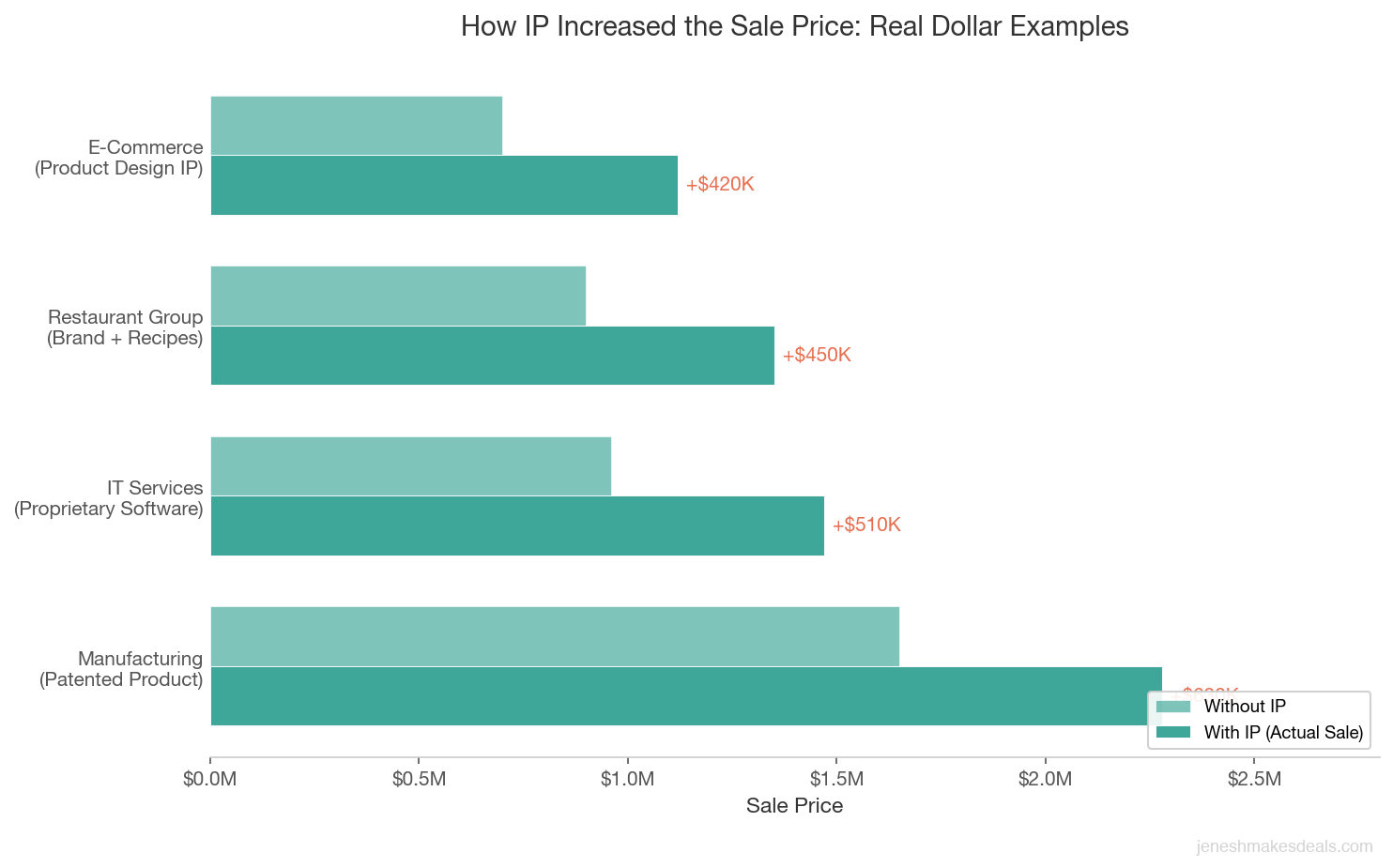
These aren't outlier results. The sellers who get these premiums aren't necessarily the ones with the best IP. They're the ones who prepared it properly for the sale.
Ready to find out what your business and its IP might be worth? Schedule a free consultation and I'll walk you through the process.
Preparing Your IP for Sale: A Timeline
If you're planning to sell within the next 12 to 24 months, here's a rough timeline for getting your IP in order.
18 to 24 months before sale: Conduct your IP audit. Identify all assets, check registration statuses, and note gaps in ownership documentation. Start registering unregistered trademarks and filing patent applications if timing allows.
12 to 18 months before sale: Fix ownership issues. Get written IP assignments from contractors and employees. Transfer any personally held IP to the business entity.
6 to 12 months before sale: Formalize trade secret protections. Organize all IP files into a clean due diligence package. Work with your broker to quantify IP value and incorporate it into the asking price.
3 to 6 months before sale: Prepare IP schedules for the purchase agreement. Draft transition plans for knowledge transfer. Identify any IP issues that might surface in due diligence and prepare responses.
During the sale process: Use NDAs before sharing proprietary information. Be prepared to explain revenue attribution for each IP asset. Have your IP attorney available for the buyer's legal team.
The sellers who start this process early sell faster, at higher prices, and with fewer deal complications.
For more on valuation methods and how they work together, see our guide to business valuation methods explained.
Have questions about how IP affects your specific business sale? Reach out for a free conversation. I'll help you figure out what you have and what it's worth.
Related Articles

April 30, 2026
How Long Does It Really Take to Sell a Business
Most sellers are shocked by how long it takes. Here's the honest timeline from listing to closing, and what actually speeds things up.

April 26, 2026
How to Structure an Earnout That Works for Seller and Buyer
Most earnouts fail because they're poorly structured. Here's how to build earnout terms that protect both sides of the deal.

April 20, 2026
Strategic Buyer vs Financial Buyer: Which Is Right for Your Business Sale?
Strategic and financial buyers value businesses differently. Here's how to decide which type of buyer gets you the best deal.
About the Author
Jenesh Napit is an experienced business broker specializing in business acquisitions, valuations, and exit planning. With a Bachelor's degree in Economics and Finance and years of experience helping clients successfully buy and sell businesses, he provides expert guidance throughout the entire transaction process. As a verified business broker on BizBuySell and member of Hedgestone Business Advisors, he brings deep expertise in business valuation, SBA financing, due diligence, and negotiation strategies.
You might also be interested in
Free Business Calculators
Try our business valuation calculator and ROI calculator to estimate values and returns instantly.
How to Buy a Business Guide
Download our comprehensive free guide covering everything you need to know about buying a business.
Our Services
Explore our professional business brokerage services including valuations and buyer representation.
More Articles
Browse our complete collection of business brokerage insights and expertise.