

Most business owners think selling will take three or four months. They're usually wrong by about six months.
I've been through this conversation hundreds of times. A seller calls me in January hoping to have cash in hand by spring. I have to walk them through the real timeline, and watch the enthusiasm on their face recalibrate in real time.
The honest answer is this: most small businesses take 6 to 12 months to sell from the day they're listed. Some take longer. A few close faster, but those are the exceptions, and they happen for specific, predictable reasons. If you're planning to sell your business, the most valuable thing you can do right now is internalize the real timeline, not the one you're hoping for.
Let me walk you through exactly what drives that timeline, what each phase looks like, and what you can do to move faster without leaving money on the table.
The Honest Answer: 6 to 12 Months Is Normal
Let's start with the data. According to BizBuySell's annual insight reports, the median time from listing to close for small businesses under $1 million is about 7 to 9 months. For businesses in the $1 million to $5 million range, it stretches to 9 to 12 months. For anything above $5 million, you're often looking at 12 to 18 months.
I know that's not what most sellers want to hear. But these numbers have been consistent for years, and they reflect the actual complexity of what happens when a real buyer tries to acquire a real business.
Here's why it takes that long. You've got the marketing phase where you find and qualify buyers. Then due diligence, where the buyer verifies everything you told them. Then financing, where an SBA lender underwrites the deal. Then legal, where attorneys negotiate purchase agreements. Each phase has its own timeline, its own actors, and its own ways to stall.
Broker insight: The sellers who are shocked by the timeline are almost always the ones who haven't sold a business before. Selling a business is not like selling a house. There's no MLS, no open houses, and no standard 30 day close. Every deal is custom, and every phase depends on the one before it going smoothly.
If you want to understand what your business might sell for before you start this process, run the numbers through our free valuation calculator. Knowing your price range upfront shapes everything else.
Phase 1: Pre Listing Preparation (1 to 3 Months)
Before your business ever hits the market, there's work to do. Most sellers underestimate this phase, and it's one of the main reasons timelines blow up later.
Pre listing preparation typically takes 4 to 12 weeks, depending on how organized your records are. During this phase you're gathering three years of tax returns, your profit and loss statements, your balance sheets, a list of assets included in the sale, vendor contracts, your lease, and any other documents that will need to be reviewed. If your financials are clean and current, this goes fast. If your bookkeeper has been using QuickBooks like a personal diary, it takes a while to sort out.
Your broker will also prepare the confidential information memorandum during this phase. This is the main selling document, usually 10 to 25 pages, that summarizes the business for prospective buyers. It covers the history, the financials, the operations, the market, and the opportunity. A well prepared CIM saves weeks during buyer conversations because the buyer gets everything they need in one document rather than extracting it through 20 emails.
This is also when you set the asking price. Getting the price right matters more than most sellers realize. An overpriced listing sits. A fairly priced listing moves. I've seen sellers who insisted on a 5x multiple for a business that warranted 3x spend six months on the market before grudgingly accepting what a broker told them on day one.
Sellers who have clean books and organized records cut this phase in half. If you're planning to sell in the next 12 to 18 months, clean up your financials now.
Phase 2: Marketing and Finding Buyers (2 to 4 Months)
Once the listing is live, the clock starts on finding a qualified buyer. This phase is where most sellers experience their first reality check.
A listing goes out to the major marketplaces (BizBuySell, BizQuest) and to your broker's proprietary buyer database. NDAs start coming in within the first week. But NDAs are not offers. Most of the people who sign an NDA and receive your CIM will never make an offer. They're researchers, competitors, or just curious. A typical listing might see 40 to 80 NDA signers and 3 to 8 serious conversations, resulting in 1 to 3 legitimate offers.
The funnel is narrow, and it takes time to work through it. Initial inquiries come in during weeks one through four. Buyer introductory calls happen in weeks two through six. Follow up questions, site visits, and financial review conversations stretch through weeks four through twelve. The right buyer often doesn't surface until month two or three.
Why does it take this long? Because qualified buyers are careful. They're about to put a significant amount of their personal wealth into your business. They want to understand every angle before they commit. The faster you answer their questions and the cleaner your documents are, the faster this phase moves.
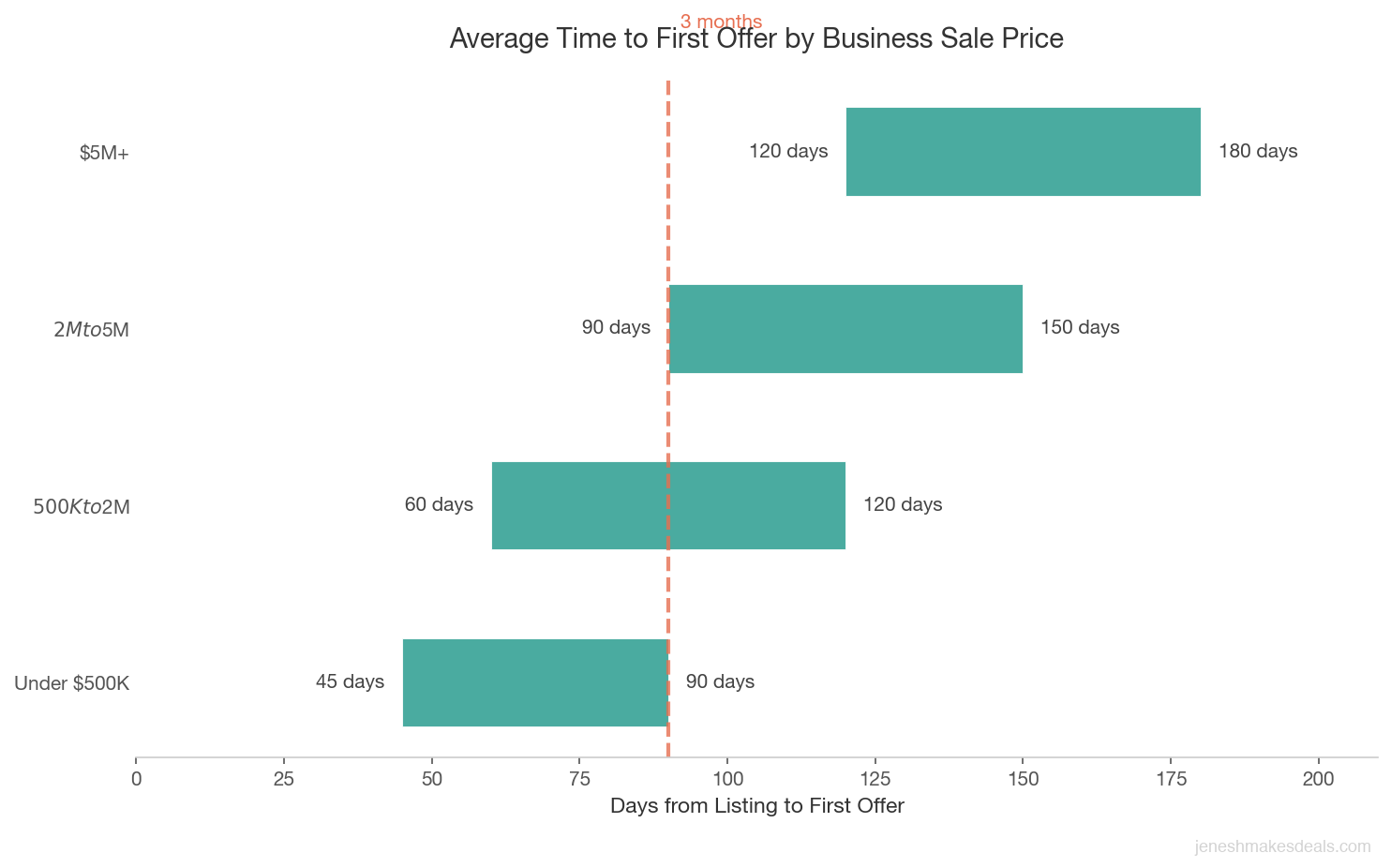
| Deal Size | Average Time to First Offer |
|---|---|
| Under $500K | 45 to 90 days |
| $500K to $2M | 60 to 120 days |
| $2M to $5M | 90 to 150 days |
| $5M+ | 120 to 180 days |
Want to know how buyers will evaluate your deal? Our SBA loan calculator shows the debt service on a typical financed acquisition, which is exactly how buyers think about whether your price works.
Phase 3: Due Diligence (30 to 90 Days)
You've accepted a letter of intent. Congratulations. Now the hard part starts.
Due diligence is the phase where the buyer, their attorney, their CPA, and their lender all verify everything in your CIM. They'll request bank statements going back 24 to 36 months. They'll want payroll records, customer contracts, supplier agreements, equipment maintenance logs, and your complete tax history. They'll send detailed questionnaires covering operations, employees, legal history, and regulatory compliance.
For a clean business with organized records, due diligence takes 30 to 45 days. For a business with complicated financials, missing documents, or issues that surface during the review, it can stretch to 90 days or longer. I've seen due diligence drag past 120 days when there were material discrepancies between the CIM and the actual tax returns.
The most common due diligence delays I see:
Tax return discrepancies. The seller's add backs don't hold up under scrutiny. The CIM shows $350,000 in SDE, but after pulling personal expenses that the CPA hasn't documented properly, the verified SDE is $280,000. Now you're renegotiating price mid process, which takes time and kills deals.
Undisclosed liabilities. A lawsuit that wasn't mentioned, a state tax lien, an EPA notice. Buyers find these things in due diligence, and each one triggers a conversation about whether to proceed and on what terms.
Lease problems. The landlord won't confirm the lease is assignable, or the remaining term is shorter than the buyer expected. More on this later.
The key to fast due diligence: have a due diligence data room ready before the listing goes live. A Google Drive or Dropbox folder with every document already organized means the buyer can start reviewing on day one, not week three when they finally get everything they asked for.
Key takeaway: Due diligence doesn't fail because buyers are unreasonable. It fails because sellers aren't prepared. Every document a buyer has to chase down adds a week to the timeline and a seed of doubt about the business. The sellers who close fastest are the ones who hand over a complete data room on day one and say, "Here's everything. Ask me anything."
Phase 4: SBA Financing and Loan Approval (45 to 90 Days)
About 70 to 75% of small business acquisitions under $5 million are financed with SBA 7(a) loans. This is the federal program that backs small business loans and makes it possible for buyers to acquire businesses with 10% down.
SBA loan approval takes 45 to 90 days from the time the buyer submits a complete application. That sounds reasonable until you realize that "complete application" is rarely achieved on day one. The buyer needs to gather personal financial statements, two years of personal tax returns, business tax returns (yours), the purchase agreement, the business plan, and often a real estate or lease documentation. Assembling all of this takes two to three weeks. Then the lender underwrites, which takes another two to four weeks. Then there's SBA review and approval, another one to three weeks.
The biggest SBA delays I've seen:
Buyer financial issues. The buyer's credit score is lower than the lender expected. Or they have a prior bankruptcy that wasn't disclosed. Or their personal debt service is too high relative to the projected income from the business. Any of these sends the deal back to square one or kills it entirely.
Business cash flow concerns. The lender's SDE calculation comes in lower than yours. SBA lenders use their own methodology, and if the calculated debt service coverage ratio falls below 1.25x, the deal doesn't work. Our DSCR calculator can show you exactly where that line is before you ever get into this situation.
Environmental issues. For businesses with real property, commercial properties, or businesses that handle chemicals, the lender may require an environmental study. This adds two to four weeks and can kill the deal if contamination is found.
In rare cases, a buyer pays all cash or uses conventional bank financing, which can close in 30 days. But all cash buyers typically expect a discount of 5 to 10% in exchange for the certainty and speed. Whether that tradeoff is worth it depends on your situation.
Phase 5: The Closing Process (2 to 4 Weeks)
Once financing is approved and due diligence is complete, the closing process itself is relatively fast. Two to four weeks for both attorneys to finalize the purchase agreement, the bill of sale, the asset allocation, the non compete agreement, and the transition plan.
The purchase agreement is where the last round of negotiation happens. Buyers and sellers fight over representations and warranties (the list of things the seller is certifying to be true), the indemnification provisions (what happens if something turns out to be wrong), the length and scope of the non compete, and the transition period.
These negotiations can take a week or they can take three weeks. If both parties are represented by experienced business transaction attorneys who know this document type, it goes faster. If one side has a general practice attorney who has never seen a business purchase agreement, expect delays.
The total picture: add up 4 to 8 weeks of preparation, 8 to 16 weeks to find a buyer, 6 to 12 weeks of due diligence, 6 to 12 weeks of SBA financing, and 2 to 4 weeks of closing, and you get a range of roughly 6 to 12 months. That's not a worst case scenario. That's an average.
What Makes Businesses Sell Faster
Some businesses consistently close in 4 to 6 months. Here's what they have in common.
Clean, accurate, reconciled financials. This is the single biggest accelerant. When a buyer opens your data room and every document is there, clearly labeled, and the numbers match across P&L, tax returns, and bank statements, confidence builds fast. I've seen deals move from LOI to close in 55 days because the seller had a pristine data room. I've seen deals take 10 months because the seller couldn't produce bank statements from 18 months ago.
Owner not critical to daily operations. The scariest thing for a buyer is wondering whether the business survives the ownership transition. If you have a manager who runs day to day operations, documented processes, and multiple people who know how things work, buyers get comfortable faster. They also pay more, typically 0.5 to 1.0x SDE higher than comparable owner operated businesses.
Growing revenue. A business with three years of consistent revenue growth at 10 to 15% per year is dramatically easier to sell than a flat or declining one. Buyers look at the trend line and ask: where will this be in three years? A growing business answers that question favorably.
Realistic asking price from day one. Listings that enter the market at a fair price generate offers faster. Listings that start at 30 to 40% above market sit for months, then cut their price, then carry the stigma of a stale listing. Buyers see how long something has been on the market and assume there's a reason. Starting at a fair price is almost always faster than starting high and coming down.
Transferable lease with favorable terms. If your business operates from a leased space, a clean, transferable lease with 3 to 5 years remaining is a major advantage. Buyers and lenders want that security. Landlords who cooperate with the assignment process remove one of the biggest potential deal delays.
What Causes Deals to Stall or Die
I've seen deals fall apart at every stage of the process. Here are the most common causes of delay and failure.
Landlord problems. This is one of the most underappreciated risks in business sales. If your landlord won't assign the lease, demands a personal guarantee from the new buyer, insists on a rent increase as a condition of transfer, or simply doesn't respond to requests, the deal can stall for weeks or collapse entirely. I've had deals die because a landlord decided mid process that he wanted to take the space back. There's not much you can do about an uncooperative landlord except try to negotiate or find a buyer who will negotiate a new lease directly.
SBA lender problems. A lender who is unfamiliar with the deal type, understaffed, or overwhelmed with their pipeline can delay approvals by weeks. The solution is working with a broker who knows which lenders are active, fast, and experienced with business acquisitions in your size range. Not all SBA lenders are created equal.
Seller financing disputes. When a deal includes seller financing (which it often does to bridge a valuation gap), the terms get negotiated in the purchase agreement. Interest rate, term, payment schedule, security, subordination. These negotiations can get contentious and slow things down significantly. Being clear about your seller financing terms at the LOI stage eliminates most of these disputes.
Title and lien issues. If your business has an SBA loan, equipment financing, or any other liens on the assets being sold, those need to be paid off or released at closing. Tracking down lien holders, getting payoff letters, and coordinating the releases takes time. Start this process early.
Buyer cold feet. It happens. A buyer signs an LOI, starts due diligence, and then gets nervous. Maybe their spouse isn't supportive. Maybe they got a job offer. Maybe they just talked themselves out of it. You can't entirely prevent this, but you can minimize it by maintaining regular communication, being responsive to their questions, and making the process feel manageable.
Industry Specific Timelines
Not all businesses sell on the same schedule. Here's what I typically see by industry.
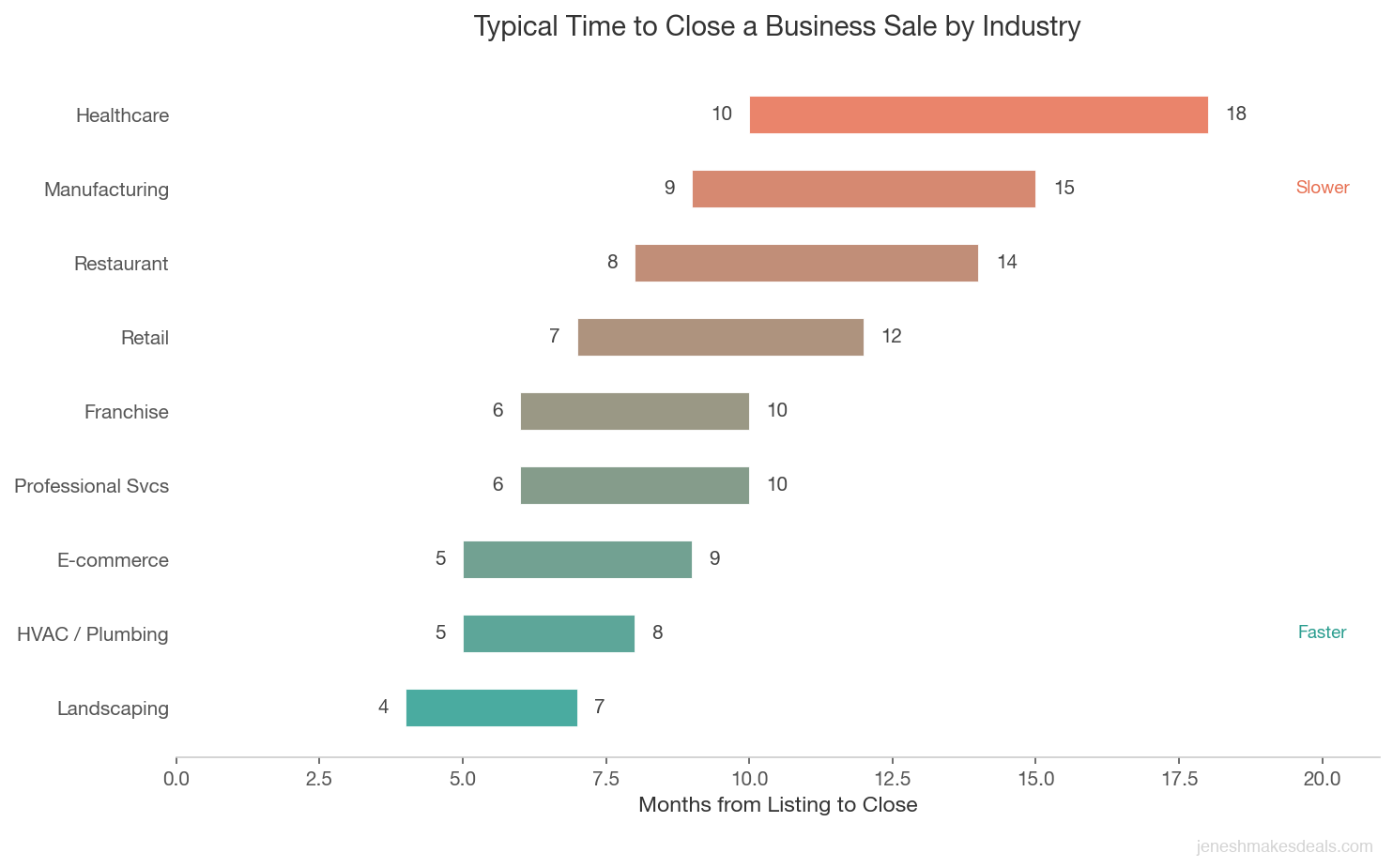
| Industry | Typical Time to Close | Key Variable |
|---|---|---|
| Restaurant / Food Service | 8 to 14 months | Health inspection history, lease |
| Professional Services (accounting, law, consulting) | 6 to 10 months | Client transferability |
| HVAC / Plumbing / Electrical | 5 to 8 months | Licensing, equipment condition |
| Retail | 7 to 12 months | Inventory valuation, lease |
| Manufacturing | 9 to 15 months | Environmental, equipment appraisal |
| Landscaping / Lawn Care | 4 to 7 months | Seasonality, equipment |
| E commerce | 5 to 9 months | Platform risk, supplier contracts |
| Healthcare / Medical | 10 to 18 months | Licensing, regulatory compliance |
| Franchise | 6 to 10 months | Franchisor approval process |
Restaurants take longer than almost any other business type. The combination of health department scrutiny, liquor license transfers (which require state approval and can take 60 to 90 days on their own), equipment verification, and the personal nature of the seller's relationship with staff and customers creates a uniquely complex transaction. If you own a restaurant and want to sell, budget 10 to 14 months and start preparing 12 months before you want to close.
Professional services firms face a different challenge: client transferability. If clients hired you personally and have no relationship with anyone else at the firm, the buyer is paying for relationships that might not survive the transition. This concern slows everything down as buyers probe client retention risks in detail. The more relationship risk, the longer it takes to get comfortable.
Trade businesses (HVAC, plumbing, electrical) tend to move faster because they're asset based, cash flow predictable, and relatively straightforward to evaluate. The main complications are licensing (the new owner may need to be licensed in the trade) and equipment condition. Well maintained equipment with current service records speeds things up considerably.
The "Days on Market" Trap
Here's something most sellers don't realize until it's too late. The longer your listing sits on the market, the harder it becomes to sell.
Buyers track days on market. BizBuySell shows it prominently. If a listing has been on the market for 9 months, buyers assume there's a problem. They start asking: why hasn't this sold? Is the price wrong? Are the financials suspicious? Is there a landlord issue? The listing develops a stigma that makes even good businesses harder to sell.
I've had clients come to me after six months on the market with a competitor broker, frustrated and discouraged. In several cases, the business itself was solid but the price was wrong, the marketing was weak, or the listing description was poor. After relisting with better materials and a price adjustment, deals came together within 60 days.
The lesson: it's better to take an extra month to prepare properly and price accurately than to rush to market at the wrong price. A fresh listing at the right price sells. A stale listing at the wrong price doesn't, no matter how good the underlying business is.
Warning: Once your listing passes the 6 month mark, buyer perception shifts from "interesting opportunity" to "what's wrong with this business." You only get one shot at a fresh listing. Price it right, prepare it properly, and present it professionally from day one. Relisting after a failed attempt is possible, but it never carries the same momentum as a well executed first launch.
How to Speed Up Your Sale
You can't eliminate the timeline, but you can compress it. Here's what actually works.
Get your documents ready before you list. Spend two to four weeks assembling a complete data room before your business hits the market. Three years of tax returns, three years of P&L statements and balance sheets, bank statements, leases, contracts, equipment lists, and employee information. When a buyer asks for documents, respond in hours not days.
Get a pre listing valuation. Know exactly what your business is worth before you set an asking price. Overpriced listings waste everyone's time. Use our business valuation calculator as a starting point, then talk to a broker to refine it with industry specific comps.
Work with an SBA preferred lender. Not all SBA lenders are created equal. Preferred Lender Program (PLP) lenders have delegated authority from the SBA, meaning they don't need SBA review on every deal. This can cut financing approval time by two to four weeks. Your broker should have relationships with PLP lenders who specialize in business acquisitions.
Fix lease issues before listing. Talk to your landlord before you go to market. Confirm the lease is assignable. Understand their requirements for a new tenant. If you know the landlord is going to be difficult, either address it early or price it into the deal. Surprises in the landlord conversation two months into due diligence are deal killers.
Hire a business transaction attorney, not a general practice attorney. The purchase agreement for a business sale is a specialized document. A general practice attorney who is learning as they go will slow the closing process and make costly mistakes. Find an attorney who does business sales regularly and has a standard set of documents they can start from.
Be responsive. This sounds obvious, but seller responsiveness is one of the most underrated factors in deal speed. Buyers are anxious. They have questions. The faster you answer them, the more confident they feel and the faster they move. A buyer who waits a week for answers to basic questions starts to wonder if they're dealing with someone they can trust. Answer emails and calls the same day.
Consider seller financing. Offering to carry a portion of the purchase price (typically 10 to 20%) signals confidence in your own business and makes deals easier to finance. SBA lenders sometimes require seller financing as part of the deal structure. Sellers who are flexible on structure close faster than those who insist on all cash.
Timeline by Deal Size
Here's a realistic summary of what to expect based on your business's value.
| Business Value | Preparation | Marketing | Due Diligence | Financing | Closing | Total |
|---|---|---|---|---|---|---|
| Under $250K | 2-4 weeks | 4-8 weeks | 3-5 weeks | 4-6 weeks | 1-2 weeks | 3-5 months |
| $250K to $1M | 4-8 weeks | 6-12 weeks | 4-8 weeks | 6-10 weeks | 2-3 weeks | 5-9 months |
| $1M to $3M | 6-10 weeks | 8-16 weeks | 6-12 weeks | 8-12 weeks | 2-4 weeks | 7-12 months |
| $3M to $10M | 8-12 weeks | 10-20 weeks | 8-16 weeks | 10-16 weeks | 3-5 weeks | 9-15 months |
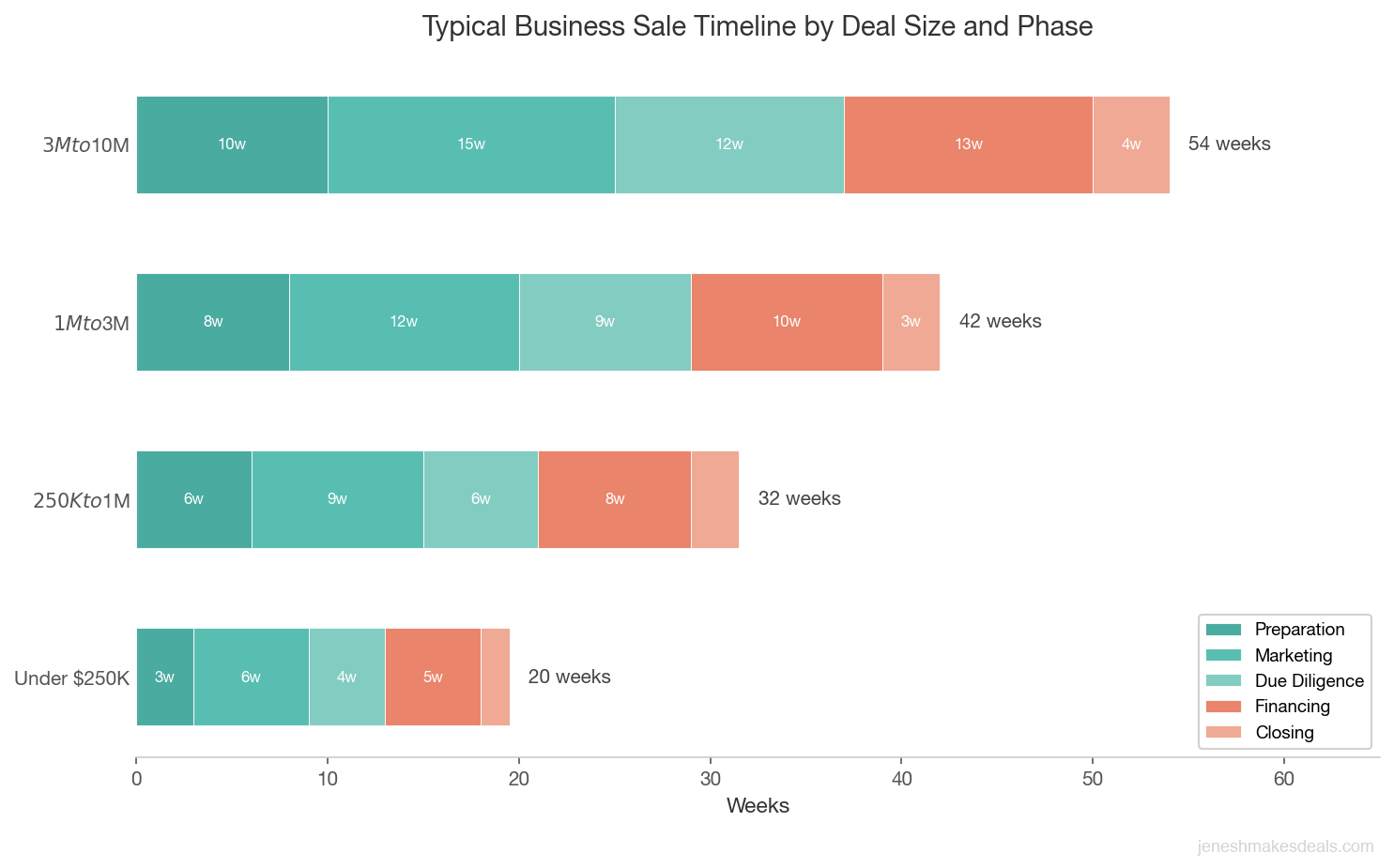
These are averages. I've seen $500,000 deals close in four months and $800,000 deals take 14 months. The variables matter more than the size.
The Bottom Line
Selling a business takes longer than most owners expect. The 6 to 12 month range isn't a failure of the market. It's the realistic timeline for what has to happen: finding the right buyer, verifying the business's value, securing financing, and transferring ownership cleanly.
The sellers who close fastest are the ones who prepare most thoroughly before listing, price their business accurately from day one, and are responsive and organized throughout the process. They make it easy for buyers to say yes.
The sellers who take longest, or don't sell at all, are the ones who list before they're ready, start too high on price, and treat every buyer request as a hassle rather than an opportunity to close.
If you're thinking about selling in the next one to two years, the best thing you can do right now is start preparing. Get your financials in order, document your processes, and get a realistic understanding of what your business is worth.
Curious what your business might sell for? Start with our free valuation calculator to get a realistic price range based on your industry's SDE multiples.
Ready to talk through your timeline? Reach out for a free consultation and I'll walk you through exactly what the process looks like for your specific business, including an honest assessment of how long it will take and what you can do to speed it up.
Want to understand how a buyer would finance your business? Run your numbers through our SBA loan calculator to see the debt service on a typical acquisition and whether your price works for a financed buyer. You can also explore business acquisition financing options to see what programs are available for buyers in your deal size range.
When you're ready to take the first step, tell us about your business and we'll help you map out the timeline.
Related Articles

April 26, 2026
How to Structure an Earnout That Works for Seller and Buyer
Most earnouts fail because they're poorly structured. Here's how to build earnout terms that protect both sides of the deal.

April 24, 2026
How to Value Intellectual Property in a Business Sale
Your IP could be worth more than your equipment. Learn how patents, trademarks, and trade secrets affect your business valuation.

April 20, 2026
Strategic Buyer vs Financial Buyer: Which Is Right for Your Business Sale?
Strategic and financial buyers value businesses differently. Here's how to decide which type of buyer gets you the best deal.
About the Author
Jenesh Napit is an experienced business broker specializing in business acquisitions, valuations, and exit planning. With a Bachelor's degree in Economics and Finance and years of experience helping clients successfully buy and sell businesses, he provides expert guidance throughout the entire transaction process. As a verified business broker on BizBuySell and member of Hedgestone Business Advisors, he brings deep expertise in business valuation, SBA financing, due diligence, and negotiation strategies.
You might also be interested in
Free Business Calculators
Try our business valuation calculator and ROI calculator to estimate values and returns instantly.
How to Buy a Business Guide
Download our comprehensive free guide covering everything you need to know about buying a business.
Our Services
Explore our professional business brokerage services including valuations and buyer representation.
More Articles
Browse our complete collection of business brokerage insights and expertise.