

To value a business, calculate its earnings (SDE or EBITDA) and multiply by an industry specific multiple (typically 1.5x to 4.0x). For example, a service business with $200,000 in SDE and a 2.5x multiple is worth $500,000. The three main methods are income based (earnings × multiple), asset based (assets minus liabilities), and market based (comparing to similar sales).
Most small businesses use income based valuation with SDE (Seller's Discretionary Earnings). Service businesses typically sell for 2.0x to 3.5x SDE, retail for 1.5x to 2.5x SDE, and manufacturing for 2.5x to 4.0x SDE. Factors like growth, customer concentration, and owner dependency can adjust value by 10% to 30%.
After working with hundreds of business buyers and sellers, I've seen the same mistakes: buyers overpaying based on emotion, sellers overvaluing their business. Business valuation isn't guesswork. The International Business Brokers Association (IBBA) and other industry organizations provide standards for valuation practices.
This guide covers the step by step process, valuation methods, factors that affect value, common mistakes to avoid, and when to get professional help.
Quick Summary: How to Value a Business
The most common method for valuing small businesses is income based valuation using SDE (Seller's Discretionary Earnings). Calculate the business's earnings, then multiply by an industry specific multiple (typically 1.5x to 4.0x depending on business type).
The three main valuation methods are:
- Income based: Multiply earnings (SDE or EBITDA) by industry multiples
- Asset based: Calculate assets minus liabilities
- Market based: Compare to similar businesses that recently sold
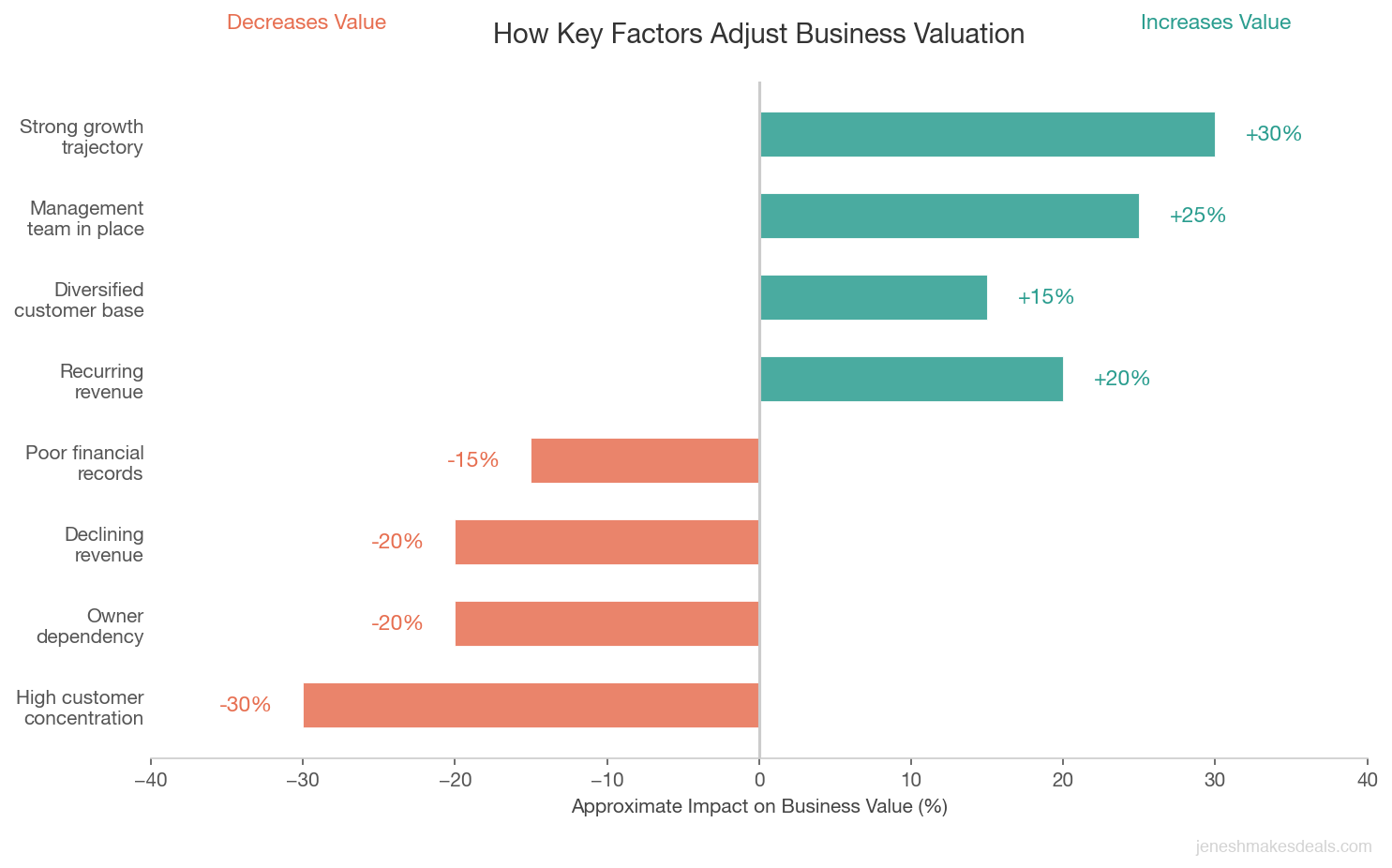
Key factors that affect value: Growth trajectory, customer concentration, owner dependency, competitive position, industry trends, and quality of earnings. These can adjust value by 10% to 30% or more.
Most small businesses (under $5 million) use SDE multiples. Service businesses typically sell for 2.0x to 3.5x SDE, retail for 1.5x to 2.5x SDE, and manufacturing for 2.5x to 4.0x SDE.
Professional valuation is required for SBA loans over $250,000, legal proceedings, and certain tax situations. It's recommended for businesses over $1 million or complex situations.
Why Business Valuation Matters
Understanding business value serves different purposes depending on whether you're buying or selling.
For buyers, accurate valuation helps you:
- Make informed offers without overpaying
- Identify good deals and walk away from bad ones
- Negotiate effectively with data driven arguments
- Secure financing (lenders need defensible valuations)
- Plan for the true cost of acquisition
For sellers, accurate valuation helps you:
- Set realistic asking prices that attract serious buyers
- Understand what your business is actually worth in today's market
- Prepare for negotiations with realistic expectations
- Maximize value by addressing factors that hurt valuation
- Avoid leaving money on the table or pricing yourself out of the market
The Small Business Administration (SBA) requires professional valuations for loans over $250,000, and the Internal Revenue Service (IRS) has specific requirements for business valuations in certain transactions. But even when not required, understanding valuation protects your interests.
Want a quick estimate of what a business might be worth? Use our free business valuation calculator to get started, or try the listing price estimator to find a realistic asking price. For more detailed analysis, keep reading.
The Three Main Business Valuation Methods
Professional business brokers typically use three main approaches to value businesses. Each method has its place, and the best valuations often combine multiple methods.
1. Income Based Valuation
This is the most common method for small businesses. It values a business based on its ability to generate profit.
How it works: You calculate the business's earnings (profit) and multiply by an industry specific multiple. The multiple reflects how much buyers are willing to pay for each dollar of profit.
Key metrics:
- SDE (Seller's Discretionary Earnings): Used for small businesses under $5 million. Includes owner salary and benefits. Learn more about SDE from the Corporate Finance Institute.
- EBITDA (Earnings Before Interest, Taxes, Depreciation, and Amortization): Used for larger businesses with management teams. Corporate Finance Institute explains EBITDA in detail.
Example: A service business with $200,000 in SDE and a 2.5x multiple would be valued at $500,000.
When to use: Most small businesses, especially service businesses, retail, and manufacturing.
Limitations: Doesn't account for assets. A business with valuable real estate or equipment might be worth more than income alone suggests.
2. Asset Based Valuation
This method values a business based on its tangible and intangible assets minus liabilities.
How it works: You add up all assets (equipment, inventory, real estate, intellectual property) and subtract liabilities (debt, accounts payable).
Example: A business with $400,000 in assets and $100,000 in liabilities would have an asset value of $300,000.
When to use: Asset heavy businesses like manufacturing, transportation, or businesses with significant real estate. Also useful as a "floor" value to compare against income based methods.
Limitations: Doesn't account for earning potential. A profitable business is usually worth more than its assets alone.
3. Market Based Valuation
This method compares your business to similar businesses that have recently sold.
How it works: You find comparable sales (comps) in your industry and region, then apply similar multiples or ratios to your business.
Example: If similar retail businesses sold for 0.5x revenue, and your business has $1 million in revenue, it might be worth around $500,000.
When to use: When you have access to recent comparable sales data. Industry databases and business brokers often have this information.
Limitations: Finding true comparables can be difficult. Every business is unique, and market conditions change.
Comparing the Three Valuation Methods
| Income Based | Asset Based | Market Based | |
|---|---|---|---|
| Best for | Service, retail, most small businesses | Manufacturing, transportation, asset heavy businesses | Businesses with plenty of comparable sales data |
| Formula | Earnings (SDE/EBITDA) x Industry Multiple | Total Assets minus Total Liabilities | Apply multiples from comparable recent sales |
| Pros | Reflects earning power and profitability | Provides a "floor" value for the business | Based on real market transactions |
| Cons | Doesn't account for asset value | Ignores earning potential | Hard to find true comparables |
| Typical Use | Primary valuation method | Secondary check or asset heavy industries | Validation of income based results |
Need help understanding which valuation method applies to your situation? Contact us for a consultation. We can help you determine the best approach for your specific business.
Step by Step: How to Value a Business
Here's a practical process for valuing any business, whether you're buying or selling.
Step 1: Gather Financial Information
You need at least three years of financial statements:
- Income statements (profit and loss statements)
- Balance sheets
- Tax returns
- Bank statements
For buyers, request these documents from the seller. For sellers, organize these documents before listing your business. The more complete and accurate your financial records, the more accurate your valuation will be.
Step 2: Normalize the Financials
Financial statements often need adjustments to show the business's true earning power. Common adjustments include:
- Owner salary and benefits (add back to show SDE)
- One time expenses (add back)
- Personal expenses run through the business (add back)
- Depreciation and amortization (add back for EBITDA)
- Non recurring revenue (remove)
This step is critical. I've seen businesses that looked unprofitable on paper but were actually quite profitable once you normalized the financials.
Normalizing financials is the single most important step in business valuation. Skip it, and you could overvalue or undervalue a business by 20% or more.
Step 3: Calculate Earnings
Determine the business's earnings using the appropriate metric:
- SDE for small, owner operated businesses
- EBITDA for larger businesses with management teams
Use the normalized financials from step 2. Take an average of the last three years, or use the most recent year if the business is growing consistently.
Step 4: Research Industry Multiples
Different industries have different valuation multiples. According to industry data:
| Industry | Typical Multiple Range | Metric |
|---|---|---|
| Technology / SaaS | 3.0x to 6.0x | Revenue or EBITDA |
| Manufacturing | 2.5x to 4.0x | SDE |
| Service Businesses | 2.0x to 3.5x | SDE |
| Retail Businesses | 1.5x to 2.5x | SDE |
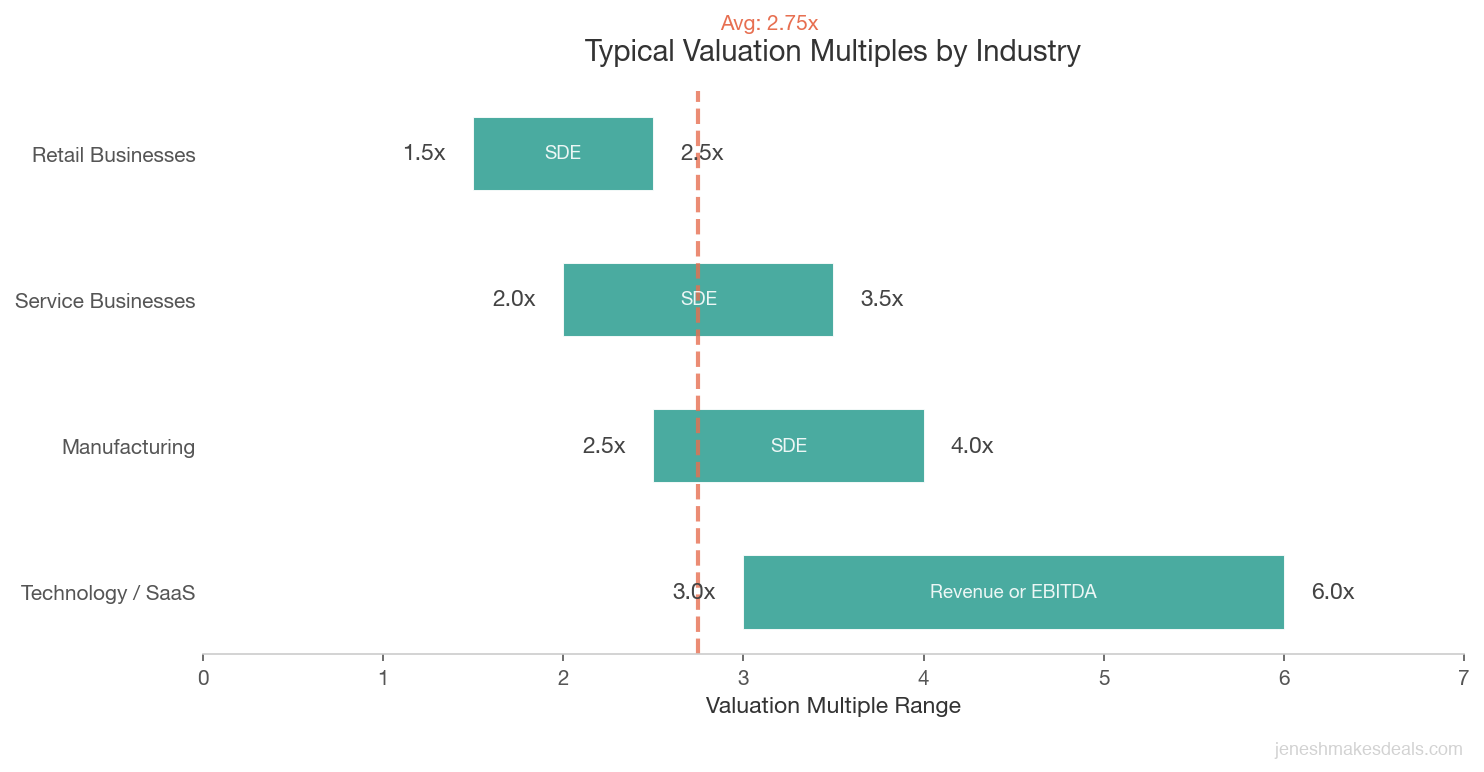
These ranges vary based on business size, growth, and other factors. A business broker or valuation professional can help you find the right multiple for your specific situation.
Step 5: Apply the Multiple
Multiply your earnings by the appropriate multiple to get a base valuation.
Example: $250,000 SDE × 2.5x multiple = $625,000 base value
The multiple you choose matters more than any other variable. A difference of just 0.5x on $250,000 in SDE changes the valuation by $125,000.
Step 6: Make Adjustments
Adjust the base value based on factors that affect value:
- Growth trajectory (growing businesses command higher multiples)
- Customer concentration (diversified customer base is worth more)
- Owner dependency (businesses that can run without the owner are worth more)
- Competitive position (strong market position increases value)
- Industry trends (growing industries command higher multiples)
- Quality of earnings (recurring revenue is worth more than one time sales)
These adjustments can move the valuation up or down by 10% to 30% or more.
Step 7: Consider Asset Value
For asset heavy businesses, calculate asset value separately and compare it to income based value. The business is worth at least the higher of the two, and often a combination.
Step 8: Get a Range, Not a Single Number
Business valuation isn't an exact science. Professional valuations typically provide a range (like $500,000 to $600,000) rather than a single number. This range accounts for different assumptions and market conditions.
Want to see how these steps apply to your business? Use our business valuation calculator to get started, then contact us for a detailed professional valuation if needed.
Key Factors That Affect Business Value
Understanding what increases or decreases business value helps you maximize value as a seller or evaluate opportunities as a buyer.
Factors That Increase Value
Strong financial performance: Consistent, growing revenue and profit margins signal a healthy business. Buyers pay premiums for businesses with strong financials.
Diversified customer base: No single customer should represent more than 20% of revenue. A well diversified customer base reduces risk and increases value.
Recurring revenue: Subscription models, long term contracts, or repeat customers create predictable revenue streams that buyers value highly.
Management team in place: Businesses that can operate without the owner are worth significantly more. A strong management team reduces owner dependency.
Growing market: Businesses in growing industries command higher multiples. Technology, healthcare services, and professional services often see strong valuations.
Strong competitive position: Unique products, strong brand, or market leadership position increases value. Barriers to entry protect the business.
Clean financial records: Well organized, accurate financial records make due diligence easier and increase buyer confidence.
Factors That Decrease Value
Declining revenue: Businesses with shrinking revenue face valuation discounts of 10% to 30% or more. Buyers see declining revenue as a major red flag.
High customer concentration: If one customer represents more than 25% of revenue, buyers see significant risk. This can reduce value by 20% to 40%.
If any single customer accounts for more than 25% of revenue, expect a valuation discount of 20% to 40%. Diversify your customer base before listing your business for sale.
Owner dependency: Businesses that can't operate without the owner are hard to sell and command lower multiples. Buyers need to know the business can run without you.
Thin profit margins: Low profitability relative to revenue reduces value. Buyers want businesses that generate strong returns.
One time revenue: Businesses dependent on one time sales or projects are worth less than those with recurring revenue streams.
Poor financial records: Disorganized or incomplete financial records raise red flags and reduce buyer confidence.
Competitive market: Businesses in highly competitive markets with low barriers to entry are worth less. Easy to replicate businesses command lower multiples.
Looking to increase your business value before selling? Contact us for a consultation. We can help you identify areas to improve and maximize your exit value.
Common Valuation Mistakes to Avoid
I've seen these mistakes cost buyers and sellers thousands of dollars. Avoid them.
Mistake 1: Using Revenue Instead of Profit
Revenue tells you how much money comes in, but profit tells you how much money stays. Two businesses with $1 million in revenue can have vastly different values if one has 5% profit margins and the other has 20% profit margins.
Fix: Always use profit based metrics (SDE or EBITDA) for income based valuations, not revenue alone. The International Business Brokers Association (IBBA) provides standards and resources on business valuation methods.
Two businesses with $1 million in revenue can have completely different values. A 5% margin business is worth a fraction of a 20% margin business. Always value on profit, not revenue.
Mistake 2: Ignoring Owner Compensation
Many small business owners don't pay themselves market rate salaries. They might take $50,000 when the position should pay $100,000. This makes the business look more profitable than it actually is.
Fix: Normalize owner compensation to market rates when calculating SDE. A business that needs a $100,000 manager but only pays the owner $50,000 isn't as profitable as it appears.
Mistake 3: Overvaluing Future Potential
Buyers pay for current performance, not future promises. I've seen sellers try to justify high valuations based on "what the business could be" rather than what it is today.
Fix: Base valuations on historical performance. Future projections can inform adjustments, but they shouldn't be the primary basis for valuation.
Mistake 4: Using Outdated Comparables
Market conditions change. A business that sold for 3x SDE in 2021 might only sell for 2.5x SDE in 2025. Interest rates, economic conditions, and market demand all affect multiples.
Fix: Use recent comparable sales from the past 12 to 24 months. Work with a business broker who has access to current market data.
Mistake 5: Not Accounting for Working Capital
The business needs cash, inventory, and accounts receivable to operate. This working capital is separate from the business purchase price.
Fix: Understand that working capital requirements are typically in addition to the purchase price. A $500,000 business might require another $50,000 to $100,000 in working capital.
Mistake 6: Failing to Normalize Financials
One time expenses, personal expenses, or unusual items can distort financial statements. Failing to adjust for these creates inaccurate valuations.
Fix: Always normalize financials before calculating earnings. Add back owner compensation, one time expenses, and other non recurring items.
Mistake 7: Ignoring Industry Specific Factors
A retail business and a service business with the same profit might have very different values. Industry specific factors matter.
Fix: Use industry appropriate multiples and consider industry specific factors like inventory turnover, customer acquisition costs, and market trends.
Making a major business decision based on valuation? Contact us for professional guidance. We can help you avoid costly mistakes and make informed decisions.
When to Get a Professional Business Valuation
While you can estimate business value yourself, there are times when professional valuation is essential or highly recommended.
When Professional Valuation Is Required
SBA loans over $250,000: The Small Business Administration requires professional valuations for larger loans. According to SBA.gov's 7(a) loan program guidelines, loans over $250,000 require a business valuation from a qualified source.
Legal proceedings: Divorce, estate planning, partnership disputes, or other legal situations often require formal, defensible valuations that can stand up in court.
Tax reporting: Certain transactions require professional valuations for IRS compliance. The IRS has specific guidelines for business valuations in estate planning, gifting, and other situations. Consult with a tax professional or business appraiser familiar with IRS requirements.
When Professional Valuation Is Highly Recommended
Businesses over $1 million: The stakes are higher, and professional valuation provides better protection and accuracy.
Complex ownership structures: Multiple owners, different classes of stock, or complex partnership agreements benefit from professional analysis.
Unusual businesses: Businesses with significant intellectual property, unique assets, or non standard revenue models need specialized expertise.
Disputes or negotiations: When buyers and sellers disagree on value, a professional valuation provides an objective third party assessment.
Maximizing exit value: Sellers preparing for exit often benefit from professional valuation to identify value drivers and areas for improvement.
For most businesses under $1 million, a business broker's opinion of value is sufficient and often included at no extra cost. Reserve formal appraisals for SBA loans, legal proceedings, or businesses over $2 million.
Professional Valuation Cost Comparison
| Valuation Type | Typical Cost | Timeline | Best For |
|---|---|---|---|
| DIY estimate (calculators, research) | Free | 1 to 2 hours | Initial ballpark, early exploration |
| Business broker opinion of value | Free to $500 | 3 to 7 days | Listing preparation, most small businesses |
| Certified business appraisal | $3,000 to $15,000 | 4 to 8 weeks | SBA loans, legal proceedings, estates |
| Full investment bank valuation | $15,000 to $50,000+ | 6 to 12 weeks | Businesses over $5 million, M&A transactions |
The American Society of Appraisers provides resources for finding qualified business appraisers.
Need a professional business valuation? Contact us for a consultation. We provide valuations for businesses of all sizes and can help you understand what your business is worth.
Frequently Asked Questions About Business Valuation
Here are answers to the most common questions about how to value a business.
How do you determine what a business is worth?
Business value is determined using three main methods: income based valuation (multiplying earnings by industry multiples), asset based valuation (assets minus liabilities), and market based valuation (comparing to similar businesses that sold recently). Most small businesses use income based valuation, calculating SDE (Seller's Discretionary Earnings) or EBITDA and multiplying by an industry specific multiple ranging from 1.5x to 4.0x depending on the business type.
What is the most common way to value a small business?
The most common method for valuing small businesses is income based valuation using SDE (Seller's Discretionary Earnings). This method calculates the total financial benefit to the owner, including profit, owner salary, and benefits, then multiplies by an industry specific multiple. Service businesses typically sell for 2.0x to 3.5x SDE, while retail businesses often sell for 1.5x to 2.5x SDE.
How much is a business worth based on revenue?
Business value based on revenue varies significantly by industry. Retail businesses might sell for 0.3x to 0.7x annual revenue, while service businesses could sell for 0.5x to 1.5x revenue. However, profit based valuation (using SDE or EBITDA) is more accurate than revenue alone, as two businesses with the same revenue can have vastly different profit margins and therefore different values.
What factors increase business value?
Factors that increase business value include: strong and growing financial performance, diversified customer base (no single customer over 20% of revenue), recurring revenue streams, management team in place (reduced owner dependency), growing market or industry, strong competitive position with barriers to entry, and clean, organized financial records.
What factors decrease business value?
Factors that decrease business value include: declining revenue (can reduce value by 10% to 30%), high customer concentration (one customer over 25% of revenue reduces value by 20% to 40%), owner dependency (business can't operate without owner), thin profit margins, one time revenue instead of recurring revenue, poor financial records, and highly competitive markets with low barriers to entry.
When do you need a professional business valuation?
Professional business valuation is required for SBA loans over $250,000, legal proceedings (divorce, estate planning, disputes), and certain tax reporting situations. It's highly recommended for businesses over $1 million, complex ownership structures, unusual businesses with significant intellectual property, disputes between buyers and sellers, and when maximizing exit value before selling.
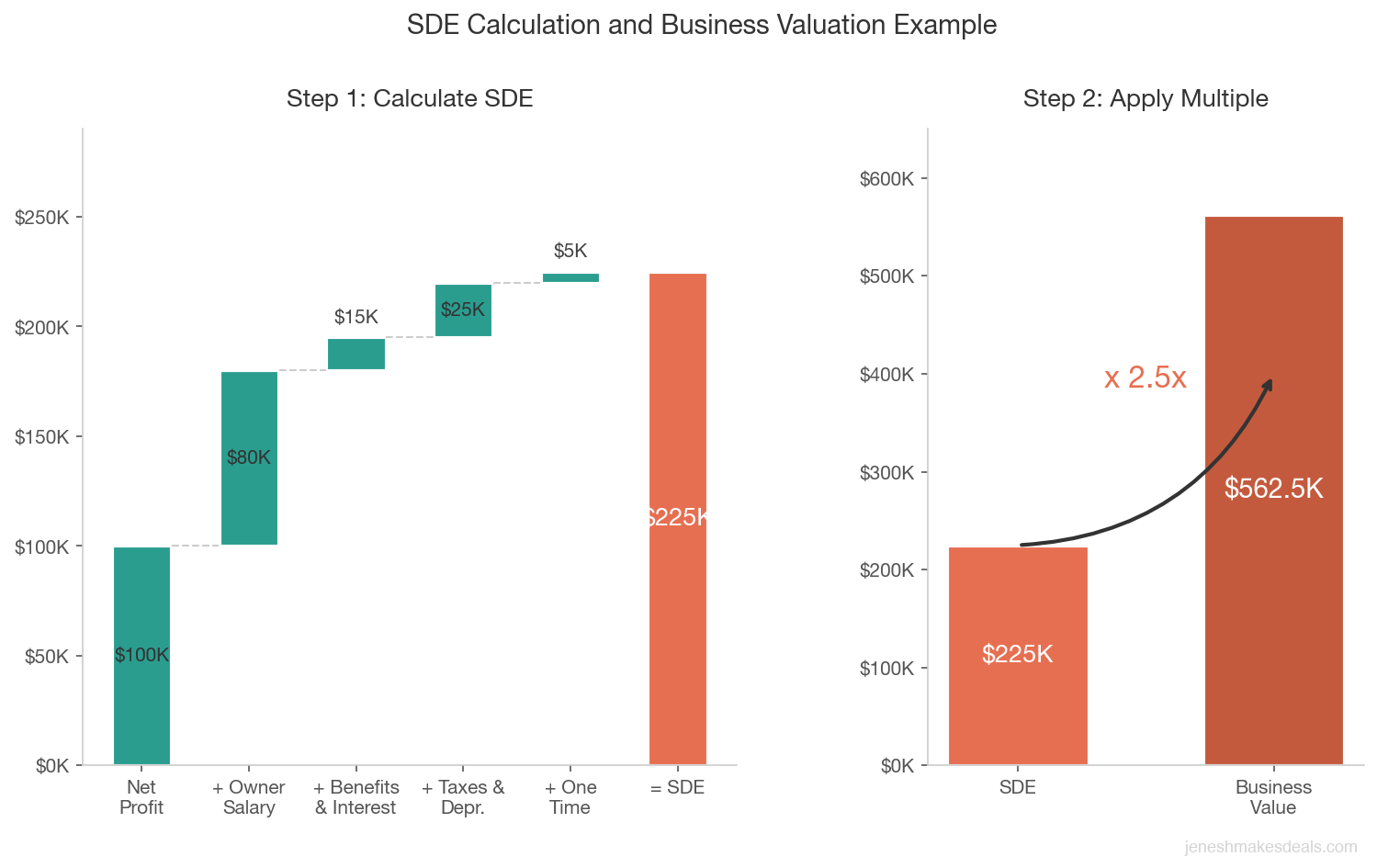
How do you calculate SDE for business valuation?
SDE (Seller's Discretionary Earnings) is calculated by adding net profit plus owner's salary, owner benefits (health insurance, car, etc.), interest, taxes, depreciation, amortization, and one time expenses. For example, if a business has $100,000 net profit, $80,000 owner salary, $10,000 owner benefits, $5,000 interest, $15,000 taxes, $10,000 depreciation, and $5,000 in one time expenses, the SDE would be $225,000. Multiply this by an industry multiple (typically 2.0x to 4.0x) to get business value.
What is a good multiple for business valuation?
Good multiples for business valuation vary by industry: service businesses typically sell for 2.0x to 3.5x SDE, retail businesses for 1.5x to 2.5x SDE, manufacturing for 2.5x to 4.0x SDE, and technology or SaaS businesses for 3.0x to 6.0x revenue or EBITDA. The exact multiple depends on business size, growth trajectory, customer concentration, owner dependency, and market conditions.
How do you value a business with no profit?
Businesses with no profit are typically valued using asset based methods, calculating the value of tangible assets (equipment, inventory, real estate) and intangible assets (intellectual property, customer lists, brand value) minus liabilities. For businesses with potential but no current revenue, valuation considers market potential, development stage, intellectual property value, and risk factors. These businesses are harder to value and often require professional expertise.
Can you value a business yourself?
Yes, you can estimate business value yourself using financial statements, industry multiples, and valuation methods. However, professional valuation is recommended for businesses over $1 million, complex situations, legal or tax requirements, and when accuracy is critical. A business broker can provide valuation services as part of their services, often at lower cost than a formal appraisal.
What To Do Next: Your Action Plan
Now that you understand how business valuation works, here's what to do next.
If You're Buying a Business
-
Request financial documents from the seller (three years of financials, tax returns, bank statements)
-
Use our calculator to get a preliminary estimate: business valuation calculator
-
Do your own analysis using the steps outlined above
-
Get professional help if the business is over $500,000 or you're unsure about your analysis
-
Use valuation in negotiations to make data driven offers
-
Consider financing options if you need funding: explore funding options
If You're Selling a Business
-
Organize your financial records (three years of statements, tax returns, bank statements)
-
Get a preliminary estimate using our business valuation calculator
-
Consider a professional valuation if your business is over $1 million or you want to maximize value
-
Address value detractors identified in the valuation (customer concentration, owner dependency, etc.)
-
Set realistic expectations based on market conditions and comparable sales
-
Work with a business broker to market your business at the right price
Ready to get started? Contact us for a consultation. Whether you're buying or selling, we can help you understand business value and make informed decisions.
Conclusion
Business valuation doesn't have to be mysterious or intimidating. By understanding the main valuation methods, key factors that affect value, and common mistakes to avoid, you can make better decisions whether you're buying or selling.
Remember these key points:
- Income based valuation is most common for small businesses
- Normalize financials to show true earning power
- Industry multiples vary significantly
- Multiple factors affect value beyond just profit
- Professional valuation is worth it for larger or complex businesses
The goal isn't to become a valuation expert overnight. It's to understand the process well enough to make informed decisions and know when to bring in professional help.
If you're buying a business, use valuation to avoid overpaying and identify good deals. If you're selling, use valuation to set realistic expectations and maximize your exit value. Either way, understanding how businesses are valued puts you in a stronger position.
Need help valuing a business or evaluating an opportunity? Contact us for a consultation. We work with buyers and sellers every day and can help you navigate the valuation process.
Want to get started with a quick estimate? Use our free business valuation calculator to see what a business might be worth based on basic financial information.
Looking for financing to buy a business? Explore our unsecured funding programs that can provide up to $500,000 with no collateral required.
Additional Resources
For more information on business valuation, consider these authoritative sources:
- Small Business Administration (SBA) - Official SBA resources on business financing and valuation requirements
- Internal Revenue Service (IRS) - IRS guidelines for business valuation in tax situations
- International Business Brokers Association (IBBA) - Industry standards and resources for business brokers
- Corporate Finance Institute: Seller's Discretionary Earnings - Comprehensive guide to understanding SDE
- Corporate Finance Institute: EBITDA - Comprehensive guide to EBITDA calculations and usage
- Wall Street Prep: SDE Guide - Detailed explanation of Seller's Discretionary Earnings with calculator
- American Society of Appraisers - Resources for finding qualified business appraisers
Related Articles

April 30, 2026
How Long Does It Really Take to Sell a Business
Most sellers are shocked by how long it takes. Here's the honest timeline from listing to closing, and what actually speeds things up.

April 26, 2026
How to Structure an Earnout That Works for Seller and Buyer
Most earnouts fail because they're poorly structured. Here's how to build earnout terms that protect both sides of the deal.
April 24, 2026
How to Value Intellectual Property in a Business Sale
Your IP could be worth more than your equipment. Learn how patents, trademarks, and trade secrets affect your business valuation.
About the Author
Jenesh Napit is an experienced business broker specializing in business acquisitions, valuations, and exit planning. With a Bachelor's degree in Economics and Finance and years of experience helping clients successfully buy and sell businesses, he provides expert guidance throughout the entire transaction process. As a verified business broker on BizBuySell and member of Hedgestone Business Advisors, he brings deep expertise in business valuation, SBA financing, due diligence, and negotiation strategies.
You might also be interested in
Free Business Calculators
Try our business valuation calculator and ROI calculator to estimate values and returns instantly.
How to Buy a Business Guide
Download our comprehensive free guide covering everything you need to know about buying a business.
Our Services
Explore our professional business brokerage services including valuations and buyer representation.
More Articles
Browse our complete collection of business brokerage insights and expertise.