

I've been watching the landscaping industry for years. The conversations I have with owners always circle back to two problems: finding workers and keeping margins. In 2026, there's a technology shift happening that solves both of those problems at once. And it's moving faster than most owners realize.
Robotic mowers and AI powered scheduling tools aren't prototypes sitting in a lab somewhere. They're deployed across 14 states, cutting real grass for real landscaping companies. One operation in Illinois went from 3 and 4 person mowing crews down to 2 person crews. That's not a marginal improvement. That's a structural change in how the business operates.
Here's what makes this urgent. Only 17% of landscaping companies currently use AI in their operations. But the ones that do are projected to see 120% higher cash flow by 2030 compared to companies that don't adopt. The gap between early movers and everyone else is getting wider every quarter. If you own a landscaping business, the decisions you make about technology in the next 12 to 18 months will determine whether you're selling at a premium or a discount.
The Robotic Mower Market Is Exploding
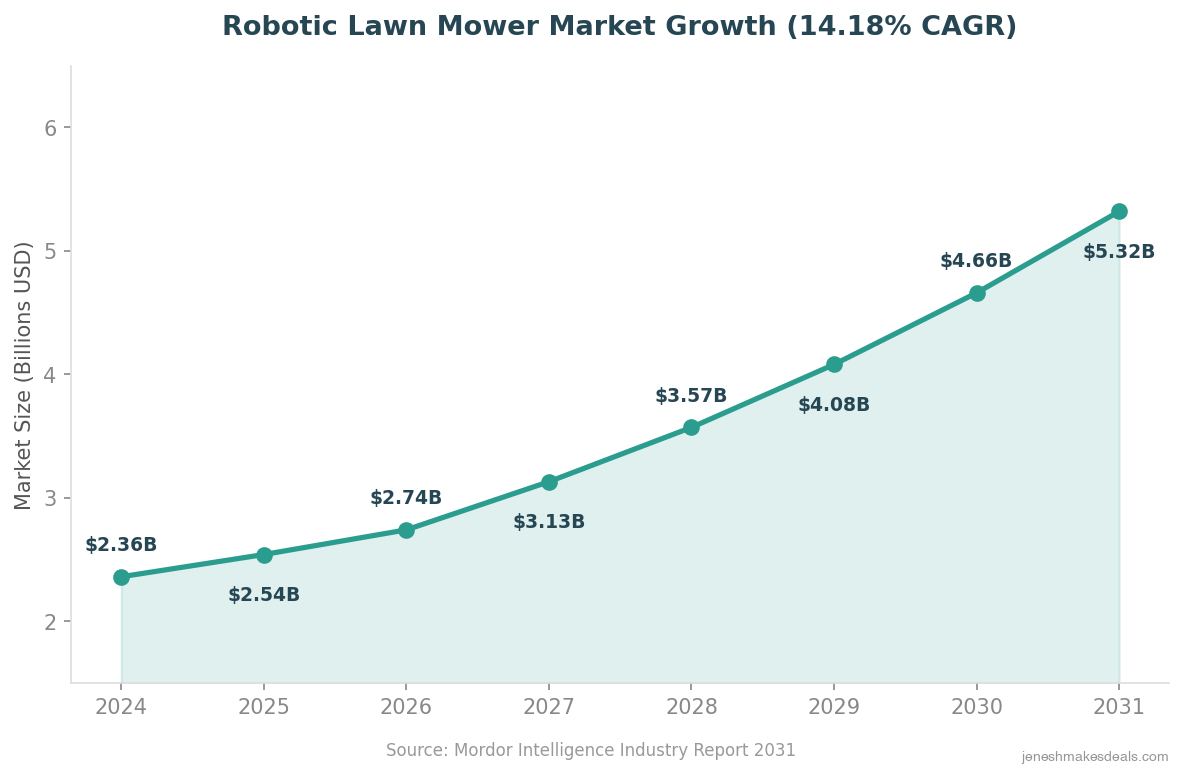
The numbers tell the story. The robotic mower market hit $2.74 billion in 2026 and is projected to reach $5.32 billion by 2031, growing at a 14.18% CAGR. Zoom out further and the global market is even more dramatic. It was $9.6 billion in 2025 and is on track for $25.56 billion by 2034.
Most of that early growth was residential. Homeowners buying small robotic mowers for their quarter acre lots. But the commercial segment is now the fastest growing piece of the market, and that's where the real disruption is happening.
Three companies are leading the charge, each with a different approach. Together, they represent what the next era of commercial landscaping looks like.
Scythe Robotics: The Crew Killer
Scythe Robotics has raised $97.47 million in total funding, including a $22.83 million Series C in June 2025. Their flagship product, the M.52, is a fully electric autonomous 52 inch commercial mower. It covers 1.5 to 2 acres per hour and operates as a Robotics as a Service model, meaning landscaping companies don't need to buy the machines outright.
The M.52 is deployed across 14 states right now. Scythe's revenue is estimated between $25 million and $50 million, which puts them well past the startup phase and into real commercial traction.
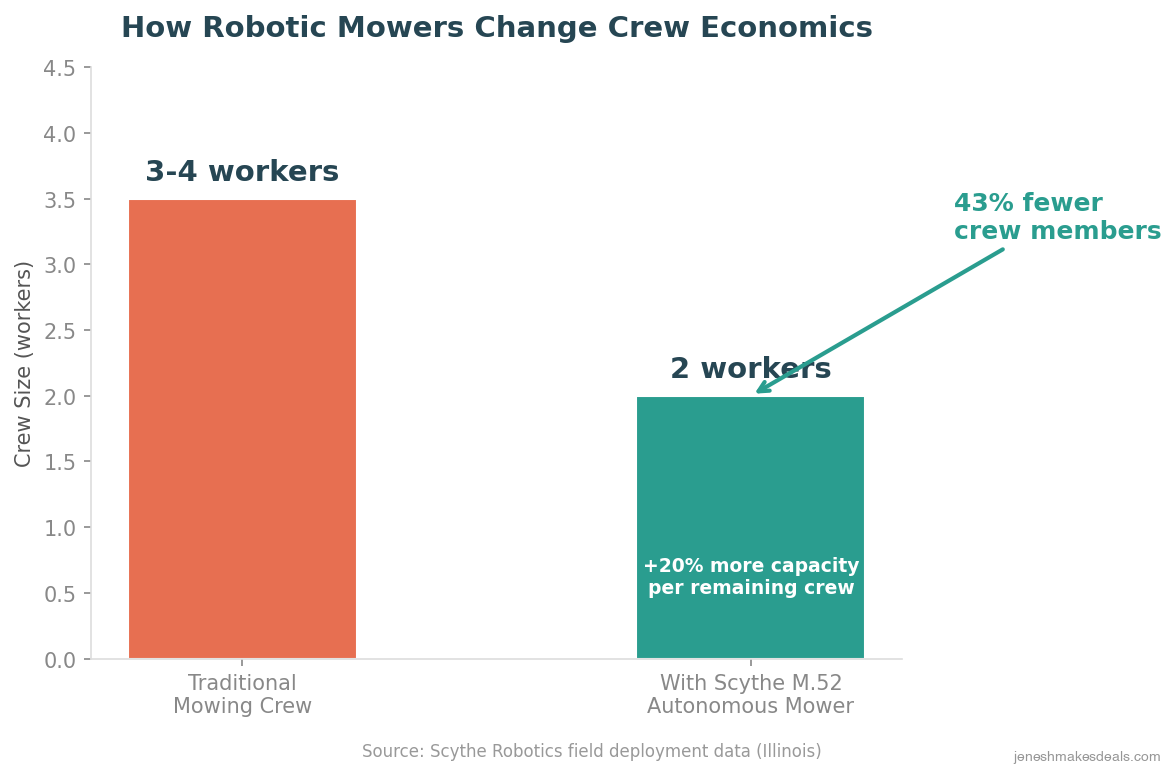
But the numbers that matter most are the ones coming from actual crews using the machines. In Illinois, the M.52 turned 3 and 4 person mowing crews into 2 person crews. It added 20% to a maintenance crew's total capacity, which opened a full extra day in their weekly schedule. Think about what that means for a company running 10 crews. You're not just saving on labor. You're gaining the capacity to take on more accounts without hiring a single additional person.
The Robotics as a Service model removes the capital expenditure barrier. You don't need to spend $50,000 on a machine. You pay per use, and the math works because you're simultaneously reducing your biggest cost line: labor.
Husqvarna CEORA: The Large Property Play
While Scythe targets standard commercial mowing operations, Husqvarna is going after the large format market. Their CEORA system covers up to 75,000 square meters (18.5 acres) per unit using EPOS satellite navigation. That's high precision positioning with 2 to 3 centimeter accuracy. No physical boundary wires. No buried cables. You program it through a mobile app and let it run.
The CEORA targets sports facilities, golf courses, parks, and large commercial properties. The Louisville Bats (a minor league baseball team) and Gwinnett Soccer Academy are already using it. For landscaping companies that maintain these types of properties, the implications are significant. A single CEORA unit can handle what used to require a dedicated crew for an entire day.
For smaller commercial properties, Husqvarna also offers the Automower 520/H EPOS, which covers 1.25 acres and retails at $3,299. That price point makes it accessible for landscaping companies managing clusters of smaller commercial accounts.
Husqvarna isn't just betting on mowing, either. They acquired Orbit Irrigation for approximately $480 million in early 2026, signaling that they see the future of landscaping as an integrated technology platform, not just individual tools.
Electric Sheep Robotics: The Acquisition Model
Electric Sheep Robotics took a completely different approach. Instead of building robots and selling them to landscaping companies, they acquired traditional landscaping businesses and added autonomous mowers and AI systems to them. The result? They grew revenue 8x, with a pipeline to grow 10x further.
In October 2025, Electric Sheep was acquired by Oso Electric Equipment. Their CEO said it plainly: "We're bringing a new business model to an industry ripe for innovation."
This is the model that should concern every landscaping business owner who's sitting on the sidelines. Private equity and technology companies aren't waiting for you to adopt AI. They're buying businesses, layering in automation, and extracting the margin improvement themselves. If you don't capture those efficiency gains before you sell, the buyer will, and they'll pay you a lower price because of it.
Wondering how technology adoption affects your company's value? Use our free landscaping business valuation calculator to see where you stand.
AI Route Optimization: The Invisible Profit Lever
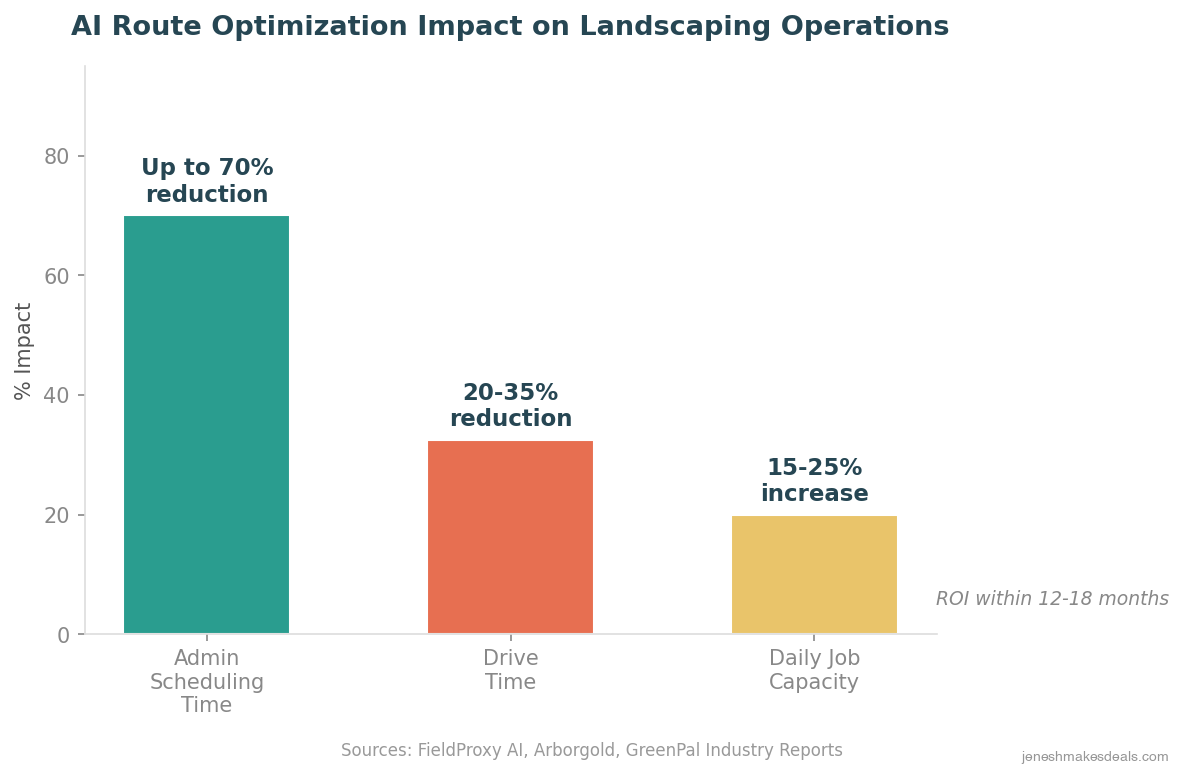
Robotic mowers get all the attention. But AI route optimization and scheduling software might have an even bigger impact on your bottom line in the short term. The results from companies using these tools are consistent across the industry.
| AI Route Optimization Impact | Result |
|---|---|
| Reduction in drive time | 20% to 35% |
| Reduction in admin scheduling time | Up to 70% |
| Increase in daily job capacity | 15% to 25% |
| Typical ROI timeline | 12 to 18 months |
Software like RealGreen Dynamic Routing, ServiceTitan, and Jobber now offers AI powered scheduling that optimizes crew routes in real time. Instead of dispatchers manually assigning jobs based on geography and gut feel, the software factors in traffic patterns, job duration, crew capabilities, and equipment availability to build optimized schedules.
33% of landscapers say they expect smart routing to be AI's biggest breakthrough for the industry. I think they're right. Here's why.
A landscaping company running 8 crews, each driving an average of 45 minutes between jobs, can recover 10 to 15 minutes per stop with optimized routing. Across a 6 stop day, that's 60 to 90 minutes per crew. Multiply that by 8 crews and 5 working days, and you're looking at 40 to 60 hours of recovered productive time per week. That's the equivalent of adding a full time crew without hiring anyone.
The admin time savings are just as real. Dispatchers and office managers who spent 3 to 4 hours daily building schedules can cut that to under an hour. That frees them up for customer acquisition, quality control, and other activities that directly grow the business.
Smart Irrigation: The Recurring Revenue Builder
There's a quieter technology shift happening alongside robotic mowers and AI routing that could matter just as much for your business value: smart irrigation.
Weathermatic received a minority growth investment from Rock Hill Capital in December 2025, validating the market opportunity. Smart irrigation systems deliver 20% to 50% water savings for commercial properties, which gives property managers an immediate, measurable ROI.
But the real value for landscaping business owners isn't the water savings. It's the recurring revenue stream. Smart irrigation creates ongoing monitoring and management contracts. You install the system, then charge monthly for oversight, adjustments, and maintenance. That's the exact type of revenue that PE buyers pay premium multiples for.
As I wrote about in the retirement timing post, the difference between a landscaping business with strong recurring revenue and one without can be the difference between a 4.0x to 5.0x SDE multiple and a 2.0x to 2.5x multiple. Smart irrigation is one of the fastest paths to building that recurring base.
The AI Adoption Gap Is a Valuation Gap
Here's where this gets personal for business owners. The industry data paints a picture of two very different types of landscaping companies emerging.
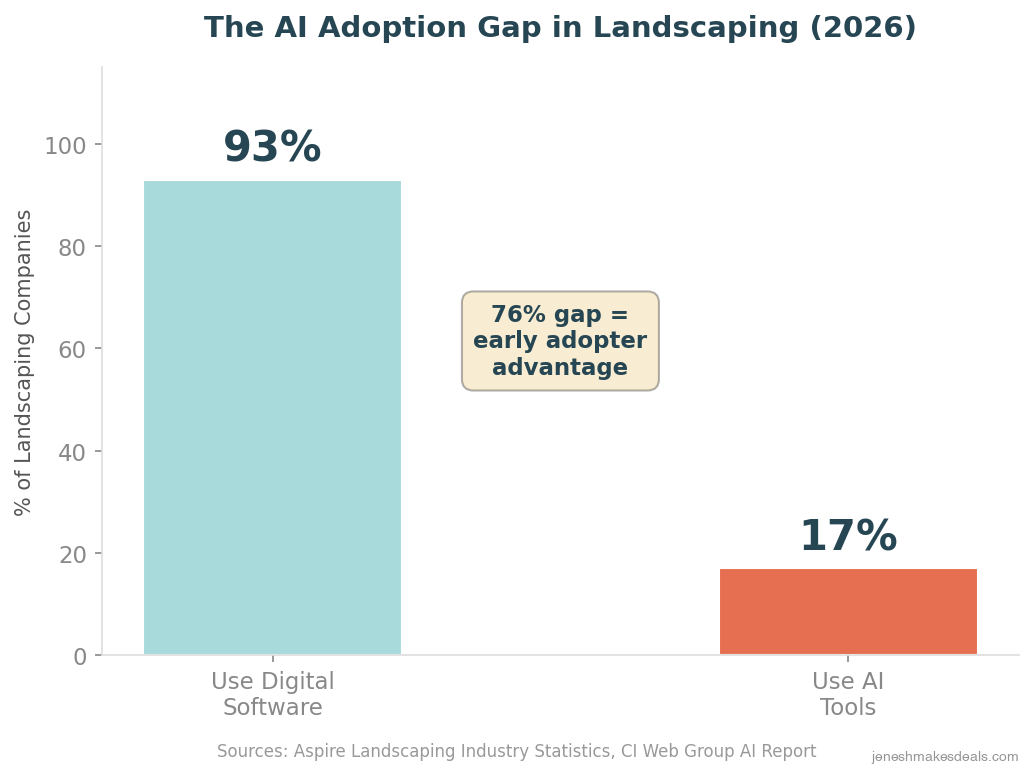
93% of landscaping companies use digital software in their daily operations. So nearly everyone has some tech in place. But only 17% are using AI. That 76 percentage point gap between basic software adoption and AI adoption represents a massive competitive window. It won't stay open forever.
The numbers on the AI adopters are striking.
| Metric | AI Adopters | Traditional Operators |
|---|---|---|
| Revenue growth rate | 2.5x higher | Baseline |
| Productivity gains | 2.4x greater | Baseline |
| Projected cash flow increase by 2030 | 120% higher | Flat to modest growth |
| Staffing risk exposure | Lower (automation buffer) | Higher (72% cite labor as biggest barrier) |
Companies using AI are growing revenue 2.5 times faster and achieving 2.4 times greater productivity. Meanwhile, 51% of landscaping businesses identify staffing as a major risk and 72% call labor their biggest barrier to growth. AI directly addresses the number one constraint most landscaping companies face.
The connection to valuations is straightforward. PE firms now account for 76% of landscaping transactions. Deal volume went from 22 in 2023 to 65 in 2024 to over 100 in 2025. Those buyers are paying 4.0x to 5.0x SDE for businesses with recurring revenue and technology systems. They're offering 2.0x to 2.5x SDE for businesses without them.
Technology adoption signals scalability to PE buyers. It tells them the business can grow without linearly adding headcount. That's the whole thesis behind buy and build roll ups. If your business still runs on paper schedules and manual dispatching, you're leaving money on the table.
Not sure how buyers would evaluate your technology stack? Get a free consultation and we'll walk through what PE firms look for in landscaping acquisitions.
The Route Density Advantage
One thing I don't see discussed enough is how technology amplifies route density, and how route density amplifies valuations.
Route density is the measure of how many jobs a crew can complete in a given area during a workday. High density means less driving, more mowing, and lower cost per job. Companies with strong route density enjoy a 15% to 20% labor cost advantage over competitors with scattered accounts.
AI routing tools make existing route density better by optimizing the sequence and timing of stops. Robotic mowers make it even better by reducing the time spent at each stop. When you combine both, you get a compounding effect. Your crews spend less time driving between jobs and less time at each job. The result is dramatically more revenue per crew hour.
For buyers, especially PE roll up platforms, route density is one of the first things they analyze. A company with tight geographic clustering and AI optimized routes is worth more than a company with the same revenue spread across a wider service area. If you're thinking about selling within the next few years, investing in route density (and the technology that maximizes it) is one of the highest return moves you can make.
For a deeper look at the full selling process, check out our guide to selling your landscaping business.
Common Mistakes Landscaping Owners Make with Technology
I talk to landscaping business owners every week, and I see the same technology mistakes over and over.
Mistake 1: Waiting for the technology to be "proven." The M.52 is deployed across 14 states. CEORA is maintaining professional sports fields. AI routing tools have been delivering measurable ROI for years. The technology is already proven. What you're really waiting for is certainty, and in business, certainty comes at the cost of opportunity.
Mistake 2: Thinking of technology as a cost instead of an investment. A $500 per month AI routing subscription that saves 40 crew hours per week is not a cost. It's the best ROI you'll find in your entire P&L. But owners who look at the monthly line item without calculating the return never adopt, and their margins reflect it.
Mistake 3: Assuming buyers don't care about your tech stack. PE buyers absolutely care. When they model post acquisition improvements, a company with no technology adoption shows them a long list of things they'll have to implement themselves. That means more risk, more transition time, and a lower purchase price. A company that's already running AI tools shows them a business that's ready to scale immediately.
Mistake 4: Adopting technology without changing processes. I've seen companies buy expensive software and then keep doing everything the old way. The dispatch manager still builds schedules manually because "that's how we've always done it." Technology only creates value when you actually change your workflows around it. Training matters as much as the software itself.
Mistake 5: Ignoring the data. AI tools generate enormous amounts of data about your operations. Job times, travel times, crew productivity, equipment utilization. Most owners never look at the dashboards. The ones who do find profit leaks they didn't know existed and competitive advantages they didn't know they had.
How Technology Changes Your Landscaping Business Valuation
Let me put some concrete numbers on this.
Consider two landscaping businesses, both doing $1.5 million in revenue with $400,000 in SDE.
Business A runs traditional operations. Paper scheduling, 6 person crews, no route optimization software, no robotic mowers, 70% project based revenue. A buyer offers 2.0x to 2.5x SDE. Valuation: $800,000 to $1,000,000.
Business B has adopted AI routing, runs smaller crews with a Scythe M.52 handling mowing, converted 60% of revenue to recurring maintenance contracts with smart irrigation monitoring, and has clean data on all operational metrics. A buyer offers 4.0x to 5.0x SDE. Valuation: $1,600,000 to $2,000,000.
Same revenue. Same profit. The difference is $600,000 to $1,000,000 in enterprise value, driven entirely by how the business operates and how attractive it is to a buyer looking to scale.
That gap is only going to widen. As more PE firms target landscaping, as the retirement wave pushes more businesses onto the market, and as the early adopters pull further ahead, the penalty for being a traditional operator will increase.
Want an estimate of what your landscaping company is worth today? Try our landscaping business valuation calculator or visit our landscaping valuation page for a detailed breakdown.
What to Do Next
If you've read this far, you're already ahead of the 83% of landscaping business owners who haven't engaged with AI at all. Here's a practical sequence for the next 90 days.
Days 1 to 14: Audit your current operations. Map every process that touches scheduling, routing, and crew management. Identify how much time your admin staff spends building schedules. Calculate your average drive time between jobs. These numbers become your baseline.
Days 15 to 30: Pick one AI tool and implement it. Start with route optimization software. ServiceTitan, Jobber, or RealGreen Dynamic Routing all offer trials or demos. The learning curve is low and the ROI is the fastest. Get your dispatchers trained and commit to using it for a full month before evaluating.
Days 31 to 60: Explore robotic mowing. Contact Scythe about their Robotics as a Service model. If you maintain large commercial properties, look at Husqvarna CEORA. Run a pilot on 2 or 3 accounts and measure the crew time savings against the cost. You don't need to convert your entire operation at once.
Days 61 to 90: Build recurring revenue. If you're not already offering smart irrigation monitoring, get a quote from Weathermatic or a similar provider. Convert at least 5 accounts to a monitoring and management contract. This starts building the recurring revenue base that PE buyers pay premium multiples for.
Throughout: Track everything. Document your before and after metrics. Time saved per route. Crew hours recovered. New capacity created. When you eventually go to sell, these numbers become powerful proof points in your CIM (confidential information memorandum).
Thinking about selling your landscaping business in the next 1 to 3 years? Contact us for a free, confidential conversation about how to position your business for a premium exit. We'll help you understand what buyers are paying, what they're looking for, and how to close the gap between where you are and where you need to be.
The Window Is Closing
The landscaping industry is at an inflection point. Robotic mowers are deployed. AI routing works. Smart irrigation creates recurring revenue. PE firms are writing checks at record pace. And the vast majority of the industry hasn't adopted any of it yet.
That last part is the opportunity. Right now, being in the top 17% of technology adopters gives you a significant edge in both operations and valuations. But that window narrows every quarter as more companies catch up. The first movers in any technology wave capture the biggest gains. The laggards pay full price for the same tools and get none of the competitive advantage.
I've seen this pattern play out in HVAC, plumbing, trucking, and car washes. The owners who move early sell at the top of the market. The owners who wait sell into a crowded field of businesses that all look the same to buyers.
Need capital to invest in robotic mowers or AI tools before selling? Check out our unsecured funding programs that provide up to $500,000 with no collateral required.
If you own a landscaping business, the question isn't whether to adopt AI and automation. It's whether you do it in time to capture the value, or whether someone else captures it after they buy your company at a discount.
Ready to find out what your landscaping business is worth? Start with our free valuation calculator or schedule a consultation to discuss your specific situation. We work with landscaping business owners across the country and can give you an honest assessment of where you stand and what to do about it.
Related Articles

April 30, 2026
How Long Does It Really Take to Sell a Business
Most sellers are shocked by how long it takes. Here's the honest timeline from listing to closing, and what actually speeds things up.

April 26, 2026
How to Structure an Earnout That Works for Seller and Buyer
Most earnouts fail because they're poorly structured. Here's how to build earnout terms that protect both sides of the deal.

April 24, 2026
How to Value Intellectual Property in a Business Sale
Your IP could be worth more than your equipment. Learn how patents, trademarks, and trade secrets affect your business valuation.
About the Author
Jenesh Napit is an experienced business broker specializing in business acquisitions, valuations, and exit planning. With a Bachelor's degree in Economics and Finance and years of experience helping clients successfully buy and sell businesses, he provides expert guidance throughout the entire transaction process. As a verified business broker on BizBuySell and member of Hedgestone Business Advisors, he brings deep expertise in business valuation, SBA financing, due diligence, and negotiation strategies.
You might also be interested in
Free Business Calculators
Try our business valuation calculator and ROI calculator to estimate values and returns instantly.
How to Buy a Business Guide
Download our comprehensive free guide covering everything you need to know about buying a business.
Our Services
Explore our professional business brokerage services including valuations and buyer representation.
More Articles
Browse our complete collection of business brokerage insights and expertise.