

The question I hear most often from owners isn't "how do I sell?" It's "how do I know if it's time?" And usually when someone is asking that question, they've been asking it to themselves for a while already. They've just been avoiding the answer.
Selling a business you built is one of the most significant financial and personal decisions you'll ever make. It's not just a transaction. It's a transition. You're not just selling a business, you're changing your identity, your daily structure, and probably your sense of purpose. That weight is real, and it's why so many owners delay too long.
But here's the thing I've learned from working on dozens of these deals: the owners who time their exit well, who sell from a position of strength rather than desperation, always say the same thing afterward. They wish they had started thinking about it two or three years earlier.
This post is about helping you figure out whether it's time, what "time" actually means, and what happens to your options when you wait too long.
The Question Most Owners Avoid Asking Until It's Almost Too Late
The honest version of the question is this: "Is my business at its best, and is this still what I want to be doing?"
Most owners don't ask it that plainly. They ask softer versions. "Should I be thinking about an exit strategy?" "Is now a good time to sell?" "What would I get if I put it on the market?"
The softer versions don't require honest self-examination. The direct version does. And the answer to the direct version often reveals things owners aren't fully ready to face: that they're burned out, that the business has plateaued, that the industry is changing in ways that favor younger, more aggressive competitors, or that the best years of the business may already be behind them.
None of these are shameful realizations. They're normal parts of the business ownership lifecycle. The only mistake is pretending they're not there, because waiting to sell until those problems become undeniable costs you money. Buyers pay more for businesses that look forward and less for businesses that look backward.
So start asking yourself the direct question now, before external circumstances force the answer on you.
The owners who time their exit well, who sell from a position of strength rather than desperation, always say the same thing afterward: they wish they had started thinking about it two or three years earlier.
Market Timing: When Industry Conditions Favor Sellers
Selling conditions aren't constant. There are windows when buyers are active, capital is available, and multiples are strong, and there are periods when buyer activity drops, financing tightens, and deals get harder to close.
Here's what favorable seller conditions look like in small business markets:
Interest rates are moderate. When interest rates are low to moderate, buyers can afford more debt service on acquisitions, which means they can pay more. When rates spike, the same cash flow supports a smaller purchase price because the buyer's financing is more expensive. Rates directly affect what buyers can offer.
Your industry is in demand. Some industries go through cycles of buyer interest. Home services, healthcare adjacent services, and e-commerce businesses have been in high demand in recent years. Restaurants and retail have faced more scrutiny. Know where your industry sits in the current buyer appetite.
M&A activity is generally strong. When deal flow is active and lenders are approving SBA loans readily, multiple buyers compete for the same businesses, which drives prices up. When deal flow is slow, sellers have less negotiating power.
Your financials are at or near peak. Buyers pay based on the last two to three years of financial performance. If your business just completed its best year ever, your multiple applies to a larger number. Sell after two strong years, not before. But don't wait for a third if the business starts to plateau.
The challenge with market timing is that no one rings a bell at the top. If you wait for the perfect moment, you'll miss it. The better approach is to stay informed about your industry's selling conditions and be ready to move when you're personally ready and the market is reasonably favorable.
Personal Timing: The Life Events That Signal It Might Be Time
Beyond market conditions, personal life events are often the real driver behind a sale decision. And being honest about them earlier rather than later makes for a better exit.
Approaching retirement age. If you're in your late 50s or 60s and the business is a significant part of your wealth, a sale converts illiquid business value into liquid assets you can actually use in retirement. Most retirement planning advisors will tell you not to rely on a future business sale as your retirement plan, because deal timing is unpredictable. Start the process before you need the money, not when you need it urgently.
Health changes. A personal health event, whether it's your own or a spouse's or a parent's, often changes what you're able and willing to commit to a business. This is one of the most common reasons owners sell, and it's often discussed in very vague terms with brokers because of privacy. You don't need to share details, but be honest with yourself about whether your health situation is changing what you can realistically sustain.
Partnership disputes. When co-owners of a business reach an impasse about direction, investment, or operations, selling the business is often the cleanest resolution. A forced sale under these conditions typically gets a lower price than a planned one. If you see a partnership conflict building, address the exit question before it becomes a crisis.
Desire to pursue something new. Entrepreneurs often have multiple ideas and interests. If you've been running the same business for 15 years and you have a new idea you're more excited about, that's a legitimate signal. Selling one business to fund or pursue another is a completely valid reason to exit.
Loss of passion. You don't need a dramatic life event to justify selling. If you've been doing this for 12 years and you've simply stopped caring as much as you used to, that's a real signal. And it usually shows up in the business before it shows up in your conversations with anyone else.
Not sure where you stand? Take our exit readiness assessment to evaluate whether your business and personal situation are aligned for a successful sale.
Business Performance: Peak vs Plateau vs Decline
The performance trajectory of your business at the time of sale has a significant impact on what you'll get and how quickly you'll get it.
Businesses at peak or growing are the easiest to sell and command the best prices. Buyers are buying the story of continued growth. You're selling momentum. These deals close faster, attract more qualified buyers, and often receive multiple offers.
Businesses that have plateaued are still very sellable, especially if the plateau is stable and the underlying fundamentals are strong. Buyers see a reliable income stream rather than a growth story. The multiple may be slightly lower than a growing business, but these deals close regularly. The key is to be able to explain the plateau in a way that doesn't suggest hidden problems.
Businesses in decline are the hardest to sell and yield the lowest prices. Buyers apply a discount for the declining trajectory, add a discount for the uncertainty about where it's going, and often require seller financing as additional security. If you're in decline, selling sooner is almost always better than waiting.
The common mistake is this: owners in decline hold on, believing the trend will reverse. Sometimes it does. More often it doesn't. And every quarter you wait with declining revenue means the next three years of historical financials look worse. Your price is based on those financials.
The lesson: don't wait for perfect conditions that may never come. Sell when the business is still clearly performing, not when it's showing cracks.
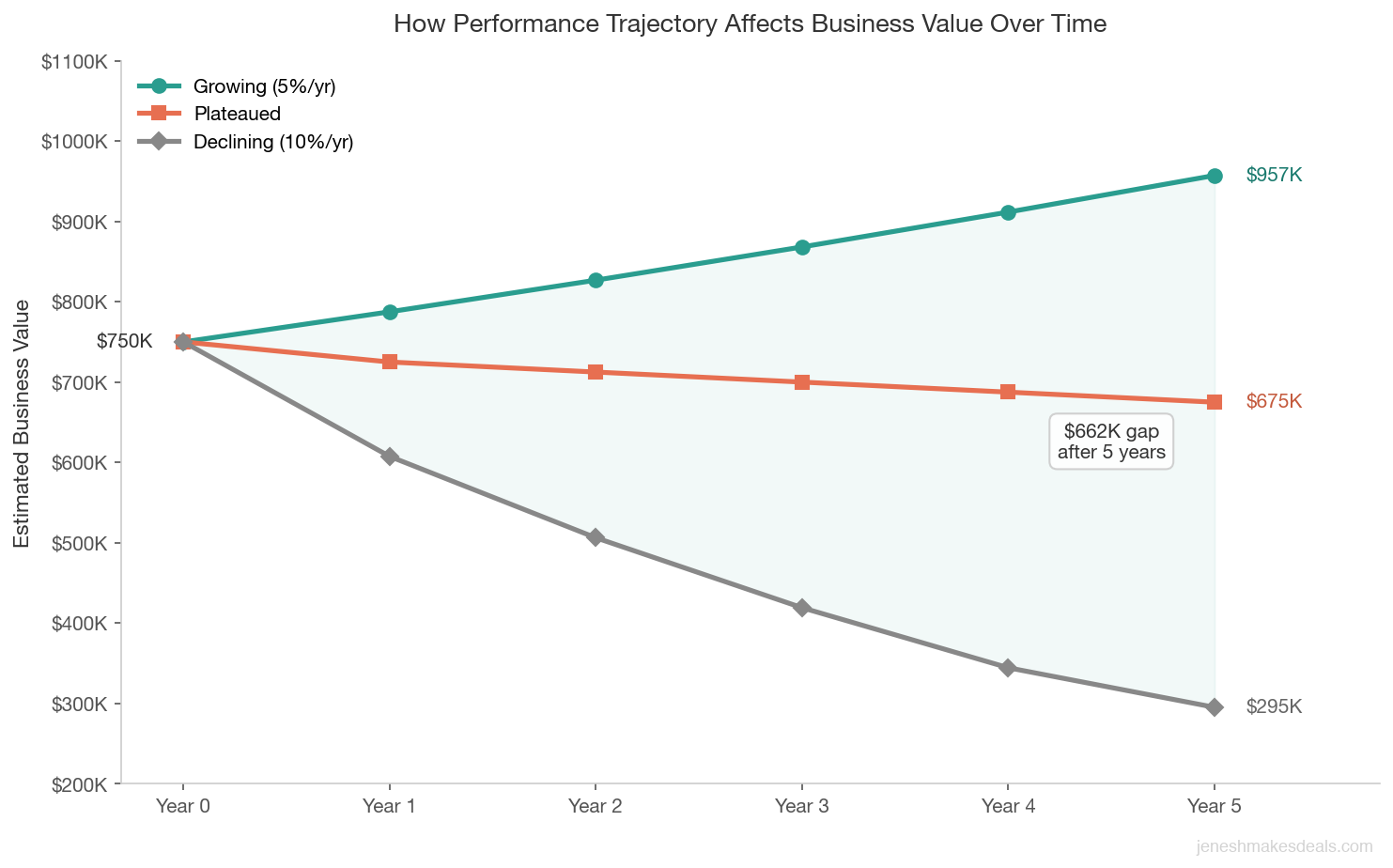
The chart above shows exactly how wide the gap gets. A growing business and a declining business that both start at $750,000 in value can diverge by hundreds of thousands of dollars within just a few years. The longer you wait while performance is declining, the steeper the loss.
Ready to talk about what your business might be worth right now? Contact us for a free consultation and we'll give you an honest assessment based on current market conditions.
The Retirement Calculation: How Much Do You Actually Need from a Sale?
Before you can make an intelligent decision about when to sell, you need to know the answer to a very specific question: how much do you need from the sale to have the retirement or next phase you want?
Here's a simple framework:
Step 1: Estimate your annual expenses in retirement. Don't guess low. Include travel, healthcare (which is expensive without employer coverage), housing, gifts, and hobbies. A realistic number for most comfortable retirements in a major metro area is $120,000 to $200,000 per year.
Step 2: Estimate your other income. Social Security, rental income, pension if applicable, spouse's income. Subtract this from your annual expense need.
Step 3: Calculate the capital required. A commonly used rule is that a portfolio can sustain 4% annual withdrawal. So if you need $100,000 per year from your portfolio, you need $2,500,000 in investable assets. If you need $150,000 per year, you need $3,750,000.
Step 4: Add up your current assets. Retirement accounts, real estate equity, other savings. Subtract from the capital required number. The gap is how much you need from the business sale.
Step 5: Compare to your business's likely sale price. Use a realistic multiple based on your industry and your actual SDE to estimate what the business would sell for today and what it might sell for in two to three years if performance continues.
This math often reveals one of two things: either the business is worth more than enough and you could sell today and be financially secure, or the business is the primary source of retirement capital and you need to either grow it more before selling or plan a sale while you're still young enough to manage the transition well.
Either way, doing this math is far better than assuming things will work out.
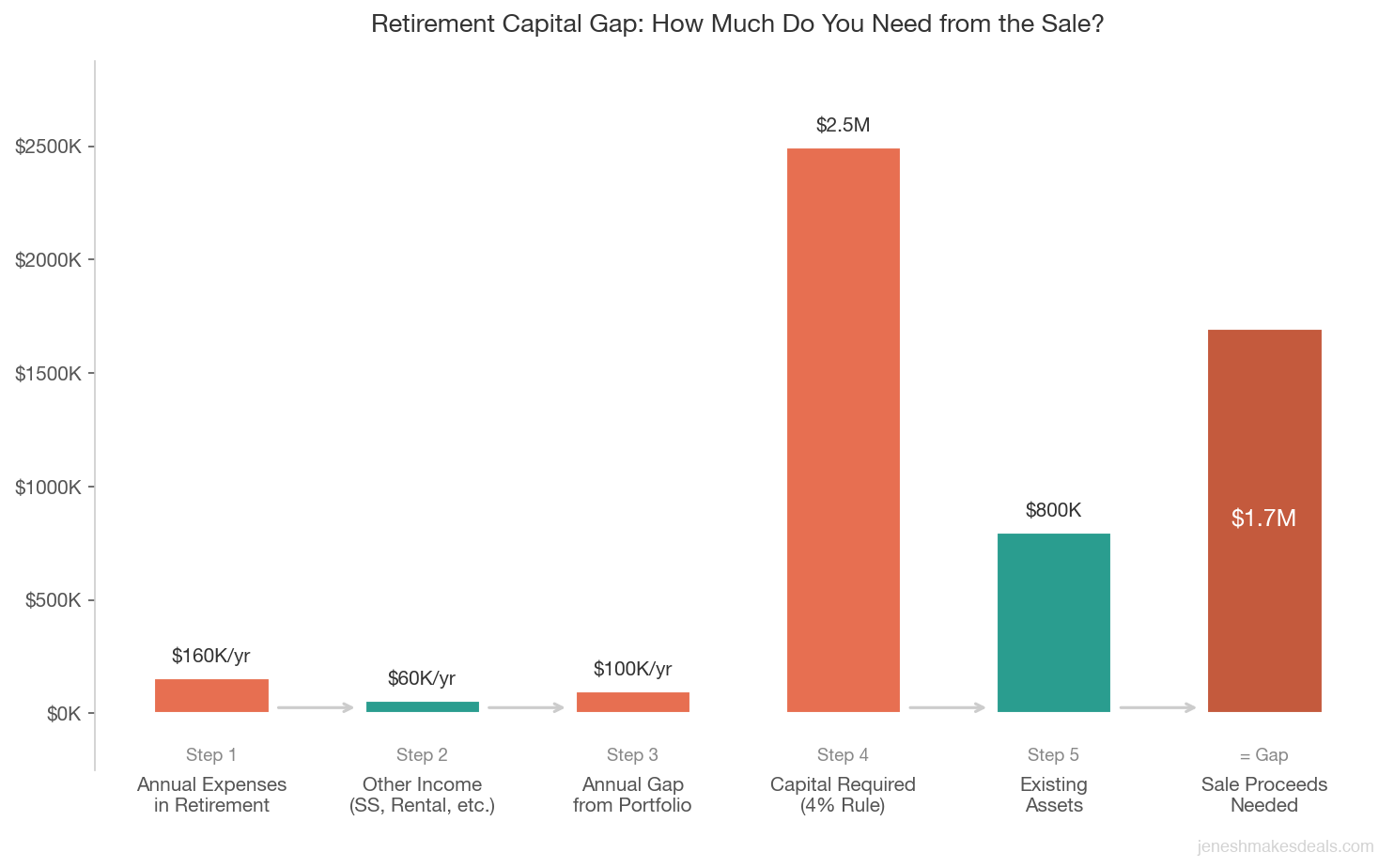
Here's an example using realistic numbers. An owner with $160,000 in annual retirement expenses, $60,000 in other income, and $800,000 in existing assets would need roughly $1.7 million from a business sale to close the gap. Running this math early is the difference between a planned exit and a panicked one.
Owner Burnout as a Signal (And Why Acting on It Early Is Smarter)
Burnout in business owners is real and it's more common than people admit. After 10 or 15 years of running the same business, many owners experience a combination of exhaustion, reduced creativity, lower tolerance for problems, and a creeping sense that they're running in place.
The danger of burnout from a sale perspective is that it shows up in the business before it shows up in any conversation. A burned-out owner makes fewer investments in the business, hires less aggressively, ignores customer retention issues, and generally lets things slide in ways that erode the business's value over time.
By the time the owner decides they're done and needs to sell, they may have two or three years of flattening or declining performance behind them. That's not the financial story that gets top dollar.
The smart move is to recognize burnout early, when the business is still performing well, and start the exit planning process then. You can still run the business for another 12 to 24 months while you prepare for a sale. During that window, focus on increasing your business value before selling. But starting from a position of performance rather than exhaustion makes a meaningful difference in both the price you get and the speed at which you close.
If you've been telling yourself "just another year" for three years now, that's a signal. Take it seriously.
A burned out owner makes fewer investments, hires less aggressively, and lets things slide in ways that erode business value. By the time they decide to sell, they may have two or three years of flattening performance behind them.
What Happens When You Wait Too Long (Valuation Decline, Motivated Seller Discount)
Waiting too long to sell has a predictable set of consequences.
Valuation decline. If the business starts showing declining revenue while you're trying to decide whether to sell, the valuation drops accordingly. A business that would have sold for $1.2 million two years ago might sell for $800,000 today if revenue has dropped 20% and the trend is negative.
Motivated seller discount. Buyers can tell when a seller needs to close. Maybe you've mentioned needing funds, or the business's performance has declined enough that buyers know you're under pressure. Motivated sellers get lower prices. Buyers routinely negotiate harder against sellers who need the deal to happen. If your retirement, a health situation, or a financial necessity is forcing the sale, expect buyers to use that information.
Reduced buyer interest. Fewer buyers will make offers on a declining business than on a stable or growing one. With less competition among buyers, you have less negotiating power on both price and deal structure.
Harder to get financing. Lenders (SBA and others) look at trailing financial performance to approve acquisition loans. A business with three years of declining EBITDA is harder to finance. Fewer buyers who can get financing means fewer serious offers.
Transition complexity. If you've been running the business at a reduced level because you're burned out, the transition to a new owner is harder. Key staff may have left. Systems may have atrophied. Customer relationships may have weakened. All of this makes a successful handoff more difficult.
| Factor | Selling at the Right Time | Waiting Too Long |
|---|---|---|
| Business valuation | Based on peak or stable performance | Discounted for declining trajectory |
| Buyer interest | Multiple competing offers | Few or no offers |
| Financing availability | Lenders approve readily | Declining EBITDA makes financing difficult |
| Negotiating power | Seller sets favorable terms | Buyers negotiate aggressively |
| Sale timeline | 6 to 12 months typical | 12 to 24 months or no sale at all |
| Net proceeds | Full market value | 20% to 40% below peak value |
The 2-Year Preparation Window: Why Starting Early Matters
The best exits are planned two to three years in advance. Here's why.
Financials. Buyers pay based on two to three years of performance. If your most recent year was good, but the two years before it were mediocre, the average doesn't look great. Two consecutive strong years before a sale produces significantly better-looking historical financials than one good year and two flat ones.
Clean up the business. Two years before a sale is the right time to address things that make a business less attractive: unexplained expenses, related-party transactions, owner dependency issues, undocumented processes, and customer concentration. Fixing these takes time.
Reduce owner dependency. Buyers discount heavily for owner-dependent businesses. If you start delegating and building a management team two years before you sell, you've created a more valuable and more sellable asset. Read how to build a business that runs without you to start that process. If you wait until you're listing to hire a manager, buyers will be skeptical.
Tax planning. The tax consequences of a business sale can be significant. With two years of lead time, your accountant can structure the business and the deal in ways that reduce your tax burden. With two weeks of lead time, your options are limited.
Find the right representation. Choosing a good business broker or M&A advisor takes time. The best brokers are selective about who they work with. Starting the process early gives you options.
Want to understand what your business might be worth today and in two years? Use our business valuation tools to model different scenarios.
Wondering how buyers will finance your business and what that means for deal structure? Explore funding options for buyers to understand how SBA loans and seller financing affect what buyers can pay.
How to Think About Selling vs Holding for Another 5 Years (The Math)
Owners often frame this as "should I sell now or hold for five years and sell for more?" Let's actually run the math.
Assume you own a business with $250,000 in SDE. At a 3x multiple, it's worth $750,000 today. You're considering selling now vs. holding five more years.
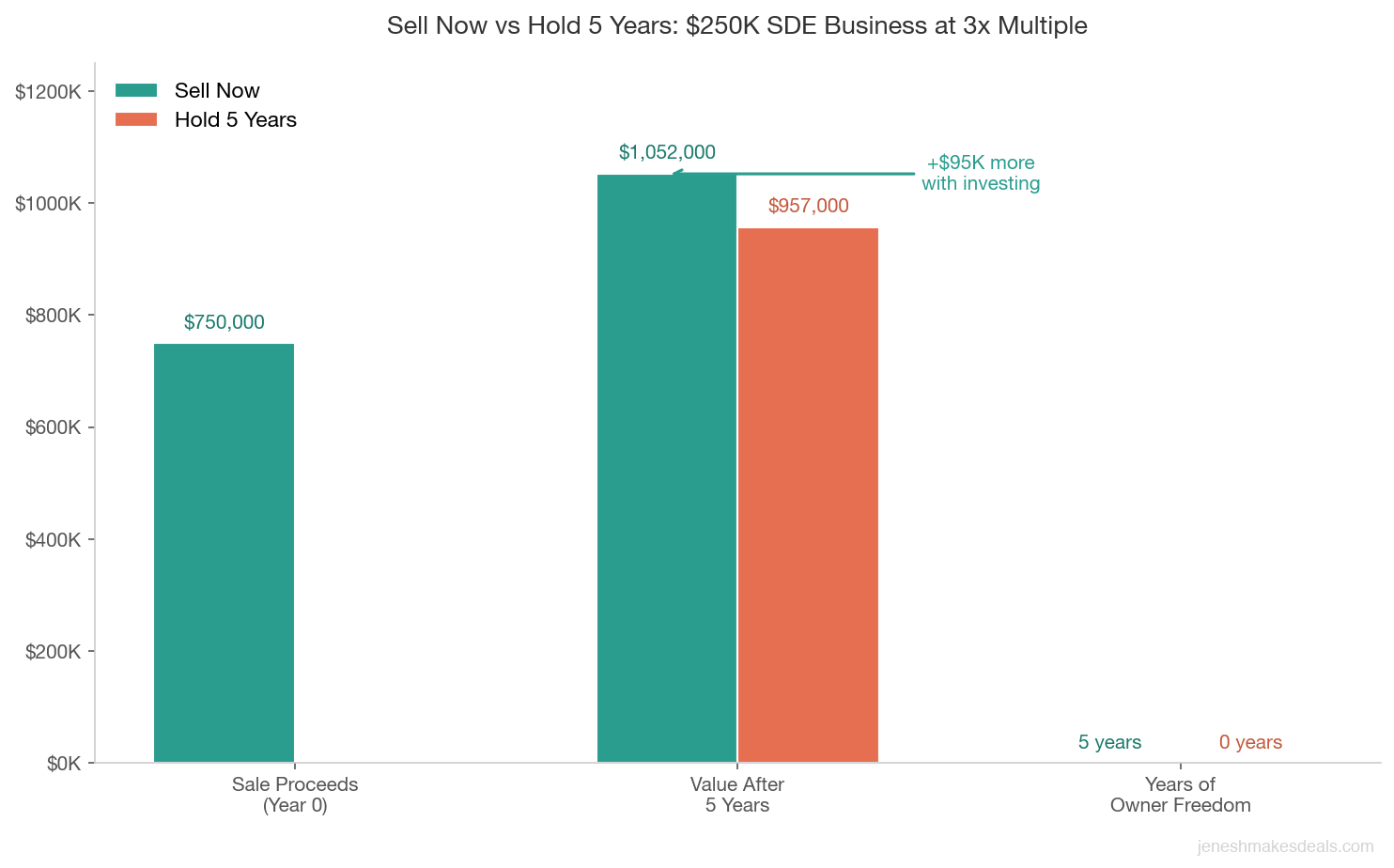
Scenario A: Sell now. You net $750,000 (before taxes). Invested conservatively at 7%, that grows to approximately $1,052,000 in five years.
Meanwhile, over those five years, you've freed yourself from the business and perhaps started another venture, taken a senior position somewhere, or simply reduced your workload. There's a non-financial value to that.
Scenario B: Hold five more years. If SDE grows at 5% per year for five years, your SDE would be approximately $319,000. At the same 3x multiple, the business would be worth about $957,000 in five years.
But you worked in the business for five years to earn that extra $207,000 in sale value. Over five years, that's less than $42,000 per year in additional value creation from the sale itself. If you're already paying yourself $250,000 per year in SDE, the incremental gain from holding is relatively small compared to the capital already at work.
The math changes significantly if:
- The business can grow faster than 5% per year (hold case gets much stronger)
- The market multiple expands (hold case gets stronger)
- The business starts declining (sell now becomes even more urgent)
- Your personal circumstances require liquidity sooner (sell now)
There's no universal right answer. But running the actual numbers, rather than assuming holding is always better, often produces a different conclusion than owners expect.
| Sell Now | Hold 5 Years | |
|---|---|---|
| Immediate proceeds | $750,000 | $0 |
| Business or portfolio value in year 5 | $1,052,000 (invested at 7%) | $957,000 (5% SDE growth, 3x multiple) |
| Owner time commitment | Free immediately | 5 more years of full time work |
| Incremental gain from holding | N/A | $207,000 over 5 years (~$42K/yr) |
| Risk profile | Diversified investments | Concentrated in one business |
Running the actual numbers, rather than assuming holding is always better, often produces a different conclusion than owners expect. Selling now and investing the proceeds can outperform holding for five more years.
Common Mistakes Owners Make When Deciding to Sell
Waiting for the "perfect" time. There is no perfect time. There is ready time. When your business is performing well, your personal situation supports a transition, and you've done the planning work, that's as close to perfect as it gets.
Selling under pressure. Forced sales, whether due to health, partnership disputes, or financial need, consistently get lower prices than planned sales. The best exit plans start well before any pressure exists.
Overestimating what the business is worth. Owners almost always have a higher number in their head than the market will support. Getting an honest valuation from a qualified broker or advisor before you've made any decisions about selling is one of the most valuable things you can do.
Not preparing the business for sale. A business that looks like it just got dressed up for the sale gets buyer scrutiny. A business that has been clean, well-documented, and professionally run for years is much easier to sell at a good price.
Handling the sale yourself. FSBO business sales consistently achieve lower prices than brokered sales, and they take longer to close. The broker's fee is more than offset by the higher sale price in most cases.
Your Next Steps
If you're seriously thinking about selling your business in the next one to three years, here's where to start:
-
Get an honest valuation. Before you make any plans, understand what the business is actually worth in the current market. Get a business valuation to start with a clear number.
-
Run the retirement math. Figure out how much you need from the sale and whether the current valuation meets that number.
-
Identify what would make the business more valuable. Are there obvious improvements you could make in the next 12 to 24 months? Less owner dependency, stronger financials, cleaner operations?
-
Talk to a broker. Not to list the business, just to have a conversation. A good broker will tell you honestly whether now is the right time or whether you should wait and what to focus on.
-
Start the tax planning conversation with your accountant. The earlier you plan the structure of the sale, the more tax-efficient options you'll have.
When the time is right, explore your selling options.
Ready to have an honest conversation about your exit options? Contact us for a free consultation and let's talk about what your business is worth and what the right timing looks like for your situation. You can also download our free Complete Guide to Selling Your Business in 2026 to see every step of the process before you commit.
Frequently Asked Questions
How long does it take to sell a business? From listing to close, most small business sales take 6 to 12 months. Larger deals can take 12 to 24 months. Starting the process early means you have time to find the right buyer rather than accepting the first offer out of urgency. For sellers aiming for a faster close, see how to sell a business in 6 months.
Also consider the emotional side of selling your business, which affects more deals than most sellers expect.
Do I need a broker to sell my business? You don't legally need one, but statistics consistently show that brokered sales close at higher prices and are more likely to close at all. The broker brings buyers, manages confidentiality, structures the deal, and keeps the process on track. For most owners, the fee is worth it. See our guide on whether to use a broker to sell for more detail.
What is my business worth? Value is based primarily on SDE or EBITDA multiplied by an industry-appropriate multiple. For a rough estimate, look at your last two to three years of average SDE and apply a multiple of 2x to 4x depending on your industry, size, and growth trajectory. See our valuation guide for a detailed breakdown.
What are the tax implications of selling? Business sales can result in capital gains, ordinary income, or a combination. The structure of the deal (asset sale vs stock sale), the allocation of purchase price among asset categories, and the holding period all affect your tax liability. Consult a CPA well before you sell.
What if I want to sell but the business isn't ready? This is actually the most common situation. Most businesses that sell need preparation work first. A good broker will tell you what needs to be cleaned up and how long it will realistically take to get the business in position for the best sale outcome.
Can I sell a business that isn't profitable? Yes, but at a very different price. Unprofitable businesses sell primarily based on asset value, strategic value to a specific buyer, or turnaround potential. The universe of buyers is much smaller. If you're in this situation, contact us and we'll give you an honest assessment of your options.
Related Articles

April 16, 2026
Preparing Your Business for Sale: The 12 Month Checklist
The best time to start preparing your business for sale is 12 months out. Here's exactly what to do each quarter.

April 12, 2026
How to Handle Multiple Offers on Your Business
Multiple offers are a great problem to have. But picking the wrong one can cost you months and thousands. Here's how to evaluate them.
April 9, 2026
Best Time of Year to List Your Business for Sale
Timing your listing right can mean more buyers, better offers, and a faster close. Here's what the data says about when to go to market.
About the Author
Jenesh Napit is an experienced business broker specializing in business acquisitions, valuations, and exit planning. With a Bachelor's degree in Economics and Finance and years of experience helping clients successfully buy and sell businesses, he provides expert guidance throughout the entire transaction process. As a verified business broker on BizBuySell and member of Hedgestone Business Advisors, he brings deep expertise in business valuation, SBA financing, due diligence, and negotiation strategies.
You might also be interested in
Free Business Calculators
Try our business valuation calculator and ROI calculator to estimate values and returns instantly.
How to Buy a Business Guide
Download our comprehensive free guide covering everything you need to know about buying a business.
Our Services
Explore our professional business brokerage services including valuations and buyer representation.
More Articles
Browse our complete collection of business brokerage insights and expertise.