

"When should I list my business for sale?"
I get this question at least once a week. And my answer is always the same: timing matters more than most sellers realize, but it's not the only thing that matters.
The right listing window can increase your buyer pool by 30 to 40%, shave weeks off your time to close, and put you in a stronger negotiating position. The wrong window can leave your listing sitting with zero serious inquiries while you burn through months of your life wondering what went wrong.
I've closed deals in every month of the year. But the data is clear: some months consistently produce more buyer activity, faster closes, and higher sale prices than others. Let me walk you through exactly what I've seen and what the numbers say.
The Business Sale Calendar: A Quarter by Quarter Breakdown
Think of the business sale market like real estate. There are hot months, lukewarm months, and months where the market goes quiet. Here's how each quarter typically plays out.
Q1 (January through March): The Prime Window
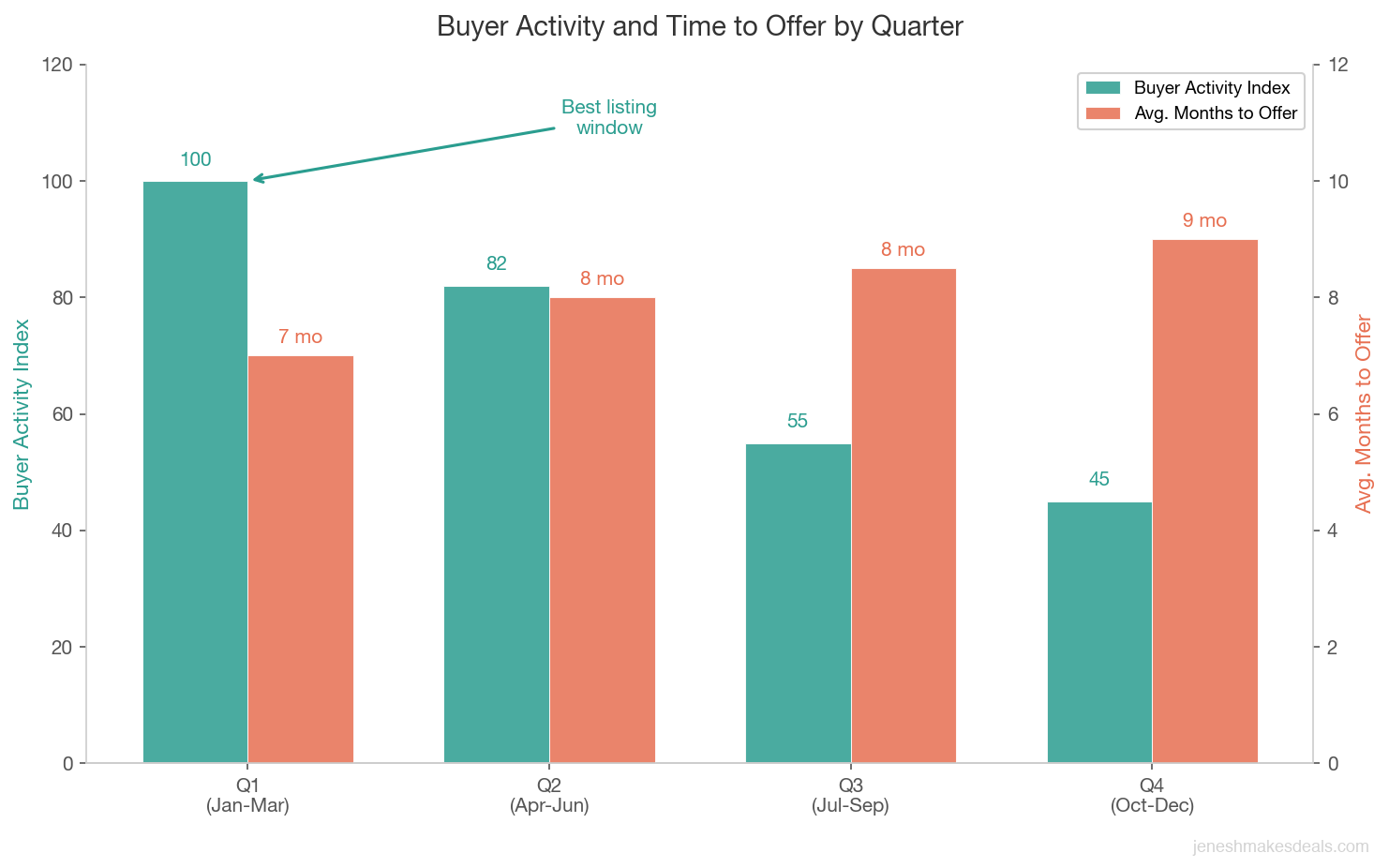
This is the best time to list a business for sale, full stop. Buyer activity surges after the new year. People who spent the holidays thinking about their next chapter are now ready to act. Search volume on BizBuySell for "businesses for sale" jumps 25 to 35% between December and January, according to the platform's own data. I see the same pattern in my inbox. January and February bring more qualified buyer inquiries than any other two month stretch.
Q2 (April through June): Still Strong
Q2 is the second best window. Buyers who started searching in Q1 are still active, and a fresh wave of spring buyers enters the market. SBA lenders are well into their fiscal year with plenty of budget to deploy. The weather is better, which sounds trivial but matters when buyers need to visit your business in person. Deals listed in Q2 tend to close before the summer slowdown.
Q3 (July through September): The Summer Slump
Things cool off in summer. Buyers go on vacation. Decision makers at larger companies are harder to reach. July and August are consistently the slowest months for new deal activity. I've seen listings sit for 6 to 8 weeks in the summer without a single serious inquiry, then get three offers in September when people come back from the beach. If you list in July, brace yourself for a slow start.
Q4 (October through December): The Holiday Drag
October can still produce deals, especially if you listed earlier in the year and a buyer is trying to close before year end. But November and December are rough for new listings. Buyers are distracted by holidays, year end planning, and family obligations. Lenders slow down. Accountants are buried in tax prep. The entire ecosystem takes its foot off the gas.
| Quarter | Buyer Activity | SBA Lending Climate | Avg. Time to Offer | Seller Recommendation |
|---|---|---|---|---|
| Q1 (Jan to Mar) | Highest of the year (+25 to 35% search volume) | Fresh budgets, hungry lenders | ~7 months | Best window to list |
| Q2 (Apr to Jun) | Strong, carries Q1 momentum | Active, mid fiscal year | ~8 months | Second best window |
| Q3 (Jul to Sep) | Low, summer vacations slow activity | Tightening as lenders near annual caps | ~8 to 9 months | Avoid unless seasonal peak |
| Q4 (Oct to Dec) | Declining, holidays distract buyers | Year end pipeline focus, few new originations | ~9 months | Worst for new listings |
Want to see where your business stands before choosing a listing date? Use our free valuation calculator to get a realistic price range based on your industry's SDE multiples.
Why January Through March Is the Prime Listing Window
Q1 doesn't win by accident. There are specific, structural reasons why the first quarter produces the most buyer activity and the best outcomes for sellers.
New year motivation is real. Every January, a wave of people commit to major life changes. For a meaningful percentage of them, that change is buying a business. The "new year, new career" effect is not just anecdotal. Google Trends data shows that search interest for "buy a business" peaks in January every single year and stays elevated through March.
Fresh budgets and fresh capital. Corporate buyers, private equity firms, and search fund operators all work on annual budgets. Those budgets reset on January 1 for most organizations. The first quarter is when they have the most capital to deploy and the most internal pressure to put it to work.
SBA lending cycles favor Q1. The Small Business Administration's fiscal year starts on October 1, but the real lending push happens in Q1 of the calendar year. SBA lenders have their annual targets, and they're hungry for deal flow in January and February. I've had lenders tell me directly that their approval rates are highest in Q1 because their teams are fully staffed, their budgets are fresh, and they haven't hit any internal caps yet.
Tax returns are done or nearly done. Buyers who need to show personal financial statements and tax returns to qualify for financing have their most recent documents ready by February or March. This removes one of the biggest bottlenecks in the buyer qualification process. When I list a business in January, buyers can get prequalified faster because their financial paperwork is current.
Year end financials are available. If you list in January or February, you can present buyers with a complete set of year end financials. Buyers love seeing 12 full months of data. Listing in the middle of the year means your most recent complete financials are from the prior year, and buyers will want to see partial year numbers that may not tell the full story.
Broker insight: I tell every seller the same thing: January is when the serious buyers show up. The people browsing listings in January aren't casually curious. They made a decision over the holidays and they're ready to write checks. That's exactly the buyer pool you want competing for your business.
The Worst Times to List and Why
If Q1 is the prime window, late November through December is the dead zone. Here's why.
Late November through December is the absolute worst time to bring a new listing to market. Buyers are shopping for holiday gifts, not businesses. Decision makers are out of the office. Lenders are focused on closing existing pipelines, not originating new loans. I once listed a highly profitable landscaping company on December 3. We got exactly two inquiries in four weeks. We pulled the listing, relisted on January 8, and had seven inquiries in the first ten days.
August is the second worst month. Families are squeezing in last vacations before school starts. Business owners who might be buyers are dealing with their own seasonal demands. The market isn't dead in August, but it's sluggish enough that I actively discourage sellers from launching new listings unless there's a compelling reason to move fast.
The numbers back this up. According to BizBuySell's annual insight reports, businesses listed in Q1 sell 15 to 20% faster on average than those listed in Q4. The median time from listing to accepted offer drops from roughly 9 months for Q4 listings to about 7 months for Q1 listings. That's two months of carrying costs, stress, and uncertainty that you avoid by timing your listing right.
Does timing feel complicated? You don't have to figure this out alone. Reach out for a free consultation and I'll help you map out the ideal listing timeline for your specific situation.
How Seasonal Businesses Should Time Their Listing
If your business has significant seasonal variation in revenue, the standard calendar advice gets flipped on its head. The golden rule for seasonal businesses is simple: list when your numbers look their best.
A landscaping company that does 60% of its annual revenue between April and August should list in May or June, right when the trucks are rolling and the revenue is pouring in. A buyer who tours the operation during peak season sees a thriving business. A buyer who visits in January sees idle equipment and a skeleton crew.
A retail store that depends on holiday sales should list in January or February, right after posting its strongest quarter. The Q4 numbers are fresh, the P&L looks fantastic, and buyers can see the upside clearly.
An ice cream shop or seasonal food business should list in early summer when foot traffic is at its peak. Buyers are emotional creatures, even the analytical ones. Walking into a packed shop on a Saturday afternoon creates a very different impression than walking into an empty one on a Tuesday in February.
A tax preparation firm should list in May or June, right after tax season ends and the year's revenue picture is clear.
The principle is always the same: buyers make decisions based on what they can see and verify. Listing during your peak season lets them see your business operating at its best, which translates directly into higher offers and faster closes.
Here's the tension though. Listing during peak season means you're managing the sale process during your busiest time of year. That's exactly why having a broker handle the process is so valuable for seasonal businesses. You focus on running the business and keeping the numbers strong. I focus on finding and qualifying buyers.
Key takeaway: For seasonal businesses, the worst mistake you can make is listing during your off season because "you have more free time." Buyers need to see your business at its best. A packed restaurant, a full service schedule, a buzzing retail floor. That first impression sets the anchor for every negotiation that follows.
Tax Year Considerations: Why Clean Year End Financials Matter
Buyers and their lenders care deeply about your financial records. The cleanliness and completeness of your financials directly affects how much a buyer will pay and whether they can get financing.
The ideal scenario is listing your business with 3 full years of clean tax returns plus year to date financials. If you list in March 2026, you can present 2023, 2024, and 2025 tax returns along with January and February 2026 P&L statements. That's a clean, complete financial picture that makes buyers and lenders comfortable.
Listing mid year creates gaps. If you list in September 2026, your most recent tax return is from 2025. Buyers will want to see 2026 year to date numbers, but those only cover January through August. Lenders will scrutinize those partial year numbers more heavily, and any dip in performance (even a seasonal one) will raise red flags.
Clean books are non negotiable. I've seen deals fall apart because the seller's QuickBooks was a mess. Comingled personal and business expenses, inconsistent categorization, missing months of data. These issues take months to fix and they destroy buyer confidence. If your books aren't clean, that's the first thing to address, regardless of when you plan to list.
The tax return timing trap. Many business owners file extensions and don't complete their tax returns until October. If you're planning a Q1 listing, make sure your CPA has the prior year returns done by January. Nothing stalls a deal faster than a buyer requesting tax returns and hearing "we filed an extension."
Thinking about selling in the next year or two? Start getting your financials in order now. Talk to us about a pre sale financial review so there are no surprises when you go to market.
SBA Lending Cycles and How They Affect Your Timeline
About 75% of small business acquisitions under $5 million involve SBA financing. That means the SBA lending environment directly impacts your buyer pool and your deal's chances of closing.
The SBA fiscal year runs from October 1 to September 30. Lenders receive their annual SBA lending authority at the start of each fiscal year. In practical terms, this means lender appetite for SBA deals is highest from October through June and starts to tighten in July through September as lenders approach their caps.
Q1 of the calendar year (January through March) is the lending sweet spot. Lenders have had a few months to settle into their new fiscal year allocations. Their teams are fully staffed after the holidays. Pipeline from the prior year has cleared. They're actively looking for new deals to fund.
End of quarter push works in your favor. SBA lenders, like all financial institutions, have quarterly targets. If you're in negotiations in March, June, or September, the lender may push harder to get your deal closed before quarter end. I've seen lenders expedite approvals by a week or more when a deal is close to closing near a quarter boundary.
Rate environment matters too. SBA 7(a) loan rates are tied to the prime rate plus a spread. As of early 2026, SBA loan rates sit around 10.5 to 11% for most small business acquisitions. Buyers are rate sensitive. When rates are stable or declining, buyer activity increases. When rates spike, some buyers sit on the sidelines.
The practical takeaway: if you list in January and accept an offer in March, the SBA lending environment is about as favorable as it gets. Your buyer has the best chance of getting approved quickly and at a competitive rate, which means your deal has the best chance of actually closing.
Industry Specific Timing: When to List Based on Your Business Type
Different industries have different rhythms. Here's what I recommend based on the businesses I work with most frequently.
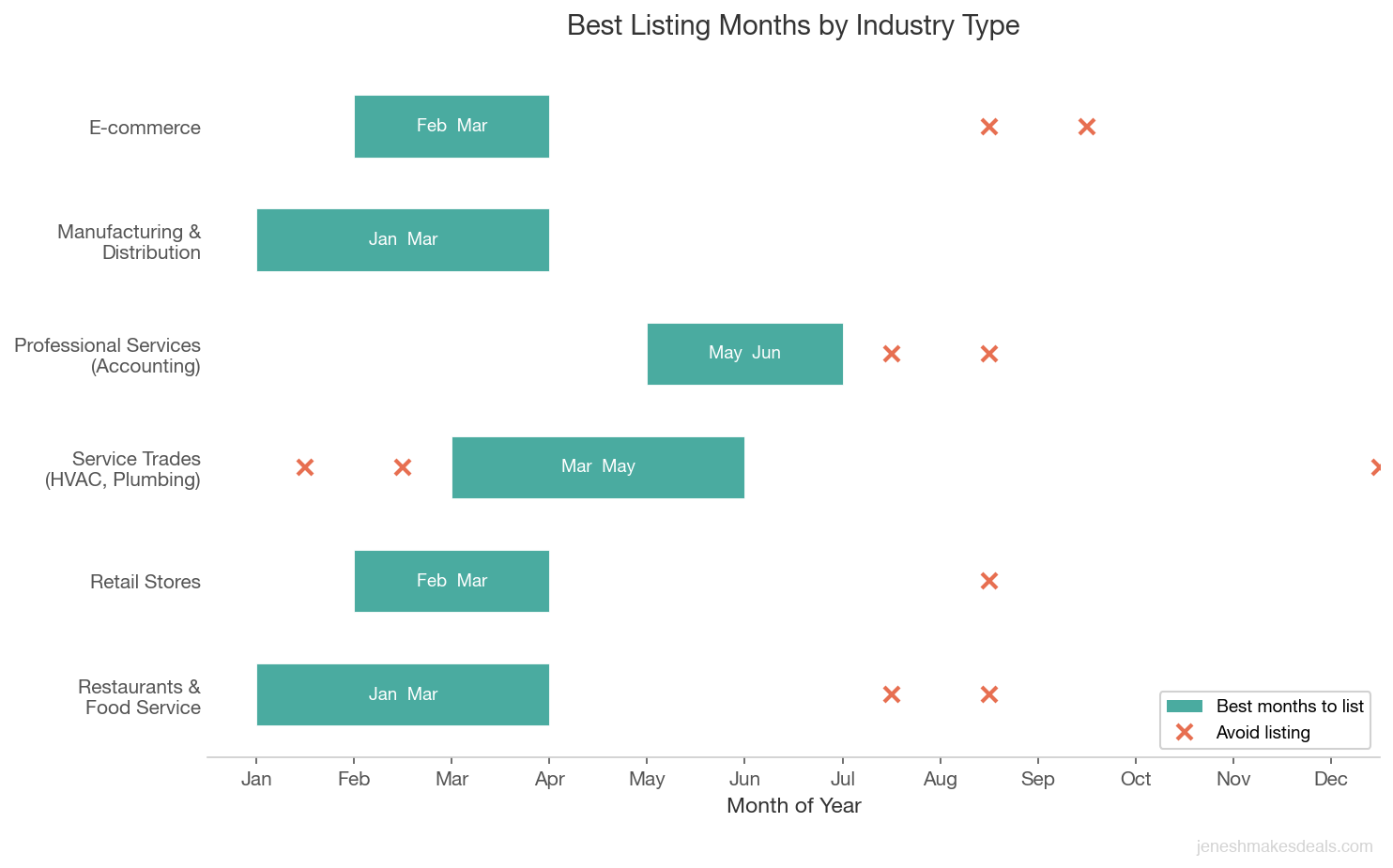
Restaurants and food service should list in January through March. Holiday season (November and December) is typically a restaurant's strongest period. Listing in January means you're presenting a business with fresh, strong Q4 numbers. Buyers see the holiday revenue and project that forward. Avoid listing a restaurant in the summer unless it's a seasonal concept that peaks in warm months.
Retail businesses should list in February or March, right after the holiday quarter. Q4 numbers for retail are usually the strongest of the year, and listing immediately after gives buyers the most favorable financial snapshot. Listing a retail business in August, when summer sales are typically weakest, is a common seller mistake.
Service businesses (HVAC, plumbing, electrical, landscaping) should list in spring. March through May is ideal. These businesses are entering their peak season, and buyers can see the phone ringing and the schedule filling up. An HVAC company that lists in March has summer revenue ahead of it, which makes the business look like an appreciating asset rather than a depreciating one.
Professional services (accounting firms, consulting practices, agencies) can list almost any time, but Q1 is still preferred because of the general market dynamics I described earlier. The exception is accounting firms, which should list after tax season wraps up in May or June.
Manufacturing and distribution businesses are less seasonally sensitive, but Q1 still wins because of buyer and lender activity cycles. If your manufacturing business has a slow period, avoid listing during it. Present the business when the production floor is busy and orders are flowing.
E commerce businesses should list in February or March, right after their strongest quarter (Q4 holiday sales). The trailing twelve month numbers will include holiday revenue, which inflates the SDE and supports a higher asking price.
| Business Type | Best Months to List | Why This Window Works | Avoid Listing In |
|---|---|---|---|
| Restaurants and food service | January to March | Fresh Q4 holiday revenue on the books | Summer (unless seasonal concept) |
| Retail stores | February to March | Strongest Q4 sales numbers just posted | August (weakest seasonal sales) |
| Service trades (HVAC, plumbing, landscaping) | March to May | Entering peak season, buyers see full schedules | Winter off season |
| Professional services (accounting, consulting) | January to March (accounting: May to June) | General market strength; accounting firms show full tax season results | Mid year with stale financials |
| Manufacturing and distribution | January to March | Buyer and lender cycles peak; less seasonal sensitivity | During production slow periods |
| E commerce | February to March | Trailing twelve months includes Q4 holiday sales | Late summer before holiday inventory buildup |
Want help figuring out the right timing for your specific industry? Schedule a free consultation and I'll map out a customized timeline.
The Preparation Timeline: Start 6 to 12 Months Before Your Target List Date
Here's what most sellers get wrong: they decide to sell on a Tuesday and want to be on the market by Thursday. Selling a business well requires preparation, and that preparation should start 6 to 12 months before your target listing date.
12 months before listing:
- Get a professional business valuation or at minimum run the numbers through a valuation calculator to understand your price range
- Start cleaning up your financials. Separate personal expenses from business expenses. Make sure your QuickBooks or accounting software is accurate and up to date
- Identify any customer concentration issues (if one client is 30%+ of revenue, start diversifying)
- Document your standard operating procedures. Buyers pay more for businesses that can run without the owner
9 months before listing:
- Fix any deferred maintenance. That broken sign, the leaky roof, the outdated equipment. Buyers notice everything, and deferred maintenance gives them ammunition to negotiate down
- Resolve any legal issues. Outstanding lawsuits, unresolved tax matters, expired licenses. Clean these up now
- Strengthen your management team. If you're the only person who knows how everything works, start cross training employees
6 months before listing:
- Finalize your asking price with your broker
- Prepare your confidential information memorandum (the "CIM" or selling prospectus)
- Get your last full year's tax returns completed if they aren't already
- Brief your attorney and CPA that a sale is coming so they're ready to move when you need them
3 months before listing:
- Finalize all marketing materials
- Build your target buyer list
- Ensure all contracts, leases, and agreements are current and transferable
- Do a final review of your financials with your broker
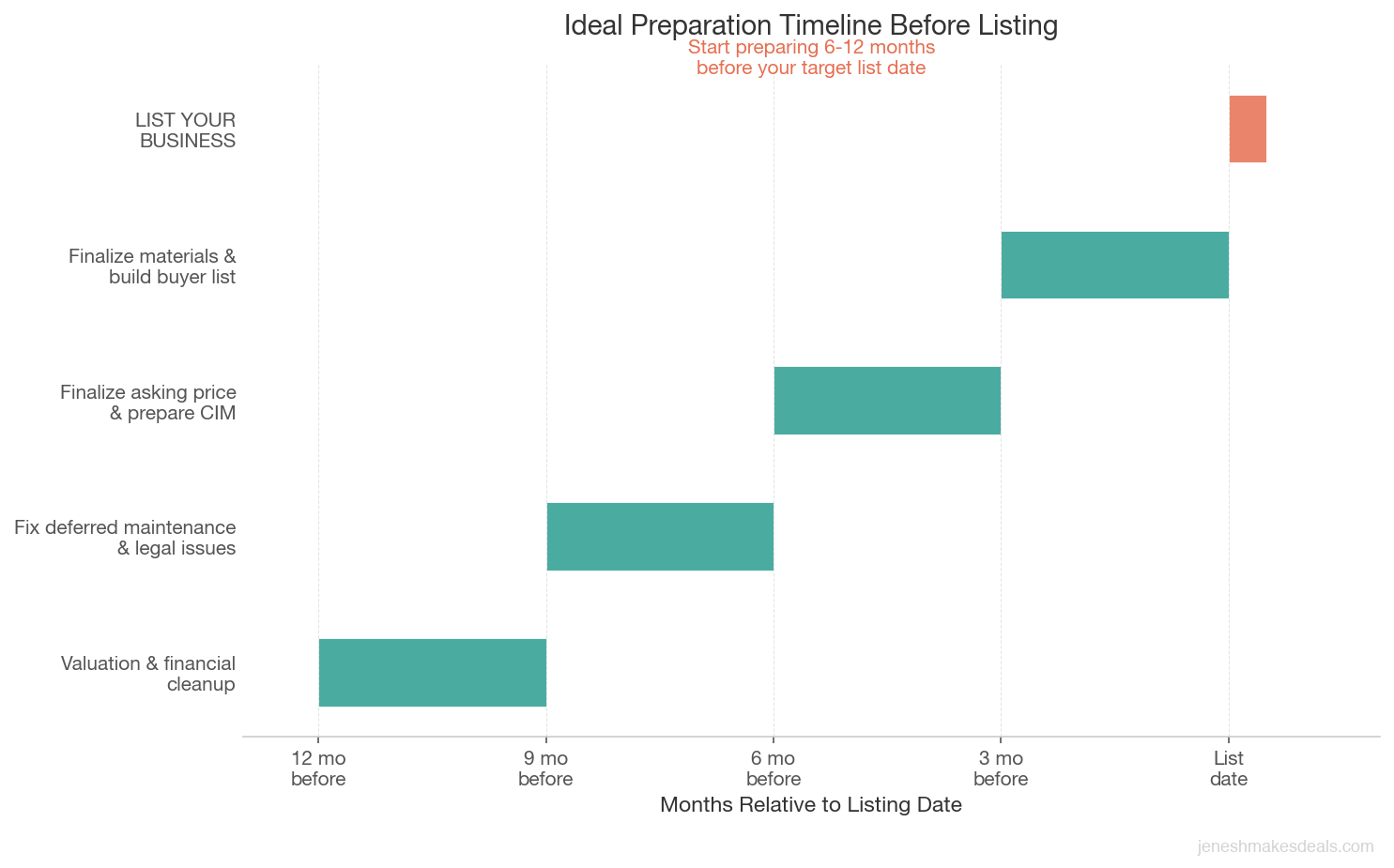
This timeline might feel aggressive, but every week of preparation saves you multiple weeks during the sale process. Buyers can smell an unprepared seller, and they'll either walk away or use your lack of preparation as a reason to offer less.
What Matters More Than Timing: Business Readiness
I need to be honest about something. Timing is important, but it's not the most important factor in selling your business successfully. Business readiness beats timing every single time.
I've sold businesses in August that closed above asking price because the owner spent a year getting ready. And I've had January listings sit for six months because the seller's books were a disaster and the business was too dependent on the owner.
Here's what matters most, in order:
1. Clean, accurate financials. This is the single biggest factor in whether your business sells and at what price. Buyers need to trust your numbers. Lenders need to verify them. If your P&L has unexplained line items, your revenue doesn't match your tax returns, or your expenses are a jumbled mess, you're going to struggle regardless of when you list. I've had deals die because the seller's reported SDE was $400,000 but their tax returns showed $280,000. That discrepancy is a deal killer.
2. Owner independence. Buyers are terrified of buying a business that falls apart when the owner leaves. If you are the business, meaning you handle every major client relationship, make every operational decision, and hold all the institutional knowledge, your business is worth less. The best thing you can do before selling is make yourself replaceable.
3. Documented processes. Standard operating procedures, employee handbooks, training materials, vendor contact lists, customer onboarding workflows. Documentation turns a "job" into a "business" in the eyes of a buyer. Businesses with documented processes sell for 10 to 25% more than equivalent businesses without them.
4. Stable or growing revenue. A business with flat or growing revenue is dramatically easier to sell than one in decline. If your revenue has dropped for two consecutive years, most buyers will pass regardless of your explanation. If you're in a downturn, it may be worth waiting until you can show at least two quarters of growth before going to market.
5. A realistic asking price. Overpriced businesses don't sell. They sit on the market for months, develop a reputation as stale listings, and eventually sell at a discount after the seller gets desperate. I'd rather list a business at a fair price in January and close in four months than list it at a fantasy price and watch it languish for a year.
Warning for sellers: A perfectly timed listing cannot save a business that isn't ready to sell. I've seen owners rush to list in January because they read that Q1 is the best window, only to fall apart in due diligence because their books were a mess. Spend the time getting your financials clean and your operations documented. Missing the "perfect" window by a month or two is far better than entering it unprepared.
Not sure if your business is ready? Let's talk through it. A 30 minute conversation can save you months of frustration.
Putting It All Together: Your Ideal Listing Strategy
Based on everything I've covered, here's the playbook I recommend to most of my clients:
Start preparing in the spring or summer of the year before you want to sell. Use Q2 and Q3 to clean up financials, document processes, fix deferred maintenance, and get a valuation.
Complete your year end financials by mid January. Work with your CPA to get the prior year's books closed and tax returns filed (or at least drafted) as early as possible.
List in late January or February. This puts you in the market during the strongest buyer activity window, with fresh year end financials, in the sweet spot of SBA lending cycles.
Aim to accept an offer by April or May. A Q1 listing with strong marketing and proper preparation should generate serious buyer interest within 60 to 90 days.
Target a summer close. With an offer accepted in spring, the due diligence, financing, and legal process typically takes 60 to 90 days. That puts your closing in the June through August range, giving the buyer the rest of the year to transition into ownership.
The exception: If your business is seasonal, adjust this timeline so that your listing window overlaps with your strongest revenue months. And if your business isn't ready, don't force a January listing just because the calendar says it's optimal. A well prepared business listed in April will outperform a poorly prepared business listed in January every time.
The Bottom Line
The best time to list your business for sale is January through March, when buyer activity peaks, SBA lending is most favorable, and fresh year end financials make your business easy to evaluate. The worst time is late November through December, when the entire market takes a holiday break.
But timing alone won't sell your business. Clean financials, documented processes, owner independence, and a realistic price are what actually drive successful exits. The smartest sellers start preparing 6 to 12 months before they want to go to market, which means if you're targeting a Q1 2027 listing, the time to start preparing is right now.
I've helped sellers time their exits in every season and every market condition. The ones who plan ahead, get their house in order, and list strategically consistently get better outcomes than those who wing it.
Ready to figure out your ideal listing timeline? Schedule a free consultation and we'll build a plan specific to your business, industry, and goals.
Curious what your business might be worth? Run the numbers through our free valuation calculator to get a starting point before we talk.
Related Articles
April 16, 2026
Preparing Your Business for Sale: The 12 Month Checklist
The best time to start preparing your business for sale is 12 months out. Here's exactly what to do each quarter.

April 12, 2026
How to Handle Multiple Offers on Your Business
Multiple offers are a great problem to have. But picking the wrong one can cost you months and thousands. Here's how to evaluate them.

April 3, 2026
How to Handle the Transition After Selling Your Business
The 30 to 90 days after closing can make or break the deal. Here's how to handle the transition smoothly.
About the Author
Jenesh Napit is an experienced business broker specializing in business acquisitions, valuations, and exit planning. With a Bachelor's degree in Economics and Finance and years of experience helping clients successfully buy and sell businesses, he provides expert guidance throughout the entire transaction process. As a verified business broker on BizBuySell and member of Hedgestone Business Advisors, he brings deep expertise in business valuation, SBA financing, due diligence, and negotiation strategies.
You might also be interested in
Free Business Calculators
Try our business valuation calculator and ROI calculator to estimate values and returns instantly.
How to Buy a Business Guide
Download our comprehensive free guide covering everything you need to know about buying a business.
Our Services
Explore our professional business brokerage services including valuations and buyer representation.
More Articles
Browse our complete collection of business brokerage insights and expertise.