

If you're selling your business, there's one clause that shows up in every single deal: the non compete agreement. I've never seen a buyer skip it. Not once.
And honestly, I get it. If you spent $800,000 buying a plumbing company, the last thing you want is the previous owner opening a competing shop two miles down the road and calling all their old customers. That would tank the value of what you just bought overnight.
But as the seller, you need to understand exactly what you're agreeing to. A non compete isn't just legal boilerplate. It's a real restriction on what you can do with the next chapter of your life. Sign the wrong one, and you could be locked out of the only industry you know for the better part of a decade.
Here's how to think about non competes when you're on the selling side of the table.
Why Every Buyer Demands a Non Compete
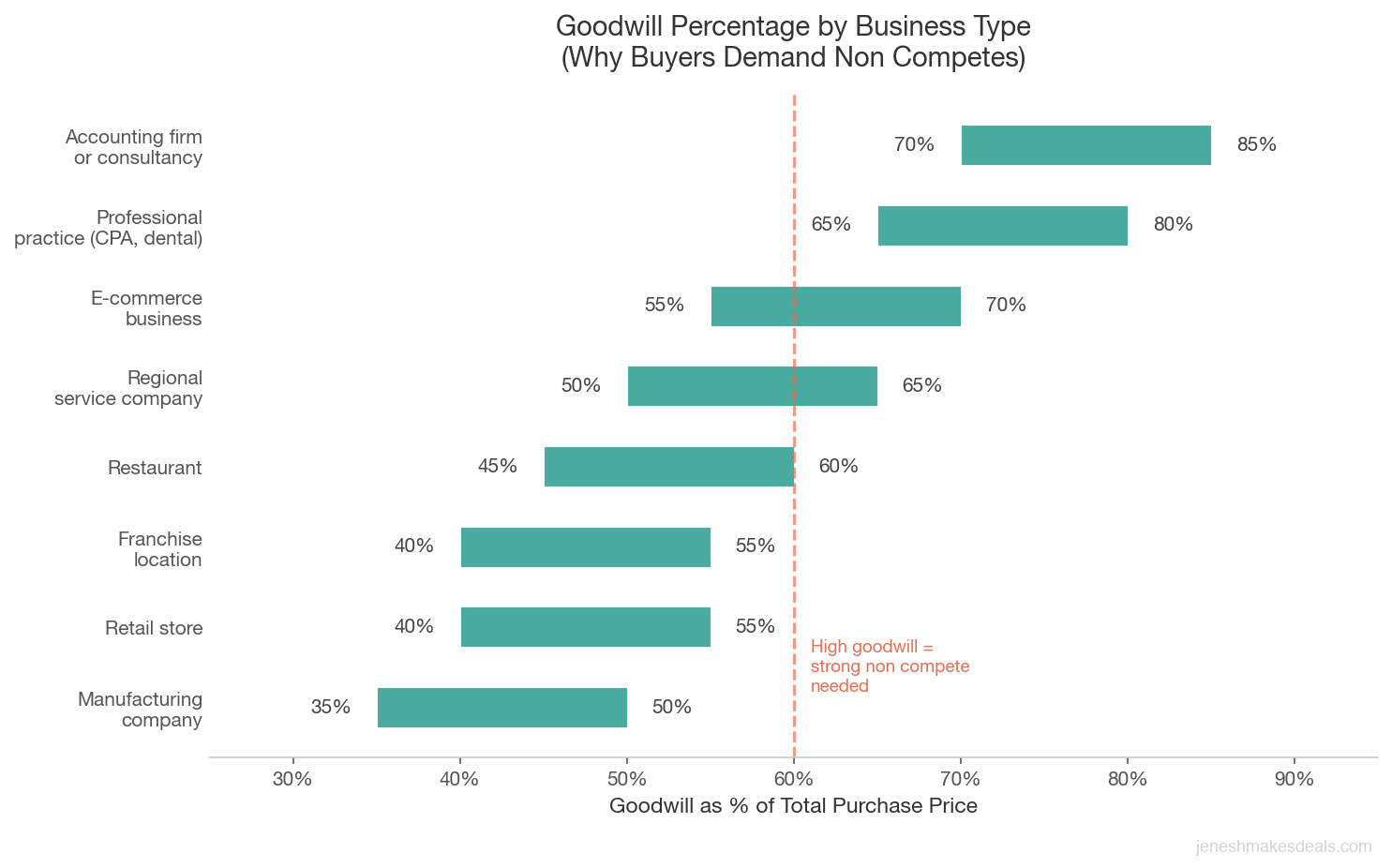
When someone buys your business, they're not just buying equipment, inventory, and a lease. They're paying for goodwill. That includes your reputation, your customer relationships, your brand recognition, and your competitive position in the market.
Goodwill often makes up 40% to 70% of a business's total purchase price. For a service business like an accounting firm or a landscaping company, goodwill can be 80% or more. The buyer is paying a premium because your customers already trust the business and keep coming back.
Without a non compete, all of that goodwill is at risk. You could take your 20 years of relationships, open up shop across the street, and pull half the customer base back to you within six months. The buyer would be left holding an overpriced shell.
I've had buyers tell me they'd rather pay 10% more for a business with a strong non compete than get a discount on a deal where the seller refuses to sign one. That tells you everything about how seriously buyers view this protection.
That's why no serious buyer will close a deal without one. If you're thinking about selling your business quickly, know that the non compete conversation is coming early.
What a Typical Non Compete Looks Like
A standard non compete in a business sale has three components: duration, geographic scope, and industry scope.
Duration is how long you're restricted. In most deals I work on, this ranges from 2 to 5 years. Three years is the most common. Five years happens in larger transactions or in industries where customer relationships take a long time to rebuild.
Geographic scope defines where you can't compete. For a local business like a restaurant or auto repair shop, this is usually a radius, anywhere from 10 to 50 miles from the business location. For a regional or national company, it might cover specific states or the entire country.
Industry scope specifies what activities are restricted. A well drafted non compete doesn't say "you can never work again." It says something like "you cannot own, operate, or manage a residential HVAC service company." The tighter the definition, the better for you as the seller.
Here's what a reasonable one looks like in practice: "Seller agrees not to directly or indirectly own, manage, or operate a commercial cleaning business within 30 miles of the business location for a period of 3 years following the closing date."
That's clear, specific, and limited. You know exactly what you can and can't do.
| Business Type | Typical Duration | Geographic Scope | Industry Scope Example |
|---|---|---|---|
| Local restaurant or retail shop | 2 to 3 years | 10 to 25 mile radius | Same cuisine or retail category |
| Regional service company | 3 to 5 years | Statewide or multi county | Same service line (e.g., commercial HVAC) |
| Professional practice (CPA, dental) | 3 to 5 years | 15 to 30 mile radius | Same professional specialty |
| E commerce or online business | 3 to 5 years | Nationwide or no geographic limit | Same product niche or market segment |
| Franchise location | 2 to 3 years | Territory defined by franchisor | Same franchise brand or direct competitor |
| Manufacturing company | 3 to 5 years | Statewide or regional | Same product type or end market |
The FTC Non Compete Ban and What It Means in 2026
You've probably heard about the FTC's push to ban non compete agreements. In 2024, the FTC issued a final rule that would have prohibited most non competes for employees nationwide. Courts blocked the rule, and the legal battle has continued into 2026.
But here's the part that matters if you're selling a business: the FTC's rule was never intended to apply to non competes tied to the sale of a business. The proposed rule included a specific exception for "a non compete clause that is entered into by a person pursuant to a bona fide sale of a business entity."
This distinction makes sense. An employee non compete restricts a worker's ability to earn a living. A business sale non compete protects a buyer's investment in a transaction where the seller is being compensated, often handsomely, for agreeing to the restriction.
So regardless of what happens with the FTC's broader push, non competes in business sales remain legal and enforceable in nearly every state. If anyone tells you that non competes are "banned now," they're confusing employment non competes with business sale non competes. Two completely different animals.
What's Reasonable and What's Not
Courts evaluate non competes based on reasonableness. If a non compete is too broad, a court may refuse to enforce it entirely or may narrow it to what the court considers reasonable.
Here's how I think about it:
Reasonable: A 3 year, 25 mile non compete for a local restaurant. The seller can't open another restaurant in the immediate market where customers would be likely to switch. After 3 years, enough time has passed for the buyer to establish their own relationships. Makes sense.
Probably reasonable: A 5 year, statewide non compete for a $3 million managed IT services company with clients throughout the state. The longer term and broader geography match the scope of the business and the size of the transaction.
Likely unenforceable: A 10 year, nationwide non compete for a single location dry cleaning business that does $400,000 in annual revenue. No court is going to tell you that you can't operate a dry cleaner in a different state, 2,000 miles away, because you sold one location in Ohio.
The general rule is that the scope of the non compete should match the scope of the business being sold. A local business gets a local non compete. A national business might justify a national restriction. The duration should be long enough to protect the buyer's investment but not so long that it amounts to a permanent ban on working in your industry.
Need help figuring out what your business is worth? Use our free business valuation calculator to get a quick estimate.
How Non Competes Affect Your Sale Price
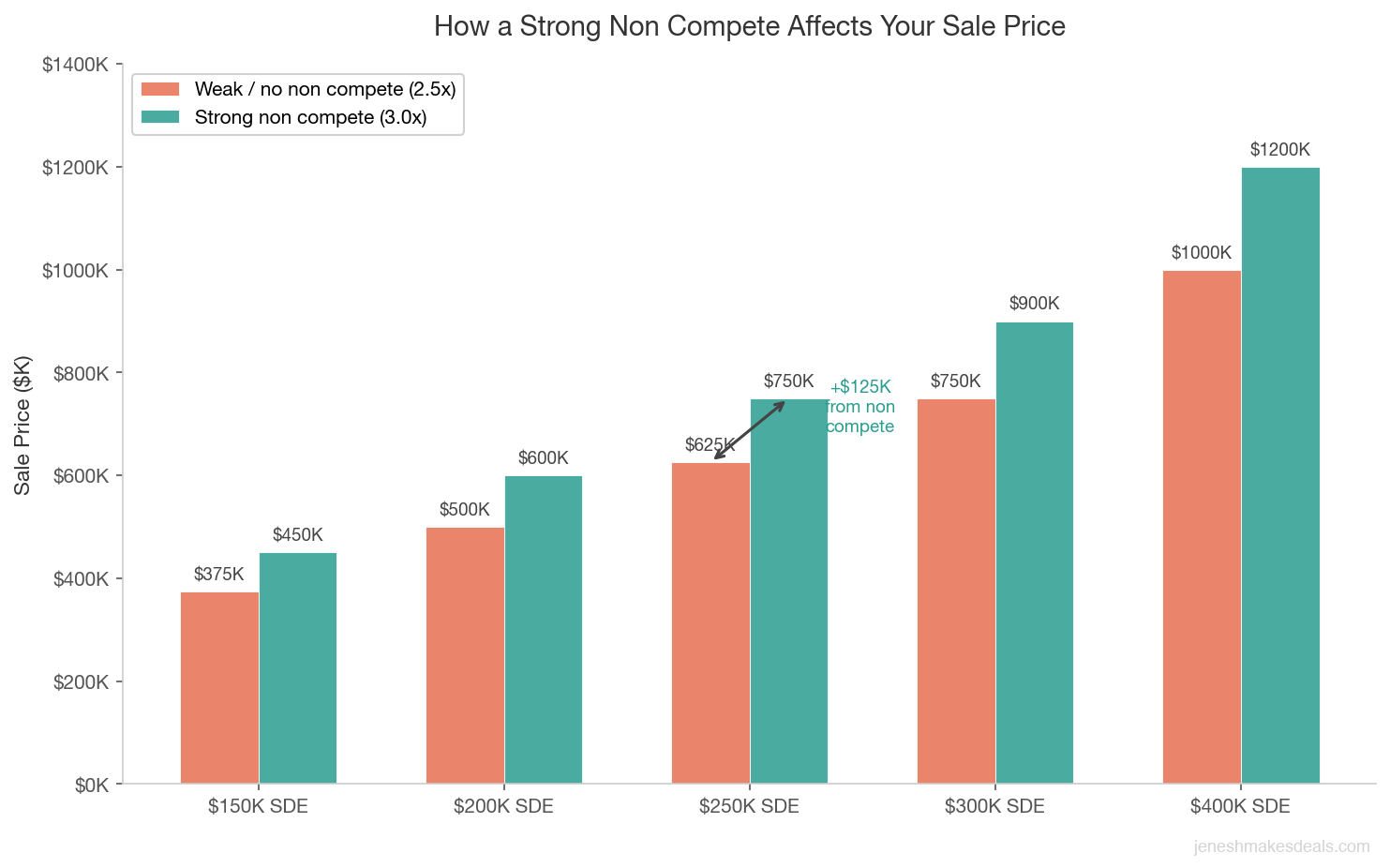
This is something a lot of sellers don't think about: the non compete is priced into the deal. Buyers factor in the strength of the non compete when they decide what they're willing to pay.
A buyer who's getting a solid 3 year, 30 mile non compete knows their investment is protected. They're willing to pay a higher multiple because the risk of the seller competing is off the table. That might mean a 3.0x SDE multiple instead of a 2.5x.
On a business earning $250,000 in seller's discretionary earnings, that's the difference between a $750,000 sale price and a $625,000 sale price. The non compete is worth $125,000 to you in this example.
A seller who refuses any non compete entirely is sending a signal to buyers. That signal is: "I might come back and compete with you." Buyers respond by either lowering their offer significantly or walking away from the deal altogether. I've seen both happen.
In some deal structures, especially when there's an earnout agreement, the non compete becomes even more critical. If the seller's future payments depend on the business hitting revenue targets, the buyer needs assurance that the seller isn't undermining those results by competing.
The bottom line: a reasonable non compete costs you very little in terms of real world freedom, but it can be worth tens or hundreds of thousands of dollars in purchase price.
Think of the non compete as part of the purchase price, not separate from it. Sellers who negotiate the non compete and the price together almost always walk away with a better overall deal than sellers who treat them as two unrelated conversations.
Negotiating the Terms
You don't have to accept the first non compete a buyer puts in front of you. In fact, you shouldn't. The first draft almost always favors the buyer, and it's expected that you'll push back.
Here's what I advise sellers to negotiate:
Narrow the geographic scope. If the buyer's first draft says "within 100 miles," ask for 25 or 30. If the business only serves customers within a 15 mile radius, there's no reason the non compete should extend to 100 miles.
Shorten the duration. If the buyer asks for 5 years, counter with 3. Most customer relationships will have transitioned fully within 2 to 3 years. Anything beyond 5 years is almost always excessive for a small to mid size business.
Define "competing business" precisely. This is where sellers get burned most often. A vague non compete that says "any business in the food service industry" could prevent you from investing in a food truck, opening a catering company, or even consulting for a restaurant chain. Push for specific language: "a sit down restaurant serving Italian cuisine" is much narrower than "food service business."
Carve out exceptions. Common carve outs include passive investments (owning less than 5% of a publicly traded company in the same industry), consulting in unrelated industries, and work as an employee (not an owner) in a different market. These carve outs give you flexibility without threatening the buyer's investment.
Tie it to the closing. If the deal falls apart or the buyer defaults on an asset sale vs stock sale agreement, the non compete shouldn't survive. Make sure the non compete is contingent on the sale actually closing and the buyer making good on their financial obligations.
All of this gets discussed during the letter of intent phase and finalized in the purchase agreement. Don't wait until closing day to raise these issues.
State by State Enforceability
Not all states treat non competes the same way, and this matters a lot when you're structuring a deal.
California is the big outlier. California Business and Professions Code Section 16600 generally prohibits non competes, but Section 16601 creates an exception for "any person who sells the goodwill of a business." So non competes in business sales are enforceable in California, but they need to be carefully drafted to fit within the statutory exception. The scope must be limited to the geographic area where the business was conducted.
Oklahoma and North Dakota have historically been hostile to non competes, though both have some allowance for business sale contexts.
Texas enforces non competes in business sales but requires that the restrictions be reasonable in time, geographic area, and scope of activity.
Florida is generally favorable to enforcing non competes, including in business sales. Florida law even creates a presumption of reasonableness for non competes of 2 years or less.
New York enforces them but courts will narrow overly broad restrictions rather than throw them out entirely.
The state that matters is usually the state where the business operates, not where you or the buyer live. If you're selling a business in Georgia but you live in Colorado, Georgia law will likely govern the non compete. This is something your attorney should address early in the process.
Ready to talk about selling? Contact us for a free consultation and we'll walk you through your options.
Non Solicitation vs Non Compete
Here's a distinction that doesn't get enough attention: a non solicitation agreement and a non compete agreement are two different things, and sometimes a non solicitation is actually more valuable to the buyer than a full non compete.
A non compete says: "You cannot own or operate a competing business within X miles for Y years."
A non solicitation says: "You cannot contact or solicit the customers or employees of the business you sold for Y years."
For many businesses, the customer relationships are the real asset. A non solicitation directly protects those relationships without broadly restricting the seller's career. If you sold a marketing agency and a non solicitation prevents you from reaching out to your former clients, the buyer's revenue is protected even if you start a new agency in the same city.
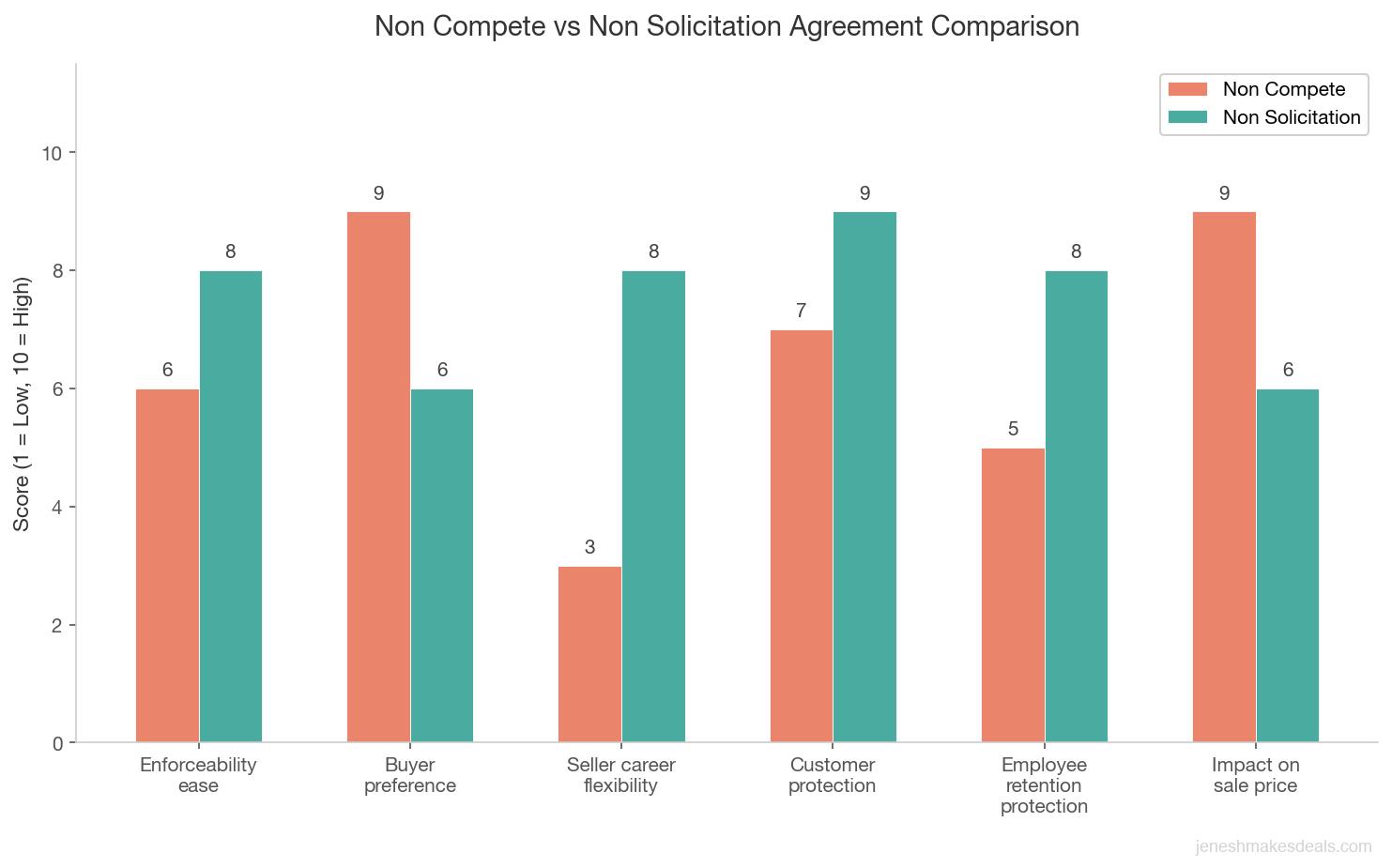
Some sellers prefer to negotiate a non solicitation in place of a non compete, or at minimum, to pair a shorter non compete with a longer non solicitation. For example: a 2 year non compete and a 5 year non solicitation of customers and employees.
Buyers often agree to this because the non solicitation protects what they actually care about, which is keeping the customers and staff. Many deals I've worked on end up with both clauses in the final agreement.
| Factor | Non Compete | Non Solicitation |
|---|---|---|
| What it restricts | Owning or operating a competing business | Contacting customers or recruiting employees |
| Typical duration | 2 to 5 years | 3 to 5 years |
| Geographic limit | Defined radius or region | Usually none (applies to specific people, not areas) |
| Impact on seller's career | Broad restriction on working in the same industry | Narrow restriction, seller can start a similar business |
| Enforceability | Varies by state, must be reasonable in scope | Generally easier to enforce because the scope is narrower |
| Best for protecting | Market position and competitive advantage | Customer relationships and employee retention |
| Common pairing | 2 to 3 year non compete paired with longer non solicitation | 5 year non solicitation paired with shorter non compete |
What Happens If You Violate a Non Compete
I've seen sellers sign non competes and then assume nobody will enforce them. That's a bad bet, especially in the context of a business sale.
Here's what a buyer can do if you violate the non compete:
Injunctive relief. The buyer can go to court and get an injunction forcing you to shut down the competing business immediately. Courts grant injunctions in business sale non compete cases more readily than in employment cases because the seller received significant consideration (the purchase price) in exchange for the restriction. This can happen fast, sometimes within weeks.
Monetary damages. The buyer can sue for the profits they lost because of your competition. If the buyer can show that revenue dropped by $200,000 after you opened a competing business, you could be on the hook for that amount plus legal fees.
Clawback of purchase price. Some purchase agreements include a clawback provision tied to the non compete. If you violate the non compete, the buyer can claw back a portion of the purchase price, sometimes a significant portion. This is especially common when part of the purchase price was allocated to the non compete itself.
Extended restriction period. In some states and under some agreements, the non compete clock pauses during any period of violation. So if you violate the non compete in year 2 of a 3 year restriction, you might end up with 4 or 5 years of total restriction.
The point is simple: courts take business sale non competes seriously because both parties entered the agreement voluntarily, and the seller was paid for the restriction. Violating one is a real legal and financial risk.
How to Protect Yourself as the Seller
Being strategic about the non compete doesn't mean fighting it. It means making sure the terms are fair and that you understand what you're agreeing to.
Hire an attorney before you sign anything. Not your cousin who does real estate closings. A business attorney who has experience with mergers and acquisitions. They'll catch overly broad language, missing carve outs, and enforceability issues. The $3,000 to $5,000 in legal fees is nothing compared to the cost of being locked into a bad non compete for 5 years.
The most expensive mistake I see sellers make is signing a non compete without reading it carefully. I worked with one seller who didn't realize his agreement prevented him from consulting in the same industry. He lost two years of potential income before his attorney got the clause narrowed. Always read every word.
Think about what you actually want to do after the sale. If you're selling because you're retiring to Florida and never want to think about work again, a broad non compete costs you nothing. If you're 45 years old and you're planning to start another business, you need to negotiate carefully. The emotional side of selling a business is real, and your post sale plans should drive how you approach the non compete.
Negotiate the non compete at the same time as the purchase price. The non compete is part of the deal, not an afterthought. If the buyer wants a 5 year, 50 mile non compete, that's fine, but the purchase price should reflect the value of that restriction. Everything is connected.
Get a clear start date. The non compete should start on the closing date, not on the date the purchase agreement is signed. If there's a 90 day gap between signing and closing, you don't want the non compete clock running before you've even received your money.
Consider the tax implications. In many deals, a portion of the purchase price is allocated to the non compete agreement. This allocation has tax consequences. Payments allocated to a non compete are treated as ordinary income, not capital gains. Your CPA should be part of this conversation to make sure the allocation works in your favor.
Putting It All Together
The non compete is one of the most important terms in any business sale. It protects the buyer's investment, and it directly affects how much that buyer is willing to pay. For you as the seller, it defines what you can and can't do for the next few years of your life.
Don't approach it as something to resist or avoid. Approach it as something to negotiate intelligently. Get the right advisors involved. Know what's standard in your industry and your state. And make sure the terms match the scope and size of the business you're selling.
A well negotiated non compete gives the buyer confidence, supports a higher sale price, and still leaves you with plenty of freedom to move on to whatever comes next.
Thinking about selling your business and want to understand how the deal terms work? Reach out for a free consultation. I'll help you think through the non compete, the valuation, and every other piece of the puzzle.
Want a quick estimate of what your business might sell for? Try our free business valuation calculator to see where you stand.
Related Articles

April 16, 2026
Preparing Your Business for Sale: The 12 Month Checklist
The best time to start preparing your business for sale is 12 months out. Here's exactly what to do each quarter.

April 12, 2026
How to Handle Multiple Offers on Your Business
Multiple offers are a great problem to have. But picking the wrong one can cost you months and thousands. Here's how to evaluate them.
April 9, 2026
Best Time of Year to List Your Business for Sale
Timing your listing right can mean more buyers, better offers, and a faster close. Here's what the data says about when to go to market.
About the Author
Jenesh Napit is an experienced business broker specializing in business acquisitions, valuations, and exit planning. With a Bachelor's degree in Economics and Finance and years of experience helping clients successfully buy and sell businesses, he provides expert guidance throughout the entire transaction process. As a verified business broker on BizBuySell and member of Hedgestone Business Advisors, he brings deep expertise in business valuation, SBA financing, due diligence, and negotiation strategies.
You might also be interested in
Free Business Calculators
Try our business valuation calculator and ROI calculator to estimate values and returns instantly.
How to Buy a Business Guide
Download our comprehensive free guide covering everything you need to know about buying a business.
Our Services
Explore our professional business brokerage services including valuations and buyer representation.
More Articles
Browse our complete collection of business brokerage insights and expertise.