

Most business owners who try to sell fast on their own end up doing one of two things: they slash the price to attract any buyer they can find, or they overprice it and sit on the market for a year wondering why nobody's calling.
Neither gets you where you want to be.
Here's what I've learned from working with sellers across New York and New Jersey: speed and price aren't tradeoffs. The businesses that sell the fastest are also the ones that sell closest to (or above) asking price. That sounds backwards, but it makes sense when you understand what actually drives a fast sale.
A fast sale doesn't come from desperation pricing. It comes from putting the right business in front of the right buyers at the right price, with clean financials and a deal structure that makes it easy for them to say yes. That's exactly what a broker does.
Why Businesses Sit on the Market
Before we get into how to sell fast, it helps to understand why most businesses take 8 to 12 months to sell. It's usually one of these five things:
1. The price is wrong. Not just "too high." Sometimes it's too low, and buyers wonder what's wrong with it. The sweet spot is a price backed by real market data and comparable sales, not a number the owner pulled from thin air or what they "need" to retire.
2. The financials are a mess. Buyers and their lenders need to see clean profit and loss statements, tax returns, and a clear picture of seller's discretionary earnings (SDE). If a buyer's accountant can't make sense of your books in a few hours, they're moving on to the next deal.
3. The owner IS the business. If every customer relationship, vendor contact, and key decision runs through you, buyers see risk. They're not buying a business, they're buying a job that disappears the moment you leave.
4. The marketing is wrong. Listing your business on one website and hoping for the best isn't a strategy. The right buyer for your business might not be browsing listing sites. They might be in a broker's buyer database, or they might be a competitor, a PE group, or someone in an adjacent industry who doesn't even know your business is available.
5. The deal structure doesn't work. A buyer might love your business but can't make the numbers work with 100% cash at closing. If you're not open to SBA-compatible terms or some seller financing, you're cutting out a huge chunk of qualified buyers.
What "Fast" Actually Looks Like
Let's set realistic expectations. Here's what different timelines look like in the 2026 market:
| Timeline | What It Takes | Typical Scenario |
|---|---|---|
| 60 to 90 days | Pre-qualified buyers, clean financials, right price, broker with active buyer list | Best case for a well-prepared business |
| 90 to 180 days | Good fundamentals, some prep needed, standard marketing process | Most common for broker-assisted sales |
| 6 to 12 months | DIY sale, overpriced, messy financials, or niche business | What happens when you wing it |
| 12+ months | Serious problems: owner dependency, declining revenue, unrealistic price | Often leads to pulling the listing |
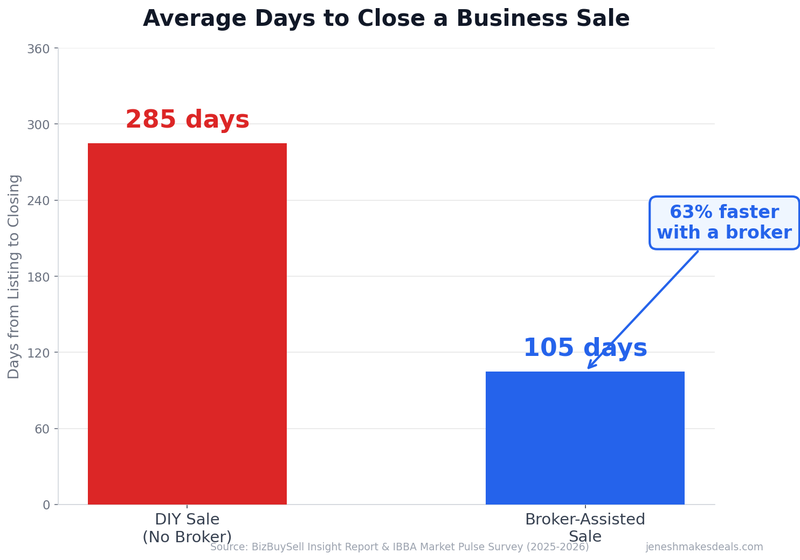
The average business sale in the US takes about 200 days. In New York and New Jersey, we're seeing closer to 160 to 180 days because of the deep buyer pool in the tri-state area. But the sellers who work with brokers and follow the process below are consistently closing in 90 to 120 days.
Curious where your business falls on this spectrum? Try our business sale timeline estimator to get a realistic estimate based on your specific situation.
The Fast-Sale Playbook: What Actually Works
Step 1: Get a Real Valuation (Week 1)
This is where most DIY sellers go wrong. They google "business valuation multiples," find a generic range, and slap a price on it.
A proper valuation looks at:
- Your adjusted SDE or EBITDA (not just what's on the tax return)
- Industry-specific multiples based on actual recent sales, not outdated averages
- Your specific strengths and weaknesses like customer concentration, recurring revenue, growth trend, and owner dependency
- Local market conditions because a restaurant in Manhattan sells at different multiples than the same restaurant in Albany
A broker does this valuation for free in most cases, and it's based on real deal data, not guesswork.
Why this speeds things up: A correctly priced business generates multiple inquiries in the first two weeks. An overpriced business generates silence. Every month you sit on the market at the wrong price, your business looks staler to buyers.
Step 2: Get Your Financials Deal-Ready (Weeks 1 to 2)
Buyers and SBA lenders want to see:
- 3 years of tax returns (2023, 2024, 2025)
- Year-to-date profit and loss statement for 2026
- Balance sheet
- SDE calculation with clear add-backs (owner salary, personal expenses run through the business, one-time costs)
- Accounts receivable and payable aging
If your bookkeeper has been sloppy, this is where things stall. I've seen deals fall apart 60 days in because the buyer's lender couldn't verify the numbers. Spending a few hundred dollars getting your books cleaned up before listing saves you months on the back end.
Pro tip: Have your CPA prepare a "quality of earnings" summary. It's not a full audit, but it gives buyers and lenders confidence in the numbers. This alone can shave 2 to 3 weeks off due diligence.
Step 3: Make the Business Transferable (Weeks 1 to 3)
Buyers want to know the business runs without you. The more you can show that, the faster they'll move:
- Document your processes. Even simple checklists for daily, weekly, and monthly operations show a buyer the business isn't just in your head.
- Strengthen your team. If you have a manager or key employee who could run things day to day, that's a huge selling point. Some sellers give a key employee a small retention bonus tied to the transition.
- Diversify your customer base. If one customer is more than 20% of revenue, that's a red flag. You may not be able to fix this overnight, but having a plan helps.
- Lock in your lease. A short-term lease or one that's about to expire scares buyers. If possible, negotiate a lease extension or option before listing.
Step 4: Work With a Broker Who Has Buyers Ready (Week 2)
This is the single biggest speed advantage a broker provides. A good broker doesn't list your business and wait for the phone to ring. They go to their buyer database first.
Here's the difference:
DIY seller: Lists on BizBuySell, maybe BusinessBroker.net. Waits for inquiries. Gets a mix of tire kickers, people who can't get financing, and maybe one or two real buyers over several months.
Broker-assisted seller: The broker matches your business to pre-qualified buyers in their database on day one. They reach out to buyers who have specifically said they're looking for businesses like yours, in your industry, in your price range, in your geography. Many brokers have relationships with PE groups and search fund operators who are actively looking to close deals.
I maintain a database of over 2,000 active buyers in the New York and New Jersey area. When a new listing comes in, I can usually identify 10 to 20 potential matches within the first week. That's 10 to 20 qualified conversations happening simultaneously, not one at a time over several months.
Step 5: Create Competition Among Buyers (Weeks 3 to 6)
This is where the "fast AND good price" part comes together. When multiple buyers are interested at the same time, several things happen:
- Buyers move faster because they know they're not the only one looking
- Offers come in higher because buyers compete on price and terms
- You have leverage to negotiate better deal structure (less seller financing, shorter training period, faster closing)
A single buyer negotiating against you will grind you down on price, ask for endless due diligence extensions, and try to retrade at the last minute. Three buyers negotiating against each other will give you their best offer quickly because they don't want to lose the deal.
This doesn't happen by accident. It happens because a broker controls the timing, releases information strategically, and sets deadlines for offers.
Step 6: Make It Easy to Finance (Ongoing)
About 80% of business acquisitions under $5 million involve SBA financing. If your business isn't set up for an SBA deal, you're automatically slower.
What makes a business "SBA-ready":
- Positive cash flow that covers debt service at 1.25x or better (meaning for every $1 in loan payments, the business generates $1.25 in cash flow)
- Clean tax returns that match your claimed SDE
- No major legal issues like pending lawsuits, environmental problems, or tax liens
- A reasonable price relative to cash flow (typically 2.5x to 4x SDE depending on industry)
- Willingness to stay for a training period (usually 30 to 90 days, which SBA lenders like to see)
When a buyer knows they can get SBA financing on your business, the timeline compresses because the financing isn't a question mark. SBA pre-qualified buyers can close in 45 to 60 days once they have a signed letter of intent.
Current SBA 7(a) rates in 2026: 10.5% to 13.0% depending on loan size and term. Use our SBA loan calculator to see what monthly payments look like for buyers at your asking price.
Step 7: Be Responsive During Due Diligence (Weeks 6 to 10)
More deals die in due diligence than at any other stage. The number one killer? Slow responses from the seller.
When a buyer or their lender asks for a document, get it to them within 24 to 48 hours. Every day of delay adds to the buyer's anxiety and gives them more time to talk themselves out of the deal or find another business.
A broker manages this process so you're not juggling requests from the buyer, their attorney, their accountant, and their lender all at once. They create a due diligence checklist upfront, collect everything in advance, and release it in an organized way. Check out our due diligence checklist tool to see what buyers typically request.
When You Need to Sell REALLY Fast
Sometimes you don't have 90 days. Health issues, partnership disputes, divorce, burnout, or a sudden relocation can create real urgency.
If you need to sell in 30 to 60 days, here's what changes:
Price aggressively but not desperately. Price at the lower end of fair market value, not below it. A 10% discount from market value will create urgency among buyers without making them wonder what's wrong with the business.
Offer seller financing. This is the fastest way to close because it removes the SBA timeline entirely. A deal with 50% seller financing and 50% cash can close in 2 to 3 weeks if both parties are motivated.
Target cash buyers and PE groups. SBA buyers need 45 to 60 days minimum for financing. Cash buyers and PE-backed buyers can close in 2 to 4 weeks. A broker knows who these buyers are.
Be flexible on terms. Longer training period? Earnout on future performance? Non-compete that the buyer wants? Say yes to the stuff that doesn't cost you money but makes the buyer feel secure.
Get a broker involved immediately. Even in a fire sale situation, a broker will get you a better outcome than selling on your own. Their buyer network alone is worth the commission when time is the priority.
The Broker Advantage: Why Speed and Price Go Together
Let me be direct about this: the biggest mistake sellers make when they want to sell fast is thinking they can save the broker's commission by doing it themselves.
Here's the math on a $500,000 business:
| Scenario | Sale Price | Commission | Time to Close | Net to Seller |
|---|---|---|---|---|
| DIY sale (no broker) | $420,000 (underpriced to sell fast) | $0 | 4 to 6 months | $420,000 |
| DIY sale (right price) | $500,000 | $0 | 8 to 14 months | $500,000 |
| Broker-assisted | $520,000 (multiple offers pushed price up) | $52,000 (10%) | 3 to 4 months | $468,000 |
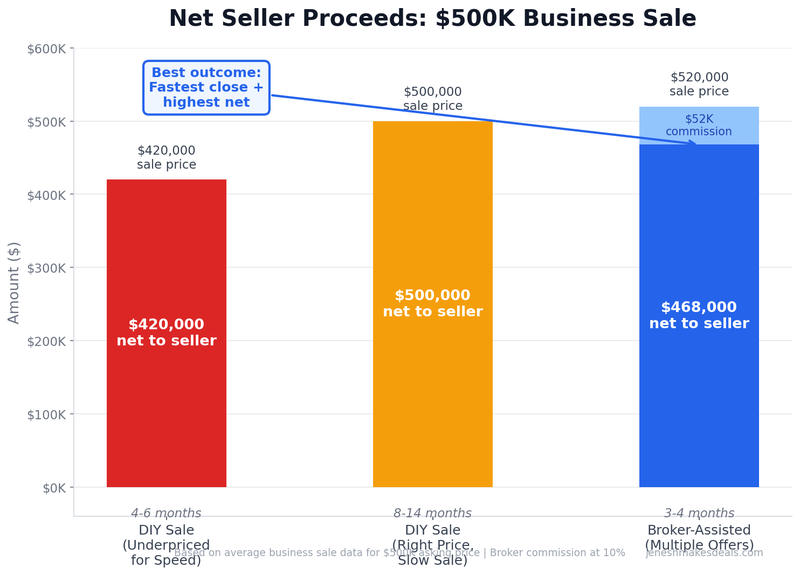
The broker-assisted sale nets the seller $48,000 more than the desperate DIY sale AND closes faster. And compared to the "right price" DIY sale, the seller nets slightly less but saves 5 to 10 months of their time, avoids the stress of managing the process, and maintains confidentiality.
That doesn't even account for the deals that fall apart when sellers manage the process themselves. About 50% of DIY business sales fall through before closing. With a broker, that number drops to about 20%.
Your 90-Day Fast Sale Timeline
Here's what the process looks like when you're working with a broker and everything is moving:
Week 1 to 2: Preparation
- Business valuation completed
- Financials organized and verified
- Marketing materials created
- Listing strategy determined
Week 2 to 4: Active Marketing
- Business matched to buyers in broker's database
- Listed on major platforms (confidentially)
- 10 to 20 buyer inquiries generated
- NDAs signed, information packages sent
Week 4 to 6: Offers and Negotiation
- Multiple buyer meetings or calls completed
- Letters of intent received
- Best offer selected and negotiated
- LOI signed
Week 6 to 10: Due Diligence and Closing
- Buyer conducts due diligence
- SBA financing (if applicable) processed
- Purchase agreement drafted and negotiated
- Closing and transition
Week 10 to 12: Transition
- Training period begins
- Customer and vendor introductions
- Systems and access transferred
What to Do Right Now
If you're reading this and thinking about selling, here's my honest advice:
Don't wait until you're desperate to start the process. The sellers who get the best outcomes (fast close AND strong price) are the ones who start planning 3 to 6 months before they want to be done.
Get a valuation first. It's free, it's confidential, and it tells you exactly where you stand. You might find out your business is worth more than you thought, or you might learn there are a few things to fix before listing that will add $100,000 or more to the sale price.
Talk to a broker, even if you're not ready. A 30-minute conversation will give you more clarity than weeks of googling. You'll learn what your business is worth, how long it might take to sell, what buyers in your industry are looking for, and what you can do now to position yourself for a fast, profitable exit.
I work with business owners across New York and New Jersey who want to sell on their terms, not out of desperation. If you're thinking about selling in 2026, let's talk. I'll give you a straight answer about your business, your timeline, and your options.
Planning your exit? Get our free Complete Guide to Selling Your Business in 2026 for a step by step walkthrough of the entire sale process, from valuation to tax planning.
Frequently Asked Questions
Can I really sell my business in 90 days?
Yes, but it depends on preparation. Businesses with clean financials, reasonable pricing, and a broker with an active buyer network regularly close in 60 to 90 days. The ones that take 12+ months usually have pricing, financial, or structural issues that could have been addressed before listing.
Will selling fast mean I get a lower price?
Not if you do it right. Selling fast with a broker who creates competition among buyers often results in a HIGHER price than a slow DIY sale. The key is correct pricing from day one and getting multiple qualified buyers interested at the same time.
Should I lower my price to sell faster?
Only if your business is currently overpriced. If it's priced at fair market value and not getting offers, the problem is usually marketing, deal structure, or buyer access, not price. A broker can diagnose which one it is.
Do I need to tell my employees I'm selling?
Not until the deal is done or close to closing. A broker markets your business confidentially so employees, customers, and competitors don't find out. This protects the value of your business during the sale process.
What's the fastest way to sell a business?
Work with a broker who has an active buyer database, price the business correctly from day one, have your financials clean and ready, and be open to SBA-compatible terms or seller financing. Combining all of these can get you to closing in 60 to 90 days.
How much does a business broker charge?
Commissions typically range from 8 to 12% for businesses under $1M and 5 to 10% for businesses between $1M and $5M. Most brokers work on a success basis, meaning you only pay if the business sells. The commission is usually more than offset by a higher sale price and faster closing.
Is 2026 a good time to sell a business?
Yes. Buyer demand is strong, SBA financing is accessible (10.5 to 13% rates), and there's significant private equity and search fund interest in businesses with $200K+ SDE. The combination of retiring baby boomer owners and active buyers makes 2026 a seller-friendly market, especially in New York and New Jersey.
Related Articles

March 28, 2026
Why Business Owners Need to Sell 2 Years Before They Retire
Most owners wait too long to sell. Here is why starting the exit process 2 years before retirement leads to better prices and smoother transitions.

February 1, 2026
What Happens After You Hire a Business Broker: Full Timeline
The real selling a business timeline from listing to close. Here is what your broker does at each stage and what to expect month by month.

January 31, 2026
7 Ways to Sell Your Business: What Works in 2026
From Facebook Marketplace to private equity, here are 7 ways to sell your business. What works, what doesn't, and what sellers get wrong.
About the Author
Jenesh Napit is an experienced business broker specializing in business acquisitions, valuations, and exit planning. With a Bachelor's degree in Economics and Finance and years of experience helping clients successfully buy and sell businesses, he provides expert guidance throughout the entire transaction process. As a verified business broker on BizBuySell and member of Hedgestone Business Advisors, he brings deep expertise in business valuation, SBA financing, due diligence, and negotiation strategies.
You might also be interested in
Free Business Calculators
Try our business valuation calculator and ROI calculator to estimate values and returns instantly.
How to Buy a Business Guide
Download our comprehensive free guide covering everything you need to know about buying a business.
Our Services
Explore our professional business brokerage services including valuations and buyer representation.
More Articles
Browse our complete collection of business brokerage insights and expertise.