

I sold a pool service company in Central Florida last year. The owner called me in November, right after his last big month. Revenue was down 40% from peak. His trucks were sitting idle three days a week. The P&L looked like a business in decline.
I told him we should wait. Not forever. Just until February.
We listed on February 12. Within three weeks, his crews were back on full schedules, the phone was ringing with new seasonal contracts, and buyers could see a business that was clearly ramping into its strongest quarter. We closed at 3.1x SDE. If we'd listed in November, I'm confident we would have left $80,000 to $120,000 on the table.
That's what timing does for seasonal businesses. It's not a nice to have. It's the single biggest variable that separates a strong sale from a disappointing one.
What Counts as a Seasonal Business
A seasonal business is any company where revenue fluctuates significantly based on the time of year, weather patterns, holidays, or calendar driven demand cycles. Some common examples:
- Landscaping and lawn care: Revenue concentrates between April and October in most of the country
- Snow removal and plowing: Revenue concentrates between November and March in northern states
- Pool service and maintenance: Peak revenue from May through September, with a smaller maintenance base in winter
- Ice cream shops and frozen dessert businesses: 60 to 70% of annual revenue comes between May and September
- Holiday retail stores: Think Halloween shops, Christmas tree lots, fireworks stands. Revenue spikes in a narrow window
- Tax preparation firms: 70 to 80% of annual revenue hits between January and April
- Wedding venues and event spaces: Peak bookings from May through October, with a dead period in winter months
The common thread is that these businesses don't earn revenue evenly across the calendar. They have a peak season where the money rolls in and an off season where cash flow slows to a trickle or stops entirely. I've brokered deals in every one of these categories, and the dynamics are very different from selling a business with steady monthly revenue.
Why Timing Matters More for Seasonal Businesses
For a business with consistent monthly revenue, the listing date matters but it's not make or break. A buyer looking at a staffing agency doing $80,000 per month, every month, can evaluate that business in January or July and see essentially the same picture.
Seasonal businesses don't work that way. The same pool service company looks like two completely different businesses depending on when a buyer walks in the door.
During peak season: 8 trucks running daily, 340 active accounts, $95,000 in monthly revenue, a waiting list of new customers, and a team of 12 working full shifts.
During the off season: 3 trucks running, 120 maintenance accounts, $28,000 in monthly revenue, 4 employees on reduced hours, and a parking lot full of idle equipment.
Which version do you want a buyer to see first?
Buyers process information rationally, but they make decisions emotionally. When they tour your operation during peak season and see every truck on the road and every employee busy, they feel the value in their gut. When they tour during the off season and see a quiet operation with idle capacity, doubt creeps in even if the annual numbers are exactly the same.
Seasonal businesses that list at the right time sell for 15 to 25% more than the same business listed during the off season. The financials are identical. The buyer's perception is not.
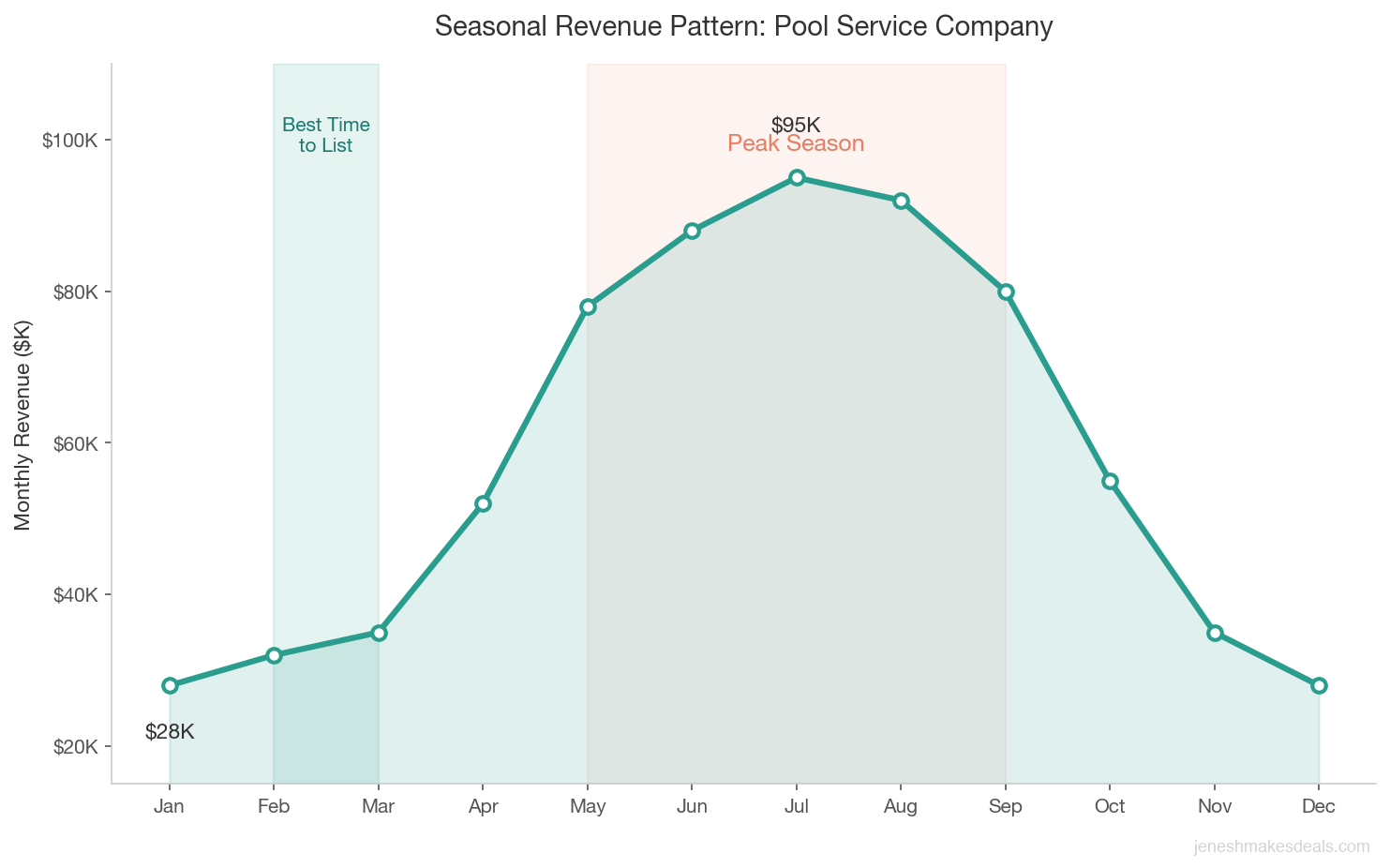
The same business can look like a thriving operation or a struggling one depending on the month a buyer walks through the door. Timing your listing 2 to 3 months before peak season lets buyers watch your numbers climb during due diligence, which is the most powerful sales tool you have.
Want to understand what your seasonal business might be worth? Run the numbers with our free valuation calculator to see where your annual SDE lands on the multiples spectrum.
The Best Window to List: 2 to 3 Months Before Peak Season
Here's the timing rule I use with every seasonal business seller: list your business 2 to 3 months before your peak season starts.
Not during peak season. Not after peak season. Before it.
Why? Because you want the buyer to go through due diligence while watching your numbers climb. You want them reviewing financials, touring the operation, and making their final decision right as revenue is accelerating upward. The trajectory matters as much as the absolute numbers.
Think about it from the buyer's perspective. They start looking at your business in early March when revenue is $35,000. By due diligence in April, it's $52,000. When they're working on financing in May, you're at $78,000. By the time the deal closes in June, the business is generating $95,000 per month.
That upward momentum creates urgency. The buyer thinks: "If I don't close this deal now, I'm missing the best part of the year." It also gives the lender confidence, because the debt service coverage ratio looks great when current month revenue is well above the monthly loan payment.
Here's how this plays out by business type:
| Business Type | Peak Season | Best Time to List | Worst Time to List |
|---|---|---|---|
| Landscaping | April through October | January through February | October through December |
| Snow Removal | November through March | August through September | April through June |
| Pool Service | May through September | February through March | October through December |
| Tax Preparation | January through April | October through November | May through July |
| Wedding Venues | May through October | February through March | November through January |
| Holiday Retail | October through December | July through August | January through March |
In every case, you're listing far enough ahead that the buyer has time to complete due diligence (60 to 90 days for most small business deals) and close right as peak season is in full swing.
The Worst Time to List: Off Season When Financials Look Terrible
If listing before peak season is the best move, listing during the off season is the worst.
A snow removal company owner in Connecticut came to me in May. He was done with winter, exhausted, and ready to sell. His January through March numbers were outstanding. $320,000 in revenue over three months, solid margins, repeat commercial contracts. But by May, his monthly revenue was $8,000 from a handful of small landscaping maintenance clients he kept on the side.
If we'd listed in May, every buyer who looked at the current financials would see a business doing $8,000 a month. Yes, the trailing 12 month numbers told the real story. But first impressions are powerful, and buyers form opinions fast.
We waited until August. Listed the business with a full year of financial history that included the prior winter's strong performance, and we timed the due diligence to happen as the first snow forecasts started showing up in the news. The buyer closed in late October, just in time for the first plowing contracts to kick in. Sale price: $485,000 at 2.8x SDE.
The off season kills your negotiating position in three ways:
- Current month financials look weak. Even sophisticated buyers who understand seasonality will anchor to the most recent numbers they see.
- The business doesn't show well. Empty parking lots, idle equipment, reduced staff. The physical impression reinforces the financial weakness.
- Urgency disappears. When peak season is 6 months away, buyers feel no pressure to move fast. They'll lowball you, ask for more concessions, or simply move on to a different opportunity.
I have never seen a seller gain negotiating power by listing during the off season. Patience is worth real money here. If you're exhausted and ready to move on, call your broker, start the prep work, and set a listing date for 2 to 3 months before your next peak. That waiting period is the highest return on investment you'll ever earn.
How Buyers Value Seasonal Businesses
Smart buyers look at full year numbers when evaluating a seasonal business. They understand that a pool company doesn't make money in December and a snow removal company doesn't make money in July. The valuation methodology is the same as any other business: seller's discretionary earnings (SDE) times a multiple.
But here's the nuance. The off season still concerns buyers, even the experienced ones. They worry about three specific things.
Cash flow gaps during slow months. If the business burns $15,000 per month in fixed costs during the off season and brings in only $8,000, the buyer needs to cover a $7,000 monthly shortfall for 3 to 5 months. That's $21,000 to $35,000 in cash they need to have on hand beyond the down payment and closing costs. This is real money that affects their willingness to pay full price.
Employee retention during slow periods. Seasonal businesses often lose skilled workers during the off season, and finding and training replacements every year is expensive. Buyers want to know your retention strategy. Do you keep key people on payroll year round? Do you cross train for off season services? A business that keeps 80% of its crew year to year is worth more than one that rebuilds its workforce every season.
Customer churn between seasons. Do your clients come back every year, or do you have to re sell them? A landscaping company with 85% annual client retention is a fundamentally different asset than one where 40% of clients need to be replaced each spring. Buyers will discount the value if seasonal client retention is low.
| Buyer Concern | Low Risk (Higher Multiple) | High Risk (Lower Multiple) |
|---|---|---|
| Off season cash flow gap | Under $5K monthly shortfall | Over $10K monthly shortfall |
| Employee retention | 80%+ crew returns each year | Rebuilds workforce every season |
| Client retention | 85%+ annual client retention | Under 60% annual retention |
| Off season revenue | Some year round services | Zero revenue for 3+ months |
| Seasonality ratio | Under 3:1 peak to trough | Over 5:1 peak to trough |
Curious how buyers would evaluate your business? Get a free valuation estimate and I'll walk you through how your seasonal patterns affect the multiple.
How to Present Financials for a Seasonal Business Sale
The way you present your numbers can make or break a seasonal business deal. I have a specific approach I use with every seasonal seller, and it works.
Show trailing 12 months, but break it out monthly. Don't just hand buyers an annual P&L. Give them a monthly breakdown that shows the seasonal pattern clearly. When buyers can see that revenue follows a predictable curve every year, seasonality stops being a red flag and starts being a documented, repeatable pattern.
Present 3 full years of data. One year of seasonal numbers could be an anomaly. Two years looks like a pattern. Three years proves consistency. I tell every seasonal business seller to have 3 full calendar years of monthly financials ready to go. If your peak season revenue has grown year over year across all three years, that's an incredibly powerful data point.
Create a visual. Build a simple chart that overlays the monthly revenue for each of the last 3 years. When a buyer sees three lines that follow the same curve and each year is slightly higher than the last, it tells a story no spreadsheet can match.
Calculate and present your seasonality ratio. This is the ratio of peak month revenue to off season month revenue. A pool service company doing $95,000 in July and $28,000 in January has a ratio of roughly 3.4 to 1. A tax prep firm doing $180,000 in March and $12,000 in August has a ratio of 15 to 1. Lower ratios are easier for buyers to finance. Higher ratios need more explanation.
Normalize your SDE. Calculate the full year SDE and present it as an annual number. Don't let a buyer see a monthly SDE figure from your worst month and extrapolate. Whether you take a larger salary draw during peak months or keep it constant, the annual number is what matters for valuation.
Working Capital Needs in Seasonal Businesses
Working capital is tricky enough in a normal business sale. In a seasonal business, it gets significantly more complicated because working capital fluctuates dramatically throughout the year.
Here's the issue. A landscaping company might have $120,000 in net working capital in June when receivables are high, cash is flowing, and inventory is fully stocked. That same company might have $35,000 in net working capital in January when receivables have been collected, cash has been drawn down over the slow months, and there's no inventory to carry.
So when the buyer's attorney asks for a working capital peg, which number do they use? $120,000? $35,000? The 12 month average of $78,000?
This matters a lot because the working capital peg determines how much cash and current assets you need to leave in the business at closing. A higher peg means less cash in your pocket. A lower peg means the buyer might be underfunded for peak season startup costs.
The standard approach is a 12 month trailing average, which is fair to both sides. But I negotiate hard on the timing of the measurement period. If you're closing at the end of peak season when working capital is naturally high, you don't want the peg set at the peak month number. You want the annual average.
Here's my advice for seasonal business sellers:
- Get your monthly balance sheets clean and accurate for the full prior year
- Calculate the 12 month average working capital yourself before a buyer ever asks
- Identify which months are outliers (peak and trough) and be ready to explain why the annual average is the fair number
- If possible, time the closing to a month when actual working capital is close to the 12 month average, so the true up adjustment is minimal
The Transition Timing Problem
Every business sale requires a transition period where the seller helps the buyer learn the operation. For seasonal businesses, the timing of this transition is a genuine strategic decision.
Option 1: Sell at the start of peak season. The buyer walks into a business that's ramping up. The seller is there to introduce returning clients, show the operational rhythm, and hand over the playbook while everything is in motion. The downside: the seller is tied up with transition duties during the busiest time of year.
Option 2: Sell at the end of peak season. The buyer takes over as things wind down. They have the slower months to learn the business, build relationships with employees, and prepare for the next peak season without the pressure of high volume operations. The downside: watching monthly revenue drop from $90,000 to $30,000 in your first months of ownership is demoralizing, even if you expected it.
Close at the start of peak season with a 90 to 120 day transition period. The buyer gets to experience peak operations with the seller as a safety net, and by the time the transition ends, they have lived through the busiest months with training wheels on.
My recommendation: Close at the start of peak season, with a 90 to 120 day transition period that carries you through the peak. This gives the buyer the best possible experience. They see the business at full speed, with the seller there to ensure nothing falls through the cracks. By the time the transition ends, the buyer has lived through peak season with training wheels on and is ready to handle the off season planning independently.
Not sure how to structure your transition? Let's talk about your specific timeline and build a transition plan that works for both you and the buyer.
How SBA Lenders View Seasonal Businesses
Most small business acquisitions are financed with SBA 7(a) loans. SBA lenders will absolutely lend on seasonal businesses, but the underwriting process has a few extra wrinkles you need to understand.
Debt service coverage ratio (DSCR) is the key metric. Lenders want to see that the business generates enough cash flow to cover loan payments with a comfortable margin. The standard threshold is 1.25x, meaning the business produces $1.25 in cash flow for every $1 in loan payments.
For a seasonal business, the annual DSCR might look fine, but individual months can be terrifying. A business might produce $45,000 in SDE during peak months and $5,000 during off months. The annual average works out, but the lender knows there will be 3 to 4 months where the business can't cover its loan payments from operating cash flow.
How lenders handle this:
- They calculate DSCR on an annual basis, not monthly. As long as the full year cash flow covers the full year of debt service at 1.25x or better, the deal can get approved.
- They may require a cash reserve. Some lenders will ask the buyer to set aside 3 to 6 months of loan payments in a reserve account to cover the off season shortfall. This is common for businesses with a seasonality ratio above 3 to 1.
- They want to see multiple years of tax returns. Lenders need to verify that the seasonal pattern is consistent and that peak season revenue reliably covers the annual debt load. Three years of returns showing the same pattern is the gold standard.
- They prefer businesses that have some off season revenue. A pool company that does maintenance year round is easier to lend on than a Christmas tree lot that does literally zero revenue for 9 months. Any off season revenue stream, even a small one, makes the lending package stronger.
As a seller, your job is to make the lending package as clean as possible. Have your tax returns organized, your monthly financials prepared, and your seasonal pattern clearly documented.
SBA lenders aren't scared of seasonal businesses. They're scared of surprises. If you walk in with 3 years of tax returns that show the same predictable seasonal curve and a clear plan for covering off season debt service, most lenders will get comfortable. The deals that stall are the ones where the seller can't explain their own revenue pattern.
How to Smooth Out Revenue Seasonality Before Selling
If you're thinking about selling in the next 12 to 24 months, one of the smartest things you can do is reduce the severity of your seasonal revenue swings. Buyers and lenders both reward businesses with more consistent cash flow.
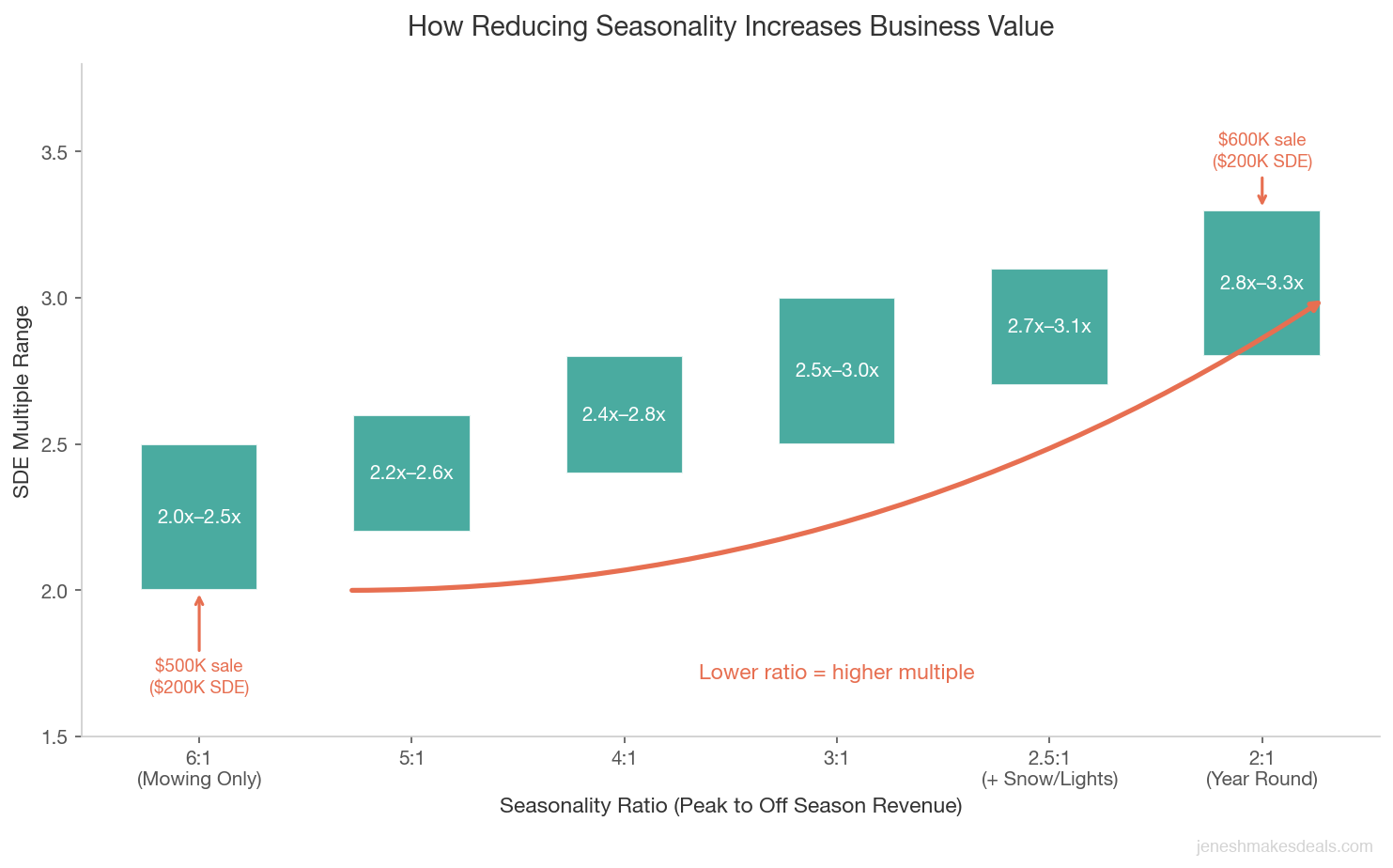
Every dollar of off season revenue you add does double duty: it increases your annual SDE and it lowers your seasonality ratio, which pushes your valuation multiple higher. That is why the best time to start reducing seasonality is 12 to 24 months before you plan to sell.
Here's how I've seen owners do it successfully.
Add complementary off season services. This is the most common and most effective strategy. A landscaping company that adds snow removal and holiday lighting immediately becomes less seasonal. A pool service company that adds hot tub maintenance and winterization services fills the fall and winter gap. A wedding venue that books corporate events and holiday parties during the off season goes from a 6 month business to a 10 month business.
The impact on valuation is direct. A landscaping business with a seasonality ratio of 5 to 1 might trade at 2.5x SDE. The same business, after adding snow removal that cuts the ratio to 2 to 1, might trade at 3.0x SDE. On $200,000 of SDE, that's the difference between a $500,000 sale and a $600,000 sale.
| Off Season Strategy | Example | Seasonality Ratio Impact |
|---|---|---|
| Add complementary services | Landscaping adds snow removal and holiday lights | Drops from 5:1 to 2:1 |
| Annual contracts with monthly billing | Pool company bills $400 per month year round | Revenue looks steady to buyers |
| Recurring maintenance agreements | HVAC adds year round service plans | Creates predictable off season cash flow |
| Corporate and event bookings | Wedding venue books holiday parties | Extends active season from 6 to 10 months |
Sign annual contracts with monthly billing. If your clients currently pay per service, consider offering annual maintenance contracts with level monthly payments. A pool company that bills $400 per month for 12 months looks very different from one that bills $800 per month for 6 months and $0 for the other 6, even though the annual revenue is nearly the same.
Build a recurring revenue base. Maintenance agreements, subscription services, monitoring contracts. Any recurring revenue you can layer onto your seasonal business creates predictable off season cash flow that reduces the buyer's risk and increases your multiple.
Thinking about adding services before you sell? Use our business valuation tools to model how reducing seasonality could change your sale price.
Real Examples from Deals I've Worked
Let me share three specific deals that show how timing and preparation affect outcomes for seasonal business sales.
The pool service company in Central Florida. This is the deal I mentioned at the top. The owner had 280 residential accounts and 12 commercial properties. Annual revenue was $680,000 with SDE of $185,000. His seasonality ratio was about 2.8 to 1 because Florida pools need some maintenance year round.
We listed in mid February. By late March, we had four interested buyers. The winning buyer toured the business in early April when every truck was running. Due diligence happened in April and May. We closed on June 3 at $573,500, which was 3.1x SDE. The buyer stepped into a business doing its best revenue of the year, with the seller available for a 90 day transition through the peak summer months.
The snow removal company in Connecticut. This owner ran 6 plow trucks with contracts for 45 commercial properties. Annual revenue was $520,000 with SDE of $173,000. The seasonality was extreme: 85% of revenue came between November and March. Summer revenue from minor landscaping work was only about $6,500 per month.
We listed in late August. Due diligence happened in September and October as winter storm forecasts started making the news. The buyer, a competitor looking to expand his territory, closed on October 28, just 2 weeks before the first significant snowfall. Sale price: $485,000 at 2.8x SDE. If we'd listed in May, this buyer might have offered $400,000 or less because he would have been staring at 5 months of nearly zero revenue.
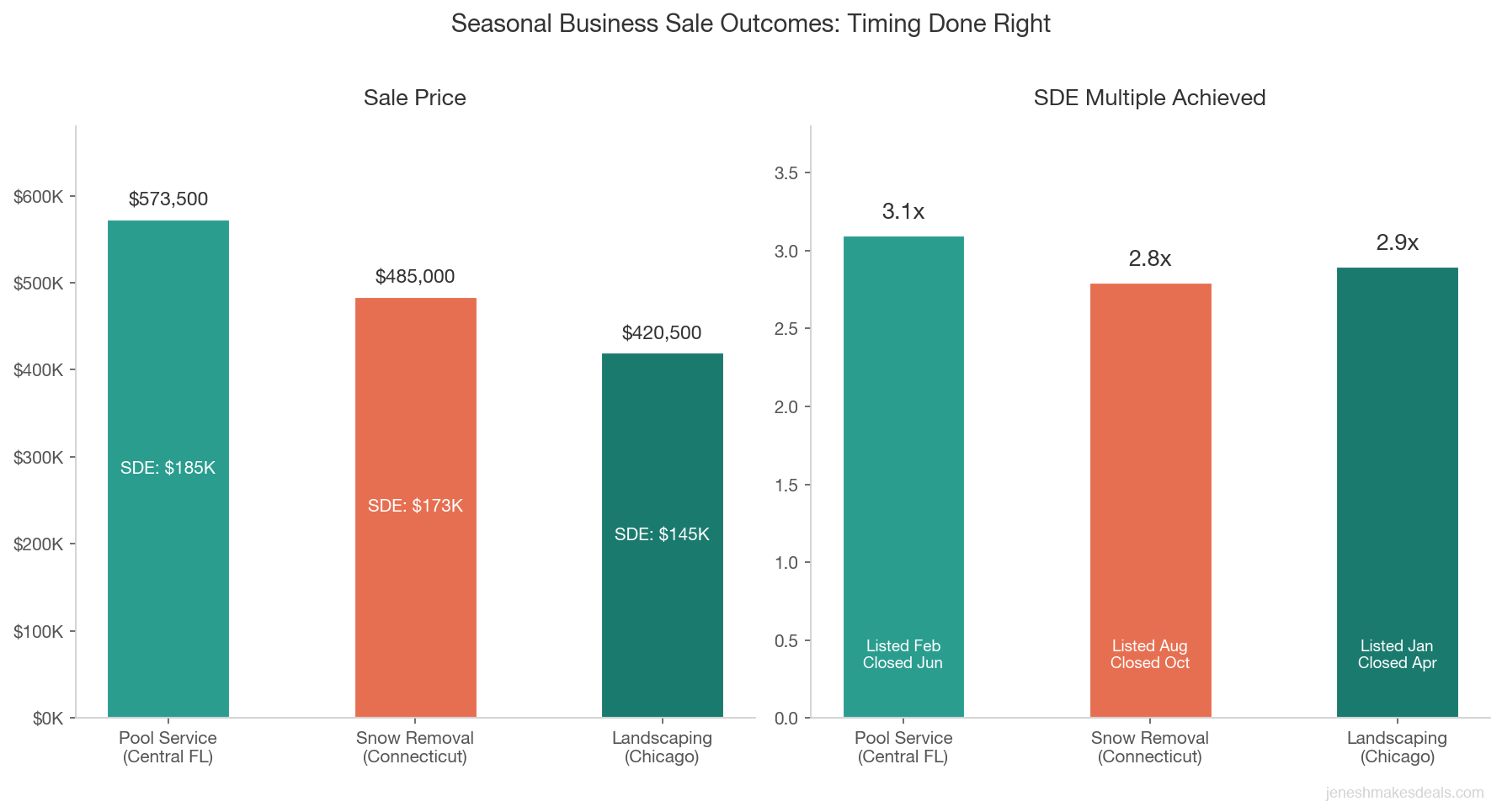
The landscaping company in suburban Chicago. The owner had spent three years reducing seasonality before selling. He started with a pure mowing operation doing 90% of revenue from April through October. He added snow plowing, holiday light installation, and spring/fall cleanup packages. By the time we listed, his seasonality ratio had dropped from 6 to 1 down to about 2.5 to 1.
Annual revenue was $410,000 with SDE of $145,000. We listed in January, ran due diligence in February and March, and closed in early April right as mowing season kicked off. The buyer paid $420,500 at 2.9x SDE. Without the off season services, this business would have sold at 2.3x to 2.5x SDE, a difference of $58,000 to $87,000.
A Step by Step Timeline for Selling Your Seasonal Business
Here's the process I walk every seasonal business seller through. Adjust the specific months based on your peak season, but the structure stays the same.
Sellers who start preparing 12 to 18 months out almost always get a better price than those who decide to sell and list the same month. The preparation window is where the real value is created, not at the negotiating table.
12 to 18 months before listing: Start preparing.
- Clean up your financials. Get your monthly P&L statements and balance sheets in order for the last 3 years.
- Add off season revenue streams if you can. Even small ones help.
- Document your processes. Buyers want to see that the seasonal ramp up and ramp down are systematic, not dependent on your personal knowledge.
- Reduce owner dependence. Train a manager or lead employee to handle peak season operations without you being involved in every decision.
6 months before listing: Get your team ready.
- Hire a business broker who has experience with seasonal businesses. This is not the time for a generalist.
- Get a professional valuation or broker's opinion of value.
- Prepare your confidential information memorandum (CIM) with monthly financial breakdowns and a clear explanation of your seasonal pattern.
- Assemble your data room with 3 years of tax returns, financial statements, client lists, equipment lists, and contracts.
2 to 3 months before peak season: List the business.
- Go to market with your CIM and begin receiving buyer inquiries.
- Qualify buyers for both financial ability and operational readiness to handle a seasonal business.
- Schedule tours and site visits to coincide with the early weeks of your ramp up period.
During peak season: Complete due diligence and close.
- Buyers conduct financial and operational due diligence while watching your revenue climb.
- Finalize SBA lending or other financing while current month DSCR looks strong.
- Negotiate the purchase agreement, including the working capital peg based on 12 month averages.
- Close the deal and begin the transition period.
90 to 120 days post closing: Transition support.
- Help the buyer through peak season operations and introduce them to key clients, vendors, and employees.
- Transfer institutional knowledge about seasonal preparation, staffing, and off season planning.
Don't Let the Calendar Work Against You
Selling a seasonal business is not fundamentally different from selling any other small business. The valuation math is the same. The deal structure is the same. The SBA lending process is the same. But timing is a weapon that seasonal business owners can use to their advantage or accidentally use against themselves.
If you own a seasonal business and you're thinking about selling, the most important decision you'll make isn't the asking price or the deal structure. It's when you go to market. Get the timing right and everything else gets easier. Buyers are more enthusiastic, lenders are more comfortable, and deals close faster. Get it wrong and you'll spend months wondering why qualified buyers aren't showing up.
Ready to figure out the right listing window for your seasonal business? Schedule a free consultation and I'll map out a timeline based on your specific industry and revenue patterns. The earlier we start planning, the more options we have.
Related Articles

April 30, 2026
How Long Does It Really Take to Sell a Business
Most sellers are shocked by how long it takes. Here's the honest timeline from listing to closing, and what actually speeds things up.

April 26, 2026
How to Structure an Earnout That Works for Seller and Buyer
Most earnouts fail because they're poorly structured. Here's how to build earnout terms that protect both sides of the deal.

April 24, 2026
How to Value Intellectual Property in a Business Sale
Your IP could be worth more than your equipment. Learn how patents, trademarks, and trade secrets affect your business valuation.
About the Author
Jenesh Napit is an experienced business broker specializing in business acquisitions, valuations, and exit planning. With a Bachelor's degree in Economics and Finance and years of experience helping clients successfully buy and sell businesses, he provides expert guidance throughout the entire transaction process. As a verified business broker on BizBuySell and member of Hedgestone Business Advisors, he brings deep expertise in business valuation, SBA financing, due diligence, and negotiation strategies.
You might also be interested in
Free Business Calculators
Try our business valuation calculator and ROI calculator to estimate values and returns instantly.
How to Buy a Business Guide
Download our comprehensive free guide covering everything you need to know about buying a business.
Our Services
Explore our professional business brokerage services including valuations and buyer representation.
More Articles
Browse our complete collection of business brokerage insights and expertise.