

You've signed the letter of intent. The buyer's excited. Due diligence is underway. Then they ask the question every seller dreads: "When can I come see the business in person?"
The site visit is one of the most important moments in the entire sale process, and it's the one sellers prepare for the least. I've watched deals worth $500,000 to $5 million fall apart because a site visit went badly. The warehouse was filthy. The owner got flustered introducing the buyer to employees. A staff member blurted out, "Oh, so you're the one buying the place?"
A great site visit doesn't just prevent deal killers. It builds buyer confidence and can accelerate the closing timeline by weeks. I'm going to walk you through exactly how to prepare, from timing and logistics to employee communication and post visit follow up.
When Site Visits Happen in the Deal Process
Site visits don't happen on the first date. A serious buyer typically visits the business after signing a letter of intent and beginning the formal due diligence period. This usually means 7 to 21 days into the DD timeline, once the buyer has reviewed your initial financials and feels confident enough to invest the time.
There are exceptions. Some buyers want a quick drive by before submitting an LOI, especially for retail or restaurant businesses where curb appeal matters. That's fine and doesn't require special preparation. The formal site visit, where the buyer walks through the operation and meets people, comes later.
The timing matters for confidentiality reasons too. Before the LOI is signed, you might be talking to multiple buyers. You don't want three different strangers walking through your shop floor in the same week. After the LOI, you typically have an exclusivity period with one buyer, making coordination simpler. If you need a refresher on how to screen buyers before reaching this stage, that's worth reviewing.
Most site visits happen on a single day and last 2 to 4 hours. For larger or more complex businesses like manufacturing facilities with multiple buildings or businesses with several locations, you might need two separate visits.
What Buyers Are Actually Looking For
Let me be direct about this: buyers are not just admiring the decor. They're building a mental model of what they're actually buying, and they're looking for gaps between what you told them on paper and what they see in person.
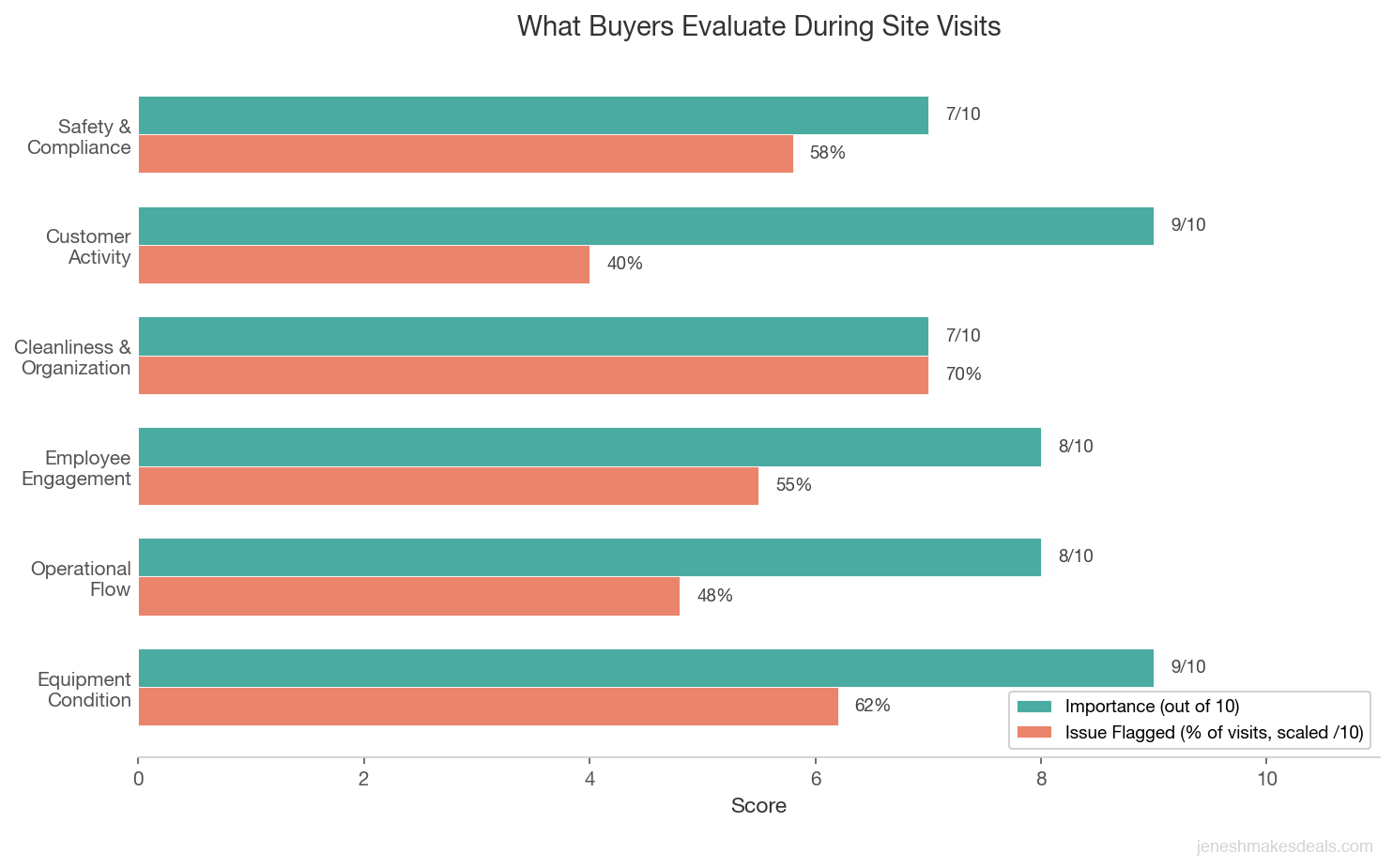
Here's what's going through a buyer's mind during a site visit.
| What Buyers Evaluate | Positive Signal | Negative Signal |
|---|---|---|
| Equipment condition | Clean, maintained, matches asset list | Worn out, jury rigged repairs, missing items |
| Operational flow | Logical layout, smooth workflow | Bottlenecks, cluttered pathways, idle workers |
| Employee engagement | Busy, friendly, aware of their roles | Disengaged, avoiding eye contact, on phones |
| Cleanliness and organization | Labeled storage, tidy workspaces | Disorganized stockrooms, dirty common areas |
| Customer activity | Steady traffic, phones ringing, orders flowing | Empty floor during business hours |
| Safety and compliance | Current inspections, visible safety gear | Expired extinguishers, missing safety guards |
Think of the site visit as the buyer's gut check. They have spent hours reviewing your financials and projections on paper. Now they are walking through the operation to see if the reality matches. Every inconsistency between what you told them and what they see in person chips away at their confidence in the deal.
Condition of physical assets. Does the equipment match what's on the asset list? Is it well maintained or held together with duct tape? Are vehicles in reasonable shape? A buyer who was told the kitchen equipment is "in excellent condition" and then sees grease buildup and worn out gaskets is going to question everything else you've told them.
Operational flow. How does work actually move through the business? Is the layout efficient? Are there bottlenecks that aren't obvious from the financials? A buyer walking through a machine shop wants to see a logical flow from raw materials to finished goods. Chaos on the floor signals management problems.
Employee engagement. Are employees busy and focused, or standing around looking at their phones? Do they seem happy? Do they greet the owner warmly or avoid eye contact? Buyers pick up on culture immediately, and it shapes their confidence in the business's sustainability after the transition.
Cleanliness and organization. This is more psychological than practical, but it matters enormously. A clean, organized business signals that the owner cares about details. A messy, disorganized one signals neglect. Buyers extrapolate from what they see: if the stockroom is a disaster, they wonder what the books look like.
Customer activity. Buyers want to see the business during operating hours when customers are present. Foot traffic in a retail store, phone calls coming in at a service business, trucks loading at a distribution company. Seeing the revenue engine in action is powerful.
Red flags. Deferred maintenance. Safety hazards. Code violations. Environmental issues. Anything that wasn't disclosed in the financials or the confidential information memorandum. Buyers are looking for surprises, and not the good kind.
How to Prepare the Physical Space
Start preparing your space at least two weeks before the scheduled visit. Don't try to do everything the night before. Here's my site visit preparation checklist.
Exterior and Curb Appeal
- Power wash the building exterior, sidewalks, and parking area
- Repair any cracked or faded signage
- Clean windows inside and out
- Remove any junk, unused equipment, or debris from outside the building
- Make sure landscaping is trimmed and presentable
- Ensure adequate lighting in the parking lot and entrance
- Repair potholes or cracked pavement (or at least mark them)
- Empty dumpsters and make sure the trash area is tidy
Interior Common Areas
- Deep clean all floors (strip and wax if needed)
- Paint touch ups on scuffed walls, especially the entrance and hallways
- Replace any burned out light bulbs
- Clean and organize the reception area or front desk
- Remove personal items, political signs, or anything controversial
- Make sure restrooms are spotless and fully stocked
- Fix anything obviously broken: leaky faucets, squeaky doors, damaged ceiling tiles
Operations Area
- Organize work areas, tool stations, and storage rooms
- Clean all equipment and make sure it's in working order
- Label storage areas and inventory sections clearly
- Remove outdated inventory or dead stock
- Ensure all safety equipment is visible and up to date (fire extinguishers, first aid kits, safety signs)
- Clear walkways and aisles of any obstructions
- If you have a fleet, wash the vehicles and park them neatly
Office and Back of House
- Organize desks and filing areas
- Clean the break room thoroughly
- Make sure technology is working (printers, computers, phone system)
- Remove any documents you don't want the buyer to see casually (employee complaints, legal correspondence, personal financial records)
- Have a clean, private meeting room available for conversation before and after the walkthrough
I had a client who owned a dry cleaning business and spent $2,200 on cleaning and minor repairs before the visit. The buyer later told me that walking into the facility sealed the deal. "Everything matched what I saw in the financials." That $2,200 investment helped close a $640,000 transaction.
Want to know what your business is worth before buyers start visiting? Use our free valuation calculator to get a baseline estimate.
What to Tell Your Employees (and What Not to Say)
This is where most sellers either over share or create more problems by saying nothing. You need a plan for employee communication, and it needs to be specific to the visit day.
The Core Dilemma
In most business sales, you want to keep the sale confidential from employees for as long as possible. I've written extensively about maintaining confidentiality during a sale because breaches can be devastating. But a site visit creates an obvious problem: a stranger is walking through the business with the owner, asking questions, and looking at everything. Your employees aren't stupid. They'll notice.
Option 1: The Cover Story (Most Common)
For the initial site visit, most sellers use a cover story. The buyer is introduced as a "consultant," an "insurance inspector," a "potential partner," or an "investor reviewing the business." This works best when:
- The buyer visits during off peak hours when fewer employees are present
- The tour is efficient and doesn't linger in any one area
- The buyer knows the cover story in advance and plays their part
- You brief anyone who needs to know (your office manager, operations lead) with the same story
I tell my sellers to keep it simple: "This is Mike. He's a consultant helping us evaluate some operational improvements." Don't over explain. The more details you add to a cover story, the more likely someone catches an inconsistency.
Option 2: Selective Disclosure (For Key Employees)
If you have a general manager, operations director, or other senior leader who's critical to the transition, you may need to bring them into the loop before the visit. This is a judgment call that depends on your relationship with that person and how essential they are.
If you do tell someone, keep it tight. "I'm exploring the possibility of bringing in a partner or transitioning ownership. This person is evaluating the business. I need you to keep this completely confidential."
Give them a reason to stay. A retention bonus tied to closing is common. Something like $10,000 to $25,000 for a key manager, payable at close, goes a long way toward ensuring loyalty and discretion.
Option 3: Full Disclosure (Late Stage)
For second or third visits very close to closing, full employee disclosure may be necessary. This usually happens when the buyer needs to interview key staff as part of DD.
When you do disclose, do it in a controlled setting. Call an all hands meeting. Be direct and positive. "I've made the decision to transition ownership. The new owner is someone I've vetted carefully, and their plan is to continue growing the company. Everyone's job is safe."
What Never to Say
- Don't tell employees you're "retiring and getting out." It sounds like abandonment.
- Don't mention the sale price. Ever. To anyone who doesn't need to know.
- Don't say "nothing is going to change." Things will change. Be honest that the new owner will bring their own approach while emphasizing continuity.
- Don't let employees find out from someone other than you. If you decide to disclose, control the timing and the message.
How to Handle Introductions During the Visit
The introductions are the highest risk moment of the entire site visit. A poorly handled introduction can blow confidentiality, make the buyer uncomfortable, or create employee anxiety. Here's how to manage them.
Before the Visit
- Brief the buyer on who they'll meet and what those people know about the sale
- Agree on the buyer's introduction: name, title, and reason for being there
- Walk the buyer through the route you'll take so there are no surprises
- Decide in advance which areas you'll show and which you'll skip
- Tell the buyer what questions are off limits in front of employees
During Introductions
Keep them brief and natural. "Mike, this is Sarah, our operations manager. She's been with us for 12 years and runs the floor." Then move on. Don't linger. The longer you stand there, the more likely someone asks a question you don't want to answer.
If an employee asks who the visitor is, the buyer should have a rehearsed one liner ready. "I'm doing some consulting work for the company." Then redirect: "Your operation here looks great. How long have you been doing this?" People love talking about themselves, and it shifts the conversation away from why the stranger is there.
After the Visit
If any employees seem curious after the visit, address it casually within a day or two. "That was a consultant I brought in to look at our workflow. Nothing exciting." Don't bring it up if no one asks.
Documents to Have Ready for the Visit
The site visit is a physical experience, but buyers often want to review documents while they're on site. Having these ready shows preparation and builds trust.
Physical Documents to Have On Hand
- Equipment list with purchase dates, maintenance logs, and current condition notes
- Floor plan or layout diagram of the facility
- Current lease agreement (with key terms highlighted: rent, expiration, renewal options)
- Recent inspection reports (health, fire, environmental, OSHA, whatever applies)
- Insurance policy summary showing coverage types and amounts
- Permits and licenses displayed or easily accessible
- Vehicle titles and registration for company fleet
- Inventory summary with current valuation
Digital Documents Accessible in the Meeting Room
- Trailing 24 month P&L statements
- Current year to date financials
- Customer concentration data (top 10 customers by revenue)
- Employee roster with tenure, roles, and compensation ranges
- Key vendor contracts summary
- Standard operating procedures
You don't have to hand all of this over. But having it available if the buyer asks sends a strong signal: you're organized, transparent, and have nothing to hide.
Getting ready to sell and want professional guidance? Contact us to discuss your timeline and what needs to happen before going to market.
Common Mistakes That Kill Deals During Site Visits
I've seen all of these destroy buyer confidence. Most are easily avoidable.
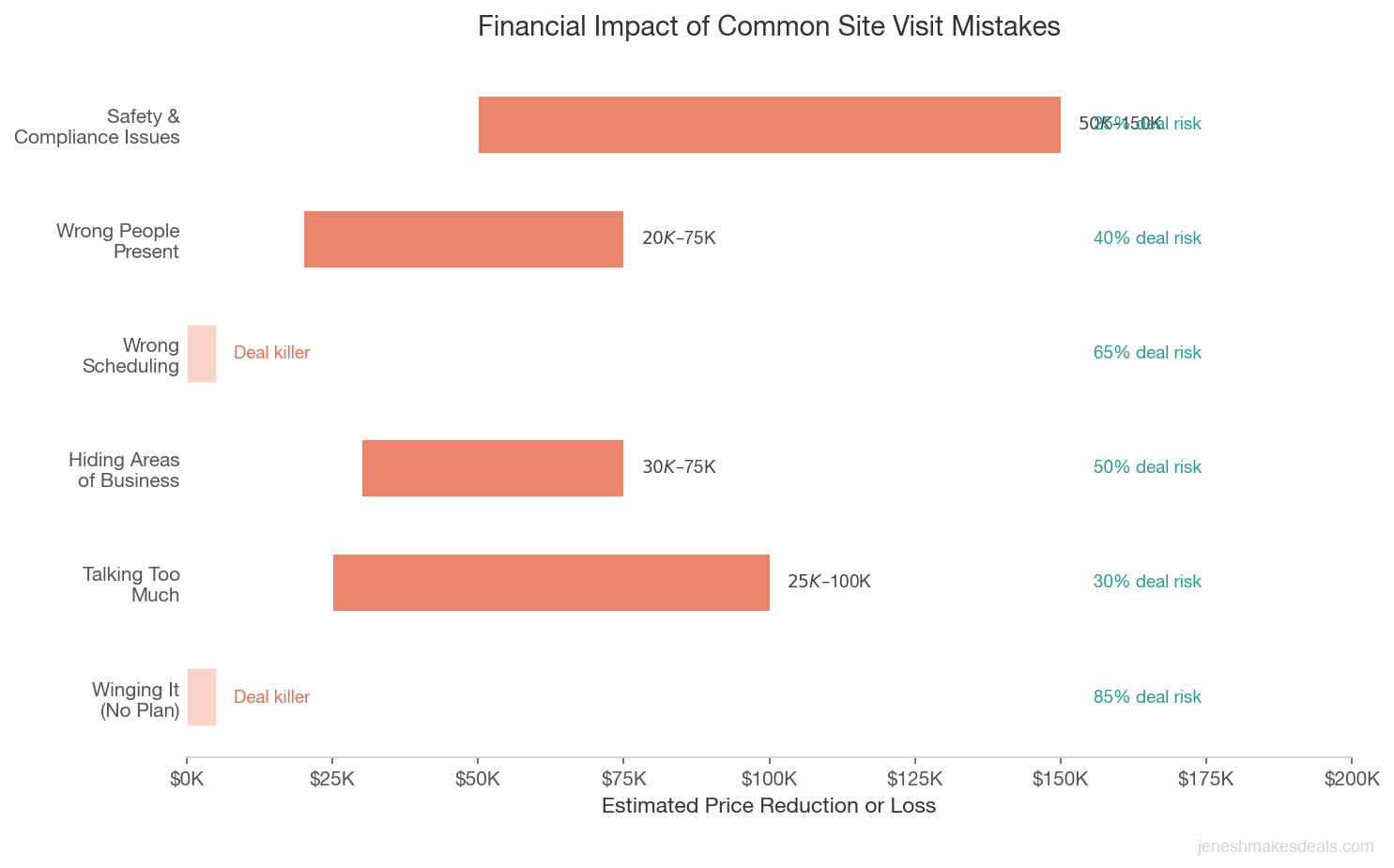
| Mistake | Typical Cost to Seller | How to Prevent It |
|---|---|---|
| Winging the visit with no plan | Buyer walks away, deal dies | Map the route, prepare talking points, do a practice run |
| Talking too much or volunteering problems | Price reduction of $25,000 to $100,000+ | Answer only what is asked, let the buyer observe |
| Hiding areas of the business | Buyer assumes the worst, demands deeper DD | Show everything and acknowledge imperfections briefly |
| Scheduling at the wrong time | Buyer sees a dead or chaotic business | Pick a normal operating day with steady activity |
| Having the wrong people present | Emotional comments derail buyer confidence | Control who is on site and brief them in advance |
| Ignoring safety and compliance issues | $50,000+ in price negotiation leverage lost | Spend $500 to $1,000 on updates before the visit |
Mistake 1: Winging It
Sellers who don't plan the visit end up wandering aimlessly, forgetting to show important areas, and improvising answers to basic questions. The buyer leaves feeling like the owner doesn't take the sale seriously.
Plan a specific route. Know exactly which rooms you'll show. Prepare talking points for each stop. Practice once before the actual visit.
Mistake 2: Talking Too Much
Nervous sellers fill every silence with words. They over explain things that don't need explanation. They volunteer problems that the buyer didn't ask about. They share personal stories that don't help sell the business.
Let the buyer look around. Let them ask questions. Answer concisely. Silence during a site visit is not your enemy. A buyer who's quietly observing is a buyer who's thinking about owning the place.
The sellers who lose deals during site visits are almost always the ones who could not stop talking. When you over explain or volunteer problems the buyer did not ask about, you are doing the buyer's due diligence for them. Show the business, answer what is asked, and let the operation speak for itself.
Mistake 3: Hiding Areas of the Business
If you steer the buyer away from the storage room, the maintenance shop, or the back office, they notice. And they wonder what you're hiding. Show everything. If something isn't perfect, acknowledge it briefly and move on. "This storage area needs some reorganizing. It's on my list."
Trying to hide a problem area is far worse than showing it and being honest about it. Buyers expect imperfections. They don't expect deception.
Mistake 4: Scheduling at the Wrong Time
Don't schedule the visit during your slowest period when the business looks dead. Don't schedule it during your most chaotic period when the buyer will only see stress and disorder. Aim for a normal operating day that represents what the business actually looks like most of the time.
For restaurants, avoid the lunch rush but don't show them an empty dining room at 3 PM. For service businesses, pick a day when your trucks are rolling and the phone is ringing. For retail, a steady but not overwhelming customer flow is ideal.
Mistake 5: Having the Wrong People Around
If you have a disgruntled employee who complains about everything, make sure they're not working the day of the visit. If your spouse is emotionally opposed to the sale, ask them to stay away. If your business partner hasn't fully agreed to the terms, don't have them present.
I once had a deal where the seller's wife made a comment to the buyer: "I can't believe he's actually going through with this." The buyer spent the rest of the visit wondering if the seller was really committed. It took two weeks of follow up to get the deal back on track.
Mistake 6: Ignoring Safety and Compliance Issues
A buyer who sees expired fire extinguishers, missing safety guards on equipment, or OSHA violations during a walkthrough is going to wonder about liability. They'll also use every safety issue as a negotiating chip to reduce the price. Spend $500 on updated safety equipment before the visit rather than lose $50,000 in price negotiations after it.
What to Do After the Visit
The site visit doesn't end when the buyer drives away. What happens in the 48 hours after the visit often determines whether the deal accelerates or stalls.
Same Day Follow Up
Send the buyer a brief message within a few hours of the visit. Something like: "Great to show you around today. I hope the visit confirmed what you've seen in the numbers. Let me know if you have any follow up questions."
This is not the time for a hard sell. Keep it warm and professional. You want the buyer to feel good about the experience, not pressured.
Address Questions Promptly
The buyer will have follow up questions after the visit. They always do. Respond within 24 hours. If you need to gather information, acknowledge the question immediately and commit to a specific timeline: "Good question about the HVAC system age. I'll pull the maintenance records and get back to you by Thursday." Then actually follow through.
Provide Requested Documents
If the buyer asked to see specific documents during the visit and you didn't have them ready, get them over quickly. I tell my sellers to treat post visit document requests like a 48 hour deadline. Speed signals confidence.
Gauge Buyer Sentiment
If you're working with a broker, this is where they earn their fee. A good broker will call the buyer after the visit and have a candid conversation about how it went. What did you think? Any concerns? Did anything surprise you? Ready to move forward with the next phase of DD?
This conversation is critical because buyers sometimes raise concerns to a broker that they won't raise directly to the seller. A broker can surface these issues early and address them before they become deal breakers.
The 48 hours after a site visit are the most important window in the entire due diligence process. A fast, professional follow up tells the buyer you are organized and serious. Going silent or taking a week to respond tells them the opposite. Treat every post visit question like it has a 24 hour deadline, because in the buyer's mind, it does.
Thinking about selling your business in the next 12 months? Reach out for a confidential conversation about your situation and what your business might be worth.
Managing Multiple Buyer Visits While Protecting Confidentiality
If you're entertaining multiple offers before signing an LOI, you might need to manage visits from more than one buyer. This is tricky because each visit increases the risk that employees figure out what's happening.
Space visits apart. Never schedule two buyer visits in the same week. Space them at least 7 to 10 days apart. Having two different strangers tour the building in short succession is the fastest way to trigger employee suspicion.
Use different cover stories. If Buyer A was introduced as an "insurance consultant," don't use the same cover for Buyer B two weeks later. "Software vendor evaluating our systems" or "industry benchmarking analyst" are alternatives. Make sure the cover matches the buyer's appearance and demeanor.
Vary the route and timing. Take different paths through the facility. Visit at different times of day. The goal is to make each visit feel like an isolated, unremarkable event.
Limit employee exposure. You don't have to show every buyer every corner. The first visit is typically a general overview. Deeper operational access comes later, usually after an LOI is signed.
Keep records. Document each visit: who came, when, what they saw, and what cover story was used. This prevents mistakes when you're managing parallel conversations.
Lessons From Real Site Visits
Let me share a few situations I've seen that illustrate how much site visits matter.
The auto body shop that closed in 30 days. The seller spent three weekends before the visit deep cleaning the shop, organizing the paint room, and getting every piece of equipment serviced. He created a one page equipment list with photos, purchase dates, and current market values. During the visit, the buyer spent 90 minutes walking through and asking questions. He made a comment afterward that stuck with me: "I've looked at six shops, and this is the first one where I felt like the owner was serious about the business and serious about the sale." They closed in 30 days. No price renegotiation.
The restaurant where the chef quit mid visit. I wish I was making this up. The seller scheduled the visit during dinner prep. Halfway through the tour, the head chef had a blowup with a line cook, threw his apron on the floor, and walked out. The buyer watched the whole thing. The buyer used the incident to negotiate a $75,000 price reduction, arguing that key employee retention was a material risk. Scheduling during a quieter time would have avoided the entire situation.
The distribution company that won on organization. This seller printed a color coded facility map showing each zone: receiving, storage, picking, packing, and shipping. He had binders at each station with SOPs, equipment specs, and maintenance logs. The buyer told me, "This is a business I can walk into on day one and run." They closed at full asking price with no contingencies.
The pattern is consistent: prepared sellers close faster and at higher prices. Unprepared sellers create doubt that costs them money and time.
Your Site Visit Preparation Checklist
Here's the full checklist in one place. Start two weeks before the scheduled visit.
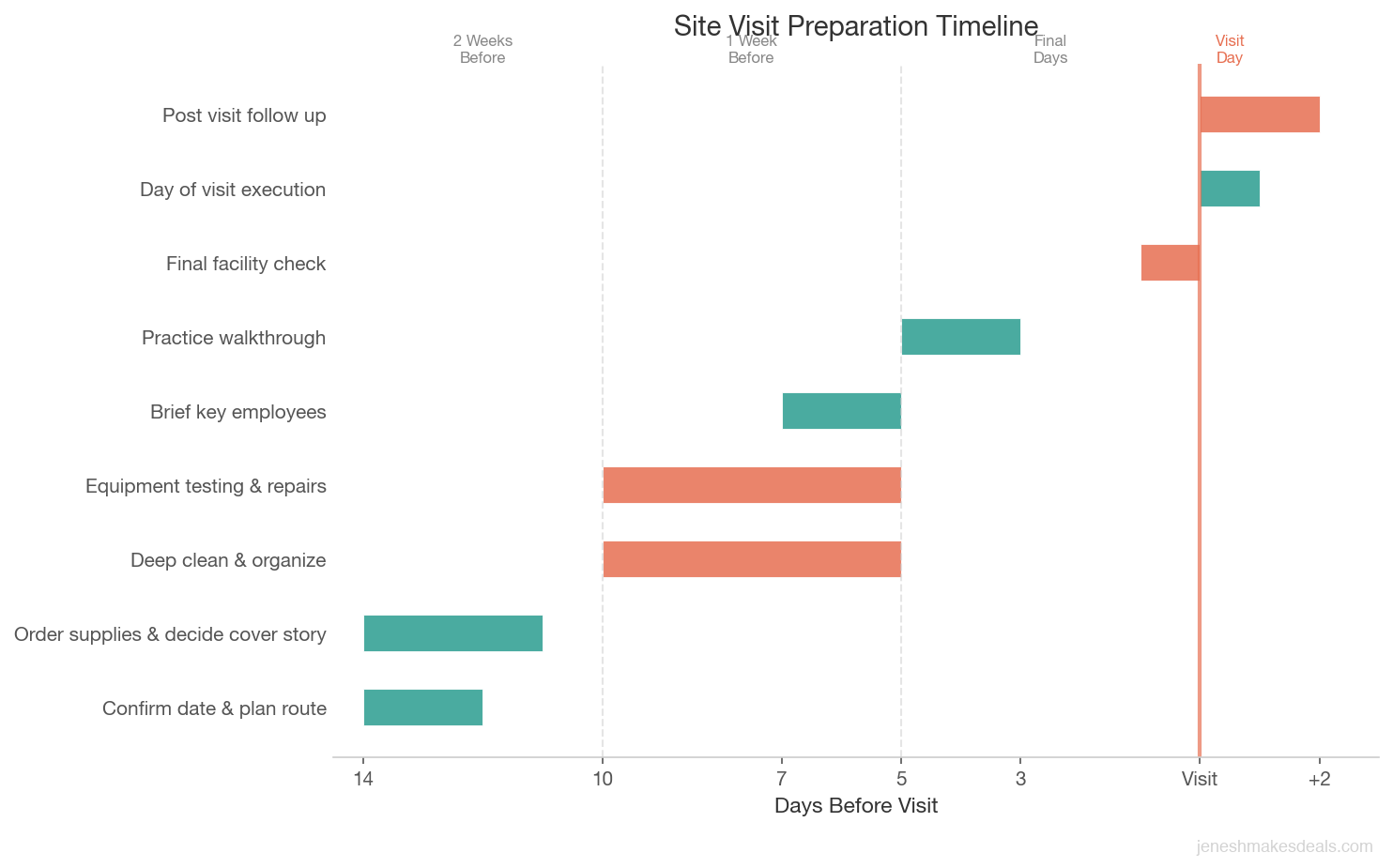
Two Weeks Before
- Confirm visit date, time, and expected duration with buyer
- Plan the tour route through the facility
- Identify areas that need cleaning, repair, or organization
- Order any supplies needed (paint, light bulbs, cleaning materials, safety equipment)
- Decide on the cover story for the buyer's presence
- Brief any employees who need to know (keep this to the absolute minimum)
- Prepare the document package listed above
One Week Before
- Begin deep cleaning and organizing all areas
- Complete any minor repairs
- Test all equipment to make sure it's operational
- Review the tour route and practice your talking points
- Confirm with the buyer: who's coming (just them or also their advisor, attorney, accountant)
- Prepare the private meeting room
Day Before
- Final walkthrough of the entire facility
- Check restrooms, break room, and common areas
- Confirm employees scheduled for the visit day (avoid scheduling known problems)
- Review the cover story one more time
- Charge any devices needed for showing digital systems
- Print any materials the buyer requested
Day Of
- Arrive early and do a final check of the facility
- Greet the buyer in a neutral location (parking lot, front entrance) before entering
- Stick to the planned route
- Let the buyer set the pace and ask questions
- Keep introductions brief and natural
- End in the private meeting room for questions and discussion
- Thank the buyer and confirm next steps
Within 48 Hours After
- Send a follow up message
- Address any questions raised during the visit
- Deliver any documents requested on site
- Debrief with your broker about the buyer's reactions
- Note any issues that came up and prepare responses if needed
The Bottom Line
A site visit is your business's audition. Everything the buyer has seen on paper gets tested against reality during those 2 to 4 hours. When reality matches or exceeds what they expected, you build the kind of buyer confidence that leads to smooth closings and strong prices.
When reality falls short, you create doubt. Doubt leads to renegotiations, extended due diligence timelines, and deals that fall apart entirely.
The good news is that preparing for a site visit isn't complicated. It's just work. Clean your facility. Organize your documents. Plan the tour. Brief your people. Follow up promptly. Sellers who take this seriously close faster and at higher prices.
Ready to start planning your exit? Contact us for a free, confidential conversation about selling your business and what you need to do to maximize your sale price.
Related Articles

May 1, 2026
What Happens to Accounts Receivable When You Sell
AR is one of the most negotiated items in any business sale. Here's exactly how it's handled, valued, and who collects it after closing.
April 28, 2026
What Is Representations and Warranties Insurance
R&W insurance protects buyers and sellers in business sales by covering breaches of reps in purchase agreements. Here's how it works.

April 27, 2026
How to Handle Inventory in a Business Sale
Inventory can make or break a business sale. Here's how to value it, negotiate it, and avoid the disputes that kill deals at closing.
About the Author
Jenesh Napit is an experienced business broker specializing in business acquisitions, valuations, and exit planning. With a Bachelor's degree in Economics and Finance and years of experience helping clients successfully buy and sell businesses, he provides expert guidance throughout the entire transaction process. As a verified business broker on BizBuySell and member of Hedgestone Business Advisors, he brings deep expertise in business valuation, SBA financing, due diligence, and negotiation strategies.
You might also be interested in
Free Business Calculators
Try our business valuation calculator and ROI calculator to estimate values and returns instantly.
How to Buy a Business Guide
Download our comprehensive free guide covering everything you need to know about buying a business.
Our Services
Explore our professional business brokerage services including valuations and buyer representation.
More Articles
Browse our complete collection of business brokerage insights and expertise.