
How to Negotiate a Non Compete Agreement When Selling Your Business

When you sell your business, the buyer is going to ask you to sign a non compete agreement. This isn't optional. Every serious buyer will require one, and honestly, they should. If you sold your landscaping company and opened an identical one across the street the next day, the buyer just paid for a customer base that's about to walk away.
But here's where sellers get into trouble. They treat the non compete as a formality. They sign whatever the buyer's attorney drafts without pushing back on the scope, duration, or geographic restrictions. Then, two years later, they want to do something new and realize they've locked themselves out of an entire industry for half a decade across three states.
I've worked with sellers who signed overly broad non competes and regretted it within months. The difference between a good outcome and a bad one comes down to understanding what's reasonable, knowing what to push back on, and treating the non compete as a real negotiation rather than an afterthought.
What Is a Non Compete Agreement in a Business Sale?
A non compete agreement (sometimes called a covenant not to compete or a restrictive covenant) is a contract where the seller promises not to start or work in a competing business for a specified period of time, within a defined geographic area, in a specified industry. It's a standard part of virtually every business acquisition.
The non compete is usually embedded in the purchase agreement itself, not a separate document. You'll find it in a section titled something like "Restrictive Covenants" or "Seller's Covenants." It typically sits near the representations and warranties section, and it's just as important.
There are three core components to every non compete.
Duration. How long you're restricted from competing. This is usually stated in years. Most small business non competes run between 2 and 5 years from the closing date.
Geographic scope. Where you're restricted from competing. This could be a radius around the business location (25 miles, 50 miles, 100 miles), specific counties or states, or in some cases the entire United States.
Industry scope. What activities you're restricted from doing. A narrow scope might prevent you from operating the exact same type of business. A broad scope might prevent you from working in any capacity in the entire industry.
Each of these components is negotiable. The buyer wants all three to be as wide as possible. You want them as narrow as you can reasonably get.
Why Every Buyer Requires a Non Compete
Put yourself in the buyer's shoes. They're paying $500,000, $1 million, maybe $3 million for your business. A huge portion of that value is tied to your customer relationships, your reputation, and the goodwill you've built over years. If you turn around and open a competing business, all of that value can evaporate overnight.
Buyers are essentially paying for three things: the hard assets, the cash flow, and the goodwill. The non compete protects the goodwill. Without it, the buyer's investment is at serious risk.
The non compete isn't about punishing the seller. It's about protecting the goodwill that the buyer just paid for. If the goodwill walks out the door, the buyer overpaid by hundreds of thousands of dollars.
Lenders care about non competes too. If the buyer is using an SBA loan to finance the purchase (and most are), the lender will require a non compete as a condition of the loan. The SBA specifically mandates non compete agreements in most business acquisitions they finance. No non compete means no loan, which means no deal.
So the question isn't whether you'll sign one. It's how you'll negotiate the terms to protect yourself while giving the buyer what they need. If you're exploring financing options for your sale, take a look at our funding resources to understand how SBA loans and seller financing affect deal structure.
What Reasonable Non Compete Terms Look Like
The biggest question sellers ask me is: "What's normal?" Here's what I see across hundreds of deals.
Duration. For most small businesses (under $5 million in sale price), 2 to 3 years is standard. For larger businesses or highly competitive industries, 3 to 5 years is common. Anything beyond 5 years is unusual and increasingly difficult to enforce. I rarely see non competes shorter than 2 years because buyers and their lenders don't consider that sufficient protection.
Geographic scope. This depends on the nature of the business. A local restaurant sale might restrict the seller within a 15 to 25 mile radius. A regional services company might cover the entire state. An e-commerce business might have a nationwide restriction. The key principle: the geographic restriction should match the business's actual market footprint.
Industry scope. This is where I see the most overreach from buyers. A reasonable scope prevents you from directly competing in the same line of business. An unreasonable scope prevents you from working in any related industry, even in roles that don't compete.
Here's the difference. Reasonable: "Seller shall not own, operate, or manage a commercial cleaning business." Unreasonable: "Seller shall not engage in any capacity in the cleaning, janitorial, maintenance, or facility services industry." The second version prevents you from taking a job as a janitor. That's not protecting the buyer's investment; that's restricting your ability to earn a living.
Typical Non Compete Terms by Business Size
| Business Sale Price | Typical Duration | Geographic Scope | Industry Scope |
|---|---|---|---|
| Under $500K | 2 to 3 years | 15 to 30 mile radius | Same specific business type |
| $500K to $1M | 2 to 3 years | 25 to 50 mile radius or county | Same business type and closely related services |
| $1M to $3M | 3 to 4 years | State or multi county | Same industry segment |
| $3M to $5M | 3 to 5 years | Multi state or regional | Same industry with defined exceptions |
| $5M to $10M | 4 to 5 years | Regional or national | Broader industry scope |
| Over $10M | 5 years (sometimes longer) | National | Industry and adjacent verticals |
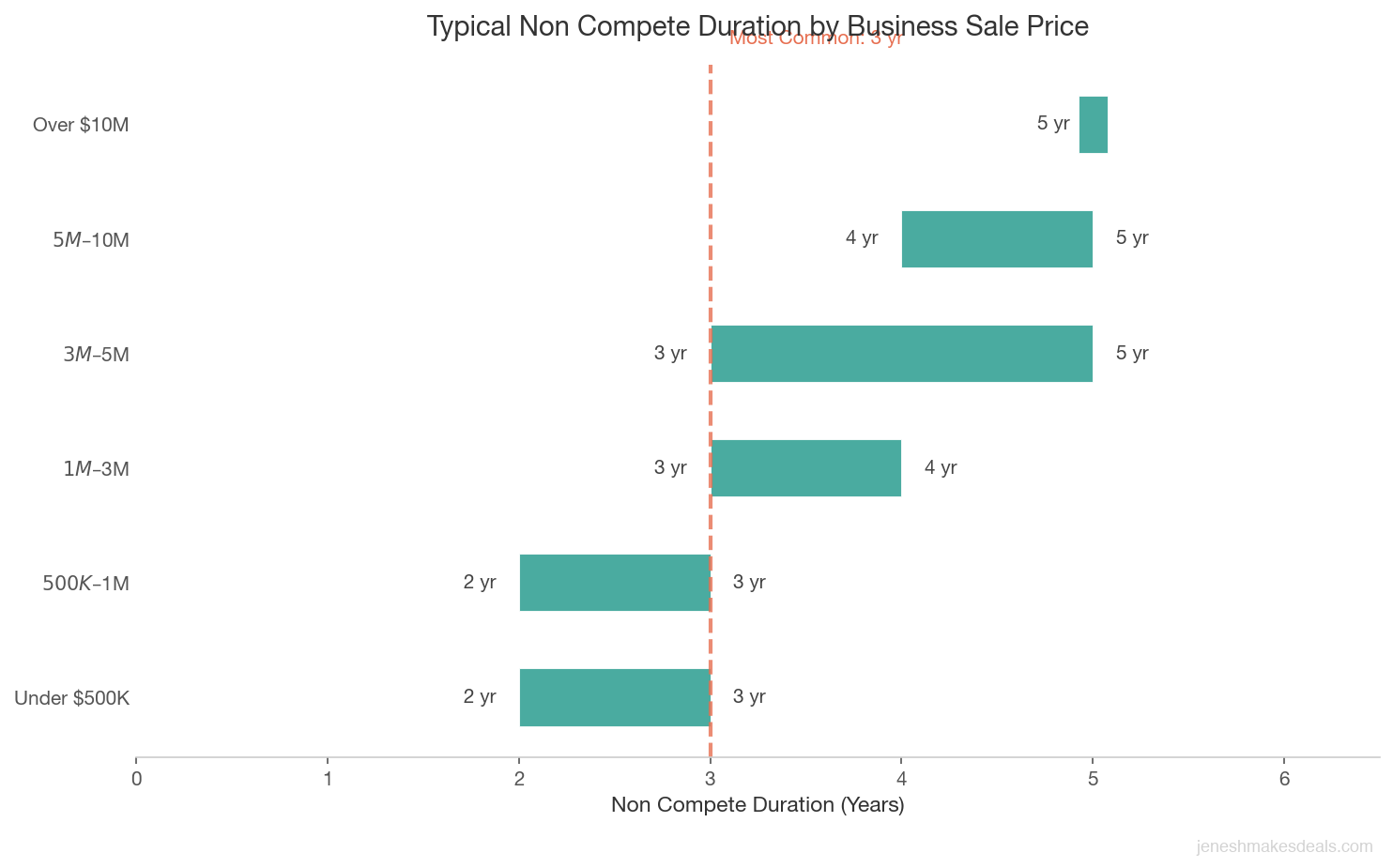
These are guidelines, not rules. A seller with deep customer relationships and a strong personal brand will face broader restrictions. A seller who's been mostly absentee will have more room to negotiate narrower terms.
How Non Compete Terms Affect Your Sale Price
Here's something most sellers don't realize. The non compete and the sale price are connected. A broader non compete can actually increase what a buyer is willing to pay for your business. A narrower non compete can decrease it.
Think about it from a valuation perspective. If a buyer knows you're locked out of the industry for 5 years in the entire state, they can confidently project that your customers will stay. That confidence translates into a higher valuation multiple. If the non compete is only 2 years and 10 miles, the buyer has to account for the very real possibility that you'll set up shop nearby and pull customers back.
I've seen this play out in purchase price negotiations. A seller wanted a narrow non compete (2 years, 15 mile radius). The buyer responded by reducing their offer by $150,000, roughly 15% of the purchase price. The seller eventually agreed to a 3 year, 40 mile radius restriction and got the original price. The extra year and wider geography were worth $150,000 to the buyer, and the seller had no actual plans to compete in that area anyway.
Thinking about what your business is worth? Use our free business valuation calculator to get a baseline estimate before entering negotiations.
Think about the non compete early, not as a last minute detail during closing. If you know you're never going to compete in the same industry, agreeing to broader terms can be a bargaining chip. If you want to stay in the industry, factor that into your price expectations.
What You're Actually Giving Up
When you sign a non compete, you're giving up real future options. Sellers sometimes treat it abstractly, but it has concrete consequences.
You can't start a competing business. This is the obvious one. If you sold your auto repair shop with a 3 year, 30 mile non compete, you cannot open another auto repair shop within that zone for 3 years. Period. Even if you find the perfect location, even if a customer begs you to, even if you have a better business model in mind.
You may not be able to work in the industry. Depending on how broad the scope is, you might not be able to take a job at a competing business either. Some non competes restrict ownership and employment. If the language says "engage in any capacity," that includes being an employee, consultant, or advisor.
You can't solicit your old customers. Most non competes include a non solicitation clause (more on this below). You can't reach out to customers you sold to the buyer and invite them to a new venture. You can't email your old customer list.
You limit your consulting and advisory options. If you planned to consult in your industry after selling, a broad non compete can shut that down. I've seen sellers who planned to advise other business owners in the same space realize they couldn't without risking a breach.
You restrict your investment options. Some non competes prevent you from investing in competing businesses. If you planned to use sale proceeds to invest in a competitor or a startup in the same space, a broadly drafted non compete could block that.
None of this means you shouldn't sign a non compete. It means you should sign one with open eyes and negotiate terms that match the buyer's legitimate needs without unnecessarily limiting your future.
Before you negotiate a single term, write down exactly what you want to do for the next 5 years after closing. If you can't answer that question, you're negotiating blind.
How to Negotiate Scope, Duration, and Geography
Now let's get into the actual negotiation tactics. These are the strategies I recommend to sellers.
Negotiate Duration First
Duration is usually the easiest term to negotiate. The buyer needs enough time to establish their own relationships with customers, employees, and vendors. That transition typically takes 1 to 2 years.
If the buyer asks for 5 years, counter with 2 years. Most customer relationships will have fully transitioned within 24 months. If you've agreed to a transition period (which you should), the buyer gets a head start on building those relationships while you're still involved. A good landing point for most small business deals is 3 years.
Narrow the Geographic Scope
Geographic scope is where I see sellers gain the most ground. The key argument is simple: the restriction should match the business's actual market area.
Pull your customer data before negotiations. If 95% of your customers are within 20 miles of the business, a 50 mile restriction is already generous. Present this data to the buyer.
For businesses with multiple locations, negotiate the restriction by location rather than accepting a blanket radius. If your business has three locations in different cities, the non compete should be tied to those specific markets, not a 100 mile radius around each one that covers half the state. Watch out for national restrictions on local businesses. Courts are more likely to invalidate overly broad geographic restrictions, so it's in everyone's interest to keep the scope reasonable.
Define Industry Scope Precisely
This is the most important part of the negotiation, and where sellers most often get burned. Vague language is your enemy. If the non compete says you can't "engage in any business that competes with the business sold," that's dangerously ambiguous.
Push for specific definitions. Instead of "the cleaning industry," define it as "commercial janitorial services for office buildings over 10,000 square feet." Instead of "the restaurant industry," define it as "full service dining establishments with liquor licenses in the Italian cuisine category."
Also negotiate carve outs. These are specific exceptions to the non compete. Common carve outs include:
- Passive investments. Owning less than 5% of a publicly traded company in the same industry shouldn't count as competing.
- Different business segments. If you sold a residential plumbing business, you might negotiate the right to start a commercial plumbing supply company.
- Employment in non competing roles. Teaching at a trade school in your industry or serving on a nonprofit board shouldn't be restricted.
- Geographic carve outs. If the buyer only operates in New York, you might negotiate the right to compete in California or Texas.
Put every carve out in writing in the purchase agreement. Verbal assurances from the buyer that "we won't enforce it that broadly" are worthless. If it's not in the contract, it doesn't exist.
Negotiation Leverage Points at a Glance
| What the Buyer Wants | What to Counter With | Your Leverage |
|---|---|---|
| 5 year duration | 2 to 3 years | Customer relationships transition in 12 to 24 months |
| 100 mile radius | Match actual market footprint (often 15 to 30 miles) | Present customer data showing geographic concentration |
| Broad industry scope | Specific business type only | Courts often invalidate overly broad restrictions |
| No carve outs | Passive investments, different segments, teaching | Standard in most deals; protects your earning ability |
| Non compete starts at closing | Starts after transition period ends | You're still helping the buyer during transition |
Want help structuring your deal terms? Reach out for a free consultation and I'll walk you through what reasonable non compete terms look like for your specific situation.
State by State Enforceability: Where You Sell Matters
Not all non competes are created equal, and not all states treat them the same way. Where your business is located (and where the non compete would be enforced) matters enormously.
States That Rarely Enforce Non Competes
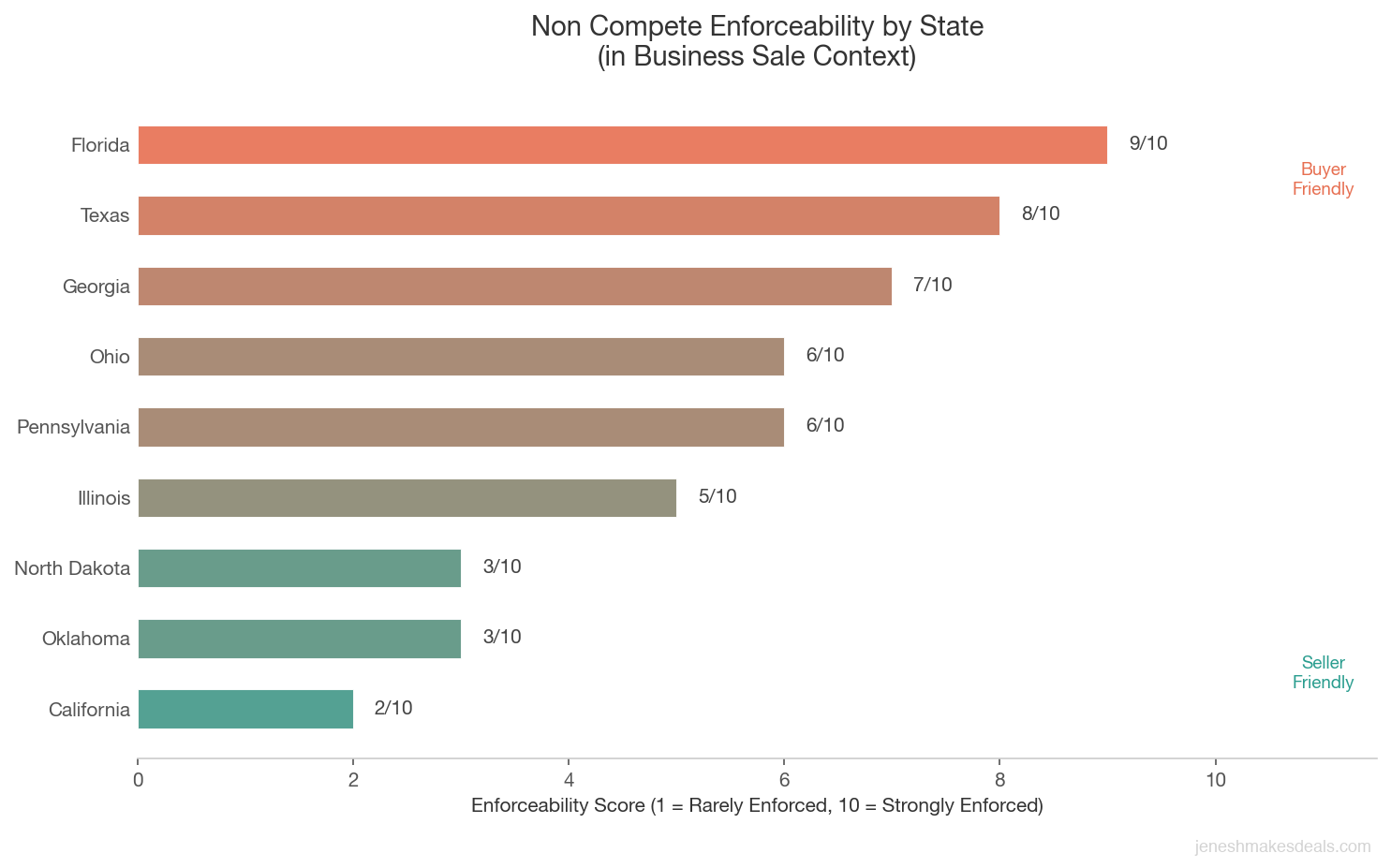
California is the most seller friendly state when it comes to non competes. California Business and Professions Code Section 16600 generally voids non compete agreements. However, there is an important exception for the sale of a business. California does allow non competes in connection with the sale of goodwill, but courts scrutinize them more heavily than in other states.
Oklahoma follows a similar approach to California, with statutory prohibitions on non competes that include a carve out for business sales.
North Dakota also restricts non compete enforcement broadly, though business sale exceptions exist.
Even in these states, sellers have more room to negotiate narrower terms because buyers know enforcement is uncertain.
States That Actively Enforce Non Competes
Texas generally enforces non competes as long as they're reasonable. Texas courts will sometimes "reform" (rewrite) an overly broad non compete to make it enforceable rather than throw it out. This means a buyer in Texas has strong protections.
Florida has one of the most pro enforcement statutes in the country. Florida Statute 542.335 creates a presumption that non competes are valid and shifts the burden to the seller to prove they're unreasonable.
Georgia, Ohio, Pennsylvania, and Illinois all enforce non competes with varying degrees of scrutiny. The definition of "reasonable" varies by state.
Recent Legislative Changes
The landscape is shifting. Several states have passed new laws restricting non competes in the employment context, though most carve out business sale non competes. In 2024, the FTC attempted to ban non compete clauses nationwide for employees, but the rule was struck down in court. Business sale non competes were explicitly excluded from the proposed ban.
The bottom line: business sale non competes remain broadly enforceable across the country. But the specific rules in your state should inform your negotiation strategy. If you're selling in California, you have more room to push for narrow terms. If you're selling in Florida, the buyer has stronger legal footing. Your attorney should know the specific case law in your state.
Non Solicitation vs Non Compete: Know the Difference
Most purchase agreements include both a non compete clause and a non solicitation clause. They're related but different, and sellers often confuse them.
Non compete: You can't start or work in a competing business. This restricts what you can do professionally.
Non solicitation: You can't actively recruit the customers, employees, or vendors of the business you sold. This restricts who you can contact.
| Feature | Non Compete | Non Solicitation |
|---|---|---|
| What it restricts | Your professional activities | Who you can contact |
| Typical duration | 2 to 5 years | 2 to 5 years |
| Geographic limits | Yes (radius, state, national) | Usually none (applies to specific people) |
| Court enforceability | Varies widely by state | Generally easier to enforce |
| Can survive if other fails | No | Yes, often enforced independently |
| Biggest risk to seller | Blocks new ventures entirely | Blocks customer and employee relationships |
Here's why the distinction matters. A non solicitation clause can survive even when a non compete is unenforceable. Courts that won't enforce a 5 year nationwide non compete might still enforce a 3 year non solicitation preventing you from poaching customers. Non solicitation clauses tend to be more specific:
- Customer non solicitation. You can't contact customers of the business you sold to offer them competing services. This usually includes customers you personally served, not every customer in the buyer's database.
- Employee non solicitation. You can't recruit or hire employees of the business you sold. The buyer doesn't want to lose their team to your new venture.
- Vendor non solicitation. Less common, but some agreements prevent you from interfering with the business's vendor relationships.
A smart negotiation strategy: if you're giving ground on the non compete, try to limit the non solicitation clause. If the buyer insists on a broad non solicitation (which protects their customer base directly), you might negotiate a narrower non compete. The buyer might agree because the non solicitation addresses their biggest concern.
One thing to watch for: "passive" contact is usually allowed even with a non solicitation clause. If a former customer reaches out to you on their own, most agreements don't prevent you from doing business with them. But get this clarified in writing. Don't assume.
What Happens If You Violate a Non Compete
I want to be straightforward about this because I've seen sellers underestimate the consequences.
Injunctive relief. The buyer can go to court and get an injunction, a court order forcing you to stop competing immediately. This can happen fast. In many states, the buyer can get a temporary restraining order within days of filing. You'd have to shut down your competing business or leave your new job while the case is pending.
Monetary damages. The buyer can sue you for the financial harm caused by your competition. If customers left because of you, the buyer can claim lost profits. These claims can be substantial.
Clawback of sale proceeds. Some purchase agreements include clawback provisions tied to the non compete. If you breach, the buyer can recover a portion of the purchase price. If part of your payment is seller financing, the buyer might stop making payments.
Legal fees. Most non compete clauses include a provision where the breaching party pays the other side's legal fees. Defending a non compete lawsuit costs $50,000 to $200,000 or more, and if you lose, you're paying for both sides.
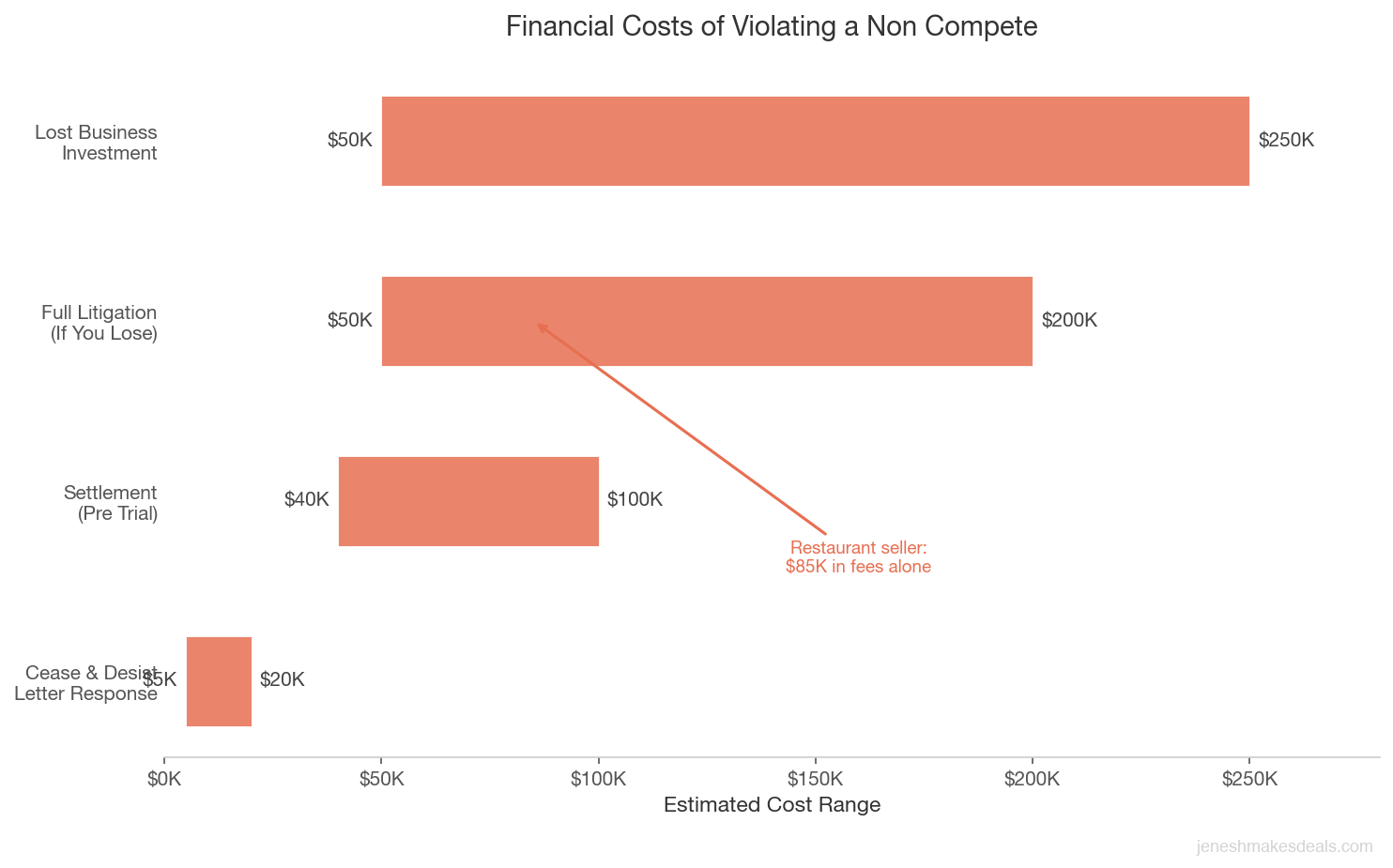
A non compete violation can cost you more than you made from the sale. Between legal fees, lost investments, and clawback provisions, the total financial exposure often exceeds $250,000.
The risk isn't theoretical. I've seen a seller open a competing restaurant 8 miles from the one he sold, within a 15 mile non compete zone. The buyer got a temporary restraining order within two weeks. He lost his entire investment in the new restaurant plus $85,000 in legal fees. Don't assume the buyer won't enforce it. They will.
Real Scenarios Where Non Competes Created Problems
Let me share some situations I've encountered that illustrate how non compete issues play out in practice.
The Seller Who Couldn't Consult
A seller sold her marketing agency for $1.2 million. The non compete restricted her from "providing marketing services of any kind" within the entire state for 4 years. She signed without pushback because she planned to retire. Eight months later, she was bored and wanted to do freelance consulting for a completely different type of client. Her attorney told her the language was broad enough that even freelance work could be a violation.
The fix: she should have negotiated specific language defining what "competing" meant. Providing marketing services to large enterprises (her agency's niche) is different from helping a friend's small business with social media.
The Seller Who Got Caught on LinkedIn
A seller sold his staffing company and signed a 3 year non compete with a non solicitation clause covering all clients and candidates in the company's database. Six months later, he posted on LinkedIn that he was "exploring new opportunities in the talent acquisition space." Three former clients reached out to him based on the post. He met with one of them over coffee.
The buyer's attorney sent a cease and desist letter, arguing that the LinkedIn post was a form of solicitation. The case never went to court, but it cost him $15,000 in legal fees to resolve.
The fix: He should have negotiated a clear definition of "solicitation" that distinguished between direct outreach and passive public statements.
The Seller Whose Partner Competed
A seller sold his 60% stake in a home services business. His former partner signed a weaker non compete with a shorter duration. The partner started a competing business after his non compete expired, and customers followed him. The buyer sued the original seller, arguing that he had "facilitated" the competition because they remained friends.
The case was dismissed, but it cost the seller $40,000 in legal fees and 18 months of stress. The fix: when multiple owners are selling, each owner's non compete terms should be coordinated, and the agreement should specify that you're not responsible for the actions of former partners.
How to Protect Yourself While Still Making the Deal Work
Let me wrap this up with practical advice for sellers heading into non compete negotiations.
Start with your post sale plans. Before you negotiate anything, figure out what you want to do after selling. If you plan to retire, a broader non compete costs you nothing. If you plan to start a new business in a related field or consult in the industry, you need to negotiate with those plans in mind.
Get your own attorney. Do not rely on the buyer's attorney to draft fair non compete terms. The buyer's attorney works for the buyer. You need your own business attorney reviewing every word, especially the definitions of "competing business," "solicit," and the geographic boundaries.
Negotiate the non compete alongside the price. Don't treat this as a separate negotiation. If the buyer wants a broader non compete, that should come with a higher price. If you want a narrower non compete, be prepared for the buyer to adjust their offer downward.
Use the transition period as a buffer. The non compete clock usually starts at closing, not at the end of the transition period. Negotiate to have it start when your transition obligations end. If you're staying on for 90 days, that effectively shortens the restriction.
Include a sunset clause for partial release. Negotiate terms where certain restrictions fall off over time. The geographic restriction might narrow from 50 miles to 25 miles after year 2. Or the industry scope might narrow after the buyer reaches a certain revenue threshold.
Specify remedies for breach. Negotiate a specific damages formula or a cap on damages if you breach. Some sellers negotiate a "cure period" where they have 30 days to stop the competing activity before the buyer can take legal action.
Get everything in writing. Every carve out, every exception, every definition. If the buyer verbally agrees that "passive investments are fine" or "consulting for nonprofits is okay," make sure it's in the purchase agreement. Verbal understandings have no value in court.
Preparing to sell your business? Schedule a free consultation and I'll help you think through the non compete and other deal terms before you start negotiating with buyers.
Final Thoughts
A non compete is a real commitment with real consequences. But it's also a negotiable part of the deal, just like the purchase price, the representations and warranties, and every other term in the purchase agreement.
The sellers who handle this well are the ones who plan ahead. They know what they want to do after the sale. They negotiate specific, measurable restrictions rather than accepting vague, sweeping language. And they have their own attorney reviewing every line.
Don't be the seller who treats the non compete as a formality and signs whatever is put in front of them. Negotiate it thoughtfully and make sure the terms you agree to are ones you can live with for the full duration.
Not sure where to start with your business sale? Use our free valuation calculator to get an estimate of what your business might be worth, then contact us to discuss the full deal structure including non compete terms. For a complete walkthrough of the selling process, grab our free Complete Guide to Selling Your Business in 2026.
Related Articles

May 1, 2026
What Happens to Accounts Receivable When You Sell
AR is one of the most negotiated items in any business sale. Here's exactly how it's handled, valued, and who collects it after closing.

April 28, 2026
What Is Representations and Warranties Insurance
R&W insurance protects buyers and sellers in business sales by covering breaches of reps in purchase agreements. Here's how it works.

April 27, 2026
How to Handle Inventory in a Business Sale
Inventory can make or break a business sale. Here's how to value it, negotiate it, and avoid the disputes that kill deals at closing.
About the Author
Jenesh Napit is an experienced business broker specializing in business acquisitions, valuations, and exit planning. With a Bachelor's degree in Economics and Finance and years of experience helping clients successfully buy and sell businesses, he provides expert guidance throughout the entire transaction process. As a verified business broker on BizBuySell and member of Hedgestone Business Advisors, he brings deep expertise in business valuation, SBA financing, due diligence, and negotiation strategies.
You might also be interested in
Free Business Calculators
Try our business valuation calculator and ROI calculator to estimate values and returns instantly.
How to Buy a Business Guide
Download our comprehensive free guide covering everything you need to know about buying a business.
Our Services
Explore our professional business brokerage services including valuations and buyer representation.
More Articles
Browse our complete collection of business brokerage insights and expertise.