

Every business owner who decides to sell faces the same question: how do I actually find a buyer?
Some people list their business on Facebook Marketplace. Others cold email private equity firms. Some try to sell from across the country without ever meeting the buyer in person. And a surprising number of owners try to sell without sharing any real financial information, hoping a buyer will just trust them.
I've seen all of these approaches. Some work in specific situations. Most don't. The method you choose to sell your business has a massive impact on your final sale price, how long it takes, and whether the deal actually closes.
After helping hundreds of business owners navigate exits, here's my honest breakdown of 7 ways people try to sell their businesses, and what the data actually shows about each one.
The 7 Methods at a Glance
Before we dive deep, here's a quick comparison of every method covered in this article.
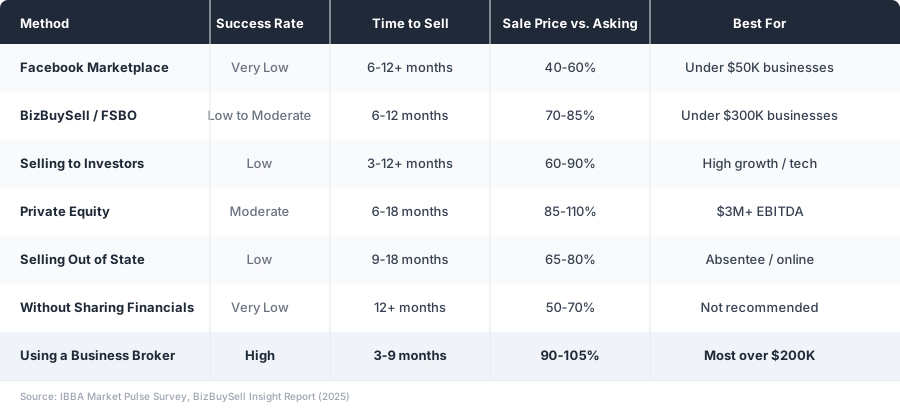
Now let's break down each one.
1. Selling Your Business on Facebook Marketplace
Yes, people actually do this. I've seen businesses listed on Facebook Marketplace right between a used couch and a 2019 Honda Civic.
How it works: You create a listing in your local Facebook Marketplace, describe the business, set a price, and wait for messages.
The reality: Facebook Marketplace is designed for consumer goods, not business transactions. The audience browsing Marketplace is looking for deals on furniture, electronics, and cars. They're not qualified business buyers with SBA preapproval letters and due diligence experience.
The biggest problems:
- Tire kickers everywhere. You'll get dozens of "is this still available?" messages from people who have no intention (or ability) to buy a business. Most don't understand what SDE means, can't get financing, and have never bought a business before.
- No confidentiality. Your business name, location, and financial details are visible to anyone scrolling Facebook. Your employees, customers, and competitors can all see that you're selling. This is one of the fastest ways to destroy the value of your business before you even find a buyer.
- No buyer qualification. There's no way to verify if someone can actually afford your business. You'll spend weeks going back and forth with people who can't secure financing.
- Massive price discounts. Marketplace buyers expect deals. The few legitimate offers you get will typically be 40-60% of what your business is actually worth [1].
When it might work: If you're selling a very small business (under $50,000), like a mobile detailing operation or a small vending route, Facebook Marketplace can generate local interest. But for anything substantial, you're wasting time and risking confidentiality.
My take: Don't do this. Selling a business on Facebook Marketplace is like trying to sell a house by taping a "For Sale" sign on a grocery store bulletin board. The audience is wrong, the format is wrong, and you'll attract the wrong kind of attention.
2. Listing on BizBuySell or BizQuest Yourself (FSBO)
This is the "For Sale By Owner" approach for businesses. You pay $59-$99 for a listing on an online business marketplace and handle everything yourself.
How it works: You create a listing on BizBuySell, BizQuest, or similar platforms. You write the description, set the price, and respond to buyer inquiries directly.
The reality: Online marketplaces are a step up from Facebook because the audience is at least looking for businesses. But selling FSBO means you're handling valuation, marketing, buyer screening, negotiations, due diligence, and legal coordination on your own.
The biggest problems:
- Pricing mistakes. Without professional valuation experience, most FSBO sellers either overprice (scaring away buyers) or underprice (leaving money on the table). According to the IBBA, FSBO sellers receive an average of 15-25% less than broker assisted sales [2].
- Screening fatigue. You'll spend hours fielding calls and emails from unqualified buyers. On BizBuySell, roughly 90% of inquiries come from people who are "just looking" or can't qualify for financing [3].
- Negotiation disadvantage. Buyers who find FSBO listings know you're not represented. They'll negotiate harder, and you won't have an experienced negotiator in your corner.
- Deal fall through. FSBO deals fall apart at a much higher rate because sellers don't know how to manage due diligence, navigate financing contingencies, or handle the legal paperwork.
When it might work: If your business is simple, priced under $300,000, you have transaction experience, and you're not in a rush. I wrote a more detailed comparison in my business broker vs. marketplace guide.
Want to know what your business is actually worth before listing it anywhere? Use our free business valuation calculator to get a realistic range based on your industry's SDE multiples.
3. How to Sell Your Business to Investors
Some business owners skip traditional sales channels and go straight to investors. They pitch their business like a startup seeking funding, hoping an angel investor or venture capital firm will acquire them.
How it works: You identify investors, prepare a pitch deck, and reach out via cold email, LinkedIn, or warm introductions. You present your business as an investment opportunity.
The reality: Most investors aren't looking to buy small businesses. Angel investors want equity in high growth startups. Venture capital firms want scalable technology companies. Neither is looking for a profitable plumbing company or a restaurant doing $800K in revenue.
The biggest problems:
- Wrong audience. Traditional investors evaluate businesses on growth potential and scalability. If your business is a stable, profitable operation (which is exactly what makes it valuable to individual buyers), investors will pass because the growth story isn't exciting enough.
- Valuation mismatch. Investors value businesses using different metrics than business buyers. They focus on revenue multiples, growth rates, and total addressable market. A business buyer focuses on SDE, cash flow, and return on investment. These frameworks produce very different numbers.
- Long timelines. Investor outreach is a numbers game. You might email 100 investors and get 5 responses, 2 meetings, and 0 offers. The process can drag on for months with nothing to show for it.
- Information exposure. Every investor you pitch gets access to your financials, customer data, and competitive information. Without proper NDAs and deal structure, you're sharing sensitive information with people who may never buy.
When it might work: If your business is in a high growth sector (tech, SaaS, healthcare), generates $2M+ in revenue, and has a clear growth trajectory, strategic investors or search fund operators might be interested. But you need warm introductions, not cold emails.
4. How to Sell Your Business to Private Equity
Private equity is the goal for many business owners. PE firms pay premium prices, and getting acquired by private equity sounds impressive. But the reality is more complicated than most sellers expect.
How it works: Private equity firms use investor capital to acquire businesses, grow them (often through add on acquisitions), and sell them at a higher valuation in 3-7 years.
The reality: PE firms have very specific criteria. Most target businesses with at least $1-3M in EBITDA, strong management teams that will stay post acquisition, and a clear path to growth. If your business doesn't check all of those boxes, PE firms won't take the meeting.
The biggest problems:
- Size threshold. Most PE firms won't look at businesses under $1M EBITDA, and many have minimums of $3-5M. If your business generates $500K in SDE, private equity isn't your buyer. Use our SDE calculator to see where you stand.
- Earn-out structures. PE firms rarely pay 100% cash at close. They typically structure deals with 60-70% cash at closing and 30-40% in earn outs tied to future performance. If the business underperforms after the sale (even if it's no longer under your control), you lose that earn out.
- You're probably staying. Most PE acquisitions require the owner to stay on for 2-3 years as a manager. If you're selling because you want to move on, PE deals can feel like you sold your business but kept your job.
- Due diligence is brutal. PE firms conduct extensive due diligence that can take 3-6 months. They'll examine every contract, every customer relationship, every financial statement going back 3-5 years. Many deals die during this phase.
When it might work: If your business has $1M+ EBITDA, a management team that can operate without you, consistent growth, and you're open to staying on for a transition period. PE can be the highest-value exit, but only for businesses that meet the criteria.
5. How to Sell Your Business From Out of State
Absentee ownership is increasingly common, especially for franchise businesses and online companies. But selling a business you're managing remotely creates unique challenges.
How it works: You list and market your business while living in a different state. Buyer meetings, property tours, and negotiations happen remotely or through intermediaries.
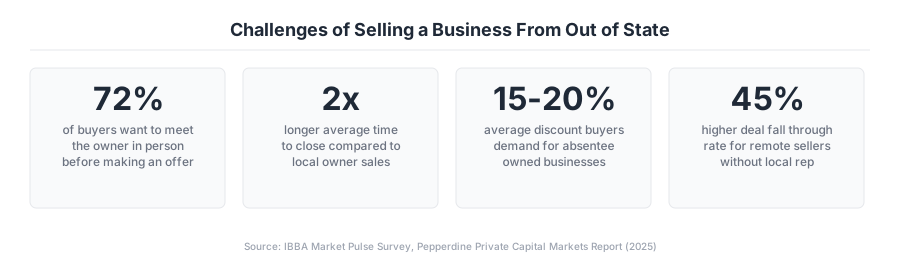
The reality: Buyers want to meet the owner, walk the property, observe operations, and talk to employees. When you're 1,000 miles away, trust becomes a major issue. Buyers wonder: if the owner doesn't need to be here, is the business really as strong as they claim?
The biggest problems:
- Trust gap. Buying a business is a massive financial decision. Buyers want to look you in the eye, see the operation firsthand, and gauge your honesty. Zoom calls don't build the same level of trust.
- Operational questions. Buyers will have questions that only on the ground observation can answer. How busy is the location during lunch? How do employees interact with customers? What's the neighborhood like? You can't answer these from another state.
- Transition complexity. Training a new owner is hard enough when you're local. Doing it remotely is exponentially harder. Buyers know this and will either demand a longer transition period or discount the price.
- Legal complications. Selling a business across state lines introduces additional legal considerations: different state regulations, tax implications, and licensing requirements.
When it might work: If your business genuinely runs without you (documented systems, strong management team, consistent revenue without owner involvement) or if it's an online business where location doesn't matter. Having a local broker represent you eliminates most of these challenges. For more on whether you should hire a broker, I wrote a complete guide.
6. How to Sell Your Business Without Sharing Everything
This is more common than you'd think. Business owners want to sell, but they don't want to share their financials, customer lists, trade secrets, or operational details with strangers. The fear is understandable: what if a "buyer" is actually a competitor fishing for information?
How it works: Sellers try to market their business with minimal information. They share general descriptions, rough revenue ranges, and industry category, but withhold specifics until they feel comfortable with a buyer.
The reality: No serious buyer will make an offer without seeing detailed financials. Imagine buying a house without a home inspection. That's what you're asking a buyer to do when you withhold information.
The biggest problems:
- Serious buyers walk away. Qualified buyers who have done this before know what they need to evaluate a business. If you won't share financials, they assume you're hiding something and move on to the next opportunity.
- Only bad buyers remain. The buyers who are willing to make offers without seeing financials are either unsophisticated (and the deal will fall apart later) or they're planning to lowball you and renegotiate after they finally see the numbers.
- Massively lower valuations. Withholding information increases perceived risk. Buyers compensate for uncertainty by discounting their offers. Businesses sold with limited disclosure typically sell for 30-50% less than comparable businesses with full transparency [4].
- Extended timelines. The back and forth of slowly releasing information drags out the process. What should take 3-6 months stretches to 12+ months because every stage involves a negotiation about what information to share.
The right way to handle confidentiality: Use proper NDAs, work with a broker who can vet buyers before sharing sensitive information, and release information in stages (general overview first, detailed financials after buyer qualification). This is exactly what a good broker manages for you. Read more about what a business broker actually does in my guide.
When it might work: It never works well if you refuse to share financials entirely. But phased disclosure with proper legal protections is standard practice and works perfectly. The key is controlling who sees your information and when, not withholding it altogether.
7. Using a Business Broker
I'm obviously biased here since I am a business broker. But the data supports this approach for most businesses, and I'll explain why.
How it works: You hire a business broker who handles valuation, marketing, buyer screening, negotiations, due diligence coordination, and closing. Brokers typically charge 8-12% commission on the sale price for businesses under $2M, with fees decreasing on a sliding scale for larger transactions [5].
The reality: A good broker manages every aspect of the sale so you can keep running your business. They maintain confidentiality, qualify buyers before sharing information, negotiate on your behalf, and coordinate the entire transaction through closing.
Why it works:
- Higher sale prices. According to the IBBA, broker assisted sales close at an average of 10-25% higher than FSBO transactions [2]. On a $1M business, that's $100,000-$250,000 more, even after paying broker commissions.
- Faster closings. Broker assisted sales close in an average of 6-9 months, compared to 9-14 months for FSBO sales [3]. Time is money when you're trying to exit.
- Confidentiality protection. Brokers market your business without revealing its identity. Buyers sign NDAs before receiving any information. Your employees, customers, and competitors don't know you're selling.
- Buyer qualification. Brokers verify that buyers have the financial capacity to complete the purchase before you waste time on meetings and negotiations.
- Deal structure expertise. Brokers help structure deals that work for both parties, including SBA loan financing, seller financing, and earn outs. They know what lenders require and what buyers will accept.
The cost: Commission rates vary, but for most small business sales, expect 8-12%. On a $1M sale with a 10% commission, you'd pay $100,000. But if the broker gets you 15% more than you'd get on your own, you net $50,000 more even after fees. I break down the full cost structure in my guide to business broker fees.
When it might not make sense: If your business is very small (under $100K), the commission might not justify the cost. In that case, a marketplace listing with a business attorney reviewing your documents could work.
Who Buys Your Business? Buyer Quality by Channel
The method you use to sell doesn't just affect your timeline and price. It determines the quality of buyers you attract.
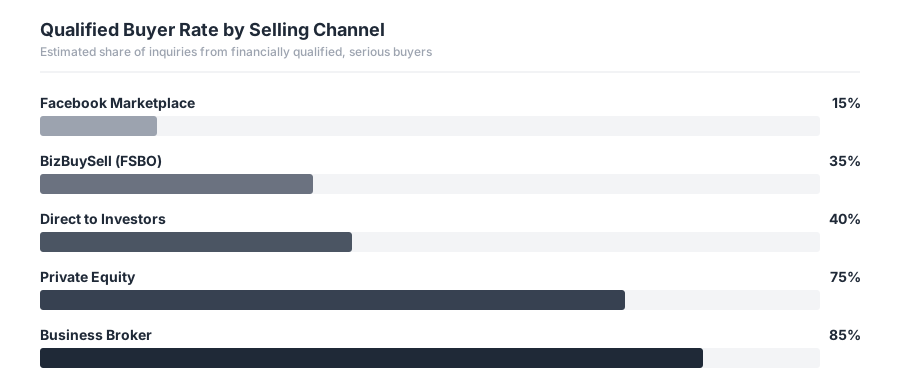
The difference is dramatic. When you list on Facebook Marketplace, maybe 1 in 7 people who message you can actually afford to buy a business. When a broker screens buyers before sharing your information, that ratio flips to 5 or 6 out of 7.
Which Method Is Right for Your Business?
The right method depends on three things: your business size, your timeline, and your tolerance for managing the process yourself.
Under $100K business value: Marketplace listings (BizBuySell, not Facebook) combined with a business attorney can work. The broker commission on a small deal may not justify the cost.
$100K-$500K business value: A broker is almost always worth it. The commission pays for itself through higher sale prices and faster closings. This is the sweet spot where broker expertise makes the biggest difference.
$500K-$5M business value: Definitely use a broker. Deals at this size involve SBA financing, complex negotiations, and extended due diligence. You need professional guidance. Use our SBA loan calculator or DSCR calculator to understand how buyers will evaluate your deal.
$5M+ business value: Consider an M&A advisor or investment banker in addition to or instead of a traditional broker. At this level, you may attract PE interest and need someone who understands institutional transactions.
Common Mistakes Sellers Make Choosing a Method
Mistake 1: Choosing based on cost, not outcome. Listing on Facebook is free. BizBuySell is $59. A broker costs 8-12%. But the "cheapest" option often results in the lowest sale price. A broker who costs $100,000 in commission but gets you $200,000 more than you'd get on your own is saving you money, not costing you money.
Mistake 2: Trying multiple methods simultaneously. Listing on Facebook, BizBuySell, emailing investors, AND talking to brokers at the same time creates chaos. You'll have conflicting conversations, confidentiality breaches, and buyers who find multiple listings and question why you're so desperate to sell.
Mistake 3: Skipping valuation before choosing a method. You can't pick the right selling method without knowing what your business is worth. A $50K mobile detailing business and a $2M HVAC company need completely different approaches. Start with a business valuation to understand where you stand.
Mistake 4: Prioritizing speed over price. Some sellers want to close fast and choose whatever method seems quickest. But rushing a sale typically costs 15-30% of the final price. Three extra months of patience can mean hundreds of thousands more in your pocket.
Frequently Asked Questions
Can I sell my business on Facebook Marketplace?
Technically yes, but it's not recommended for businesses worth more than $50,000. The audience isn't qualified, there's no confidentiality protection, and you'll attract mostly tire kickers. For serious business sales, use proper business marketplaces or work with a broker.
How do I sell my business to private equity?
Your business typically needs at least $1-3M in EBITDA to attract PE interest. If you meet that threshold, a broker or M&A advisor with PE relationships is the best path. Cold emailing PE firms rarely works because they receive hundreds of pitches monthly and prioritize deals from trusted intermediaries.
Can I sell my business without sharing my financials?
Not effectively. Serious buyers require detailed financial information to make offers and secure financing. The right approach is phased disclosure with proper NDAs, not withholding information entirely. A broker can manage this process so your sensitive information only goes to verified, qualified buyers.
What's the best way to sell a business from out of state?
Hire a local broker who can represent you on the ground. They handle property tours, buyer meetings, and negotiations in person while you manage your end remotely. Without local representation, expect longer timelines and lower offers.
Should I use a broker to sell my business?
For most businesses worth $100,000 or more, yes. Broker assisted sales close faster, at higher prices, and with better confidentiality protection. I wrote a complete guide on this question that covers when brokers make sense and when they don't.
The Bottom Line
There's no shortage of ways to try to sell your business. But most sellers who go the DIY route end up spending months chasing unqualified buyers, making pricing mistakes, and leaving money on the table.
The data is clear: broker assisted sales close faster, at higher prices, and with fewer deal fall throughs than any other method [2][3]. The commission pays for itself in the majority of transactions.
If you're thinking about selling and want to understand what your business is worth, start with our free valuation calculator. And if you want to talk through your options with someone who's helped hundreds of business owners navigate exits, reach out for a free confidential consultation. No pressure, no commitment. Just honest guidance on the best path for your specific situation.
Want the full playbook? Download our free Complete Guide to Selling Your Business in 2026 for 10 chapters covering valuation, preparation, negotiation, closing, and tax planning.
Sources:
[1] National Association of Realtors (NAR), "Business Sales Through Non-Traditional Channels" (2025)
[2] International Business Brokers Association (IBBA), Market Pulse Survey (2025)
[3] BizBuySell Insight Report, Annual Business Sales Data (2025)
[4] Pepperdine Private Capital Markets Report (2025)
[5] IBBA & M&A Source, Broker Commission Survey (2025)
Related Articles

March 28, 2026
Why Business Owners Need to Sell 2 Years Before They Retire
Most owners wait too long to sell. Here is why starting the exit process 2 years before retirement leads to better prices and smoother transitions.

February 1, 2026
What Happens After You Hire a Business Broker: Full Timeline
The real selling a business timeline from listing to close. Here is what your broker does at each stage and what to expect month by month.

January 29, 2026
How to Sell Your Business Fast in 2026
Want to sell your business fast in 2026? Real timelines, pricing strategies, and what makes buyers move quickly.
About the Author
Jenesh Napit is an experienced business broker specializing in business acquisitions, valuations, and exit planning. With a Bachelor's degree in Economics and Finance and years of experience helping clients successfully buy and sell businesses, he provides expert guidance throughout the entire transaction process. As a verified business broker on BizBuySell and member of Hedgestone Business Advisors, he brings deep expertise in business valuation, SBA financing, due diligence, and negotiation strategies.
You might also be interested in
Free Business Calculators
Try our business valuation calculator and ROI calculator to estimate values and returns instantly.
How to Buy a Business Guide
Download our comprehensive free guide covering everything you need to know about buying a business.
Our Services
Explore our professional business brokerage services including valuations and buyer representation.
More Articles
Browse our complete collection of business brokerage insights and expertise.