

A 10% commission on a $500,000 business is $50,000. That number stops a lot of business broker fees conversations cold. You built this thing from nothing, and now someone wants $50,000 just to help you sell it?
I get it. But before you close this tab, look at the math.
ClearlyAcquired's research shows that businesses sold with professional broker representation sell for 6% to 25% more than those sold by owners directly [1]. On a $500,000 business, even the low end of that range (6%) puts $30,000 back in your pocket. At the high end (25%), you net $125,000 more. That $50,000 commission starts looking less like a cost and more like an investment with a 60% to 150% return.
I am Jenesh Napit, and I broker business sales every day. I have seen every fee structure, every negotiation tactic, and every listing agreement trap. This post breaks down every dollar so you can walk into a broker meeting knowing exactly what to expect and what to push back on.
Here is what this guide covers:
- The standard commission runs 8% to 12% for businesses under $1M, dropping to 2% to 6% for deals above $5M.
- 50% of brokers use the Lehman Formula or a variation. Another 33% use a flat percentage, and 17% use an accelerator model.
- Businesses sold with a broker sell for 6% to 25% more than those sold by owner, according to ClearlyAcquired.
- Total transaction costs beyond the commission add 5% to 10% to your overall expenses.
How Much Do Business Broker Fees Cost by Deal Size?
The short answer: it depends on your deal size. Here is the breakdown based on current industry data from the IBBA Market Pulse survey, BizBuySell, and Axial's annual fee guide [2][3][4]:
| Deal Size | Typical Commission Range | Common Structure | Blended Rate |
|---|---|---|---|
| Under $1M | 8% to 12% | Flat percentage | ~10% |
| $1M to $2M | 6% to 10% | Double Lehman or flat | ~8% |
| $2M to $5M | 5% to 8% | Double Lehman | ~6% |
| $5M to $10M | 4% to 6% | Lehman or Double Lehman | ~5% |
| $10M to $25M | 2% to 4% | Lehman or custom | ~3% |
| $25M+ | 1% to 4% | Custom negotiated | ~2% |
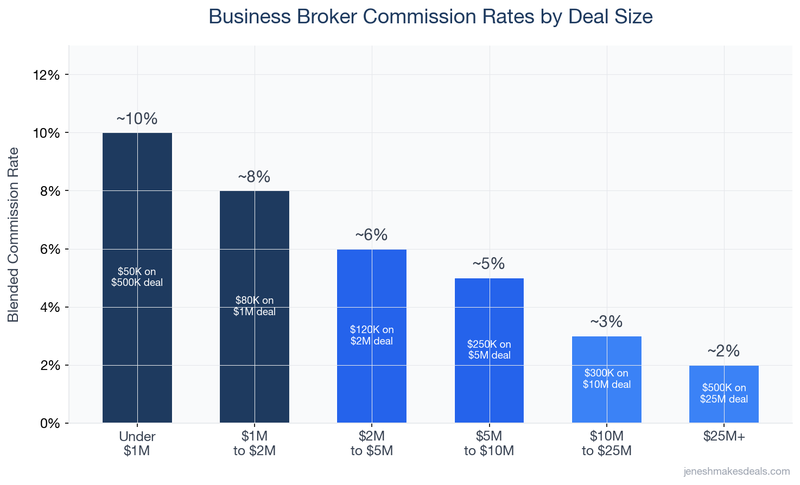
The pattern is straightforward: the larger your business, the lower the percentage. But the broker earns more on larger deals because the total dollar amount is higher. A 10% commission on a $500,000 deal is $50,000. A 3% commission on a $10M deal is $300,000.
Why Small Business Commissions Are Higher
If you own a business under $1M, you are probably looking at a 10% commission. That feels steep compared to the 2% to 4% rate quoted for larger transactions.
Here is the reality most owners do not think about: the broker does roughly the same work regardless of deal size. They still value your business, create marketing materials, screen buyers, negotiate offers, and coordinate the closing. A $50,000 fee on a $500,000 deal barely covers 6 to 12 months of active effort.
I had a bakery owner in Bergen County ask me why she was paying the same rate as a friend who sold a $3M distribution company. She was not. Her friend paid 6%. She was looking at 10%. But the actual hours I spent on both deals were nearly identical. That is the part no one tells you. Smaller deals are not less work. They are often more work for less pay, which is exactly why brokers set the rate where they do.
For businesses valued under $100,000, most brokers skip the percentage model entirely and charge a flat fee of $10,000 to $15,000 [5]. Even a 12% commission on an $80,000 sale would only generate $9,600, which is not enough to justify the time investment.
Average Commissions on Closed Deals
BizBuySell's 2025 Year in Review reports 9,586 small business transactions with a median sale price of $350,000 and an average sale to asking price ratio of 94% [6]. Industry sources consistently place the average commission paid at 10% to 12% for businesses under $1M and 5% to 8% blended for deals in the $1M to $5M range.
The IBBA's Market Pulse data confirms that Main Street businesses (sub $2M) achieved 94% of asking prices in Q1 2025 [2]. That matters because it shows brokers are pricing businesses accurately and buyers are paying close to asking.
The Lehman Formula: How Most Business Broker Commissions Work
If your business is worth more than $1M, you will likely encounter the Lehman Formula or one of its variations. You need to understand how this works before you sit down with anyone. If you are still deciding whether to hire a broker in the first place, read our full guide on whether you need a broker to sell your business.
The Original Lehman Formula (5-4-3-2-1)
Created by Lehman Brothers as a standardized method for calculating transaction fees [7]:
- 5% on the first $1 million
- 4% on the second $1 million
- 3% on the third $1 million
- 2% on the fourth $1 million
- 1% on everything above $4 million
On a $5 million deal, this produces a total fee of $150,000 (a blended rate of 3%).
The Double Lehman Formula (10-8-6-4-2)
Also called the "Modern Lehman," this version has largely replaced the original to account for decades of inflation [4][8]:
- 10% on the first $1 million
- 8% on the second $1 million
- 6% on the third $1 million
- 4% on the fourth $1 million
- 2% on everything above $4 million
On the same $5 million deal, the Double Lehman yields a total fee of $300,000 (a blended rate of 6%). This formula is common in lower middle market transactions because those deals take longer to close and involve more complexity.
Which Formula Will Your Broker Use?
According to Axial's annual fee guide survey, 50% of M&A advisors and brokers use the Lehman Formula or a variation, 33% use a flat percentage (a straight 5% of purchase price, for example), and 17% use an accelerator structure where fees increase as the deal size grows [4].
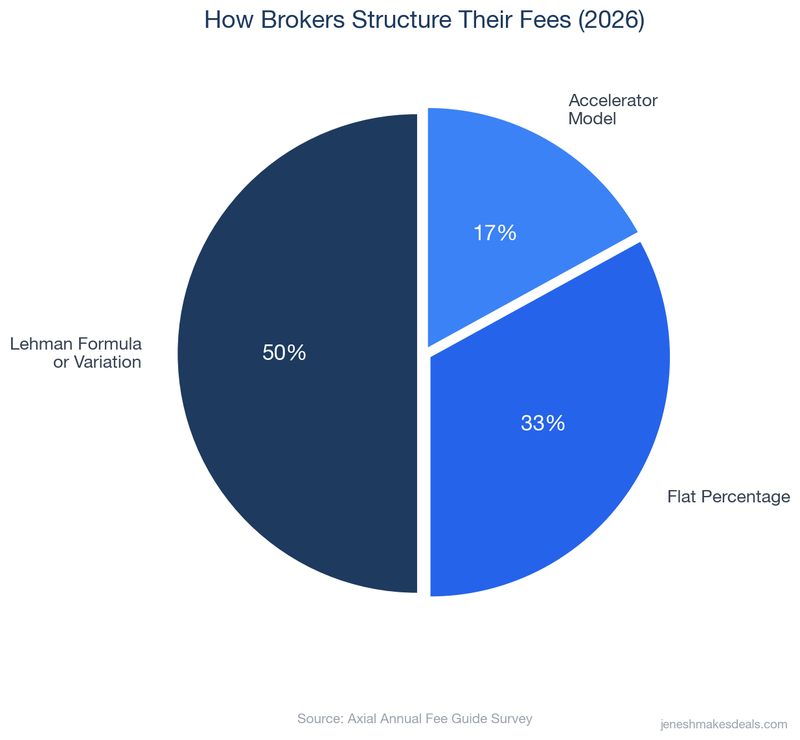
The formula matters less than the total dollar amount. Always ask for the blended rate on your expected sale price.
Example: You own a $3M manufacturing business. A broker proposes the Double Lehman. Here is what you actually pay: 10% on the first $1M ($100,000) + 8% on the second $1M ($80,000) + 6% on the third $1M ($60,000) = $240,000 total, or an 8% blended rate. Know that number before you sign anything.
Want to see what those numbers look like for your specific deal size? Run the math through our free business calculators to estimate your net proceeds under different fee structures.
Fee Structures Beyond the Commission
The commission is the biggest cost, but not the only one. Most owners I talk to are surprised by how much they spend outside the commission itself. You need to budget for the full picture.
Upfront Retainers and Engagement Fees
Upfront retainers are increasingly common, particularly in the lower middle market. According to Axial's survey data [4]:
- 35% of brokers charge a one time fixed retainer fee
- 36% use monthly or milestone based retainer structures
- 24% of firms charge no retainer at all, relying entirely on success fees
- Only 6% use milestone based billing (payment at CIM creation, LOI execution, etc.)
For Main Street businesses, retainers typically range from $10,000 to $25,000. For M&A advisory engagements, retainers can exceed $50,000. For transactions over $25 million, retainers often range from $50,000 to $250,000, frequently billed monthly.
Here is the key detail: in most cases, retainer fees are credited toward the success fee at closing. A $20,000 retainer reduces a $200,000 success fee to $180,000. But this is not always the case. I sat with a dry cleaning chain owner in Fairfield County last year who signed an agreement without reading the retainer terms. His $15,000 retainer was non refundable and not credited toward the final fee. He paid $15,000 on top of the full commission.
Ask upfront whether the retainer is credited or treated as a separate, non refundable fee. Get it in writing.
Monthly Retainer Fees
Monthly retainer fees vary by deal size [4]:
- 7 figure deals: $500 to $5,000 per month
- 8 figure deals: $5,000 to $15,000+ per month
About 19% of advisors and brokers set their monthly retainer at less than $5,000. Main Street brokers rarely charge monthly retainers, with most working on straight commission.
Marketing, Listing, and Advertising Fees
Beyond retainers, expect additional costs:
- Marketing packages (professional photography, video tours, targeted advertising): $2,000 to $5,000
- Business listing fees (if using online marketplaces directly): $66 to $260/month on BizBuySell [9]
- Confidential Information Memorandum (CIM) preparation: Often included in the retainer or commission, but sometimes billed separately at $1,000 to $5,000
Most brokers include basic marketing in their commission, but premium marketing packages are charged separately. If you are weighing whether a broker or an online marketplace is the better fit for your sale, we break down the full comparison of brokers vs marketplaces here.
Success Fee Minimums
Most brokers set minimum success fees of $10,000 to $25,000 for Main Street deals. Larger franchise firms like Transworld Business Advisors, Sunbelt Business Brokers, and VR Business Brokers set minimums at $50,000 or higher [5].
These minimums protect the broker if your business sells for less than expected. If you own a $300,000 business and your broker has a $25,000 minimum fee, that is effectively an 8.3% commission floor. Make sure you understand the minimum before signing.
What Is Included in a Broker's Fee (And What Is Not)
What Your Commission Typically Covers
A full service business broker's commission generally includes [5][3]:
Valuation and Preparation
- Business assessment and Broker's Opinion of Value
- Financial analysis and recast of financial statements
- Identification of deal structure options to minimize tax liability
Marketing and Buyer Outreach
- Development of a Confidential Information Memorandum (CIM)
- Listing on business for sale marketplaces and industry publications
- Targeted outreach to strategic and financial buyers
- Confidentiality management through NDAs and blind profiles
Buyer Management and Closing
- Pre qualification of all buyers (financial capability, background, experience)
- Coordination of buyer meetings and negotiations
- Due diligence coordination and document management
- Communication management between attorneys, accountants, and lenders
- Closing logistics and post close transition support
That is 6 to 12 months of active work for one fee. For a deeper look at each of these services, read our full guide on a business broker's role in selling your business. When sellers tell me the commission is too high, I walk them through this list and ask which items they want to handle themselves. That conversation usually ends quickly.
What You Pay Separately
These costs fall outside the broker's commission:
| Expense | Typical Cost Range |
|---|---|
| Legal fees (small deals) | $5,000 to $15,000 |
| Legal fees (larger M&A) | $10,000 to $50,000+ |
| Accounting and tax advisory | Varies by complexity |
| Escrow fees and transfer taxes | Varies by state |
| Environmental assessments (if real estate involved) | Varies |
| Machinery/equipment appraisals | Varies |
Total additional costs beyond the broker's commission can add 5% to 10% to overall transaction expenses [1]. On a $1M sale, that means an extra $50,000 to $100,000 beyond the broker's fee. Budget for it. Use our business sale cost calculator to estimate every line item before you sign a listing agreement.
Example: You sell your $1.2M logistics business with a broker charging 8% blended ($96,000). Your attorney bills $12,000, your CPA bills $4,000 for tax advisory, and escrow fees run $3,000. Your total transaction cost: $115,000, roughly 9.6% of the sale price. The broker's commission is $96,000 of that. The rest adds up faster than most sellers expect.
To understand how much you will actually walk away with after all fees, model different scenarios with our deal calculators.
FSBO vs. Broker: The Real Cost Comparison
The question behind every fee conversation is this: "Can I just sell it myself and save the commission?"
Let me be direct. Here are the numbers.
Close Rates Tell the Story
- Broker listed (accredited advisors): approximately 50% close rate, per IBBA data [2]
- All broker listed (industry wide): approximately 20% of BizBuySell listings sell annually (roughly 9,600 sales out of about 50,000 active listings) [6]
- Small businesses overall: 15% to 30% success rate, per Morgan & Westfield [10]
- FSBO: 70% of small businesses listed for sale never find a buyer, per Exit Planning Institute data [11]
ClearlyAcquired reports that sellers who go it alone face a 60% to 70% lower chance of successfully closing compared to broker represented sellers [1].
That is the single most important statistic in this post. You can negotiate the best commission rate in the world, but it means nothing if your business never sells.
Sale Price Differential
The price gap between broker assisted and FSBO sales is real. ClearlyAcquired reports that businesses sold with professional representation fetch 6% to 25% more than those sold by owners directly [1].
The Exit Planning Institute found that businesses with proper exit planning sell for median profits of $100,000, while unplanned exits yield just $6,000 [11].
For deals that successfully closed with broker representation, nearly 47% had at least one other offer, and 40% had at least two other offers, according to the IBBA [2]. That competitive dynamic does not happen in a FSBO sale where you negotiate one on one with the only buyer who showed up.
A Real Numbers Comparison
Let me run the math on a $750,000 restaurant business, a deal size I see regularly in the tri state area.
FSBO scenario: You save the broker commission but sell for 15% less (the midpoint of the 6% to 25% range). Your sale price: $637,500. You pay $10,000 in legal fees and $3,000 in other transaction costs yourself. Net proceeds: $624,500.
Broker assisted scenario: Your business sells at full value ($750,000). Your broker charges a 10% commission ($75,000). You pay $10,000 in legal fees and $3,000 in other transaction costs. Net proceeds: $662,000.
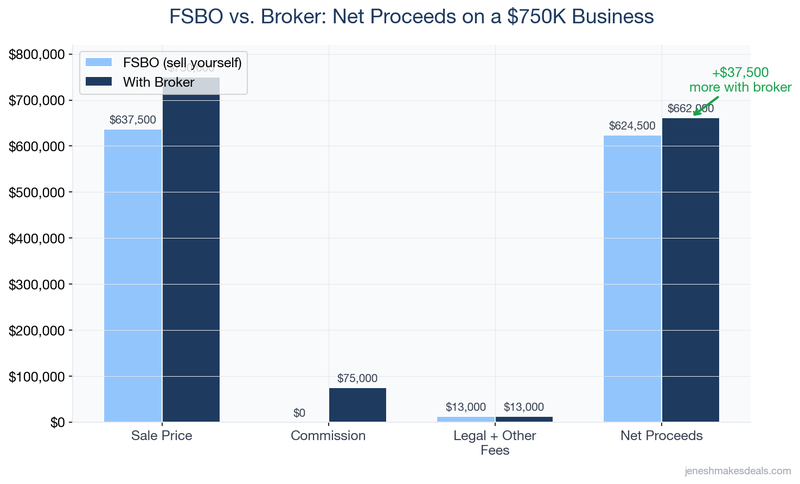
The broker scenario nets you $37,500 more. And that calculation does not account for the 20 to 30 hours per week you would spend managing the sale process yourself, the higher chance your deal falls apart without professional buyer screening, or the confidentiality risk of employees and customers finding out.
Here is what I think most owners get wrong about going FSBO: they focus entirely on the commission they save and completely ignore the price they leave on the table. I have seen this play out three times this year alone. An owner tries to sell on their own, gets one lowball offer, panics, and comes to me six months later. By that point, the business has been on the market too long, buyers are suspicious, and we are starting from a weaker position than if they had listed with a broker from day one.
The question is not "can I afford a broker?" The question is "can I afford not to use one?"
If you are leaning toward selling, the best first step is a confidential valuation. Get a free estimate of what your business is worth so you know the real numbers before making any decisions.
How to Negotiate Business Broker Fees in 2026
Broker fees are negotiable. Here is how to do it without burning the relationship.
Know What to Ask
The best way to evaluate a broker is not to shop around endlessly. It is to ask the right questions upfront. A good broker will walk you through their fee structure, explain exactly what is included, and show you comparable deals they have closed. If they cannot answer those questions clearly, that tells you everything.
What to Look For in a Fee Structure
-
Understand whether the fee is flat or tiered. Flat percentages are straightforward. Tiered structures like the Lehman Formula can work in your favor on larger deals because the blended rate decreases as the price goes up.
-
Confirm the retainer is credited toward the success fee. A $20,000 retainer that reduces your final success fee to $180,000 is very different from a $20,000 retainer on top of a $200,000 success fee.
-
Ask about minimum fee requirements. If your broker has a $50,000 minimum fee and your business sells for $400,000, you are paying an effective 12.5% commission. Know that number before you sign.
-
Look for alignment, not just the lowest rate. The cheapest broker is rarely the best one. You want someone whose fee structure incentivizes them to get you the highest possible price, not just a quick close.
Consider an Accelerator Structure
Accelerator models align your interests with your broker's. The broker gets a base fee on the sale at or below your asking price, and a higher percentage on any amount above your target [4]. For example:
- Base: 5% success fee on sale at or below $5M asking price
- Accelerator: 7% on any amount above $5M
According to Axial's data, 17% of brokers currently use accelerator fee structures [4]. This model gives the broker a financial incentive to push for the highest possible price, not just a fast close.
Here is something you are probably not hearing from other brokers: the accelerator structure is often the best deal for the seller. If your broker only gets paid more when you get paid more, your incentives are perfectly aligned. I use this structure on about a third of my deals and it works.
Before you start negotiating fees, make sure your business is in the best possible position to sell. Preparing properly can increase your sale price by 15% to 30%, which dwarfs any savings from negotiating the commission down a point or two.
Have questions about the right fee structure for your deal? Reach out for a confidential, no pressure conversation about your options.
Red Flags in Broker Fee Agreements
Before you sign a listing agreement, read every line. I have seen sellers get trapped by clauses they did not notice until it was too late.
Tail Provisions That Go Too Far
A tail provision says the broker gets paid if your business sells within a certain period after your listing agreement ends [12][13]. Fair tail provisions cover only buyers the broker introduced, over a 6 to 12 month period. Unfair tail provisions cover all buyers regardless of who introduced them, or have indefinite time periods.
I reviewed an agreement last quarter for a restaurant group owner in northern New Jersey. His tail clause covered any buyer for 24 months after termination, even buyers who found the business on their own. That is not standard. That is a trap.
Negotiate a tail period of less than six months covering only broker introduced buyers.
Other Red Flags
- Excessive upfront fees with no clear service. A $5,000 retainer with no valuation or marketing provided should raise questions.
- Automatic renewal clauses that silently extend the agreement. Miss the cancellation window and you could be locked in for another 6 to 12 months.
- Full commission due if you withdraw. Some agreements require paying the full fee if you take your business off the market, whether or not a buyer was found.
- No performance reporting. You should receive regular progress reports and buyer activity updates.
- No exclusion for pre existing buyers. If you already have a potential buyer, the agreement should address a reduced fee for that scenario.
What to Do Next
If you are reading this, you are probably getting ready to sell your business or at least seriously considering it. Here are your next steps:
-
Get a ballpark valuation. Before anything else, understand roughly what your business is worth. Use our free business valuation calculator to get an initial estimate. Knowing your approximate value lets you calculate the expected commission in real dollars, not just percentages.
-
Have an honest conversation with a broker. Ask about their fee structure, what is included, and what comparable deals they have closed in your industry. A good broker will be transparent about costs and walk you through the entire process before you commit to anything.
-
Run the math on broker vs. FSBO. Calculate what you would net with a broker versus selling on your own at a 10% to 25% lower price (based on ClearlyAcquired's data). The math usually makes the decision for you.
-
Start preparing your business now. Clean financials, documented processes, and a management team that can operate without you all increase your sale price. Planning two years ahead makes a measurable difference, as we explain in our post on why owners should start selling two years before retirement.
Here is the thing most owners get wrong: they spend all their energy negotiating the commission percentage down by a point or two and zero energy preparing the business to sell at a higher price. A 1% reduction on a $500,000 commission saves you $5,000. Increasing your sale price by 10% through proper preparation nets you $50,000. Focus on what moves the needle.
Ready to take the first step? Tell us about your business and get straight answers about your sale timeline, expected value, and what the process looks like.
Frequently Asked Questions About Business Broker Fees
What is the average business broker commission?
The average business broker commission is 8% to 12% for businesses under $1M, declining to 5% to 8% for businesses in the $1M to $5M range, and 2% to 4% for deals above $5M. According to Axial's survey, 50% of brokers use the Lehman Formula, 33% use a flat percentage, and 17% use an accelerator model [4].
Do business brokers charge upfront fees?
35% of brokers charge a one time fixed retainer fee, and 36% use monthly or milestone based retainer structures. About 24% of firms charge no retainer at all. For Main Street businesses, retainers typically range from $10,000 to $25,000. In most cases, retainer fees are credited toward the success fee at closing. Always confirm whether the retainer is credited or is a separate charge [4].
Can you negotiate business broker fees?
Yes. Effective strategies include asking about tiered success fee structures, ensuring retainer fees are credited toward the final success fee, and looking for accelerator models that align your broker's incentives with yours. The best negotiation is finding a broker whose fee structure rewards getting you the highest price [5][1].
Is it worth paying a business broker?
The data says yes for most situations. Broker assisted sales close at rates up to 50% (for accredited advisors), compared to FSBO sellers who face a 60% to 70% lower chance of closing [2][1]. Businesses sold with broker representation sell for 6% to 25% more than those sold by owners directly. On a $1M business, even a 6% price premium ($60K) offsets a large portion of a 10% commission ($100K), and a 15% premium ($150K) puts you ahead by $50K.
What is the Lehman Formula?
The Lehman Formula is a tiered commission structure: 5% on the first $1M, 4% on the second $1M, 3% on the third $1M, 2% on the fourth $1M, and 1% on everything above $4M. The Double Lehman (10-8-6-4-2) has largely replaced the original. On a $5M deal, the original Lehman produces $150,000 (3% blended), while the Double Lehman produces $300,000 (6% blended) [7][8].
How long does it take to sell a business with a broker?
The average timeline is 6 to 12 months, with 10 months being the current norm. Technology and healthcare businesses tend to sell faster (3 to 6 months), while manufacturing businesses take longer (8 to 14 months). The due diligence phase alone takes 3 to 4 months after a signed LOI [14].
What happens if my business does not sell?
If your business does not sell during the listing period, you typically owe any upfront retainer fees already paid but not the success fee. However, watch for tail provisions that could require you to pay the broker if you sell to a buyer they introduced within 6 to 12 months after the agreement ends. Some agreements also include withdrawal penalties if you take your business off the market early [12][13].
How do I know if a broker is worth their fee?
Ask for references from past clients, verify their track record of closed deals in your industry and deal size range, and confirm their professional credentials (CBI or M&A designations from the IBBA). A broker who has sold businesses similar to yours will typically deliver a higher sale price than one working outside their specialty.
Sources
[1] ClearlyAcquired, "How Much Do Business Brokers Charge? Commission Rates and Fees Explained," clearlyacquired.com
[2] IBBA, "Q2 2025 Market Pulse Survey Highlights," ibba.org
[3] IBBA, "Q3 2025 Market Pulse Highlights," ibba.org
[4] Axial, "2025 Annual Fee Guide: What Investment Bankers and M&A Advisors Charge," axial.net
[5] Morgan & Westfield, "Business Broker Fees and Commissions," morganandwestfield.com
[6] BizBuySell, "2025 Year in Review: BizBuySell Market Recap," bizbuysell.com
[7] Investopedia, "What Is the Lehman Formula?" investopedia.com
[8] Divestopedia, "Double Lehman Formula," divestopedia.com
[9] BizBuySell, "Advertise Your Business for Sale," bizbuysell.com
[10] Morgan & Westfield, "What Percentage of Businesses Listed for Sale Actually Sell?" morganandwestfield.com
[11] Exit Planning Institute, "State of Owner Readiness Survey," exit-planning-institute.org
[12] Divestopedia, "Tail Fee Provisions in Engagement Letters," divestopedia.com
[13] Exit Promise, "Listing Agreement Red Flags When Hiring a Business Broker," exitpromise.com
[14] BizBuySell, "How Long Does It Take to Sell a Business?" bizbuysell.com
Related Articles

March 28, 2026
Why Business Owners Need to Sell 2 Years Before They Retire
Most owners wait too long to sell. Here is why starting the exit process 2 years before retirement leads to better prices and smoother transitions.

February 1, 2026
What Happens After You Hire a Business Broker: Full Timeline
The real selling a business timeline from listing to close. Here is what your broker does at each stage and what to expect month by month.

January 31, 2026
7 Ways to Sell Your Business: What Works in 2026
From Facebook Marketplace to private equity, here are 7 ways to sell your business. What works, what doesn't, and what sellers get wrong.
About the Author
Jenesh Napit is an experienced business broker specializing in business acquisitions, valuations, and exit planning. With a Bachelor's degree in Economics and Finance and years of experience helping clients successfully buy and sell businesses, he provides expert guidance throughout the entire transaction process. As a verified business broker on BizBuySell and member of Hedgestone Business Advisors, he brings deep expertise in business valuation, SBA financing, due diligence, and negotiation strategies.
You might also be interested in
Free Business Calculators
Try our business valuation calculator and ROI calculator to estimate values and returns instantly.
How to Buy a Business Guide
Download our comprehensive free guide covering everything you need to know about buying a business.
Our Services
Explore our professional business brokerage services including valuations and buyer representation.
More Articles
Browse our complete collection of business brokerage insights and expertise.