

When you sell your business, the buyer is going to ask you to sign a non solicitation agreement. This is standard in virtually every business sale, and most sellers don't give it much thought. They see it as just another clause in the purchase agreement, something the lawyers handle.
But a non solicitation agreement can significantly affect what you're allowed to do after the sale. It can restrict your ability to contact former employees, customers, vendors, and business contacts for years. If you sign one without understanding the terms, you could find yourself locked out of your own professional network.
I've seen sellers sign overly broad non solicitation agreements and then realize months later that they can't even call a former employee to have lunch. I've also seen sellers who negotiated reasonable terms and maintained their professional relationships without any issues.
The difference comes down to understanding what you're agreeing to and pushing back on terms that are unreasonable.
The non solicitation agreement is one of the most overlooked documents in a business sale. Sellers who understand the terms before signing protect both their professional relationships and their financial future.
What Is a Non Solicitation Agreement
A non solicitation agreement is a contractual provision that prohibits the seller from actively reaching out to or doing business with certain people or entities after the sale. It's different from a non compete agreement, which restricts the seller from starting or working for a competing business.
Non solicitation agreements typically cover three categories:
Customer non solicitation. You agree not to contact or solicit the business's customers for a specified period after the sale. The buyer doesn't want you calling up your former clients and convincing them to follow you to a new venture.
Employee non solicitation. You agree not to recruit, hire, or attempt to lure away the business's employees. The buyer is paying for a functioning team, and losing key employees to the former owner would undermine the value of their purchase.
Vendor and supplier non solicitation. Less common, but some agreements include provisions that prevent the seller from interfering with the business's vendor relationships. If you have special pricing arrangements or exclusive deals with suppliers, the buyer wants to maintain those.
The key word here is "solicit." Most non solicitation agreements don't prevent you from responding if a customer or employee reaches out to you first. They just prevent you from initiating the contact. This distinction matters, and I'll explain why later.
Why Buyers Require Non Solicitation Agreements
Put yourself in the buyer's shoes for a moment. They've just paid you a significant amount of money for your business. The value they paid was based in part on the customer relationships, the employee team, and the vendor arrangements that come with the business.
Now imagine you turn around the day after closing and start calling your best customers to offer them a better deal at a new company. Or you recruit the general manager and two key technicians to join your next venture. The buyer's business would be gutted before they even had a chance to get settled.
That's why non solicitation agreements exist. They protect the buyer's investment by ensuring that the seller doesn't undermine the very thing they sold.
From the buyer's perspective, the non solicitation agreement is as important as the purchase price. It's part of what they're paying for. Without it, the business is worth significantly less because there's no guarantee that the customers and employees will stay.
Most buyers won't close a deal without a non solicitation agreement, and honestly, I can't blame them. If I were buying a business, I'd want the same protection.
How Non Solicitation Differs From Non Compete
Sellers often confuse non solicitation agreements with non compete agreements. They're related but different.
Non compete agreement: Prevents you from starting, owning, or working for a competing business within a defined geographic area for a specified period. A non compete is broader because it restricts your overall business activities.
Non solicitation agreement: Prevents you from actively reaching out to specific people (customers, employees, vendors) but doesn't prevent you from working in the same industry or starting a new business, as long as you don't solicit the protected parties.
| Factor | Non Solicitation | Non Compete |
|---|---|---|
| Contact former customers | Restricted | Depends on terms |
| Recruit former employees | Restricted | Depends on terms |
| Start a competing business | Allowed | Restricted |
| Work in the same industry | Allowed | Restricted |
| Attend industry events | Allowed | Depends on terms |
| Respond to inbound contact | Generally allowed | Allowed |
| Typical duration | 2 to 3 years | 2 to 5 years |
| Primary purpose | Protect relationships | Prevent direct competition |
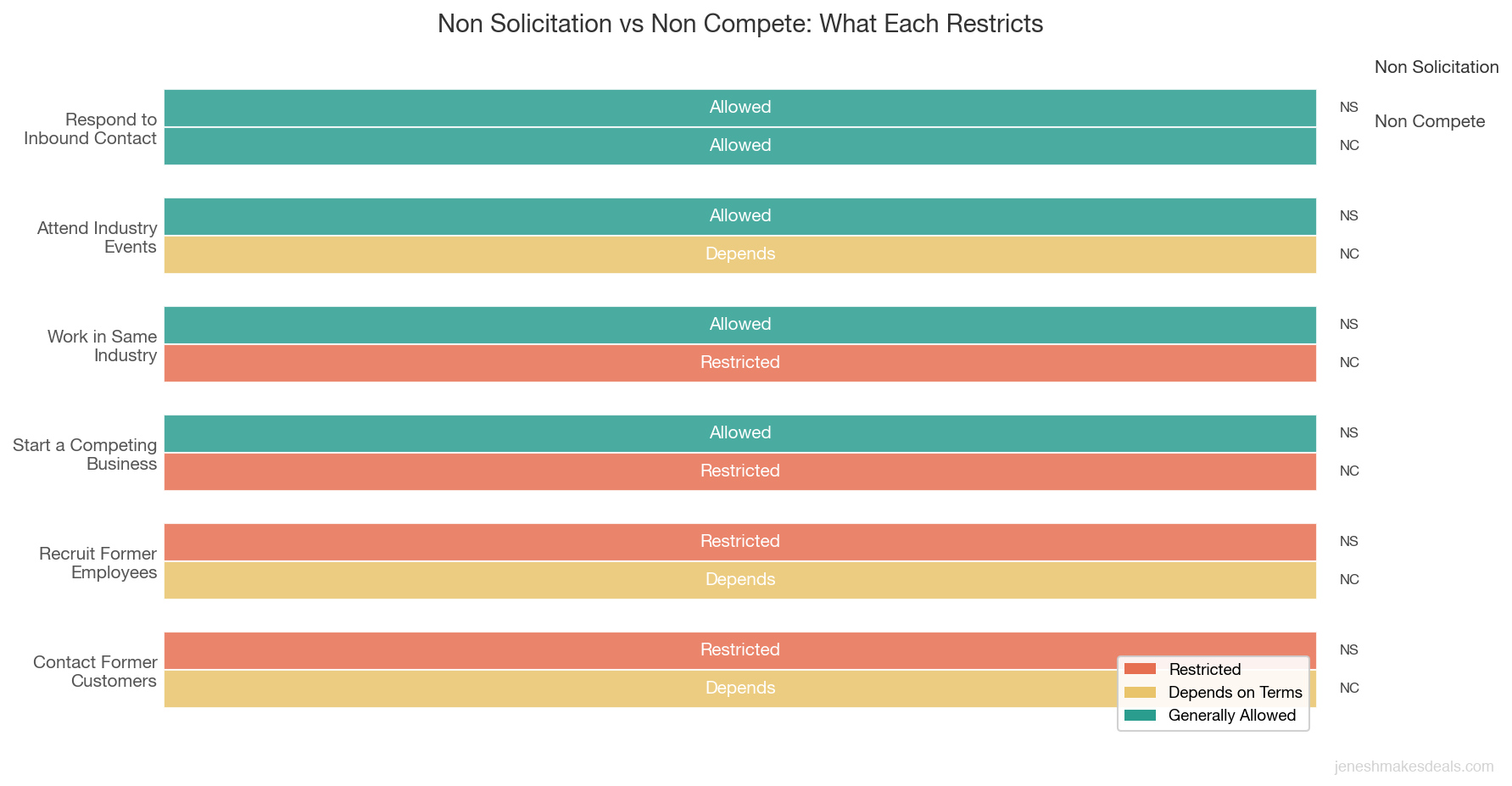
In most business sales, the buyer will ask for both. But the non solicitation terms are often where the real negotiation happens because they directly affect your ability to maintain your professional network.
Here's an example. You sell your accounting firm and sign a non compete that says you can't start another accounting firm within 50 miles for 3 years. You also sign a non solicitation that says you can't contact your former clients for 3 years.
The non compete prevents you from opening a competing firm. The non solicitation prevents you from calling your old clients even if you start a completely different type of business. If a former client calls you to ask for accounting advice, the non solicitation typically allows you to respond, but you can't be the one to initiate that call.
Want to understand how these restrictions might affect your business's value? Use our free business valuation calculator to get a baseline estimate of what your business is worth.
Key Terms to Negotiate
Every non solicitation agreement is negotiable. Here are the terms you should pay close attention to and what to push for:
Duration
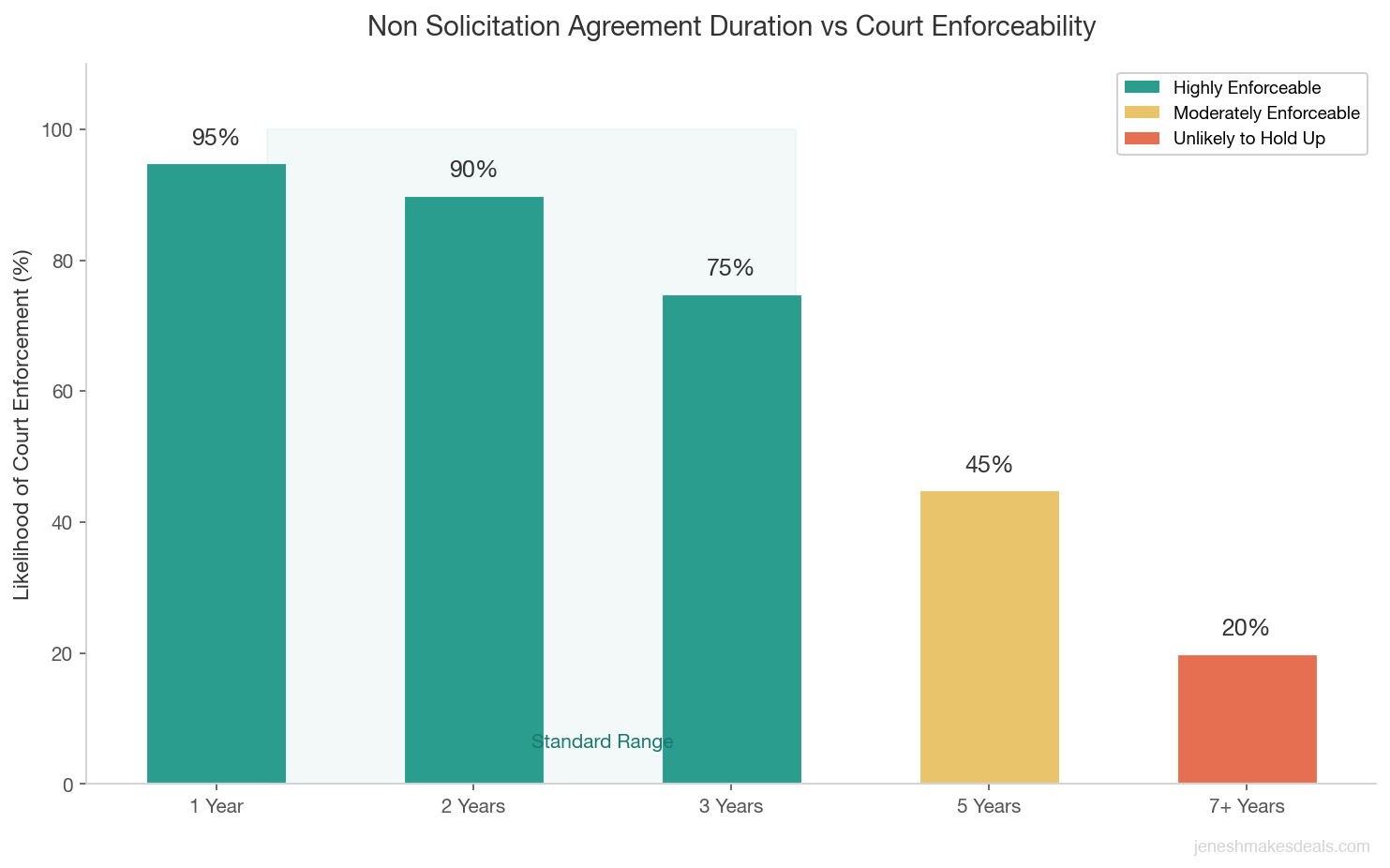
The typical non solicitation period is 2 to 3 years. Some buyers push for 5 years, and I've seen agreements that extend to 7 years or longer. Generally, courts are more likely to enforce shorter, more reasonable durations.
What to negotiate: Push for the shortest duration possible. Two years is standard and usually enforceable. Anything beyond 3 years is aggressive and may not hold up in court depending on your jurisdiction.
Scope of Protected Parties
The agreement should clearly define who you can't solicit. Are we talking about all customers or only active customers? Customers from the last year or customers from the last 5 years? All employees or only management?
What to negotiate: Narrow the scope as much as possible. Push for the agreement to cover only active customers (those who've done business in the last 12 months) and key employees (management and senior team members), not every part time worker or customer from 5 years ago who hasn't returned.
Definition of Solicitation
What counts as "soliciting"? Does sending a LinkedIn connection request count? Does attending the same industry conference count? Does responding to a customer's inquiry count?
What to negotiate: Make sure the definition of solicitation is limited to active, direct outreach with the intent to do business. General advertising, attending industry events, social media activity, and responding to unsolicited contacts should all be explicitly excluded.
Geographic Limitations
Some non solicitation agreements are limited to a specific geographic area. Others apply globally. For a local business, geographic limitations make sense. For an online business, they may not.
What to negotiate: If your business is local, the non solicitation should be limited to the area where the business operates. If the buyer pushes for a broader geographic scope, push back. You shouldn't be restricted from contacting people in markets where the business doesn't operate.
Exceptions
Life happens. You might have personal relationships with people who are also customers or employees. You might serve on boards or volunteer with organizations that include people connected to the business.
What to negotiate: Carve out specific exceptions for personal relationships, family connections, volunteer activities, and other non business interactions. Also carve out an exception for contacts who approach you first, which is sometimes called a "passive response" exception.
Remedies for Breach
What happens if you violate the non solicitation agreement? Most agreements include provisions for injunctive relief (a court order to stop the violating behavior) and monetary damages.
What to negotiate: Try to cap the damages at a reasonable amount, such as the value of the business relationship that was damaged. Push back against provisions that would require you to return a portion of the purchase price as a penalty for any violation, no matter how minor.
The Intersection With Earnouts
If your deal includes an earnout, the non solicitation agreement takes on extra significance. Here's why.
An earnout means a portion of your purchase price is contingent on the business's future performance. If you're restricted from contacting customers and employees, you're essentially being told "don't interfere with the business," while simultaneously having your payment tied to that business's success.
This creates a potential conflict. What if the buyer mismanages a key customer relationship and that customer leaves? Your earnout payment drops, but you can't do anything to help because the non solicitation agreement prevents you from reaching out.
When earnouts are involved, I recommend negotiating terms that:
- Allow you to assist with customer retention during the earnout period (as part of a transition services agreement)
- Exclude customer attrition from the earnout calculation if the buyer's actions or inactions caused the loss
- Set a cap on the earnout reduction that can result from customer losses during the non solicitation period
These provisions align the incentives between the buyer and seller and prevent the non solicitation agreement from inadvertently punishing the seller for the buyer's failures.
Thinking about selling your business? Contact us for a free consultation and we'll help you understand all the agreements involved in a business sale, including non solicitation terms.
State by State Enforceability
Non solicitation agreements are governed by state law, and enforceability varies significantly depending on where you are.
Generally more enforceable states: Texas, Florida, Georgia, and most Southern and Midwestern states tend to enforce non solicitation agreements as long as the terms are reasonable in scope, duration, and geographic area.
Generally less enforceable states: California, North Dakota, and Oklahoma have strong public policies against restricting post employment activities. California in particular has very strict limitations on non compete and non solicitation agreements, though agreements tied to the sale of a business are treated differently than employment based restrictions.
Middle ground states: Many states will enforce non solicitation agreements but will "blue pencil" or modify terms that are overly broad. For example, if you signed a 5 year non solicitation and the court thinks 2 years is reasonable, the court might enforce the agreement for 2 years instead of throwing it out entirely.
The important thing to understand is that non solicitation agreements tied to the sale of a business are generally more enforceable than those tied to employment. Courts recognize that business sellers receive substantial consideration (the purchase price) in exchange for the restriction, which makes the agreement more likely to be upheld.
That said, you should still work with an attorney who understands your state's specific rules. A non solicitation agreement that's enforceable in Texas might be completely unenforceable in California.
Non solicitation agreements tied to business sales receive far more deference from courts than employment based restrictions. The purchase price counts as substantial consideration, which makes judges more willing to enforce the terms.
Common Pitfalls for Sellers
Here are the mistakes I see sellers make most often with non solicitation agreements:
Not reading the agreement carefully. This sounds obvious, but many sellers treat the non solicitation clause as an afterthought. They focus on the purchase price and the big deal terms, then sign the non solicitation without really understanding what they're giving up.
Signing overly broad terms. An agreement that says you can't contact "any person or entity that has ever done business with the company" is far too broad. Push back on language that doesn't have clear boundaries.
Not understanding what "solicit" means. If the agreement doesn't define solicitation clearly, you're at risk. Could posting on LinkedIn be considered solicitation? Could speaking at a conference attended by former customers? Get clear definitions.
Ignoring the agreement after signing. Some sellers sign the non solicitation and then ignore it, assuming the buyer won't notice or won't care. This is a bad strategy. If the buyer discovers you've been contacting their customers, they can take legal action, and the courts are generally sympathetic to buyers in this situation.
Not considering the impact on future career plans. If you plan to stay in the same industry, a broad non solicitation agreement could significantly limit your options. Think about your post sale plans before agreeing to terms.
Failing to get legal advice. Non solicitation agreements are legal documents with real consequences. Don't negotiate them without an attorney who has experience in business sales.
What Happens If You Violate the Agreement
If you violate a non solicitation agreement, the buyer has several legal options:
Injunctive relief. The buyer can go to court and get an order that requires you to stop the soliciting behavior immediately. Courts can issue temporary restraining orders and preliminary injunctions, sometimes within days of the buyer filing.
Monetary damages. The buyer can sue you for the financial losses caused by your solicitation. This could include lost revenue from customers you contacted, the cost of replacing employees you recruited, and attorney's fees.
Escrow clawback. If there's an escrow from the sale, the buyer might make a claim against the escrow funds for damages related to your breach.
Earnout reduction. If you have an earnout, the buyer might argue that your solicitation caused the business to underperform and reduce or eliminate your earnout payments.
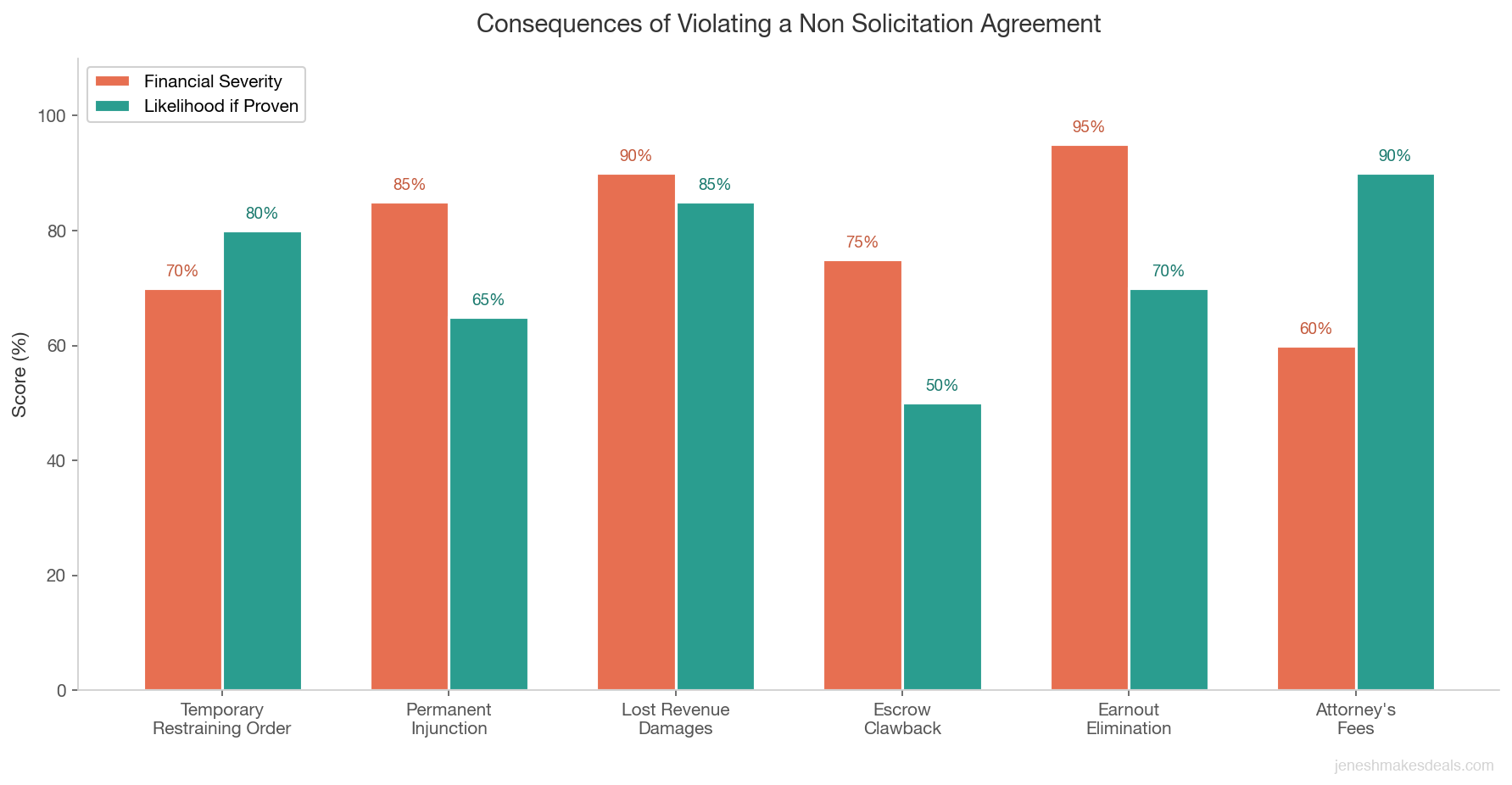
The consequences can be severe, which is why it's so important to understand and respect the terms you agree to. If you're unsure whether a particular action violates the agreement, ask your attorney before doing it.
| Consequence | What It Means for the Seller | Speed of Impact |
|---|---|---|
| Temporary restraining order | Court orders you to stop all solicitation immediately | Days |
| Permanent injunction | Long term court order enforcing the agreement | Weeks to months |
| Lost revenue damages | You pay the buyer for every dollar of business they lost | Months |
| Escrow clawback | Buyer takes funds from the sale escrow to cover damages | Weeks |
| Earnout elimination | Future payments tied to business performance get reduced or eliminated | Immediate |
| Attorney's fees | You may be responsible for the buyer's legal costs on top of your own | Ongoing |
Negotiation Strategies for Sellers
Here's my practical advice for negotiating non solicitation terms that are fair:
Start with what you need. Before you negotiate, make a list of the relationships you want to maintain after the sale. Personal friends who happen to be customers. Industry contacts you want to keep networking with. Former employees you might want to hire someday. Use this list to identify the carve outs you need.
Propose a "sunset" provision. Instead of a hard cutoff where the non solicitation ends on a specific date, propose a gradual relaxation. For example, in year one, no solicitation of any customers. In year two, you can contact customers who haven't done business with the company in the past 6 months.
Tie it to the transition period. The more involved you are in the transition, the more the buyer should be willing to relax the non solicitation terms. If you're spending 6 months helping the buyer build relationships with customers, a shorter non solicitation period is justified.
Offer a strong non compete in exchange for a narrower non solicitation. If the buyer's primary concern is competition, offer a strong non compete agreement in exchange for more relaxed non solicitation terms. This gives the buyer the protection they want while preserving your professional relationships.
Get everything in writing. Don't rely on verbal assurances from the buyer about how the non solicitation will be interpreted. If the buyer says "we won't enforce it for casual lunch meetings with former employees," get that exception written into the agreement.
The strongest negotiation position is before you sign. Once the deal closes, you have zero bargaining power to change non solicitation terms. Negotiate them with the same attention you give the purchase price.
The Bottom Line
Non solicitation agreements are a necessary part of selling a business. They protect the buyer's investment and are expected in virtually every deal. But they're also negotiable, and the terms can significantly affect your post sale life.
Take the time to read the agreement carefully. Negotiate reasonable terms for duration, scope, and definitions. Carve out exceptions for personal relationships and passive responses. And work with an attorney who understands business sales in your state.
The goal is to sign an agreement that protects the buyer's legitimate interests while preserving your ability to maintain your professional relationships and pursue your next chapter.
Need help figuring out what your business is worth? Use our free business valuation calculator to get a quick estimate.
Ready to start the selling process? Contact us for a free consultation and we'll walk you through every aspect of the deal, including the non solicitation terms.
Related Articles

May 1, 2026
What Happens to Accounts Receivable When You Sell
AR is one of the most negotiated items in any business sale. Here's exactly how it's handled, valued, and who collects it after closing.

April 28, 2026
What Is Representations and Warranties Insurance
R&W insurance protects buyers and sellers in business sales by covering breaches of reps in purchase agreements. Here's how it works.

April 27, 2026
How to Handle Inventory in a Business Sale
Inventory can make or break a business sale. Here's how to value it, negotiate it, and avoid the disputes that kill deals at closing.
About the Author
Jenesh Napit is an experienced business broker specializing in business acquisitions, valuations, and exit planning. With a Bachelor's degree in Economics and Finance and years of experience helping clients successfully buy and sell businesses, he provides expert guidance throughout the entire transaction process. As a verified business broker on BizBuySell and member of Hedgestone Business Advisors, he brings deep expertise in business valuation, SBA financing, due diligence, and negotiation strategies.
You might also be interested in
Free Business Calculators
Try our business valuation calculator and ROI calculator to estimate values and returns instantly.
How to Buy a Business Guide
Download our comprehensive free guide covering everything you need to know about buying a business.
Our Services
Explore our professional business brokerage services including valuations and buyer representation.
More Articles
Browse our complete collection of business brokerage insights and expertise.