

Most business owners don't think about environmental liability until they're in the middle of a sale and someone mentions a Phase I environmental assessment. By then, it's usually too late to fix anything cheaply. Environmental issues can delay a deal by months, reduce the sale price by hundreds of thousands of dollars, or kill the transaction entirely.
I've worked on deals where a gas station had underground storage tanks that leaked decades ago, and the cleanup costs nearly exceeded the value of the business. I've seen manufacturing deals fall apart because the buyer's lender required an environmental assessment and the results showed contaminated soil. And I've seen sellers get hit with remediation costs years after they thought they were done with the property.
Environmental liability is one of those areas where what you don't know absolutely can hurt you. So let's walk through what it is, how it works, and what you can do to protect yourself whether you're buying or selling.
A $3,000 Phase I assessment can save you $200,000 or more in unexpected remediation costs. Skipping environmental due diligence is the most expensive shortcut in business acquisitions.
What Environmental Liability Means in a Business Sale
Environmental liability refers to the legal and financial responsibility for environmental contamination or non compliance with environmental regulations at a business property. This includes things like contaminated soil, polluted groundwater, hazardous waste storage, air emissions violations, and improper disposal of chemicals or other materials.
The tricky part about environmental liability is that it can follow the property, not the person. Under federal environmental laws like CERCLA (the Comprehensive Environmental Response, Compensation, and Liability Act), the current owner of a property can be held responsible for contamination that occurred decades ago, even if they had nothing to do with it.
This means that if you buy a business and later discover that the previous owner, or the owner before them, or a tenant from 30 years ago, dumped chemicals in the back lot, you could be on the hook for the cleanup. The costs can range from a few thousand dollars for minor issues to millions for serious contamination.
For sellers, this creates a different kind of risk. If you know about environmental issues and don't disclose them, you could face legal action from the buyer after the sale. And even if you disclose everything, the buyer may demand a price reduction, an escrow holdback, or an indemnification provision that makes you responsible for remediation costs.
Industries With the Highest Environmental Risk
While environmental liability can affect any business, certain industries are much more likely to have issues. If you're buying or selling a business in any of these sectors, environmental due diligence isn't optional. It's essential.
Manufacturing. Factories and production facilities often use chemicals, solvents, heavy metals, and other hazardous materials. Decades of industrial use can result in contaminated soil and groundwater, especially at older facilities.
Gas stations and fuel distributors. Underground storage tanks are a major source of contamination. Even tanks that have been properly maintained can develop leaks over time, and the cost to remediate a leaking underground storage tank can easily exceed $100,000.
Dry cleaners. The solvent perchloroethylene (PERC) is used in traditional dry cleaning and is a known groundwater contaminant. Many former dry cleaning sites require expensive remediation.
Auto repair shops and body shops. Waste oil, solvents, paint, and other hazardous materials are routinely used in these businesses. Improper storage or disposal can create significant contamination.
Agriculture. Pesticides, herbicides, and fertilizers can contaminate soil and groundwater. Concentrated animal feeding operations (CAFOs) have their own set of environmental regulations and potential liabilities.
Printing and publishing. Inks, solvents, and cleaning chemicals used in printing operations can create environmental issues if not properly managed and disposed of.
Construction and demolition. Asbestos, lead paint, and other hazardous materials in older buildings can trigger significant remediation costs during renovation or demolition.
Real estate with commercial tenants. If you're buying a property that has been leased to industrial or commercial tenants, those tenants may have created environmental issues that you'll inherit as the property owner.
The following table summarizes the environmental risk level and most common contamination sources for each industry:
| Industry | Risk Level | Primary Contamination Sources |
|---|---|---|
| Manufacturing | Very High | Chemicals, solvents, heavy metals in soil and groundwater |
| Gas Stations / Fuel Distributors | Very High | Underground storage tank leaks, fuel spills |
| Dry Cleaners | High | Perchloroethylene (PERC) in groundwater |
| Auto Repair / Body Shops | High | Waste oil, solvents, paint, hazardous materials |
| Agriculture | High | Pesticides, herbicides, fertilizer runoff |
| Printing / Publishing | Moderate | Inks, solvents, cleaning chemicals |
| Construction / Demolition | Moderate | Asbestos, lead paint, hazardous building materials |
| Commercial Real Estate | Variable | Depends on tenant history and prior use |
Considering selling a business in one of these industries? Contact us for a free consultation and we'll help you assess your environmental risk before going to market.
Phase I Environmental Site Assessment
A Phase I Environmental Site Assessment, commonly called a Phase I ESA, is the standard first step in environmental due diligence. It's essentially a historical review of a property to determine whether there's a likelihood of contamination.
A Phase I ESA does not involve any actual testing of the soil, water, or air. It's a records review and site inspection conducted by an environmental consultant. Here's what it typically includes:
Historical records review. The consultant reviews historical aerial photographs, fire insurance maps, city directories, and other records to understand how the property has been used over time. If the site was a gas station in the 1960s, that's a red flag even if it's a retail store today.
Regulatory records review. The consultant checks federal, state, and local databases for any recorded environmental violations, cleanup sites, underground storage tanks, or hazardous waste generators at or near the property.
Site inspection. The consultant visits the property and walks the site, looking for signs of contamination like stained soil, stressed vegetation, chemical odors, abandoned drums, or improperly stored materials.
Interviews. The consultant interviews current and past owners, operators, and occupants of the property to learn about any historical or current uses of hazardous materials.
Report. The consultant produces a report that identifies any recognized environmental conditions (RECs), which are conditions that indicate existing contamination, past contamination, or the material threat of future contamination.
A Phase I ESA typically costs $2,000 to $5,000 depending on the size and complexity of the property. The entire process takes 2 to 4 weeks.
If the Phase I identifies recognized environmental conditions, the next step is usually a Phase II ESA, which involves actual physical testing of the soil, groundwater, and sometimes air at the property.
Phase II Environmental Site Assessment
A Phase II ESA is where things get real. Unlike the Phase I, which is just a records review and visual inspection, the Phase II involves collecting and analyzing physical samples.
Here's what a Phase II typically involves:
Soil sampling. The consultant drills bore holes or hand augers at strategic locations around the property and collects soil samples at various depths. These samples are sent to a certified laboratory for analysis.
Groundwater sampling. If there's a concern about groundwater contamination, the consultant installs monitoring wells and collects water samples. Groundwater contamination is particularly serious because it can migrate off site and affect neighboring properties.
Soil vapor sampling. In some cases, the consultant collects soil vapor samples to test for volatile organic compounds (VOCs) that can migrate upward into buildings through a process called vapor intrusion.
Lab analysis. All samples are analyzed for specific contaminants of concern. The results are compared to regulatory standards to determine whether contamination levels exceed allowable limits.
A Phase II ESA costs $10,000 to $50,000 or more, depending on the number of samples collected, the types of analysis required, and the complexity of the site. The timeline is typically 4 to 8 weeks.
If the Phase II confirms contamination above regulatory limits, you're looking at a remediation project, which is where costs can really escalate.
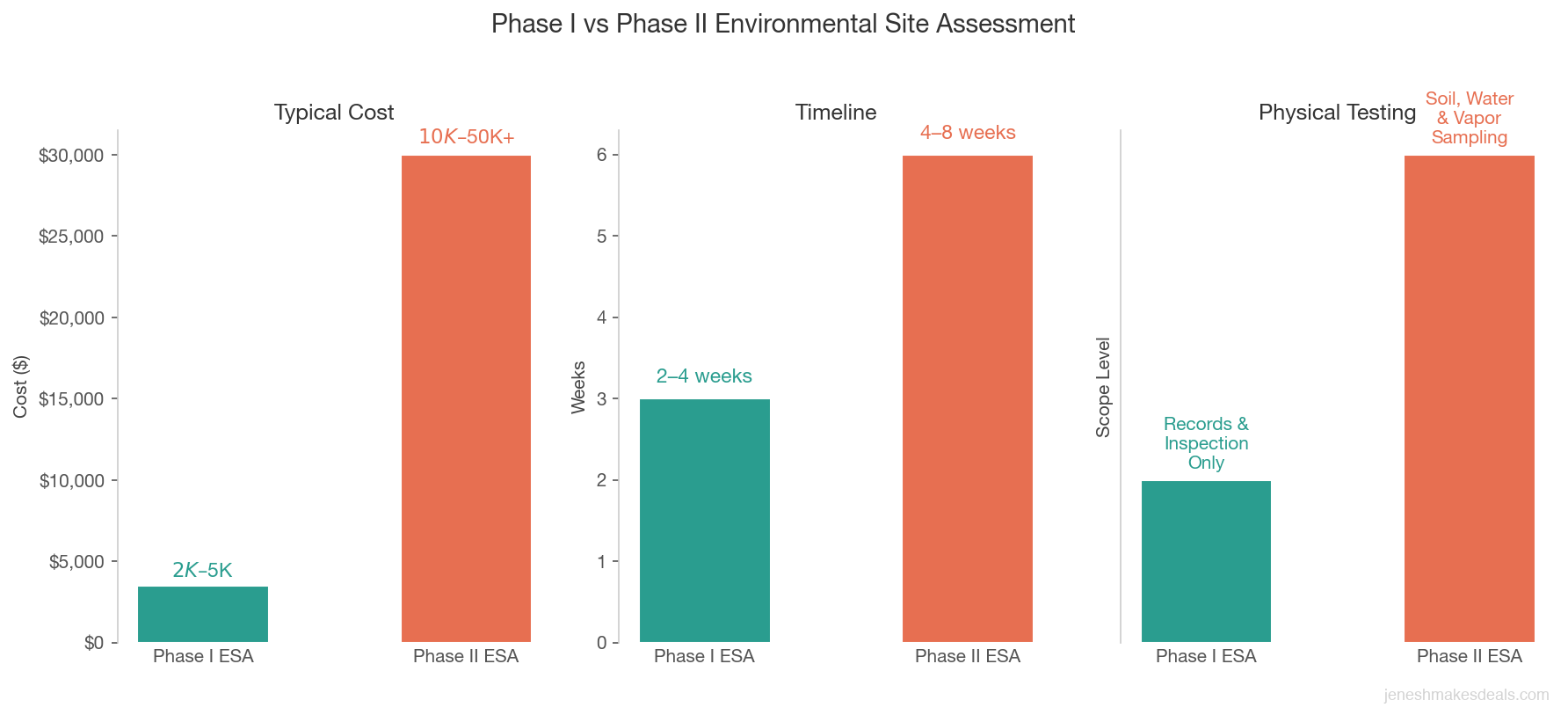
Here's a quick reference comparing the two assessment levels:
| Factor | Phase I ESA | Phase II ESA |
|---|---|---|
| Cost | $2,000 to $5,000 | $10,000 to $50,000+ |
| Timeline | 2 to 4 weeks | 4 to 8 weeks |
| Physical Testing | None | Soil, groundwater, soil vapor |
| Deliverable | Report identifying RECs | Lab results vs regulatory limits |
| When Required | Standard for any deal with real property | Only if Phase I identifies concerns |
| Who Performs It | Environmental consultant | Environmental consultant with lab support |
Want to understand how environmental issues might affect your business's value? Use our free business valuation calculator to get a baseline estimate and factor in potential remediation costs.
How Environmental Issues Affect Deal Structure
When environmental issues are identified during due diligence, they don't necessarily kill the deal. But they do change the deal structure significantly. Remediation costs vary dramatically depending on the type and severity of contamination.
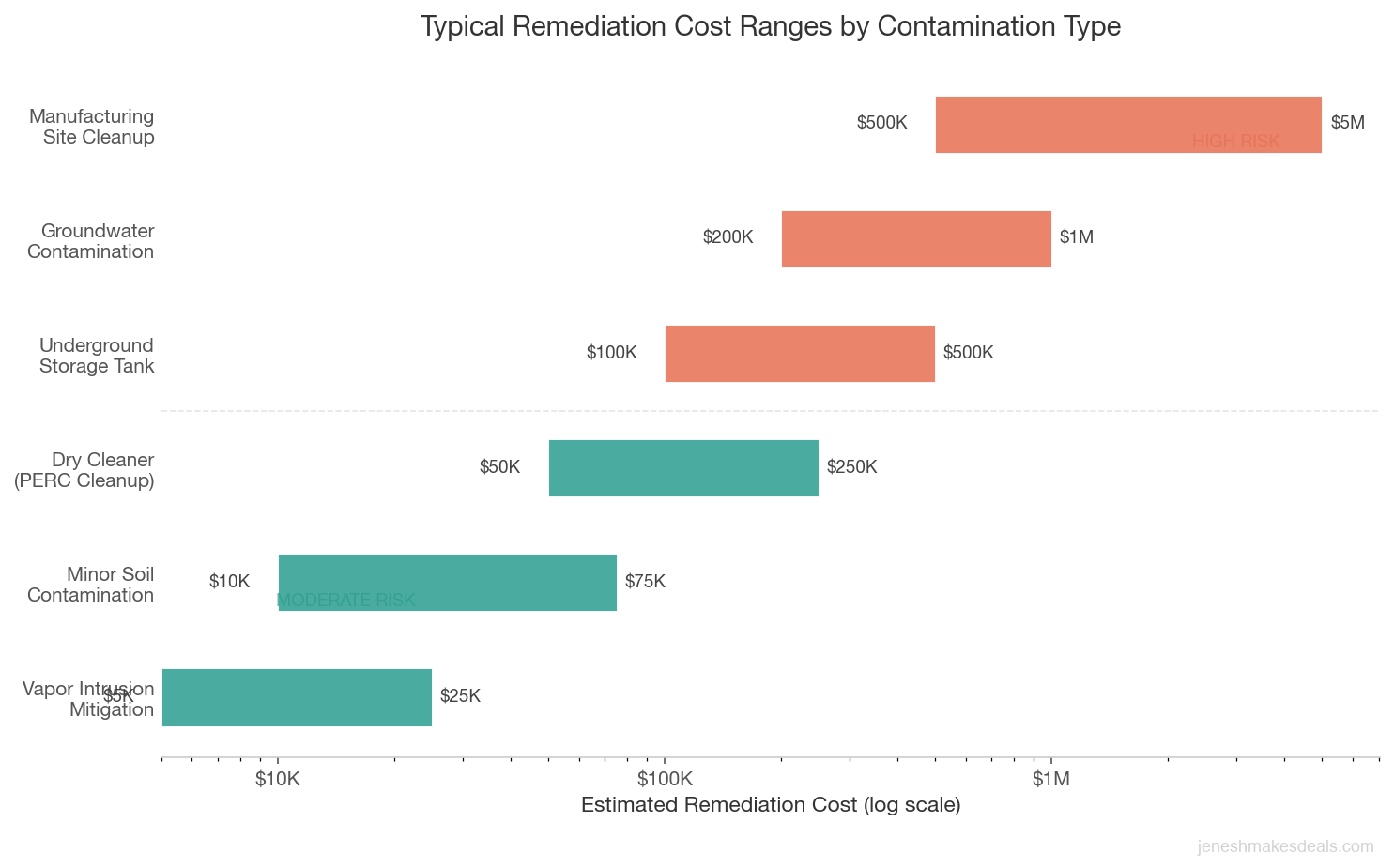
Environmental issues are not always deal killers. Many deals close successfully with proper assessment, appropriate deal structuring, and realistic cost estimates. The key is early identification and transparent negotiation.
Here are the most common approaches:
Price Reduction
The most straightforward approach is to reduce the purchase price by the estimated cost of remediation. If the Phase II estimates that cleanup will cost $200,000, the buyer might reduce their offer by that amount.
The challenge with this approach is that remediation cost estimates are notoriously unreliable. The actual cost could be significantly higher or lower than the estimate. This creates risk for the buyer, who may push for a larger reduction to account for uncertainty.
Escrow Holdback
Instead of reducing the price, the parties might agree to set aside a portion of the purchase price in an escrow account to cover potential remediation costs. If the actual costs come in below the escrow amount, the remaining funds go to the seller. If the costs exceed the escrow, the parties negotiate who's responsible for the overage.
Seller Remediation
In some cases, the seller agrees to handle the remediation before closing. This delays the closing timeline but allows the seller to control the process and potentially reduce costs. It also gives the buyer more certainty about the property's condition at closing.
Environmental Insurance
Environmental insurance policies can cover the cost of unknown contamination, remediation cost overruns, and third party claims related to environmental issues. Both buyers and sellers can benefit from these policies, especially when the extent of contamination is uncertain.
Environmental insurance premiums typically range from 2% to 5% of the policy limit. For a policy covering $500,000 in potential remediation costs, the premium would be $10,000 to $25,000.
Indemnification
The seller can agree to indemnify the buyer for environmental costs that arise from pre closing contamination. This shifts the risk back to the seller but gives the buyer the confidence to proceed with the deal. Indemnification provisions for environmental issues often have longer survival periods than general representations, sometimes 5 to 10 years.
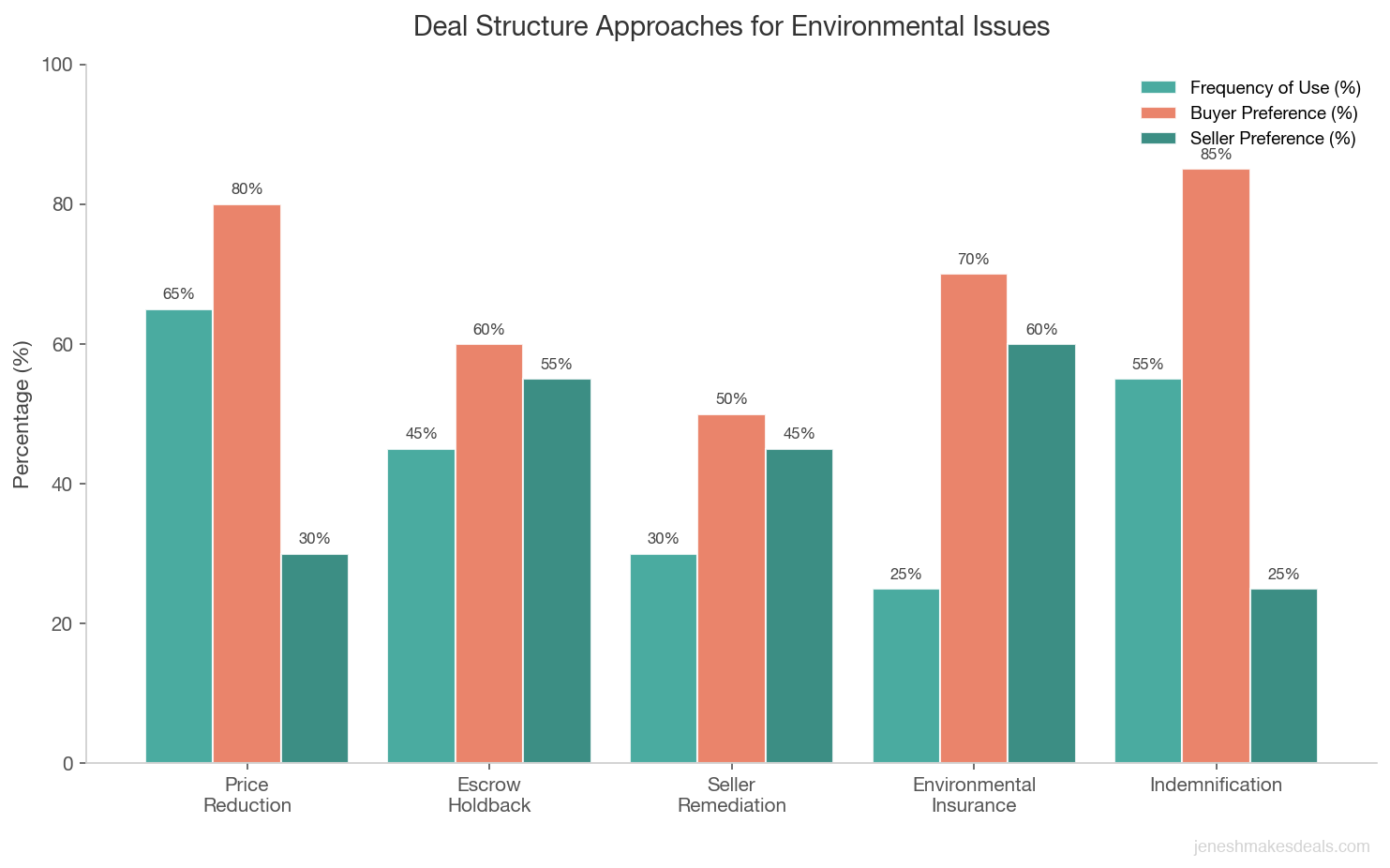
For sellers, getting ahead of environmental issues before they become a negotiating tool for the buyer is always the better strategy. A proactive Phase I assessment and organized compliance records will serve you far better than hoping no one asks.
What Sellers Should Do Before Listing
If you suspect your property might have environmental issues, or if your business operates in a high risk industry, here's what I recommend doing before you put the business on the market:
Get a Phase I assessment done proactively. If you know what the issues are before the buyer finds them, you're in a much stronger negotiating position. You can address minor issues before listing, and you can price the business appropriately if there are larger concerns.
Review your compliance records. Make sure all environmental permits are current, all required reports have been filed, and all inspections are up to date. Compliance issues are often easier and cheaper to fix than contamination problems.
Check your underground storage tanks. If your property has or had underground storage tanks, make sure they've been properly registered, tested, and maintained. If old tanks have been removed, get the closure documentation organized.
Document your hazardous material management. If your business uses hazardous materials, document how they're stored, used, and disposed of. Proper documentation shows the buyer and their consultants that you've been responsible.
Talk to your environmental attorney. Environmental law is complex and varies significantly by state. An environmental attorney can help you understand your potential exposure and develop a strategy for addressing it before or during the sale.
Buyer's Environmental Due Diligence Checklist
If you're on the buying side, here's what you should be doing:
- Always get a Phase I ESA. This is non negotiable for any deal involving real property. Many lenders require it, and even if yours doesn't, skipping it is not worth the risk.
- Understand the property's history. Who owned it before? What was it used for? Even if the current business is low risk, previous uses could have created contamination.
- Check neighboring properties. Contamination can migrate from adjacent sites. If the property next door was a dry cleaner or gas station, that could affect your property too.
- Review all environmental permits and compliance records. Are they current? Have there been any violations? Any ongoing corrective action?
- Talk to state environmental regulators. Many states have databases of known contaminated sites, leaking underground storage tanks, and hazardous waste generators. Check these databases for the property and surrounding area.
- Factor remediation costs into your offer. If environmental issues are identified, adjust your offer accordingly. Don't assume the seller will fix everything.
- Get environmental insurance if the risk is uncertain. If the Phase I identified potential concerns but the Phase II results are ambiguous, environmental insurance can protect you from unexpected costs down the road.
Common Environmental Pitfalls in Business Sales
Here are mistakes I've seen that cost buyers and sellers real money:
Skipping the Phase I to save $3,000. I've seen buyers skip the environmental assessment because they didn't want to spend the money. Then they discovered contamination a year later and spent $200,000 on remediation. A $3,000 investment could have saved them $197,000.
Not checking neighboring properties. A buyer purchased a commercial property that was clean, but the former gas station next door had a plume of contaminated groundwater that had migrated under the buyer's property. The buyer ended up sharing in the remediation costs.
Assuming the seller knew about everything. Sellers can genuinely be unaware of environmental issues, especially if they purchased the property from someone else or if contamination occurred decades ago. Don't rely on the seller's representations alone. Do your own independent assessment.
Ignoring state specific requirements. Environmental regulations vary widely by state. Some states have strict disclosure requirements that can create liability for sellers who fail to disclose known conditions. Others have voluntary cleanup programs that can reduce remediation costs significantly. Know your state's rules.
Not considering vapor intrusion. Even if soil and groundwater contamination levels are below regulatory limits, volatile compounds can still migrate into buildings through foundation cracks. Vapor intrusion testing is often overlooked but can be critical, especially for occupied buildings.
Thinking environmental issues are always deal killers. They're not. Many deals close successfully despite identified environmental concerns. The key is proper assessment, appropriate deal structuring, and realistic cost estimates.
Government Programs That Can Help
Several government programs exist to help with environmental contamination at commercial properties:
EPA Brownfields Program. The EPA provides grants and technical assistance for the assessment and cleanup of contaminated properties. Small businesses and communities can apply for grants of up to $500,000 for cleanup.
State voluntary cleanup programs. Most states have voluntary cleanup programs (VCPs) that provide a regulatory framework for cleaning up contaminated properties. Completing a VCP typically results in a "no further action" letter from the state, which provides some protection against future liability.
Underground Storage Tank (UST) funds. Many states maintain funds to help pay for the cleanup of leaking underground storage tanks. These funds can cover a significant portion of remediation costs for qualifying properties.
Environmental insurance. While not a government program, environmental insurance products have become increasingly affordable and accessible. They can cover known contamination, unknown contamination, and third party claims.
Tax incentives. Federal tax law allows businesses to deduct certain environmental remediation costs in the year they're incurred, rather than capitalizing them over time. Some states offer additional tax incentives for cleaning up contaminated properties.
The Bottom Line
Environmental liability is one of those things that can completely blindside you in a business sale if you're not prepared. Whether you're buying or selling, the key is to identify potential issues early, understand the financial implications, and structure the deal accordingly.
For sellers, the message is clear. Get ahead of environmental issues before they become a negotiating tool for the buyer. A proactive Phase I assessment, organized compliance records, and transparency about known conditions will serve you far better than hoping no one asks.
For buyers, never skip environmental due diligence. The cost of a Phase I assessment is a tiny fraction of what you could spend on remediation if you discover problems after closing. And make sure your purchase agreement includes appropriate protections, whether that's indemnification, escrow, or environmental insurance.
Need help understanding what your business is worth? Use our free business valuation calculator to get a baseline estimate.
Ready to discuss selling your business? Contact us for a free consultation and we'll help you through every aspect of the deal, including environmental due diligence.
Related Articles

May 1, 2026
What Happens to Accounts Receivable When You Sell
AR is one of the most negotiated items in any business sale. Here's exactly how it's handled, valued, and who collects it after closing.

April 28, 2026
What Is Representations and Warranties Insurance
R&W insurance protects buyers and sellers in business sales by covering breaches of reps in purchase agreements. Here's how it works.

April 27, 2026
How to Handle Inventory in a Business Sale
Inventory can make or break a business sale. Here's how to value it, negotiate it, and avoid the disputes that kill deals at closing.
About the Author
Jenesh Napit is an experienced business broker specializing in business acquisitions, valuations, and exit planning. With a Bachelor's degree in Economics and Finance and years of experience helping clients successfully buy and sell businesses, he provides expert guidance throughout the entire transaction process. As a verified business broker on BizBuySell and member of Hedgestone Business Advisors, he brings deep expertise in business valuation, SBA financing, due diligence, and negotiation strategies.
You might also be interested in
Free Business Calculators
Try our business valuation calculator and ROI calculator to estimate values and returns instantly.
How to Buy a Business Guide
Download our comprehensive free guide covering everything you need to know about buying a business.
Our Services
Explore our professional business brokerage services including valuations and buyer representation.
More Articles
Browse our complete collection of business brokerage insights and expertise.