
You've spent years building a plumbing business. Early mornings, late night emergency calls, training apprentices, dealing with no shows. The business runs, the phones ring, and you're making good money.
But something is shifting. Your dispatcher now uses AI to route technicians. Your competitor just bought pipe inspection cameras that find leaks without digging. Smart home systems are catching water problems before customers even call. And PE firms keep sending letters asking if you want to sell.
Here's what most plumbing business owners don't realize. The technology changes happening right now are creating a window where your business is worth more than it may ever be again. Not less. More. But that window has a shelf life.
I'll walk you through what's happening with AI in the plumbing industry, why it matters for your business value, and how to decide whether 2026 is the right time to exit.
What Your Plumbing Business Is Worth Right Now
Plumbing businesses are selling at strong multiples in 2026. The typical range is 2.5x to 4.5x SDE for most owner operated businesses, with well run companies hitting 5x or higher.
Here's how multiples break down by size.
| Business Size | Typical Multiple | Example Valuation |
|---|---|---|
| Under $500K EBITDA | 2x to 4x SDE | $200K to $500K |
| $500K to $2M EBITDA | 4x to 6x EBITDA | $2M to $12M |
| $2M to $5M EBITDA | 5x to 7x EBITDA | $10M to $35M |
| $5M+ EBITDA (platform) | 8x to 15x EBITDA | $40M+ |
The median sale price for a plumbing business in the US is about $620,000, up 46% since 2022. That increase isn't random. It's driven by PE consolidation, a historic labor shortage, and growing demand for essential services.
Want to see where your plumbing business falls in this range? Use our free plumbing business valuation calculator to get an estimate based on your SDE, growth trend, and business characteristics.
46% of Plumbing Contractors Are Already Using AI
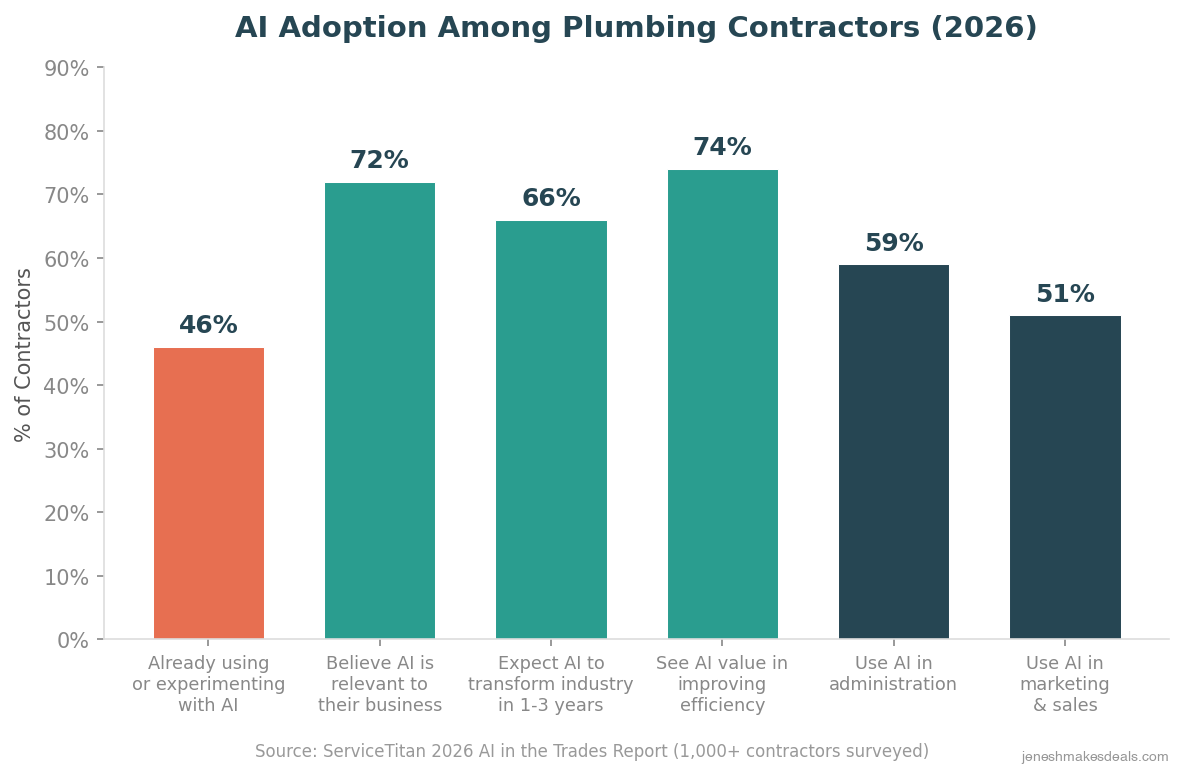
This number surprised me. According to ServiceTitan's 2026 AI in the Trades report, which surveyed over 1,000 contractors, nearly half are already using or experimenting with AI tools.
The adoption is accelerating fast.
- 72% of contractors believe AI is relevant to their business
- 66% think AI will meaningfully change the industry within 1 to 3 years
- 74% see AI's biggest value in improving efficiency and productivity
- 59% already use AI features built into their existing software
The most common areas where plumbing businesses use AI today are administration (59%), marketing and sales (51%), and customer service and field operations (39%).
This isn't some far off future scenario. Almost half your competitors are already using these tools. The question isn't whether AI will change plumbing. It's whether you're positioned to benefit from it, or get left behind.
How AI Is Changing Plumbing Operations Right Now
The AI tools hitting the plumbing industry fall into seven main categories. Each one affects how businesses operate and what buyers are willing to pay.
AI Powered Diagnostics
Traditional CCTV pipe inspections miss about 40% of defects. New AI systems trained on tens of thousands of pipe images can identify cracks, corrosion, root intrusion, and other problems with significantly higher accuracy.
Electro Scan's 2025 AI tool can pinpoint exact leak locations from inside water pipes, including the clock position and severity measured in gallons per minute. Industry estimates suggest roughly 80% of leak digs are dry holes without this technology. AI is changing that math entirely.
Smart Scheduling and Dispatch
ServiceTitan's Dispatch Pro uses AI to run thousands of scenarios and match the best technician to each job based on skills, location, and availability. Housecall Pro's CSR AI answers calls 24/7, books jobs, and checks technician schedules without a human receptionist.
The companies using these tools are already operating at higher margins. An AI driven plumbing company can be 2 to 4x more productive than a competitor still using manual dispatch. By late 2026, AI is expected to automatically assign jobs based on technician skill sets, drive time, job complexity, and revenue potential.
Estimating and Invoicing
AI tools now read blueprints, reference historical job data, and generate estimates in minutes instead of hours. When a job finishes, AI detects completion and generates invoices immediately. This eliminates the revenue leakage that comes from delayed billing, a problem I see in almost every plumbing business I evaluate.
Predictive Maintenance and IoT
IoT sensors combined with AI algorithms can predict equipment failures weeks before they happen. Smart leak detectors, flow monitors, and water heater sensors are shifting maintenance from reactive to proactive. The smart water leak detector market alone is projected to hit $2.27 billion by 2033.
Smart Homes Are Quietly Threatening Your Highest Margin Work
This is the part most plumbing business owners haven't thought through.
Emergency and after hours calls are the highest margin work in plumbing. A burst pipe at 2 AM generates 2 to 3x the revenue of a scheduled service call. These emergency calls are what push plumbing businesses into premium SDE multiple territory.
Now consider what smart home technology is doing. Modern leak detection systems monitor water pressure, flow rates, and temperature continuously. They catch problems early and alert homeowners before a small drip becomes a flooded basement.
The smart water management market is projected to reach $50.7 billion by 2033, growing at 13% annually. As these systems become standard in new construction and major renovations, the volume of emergency plumbing calls will decrease.
This doesn't mean plumbing businesses become worthless. But it means the mix shifts. The businesses that adapt will offer installation, monitoring, and proactive maintenance services. The ones that rely on break fix emergency revenue will see their margins compressed over time.
Right now, most homes don't have these systems. The impact on your emergency call volume is still minimal. But 5 years from now? That's a different story. And that's exactly why the current valuation window matters.
PE Firms Are Still Paying Premium Prices
Despite everything happening with technology, buyer demand for plumbing businesses remains intense. PE add on transactions in home services surged 88.2% year over year in the first half of 2025. PE buyers now account for over 50% of all transactions in the space.
The biggest deals tell the story.
- Champions Group sold to Blackstone for $2.5 billion at roughly 18.5x EBITDA in February 2026
- Sila Services sold for approximately $1.5 billion in early 2025
- Wrench Group sold for $14 billion at 14x EBITDA after acquiring 450 companies
These are platform level deals with multiples that small business owners won't see. But they create a powerful trickle down effect. Every PE platform needs to buy 10, 20, or 50 smaller plumbing companies to grow. Those tuck in acquisitions typically happen at 3x to 5x EBITDA with structures like 20% down, 60% bank financing, and 20% seller financing.
With roughly 129,000 plumbing businesses in the US and no single company holding more than 5% market share, the consolidation runway is massive. Residential plumbing is still considered to be in the early to mid stages of its consolidation cycle. That means buyer demand should remain strong for the next few years.
Thinking about what a PE buyer would pay for your business? Contact us for a free consultation and we'll walk you through how PE firms evaluate plumbing companies.
The AI Paradox: Why Your Business Is Worth More Now Than Later
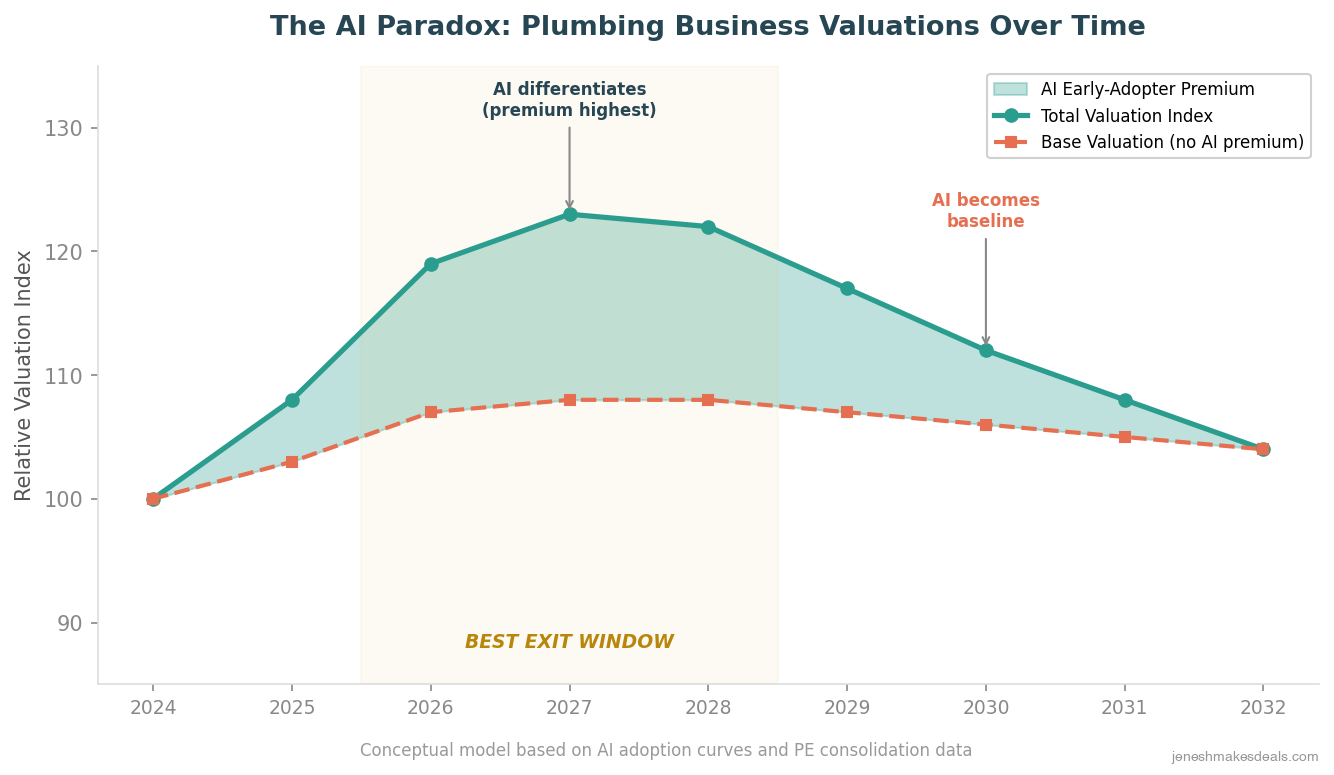
Here's the timing argument that matters most.
Right now (2026 to 2028): AI makes your business more valuable. If you've adopted AI scheduling, diagnostics, or dispatch tools, your business operates more efficiently than competitors. Buyers see higher margins, better scalability, and a tech forward operation. Early AI adopters command premium multiples.
In 2 to 3 years (2028 to 2030): AI becomes the baseline. Every plumbing business uses AI dispatch and scheduling because the software platforms build it in by default. It no longer differentiates your business. Multiples normalize because AI efficiency is expected, not rewarded.
In 5+ years (2031 and beyond): Smart home ecosystems, predictive maintenance, and autonomous diagnostics reduce demand for reactive plumbing work. Businesses that haven't shifted to proactive service models see margin compression. The pool of premium buyers shrinks as PE platforms have already acquired their targets.
The point isn't that plumbing businesses will become worthless. Pipes still break. Toilets still clog. New construction still needs plumbing. But the premium that buyers pay for established plumbing businesses, the 4x to 5x SDE multiples, those are driven by today's market conditions. Labor scarcity, PE appetite, and the early stages of consolidation.
Those conditions won't last forever.
What Buyers Are Paying Premium Multiples For
Not every plumbing business gets the same multiple. After reviewing hundreds of valuations, here's what separates a 2.5x business from a 4.5x business.
Recurring Revenue
Maintenance agreements with monthly or annual fees generate predictable revenue and 70 to 80% gross margins compared to 60% for one off service calls. Businesses with 30%+ recurring revenue command significantly higher multiples. Some buyers value recurring revenue streams at 3 to 5x more than transactional revenue.
Team Depth and Licensing
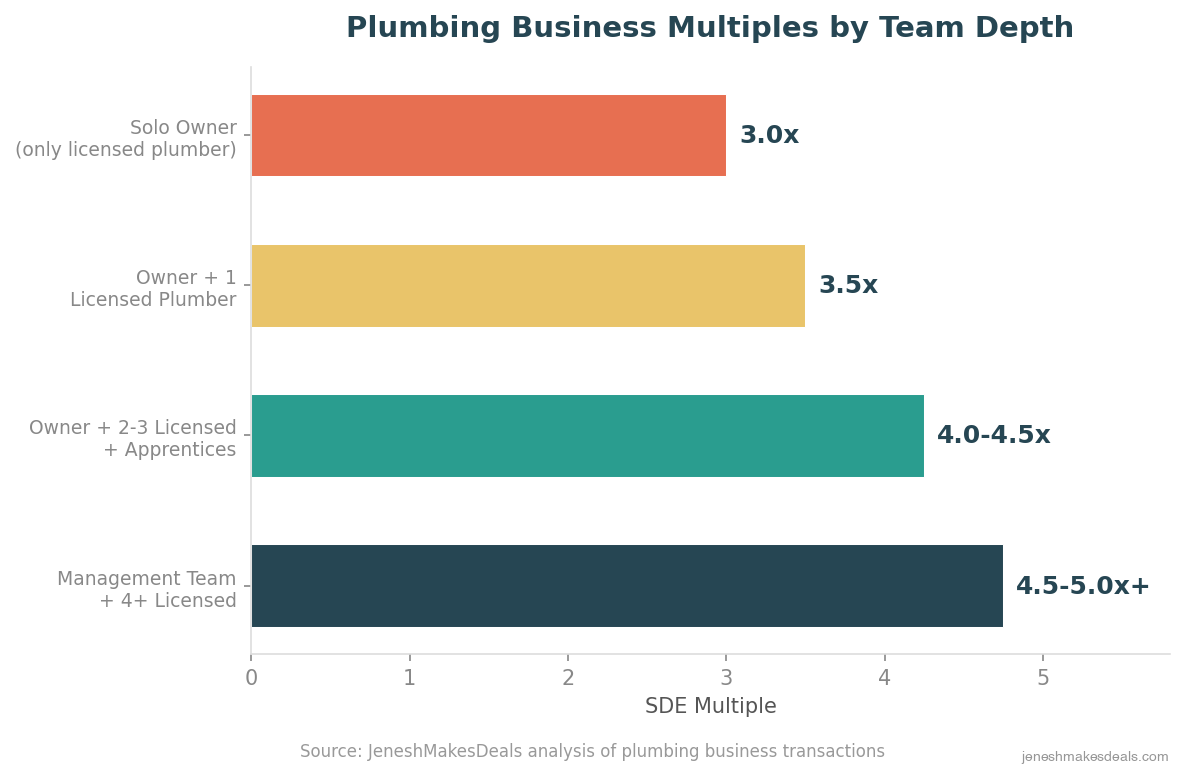
If you're the only licensed plumber, your business has a problem. Buyers discount heavily for owner dependency. Here's how team structure affects multiples.
| Team Structure | Typical Multiple |
|---|---|
| Solo owner (only licensed plumber) | 3.0x SDE |
| Owner + 1 licensed plumber | 3.5x SDE |
| Owner + 2 to 3 licensed + apprentices | 4.0x to 4.5x SDE |
| Management team + 4+ licensed plumbers | 4.5x to 5.0x+ SDE |
With a projected shortage of 550,000 plumbers by 2027 and 20% of the current workforce over age 55, businesses that have already built and retained a team are worth substantially more. The labor shortage costs the industry an estimated $33 to $38 billion annually.
Technology Adoption
This is the new differentiator. Buyers in 2026 specifically look for businesses running modern software like ServiceTitan, Housecall Pro, or FieldEdge. AI enabled scheduling, digital dispatching, and CRM systems signal a business that can scale.
A plumbing company using paper invoices and manual scheduling in 2026 gets a different conversation from buyers than one running AI powered dispatch with automated follow ups and online booking.
Service Mix
Your revenue mix matters more than most owners realize.
| Service Type | Value to Buyers |
|---|---|
| Emergency and after hours | Highest (but at risk from IoT) |
| Maintenance contracts | Very high (recurring) |
| Standard service and repair | Solid |
| Remodeling and renovation | Moderate |
| New construction | Lowest (project based, cyclical) |
The best valued businesses have a balanced mix weighted toward service, repair, and maintenance rather than new construction.
DOE Regulations Are Adding Pressure
New Department of Energy efficiency standards for commercial water heaters take effect October 6, 2026. These rules require a shift to condensing technology for both storage and tankless models, projected to save businesses $140 million per year in operating costs.
By 2029, residential standards will require that 50% or more of new electric storage water heaters meet heat pump efficiency levels. Currently, only about 3% of the market hits that mark. That's a massive shift in what plumbers need to know how to install and service.
For business owners, this means training costs, new equipment, and adapting your service capabilities. For sellers, it's one more reason the next 12 to 24 months are favorable. You can sell before absorbing those transition costs, or position your business as already prepared and charge a premium for it.
Not sure how these changes affect your business value? Use our free valuation calculator to see where you stand, then reach out for a detailed analysis.
5 Signs You Should Start Planning Your Exit
Not every plumbing business owner should sell right now. But if several of these apply to you, it's worth having the conversation.
-
You're the only licensed plumber. Your business is worth less every year you wait without adding licensed team members. Buyers heavily discount for owner dependency.
-
You're over 55 and haven't started succession planning. The average small business owner is about 60 years old. Waiting until you're burned out means selling from a weaker position.
-
You haven't adopted modern software. If you're still running the business on paper or basic spreadsheets, you're falling behind. Buyers expect technology systems, and retrofitting them takes 12 to 18 months.
-
Your revenue depends on emergency calls. As smart home technology reduces emergency volume over the next 5 years, businesses without recurring revenue or maintenance programs face margin pressure.
-
You've been approached by PE buyers. If PE firms or their acquisition teams are reaching out, that's a signal that your business fits their criteria. The outreach won't last forever as platforms fill their geographic needs.
How to Maximize Your Plumbing Business Value Before Selling
If you're considering a sale in the next 12 to 24 months, these steps can meaningfully increase what you get.
Build Recurring Revenue
Start or expand a maintenance membership program. Target 30% or more of revenue from recurring contracts. This single change can add 1 to 2 full points to your SDE multiple. Maintenance agreements generate 70 to 80% gross margins and give buyers predictable cash flow.
Clean Up Your Financials
Get at least 3 years of clean profit and loss statements. Remove personal expenses, document add backs clearly, and work with a CPA who understands business sales. Messy financials kill deals or force price reductions.
Reduce Owner Dependency
If the business can't run for 2 weeks without you, it's not ready to sell at a premium. Hire and train at least one additional licensed plumber. Document your processes. Build a management layer, even if it's one operations manager.
Adopt Technology
Implement a modern field service platform. AI powered scheduling and dispatch alone can improve technician utilization by 20 to 30%. Digital customer records, online booking, and automated follow ups signal to buyers that the business is scalable.
Retain Your Team
In a market with a 550,000 plumber shortfall, your team IS your business. Competitive pay, benefits, training programs, and retention bonuses protect your most valuable asset. High technician turnover tanks valuations.
Ready to start planning your exit? Schedule a free consultation and we'll help you build a 12 month roadmap to maximize your sale price.
Common Mistakes Plumbing Business Owners Make When Selling
I've seen these mistakes cost owners tens of thousands, sometimes hundreds of thousands of dollars.
Waiting too long to prepare. Sellers who start preparing 12 to 24 months before listing see 20 to 30% higher exit values than those who decide to sell and list immediately. Preparation matters more than timing the market perfectly.
Not getting a professional valuation. Your buddy's estimate or a rule of thumb from 2019 isn't a valuation. Market conditions, buyer demand, and your specific financials determine your real number. Get a proper valuation before talking to buyers.
Ignoring the technology gap. A buyer in 2026 expects modern software. If they have to budget $50,000 to $100,000 to bring your systems up to date after acquisition, that comes directly off your sale price.
Selling to the first buyer who calls. PE firms send acquisition letters to thousands of plumbing businesses. The first offer is rarely the best offer. A competitive process with multiple qualified buyers typically produces 15 to 25% higher final prices.
Neglecting your team during the sale process. If key technicians leave during due diligence because they heard rumors about a sale, the deal can collapse or the price drops significantly. Have a communication plan for your team.
The Labor Shortage Makes This Window Unique
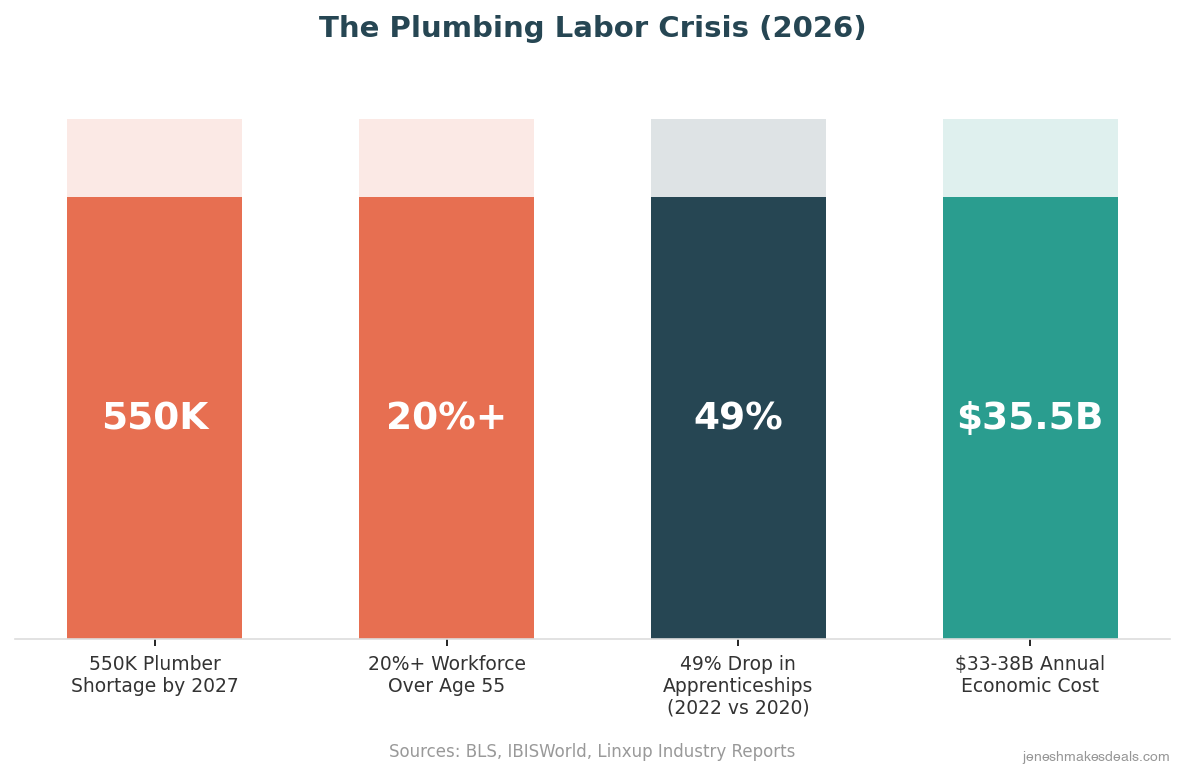
The numbers here are hard to ignore. The US faces a projected shortage of 550,000 plumbers by 2027. Over 20% of the current plumbing workforce is 55 or older. Apprenticeship enrollment dropped 49% in 2022 compared to 2020.
This shortage is what makes established plumbing businesses so valuable right now. A buyer isn't just purchasing your revenue stream or your customer list. They're buying your trained, licensed workforce. In an industry where finding and training a single plumber takes 4 to 5 years, a business with 5 or 10 experienced technicians has a built in advantage that can't be replicated quickly.
As AI tools improve technician productivity (potentially making 1 plumber as effective as 2 to 4), the labor premium may decrease. Businesses with strong teams are most valuable right now, while the shortage is at its worst and AI hasn't yet closed the productivity gap.
Looking for funding to grow your plumbing business before selling? Check out our unsecured funding programs that provide up to $500,000 with no collateral required.
What to Do Next
The plumbing industry is at an inflection point. AI adoption is accelerating, PE buyers are actively acquiring, and the labor shortage has pushed valuations to historic levels. These conditions favor sellers, but they won't last indefinitely.
Here's your action plan.
-
Get a current valuation. Understand what your business is actually worth in today's market. Use our free calculator for a quick estimate, or contact us for a detailed analysis.
-
Assess your readiness. How dependent is the business on you? Do you have recurring revenue? Is your technology current? These factors determine whether you can sell now or need 6 to 12 months of preparation.
-
Talk to an advisor. Even if you're not ready to sell today, understanding the market and your options helps you make a better decision. A 30 minute conversation can save you years of guessing.
-
Set a timeline. Whether it's 6 months or 2 years, having a clear exit timeline lets you make strategic decisions about hiring, technology investments, and growth that directly increase your sale price.
The plumbing businesses selling for top dollar in 2026 are the ones whose owners planned ahead. They built teams, adopted technology, created recurring revenue, and cleaned up their books. You can do the same.
Ready to find out what your plumbing business is worth? Schedule a free, confidential consultation and we'll give you a clear picture of your options.
Related Articles

April 30, 2026
How Long Does It Really Take to Sell a Business
Most sellers are shocked by how long it takes. Here's the honest timeline from listing to closing, and what actually speeds things up.

April 26, 2026
How to Structure an Earnout That Works for Seller and Buyer
Most earnouts fail because they're poorly structured. Here's how to build earnout terms that protect both sides of the deal.

April 24, 2026
How to Value Intellectual Property in a Business Sale
Your IP could be worth more than your equipment. Learn how patents, trademarks, and trade secrets affect your business valuation.
About the Author
Jenesh Napit is an experienced business broker specializing in business acquisitions, valuations, and exit planning. With a Bachelor's degree in Economics and Finance and years of experience helping clients successfully buy and sell businesses, he provides expert guidance throughout the entire transaction process. As a verified business broker on BizBuySell and member of Hedgestone Business Advisors, he brings deep expertise in business valuation, SBA financing, due diligence, and negotiation strategies.
You might also be interested in
Free Business Calculators
Try our business valuation calculator and ROI calculator to estimate values and returns instantly.
How to Buy a Business Guide
Download our comprehensive free guide covering everything you need to know about buying a business.
Our Services
Explore our professional business brokerage services including valuations and buyer representation.
More Articles
Browse our complete collection of business brokerage insights and expertise.