

If you run a service business, recurring revenue is the single most powerful thing you can show a buyer.
I've worked with hundreds of service business owners preparing to sell. The ones with strong recurring revenue consistently get better offers, faster closings, and more competitive bidding. The ones without it? They fight for every dollar at the negotiation table.
But here's the thing most sellers miss. Not all recurring revenue is created equal. A buyer won't just take your word that customers keep coming back. They want proof, and they want to understand exactly how reliable that revenue stream really is.
Let me walk you through how buyers actually evaluate recurring revenue, what it does to your valuation multiples, and how to present it in a way that gets you the best possible price.
Why Recurring Revenue Matters So Much to Buyers
When someone buys a service business, they're buying future cash flow. That's it. Everything else, your brand, your team, your equipment, only matters because it supports the ability to generate cash tomorrow.
Recurring revenue makes that future cash flow predictable. And predictability is what buyers pay a premium for.
Think about it from the buyer's perspective. If they're acquiring a business where 70% of revenue comes from locked in contracts, they can walk in on day one knowing that a huge chunk of next month's income is already secured. Compare that to a business where every dollar depends on landing new projects. The risk profile is completely different.
Here's what recurring revenue signals to a buyer:
- Lower customer acquisition costs. You don't need to spend as much on marketing and sales to hit your revenue targets each month.
- Predictable cash flow. The buyer can plan expenses, hire staff, and service debt with confidence.
- Higher customer lifetime value. Recurring customers spend more over time than one time buyers.
- Built in growth. If you retain 90% of your recurring revenue and add new customers on top, the business grows without heroic sales efforts.
Buyers quantify all of this. A service business with 70% recurring revenue might trade at 3.5x to 4.0x SDE, while one with mostly project based revenue might only get 2.0x to 2.5x. That's a massive difference. On a business earning $300,000 in SDE, we're talking about a gap of $450,000 to $600,000 in sale price.
A service business with strong recurring revenue doesn't just sell for more. It sells faster, attracts more competing offers, and gives the buyer confidence to close without grinding on price.
Types of Recurring Revenue in Service Businesses
Not all recurring revenue looks the same. Buyers rank these types from strongest to weakest based on how enforceable and predictable they are.
| Revenue Type | Example | Buyer Confidence |
|---|---|---|
| Long term contracts (2+ years) | Government janitorial contracts | Very high |
| Annual contracts with auto renewal | IT managed services agreements | High |
| Monthly subscriptions | Bookkeeping or marketing retainers | Medium to high |
| Maintenance agreements | HVAC seasonal maintenance plans | Medium |
| Retainers | Legal or consulting monthly retainers | Medium |
| Membership models | Fitness or coaching memberships | Medium to low |
Let me break down the most common types I see in service businesses.
Long term contracts. These are the gold standard. If you have a 3 year contract with a commercial client for weekly cleaning services, that's about as close to guaranteed revenue as a buyer can get. Government contracts are especially valuable because they're less likely to cancel.
Annual contracts with auto renewal. Very common in IT services, pest control, and landscaping. The key detail buyers care about is the renewal rate. If 85% of your annual contracts renew each year, that's strong. If it's 60%, buyers will discount the value significantly.
Monthly retainers. Popular in marketing agencies, bookkeeping firms, and consulting practices. These are good, but buyers know that month to month retainers can be cancelled with 30 days notice. The longer the average client tenure, the more valuable these become.
Maintenance agreements. HVAC companies, elevator service firms, and pool maintenance businesses often sell annual maintenance plans. These create a reliable revenue base and give the business recurring access to customers for upselling repairs and upgrades.
Membership models. Gyms, coaching programs, and professional networks use membership structures. The challenge here is that membership revenue often has higher churn than contract revenue. Buyers will want to see monthly retention data going back at least 12 months.
Recurring Revenue vs. Repeat Revenue: Buyers Know the Difference
This is where a lot of sellers trip up. They confuse repeat revenue with recurring revenue, and buyers can spot the difference immediately.
Recurring revenue means there's a formal agreement in place. A signed contract, an active subscription, an auto renewing retainer. The customer has committed to paying on a schedule, and there's usually a cancellation process involved.
Repeat revenue means customers come back regularly, but there's no commitment. A restaurant where the same people eat lunch every Tuesday has repeat revenue. A landscaping company where homeowners call every spring has repeat revenue. It's great for the business, but it doesn't carry the same weight in a valuation.
Here's why the distinction matters. If a customer is under contract, the buyer can reasonably count that revenue in their projections. If a customer just tends to come back, there's no guarantee they will after the business changes hands. And buyers know this.
I worked with a pest control company that claimed 80% recurring revenue. When we dug into the numbers, about half of that was customers who called every quarter for treatments but never signed a service agreement. The actual contract based recurring revenue was closer to 40%. That's a big difference when you're calculating valuation multiples.
The fix is simple. If you have loyal customers who keep coming back, get them on a formal agreement before you sell. Even a basic service agreement with auto renewal terms converts repeat revenue into recurring revenue.
I tell every seller the same thing: if a customer has been paying you monthly for two years but never signed a contract, you don't have recurring revenue. You have a habit. Habits break. Contracts don't, at least not without notice.
Here's a quick comparison of the key differences:
| Factor | Recurring Revenue | Repeat Revenue |
|---|---|---|
| Formal agreement | Yes (contract, subscription) | No (informal habit) |
| Cancellation process | Required notice period | Customer simply stops buying |
| Valuation impact | Increases SDE multiple | Minimal impact on multiple |
| Buyer confidence | High (projectable) | Low (no guarantee post sale) |
| Revenue predictability | Monthly or annual commitment | Seasonal or unpredictable |
Want to see how recurring revenue affects your business valuation? Try our free valuation calculator to model different scenarios.
How Buyers Evaluate the Quality of Your Recurring Revenue
Buyers don't just look at the total dollar amount. They dig into the quality of your recurring revenue using several key metrics.
Monthly churn rate. This is the percentage of recurring revenue you lose each month from cancellations. A churn rate under 3% monthly (about 30% annually) is considered healthy for most service businesses. Under 2% is excellent. Over 5% is a red flag that tells buyers your customers aren't sticky.
Net revenue retention. This accounts for both churn and expansion revenue from existing customers. If your customers cancel $5,000 per month but your remaining customers upgrade or buy more, netting you $7,000 in growth, your net revenue retention is above 100%. Buyers love seeing this number above 100% because it means the business grows even without new customer acquisition.
Contract length and terms. Longer contracts are better. A buyer will value a 3 year contract much more than a month to month agreement, even if both generate the same monthly revenue today. Buyers also look at cancellation clauses. If clients can cancel with 30 days notice, that's much weaker than a contract requiring 90 day notice or including an early termination fee.
Customer concentration. If 40% of your recurring revenue comes from a single client, that's a serious risk factor. Buyers typically get nervous when any single customer represents more than 15% of total revenue. If that customer leaves after the sale, the buyer just lost a massive chunk of what they paid for.
Here's how buyers assess concentration risk:
| Largest Customer % of Revenue | Buyer Perception |
|---|---|
| Under 10% | Low risk, ideal |
| 10% to 15% | Acceptable |
| 15% to 25% | Moderate risk, discount likely |
| Over 25% | High risk, significant discount or deal breaker |
Revenue growth trend. Is your recurring revenue base growing, flat, or shrinking? A business adding $5,000 in net new recurring revenue each month tells a very different story than one that's been flat for two years. Buyers will project these trends forward, so a growth trajectory directly impacts what they're willing to pay.
How Recurring Revenue Affects Your Valuation Multiple
Let me get specific about the math, because this is where recurring revenue really shows its value.
Service businesses are typically valued using a multiple of Seller's Discretionary Earnings (SDE) for businesses under $1 million in earnings, or EBITDA for larger ones. The multiple itself varies based on dozens of factors, but recurring revenue is one of the biggest.
Here's a general framework I use when advising sellers:
| Recurring Revenue % | Typical SDE Multiple | Notes |
|---|---|---|
| Under 20% | 1.5x to 2.5x | Mostly project based, higher risk |
| 20% to 40% | 2.0x to 3.0x | Some stability, but buyer still cautious |
| 40% to 60% | 2.5x to 3.5x | Good mix, attractive to most buyers |
| 60% to 80% | 3.0x to 4.0x | Strong predictability, competitive offers |
| Over 80% | 3.5x to 5.0x+ | Premium valuation, multiple buyers likely |
These are general ranges, not guarantees. Industry, geography, growth rate, owner involvement, and dozens of other factors affect the final number. But the pattern is clear. More recurring revenue means a higher multiple.
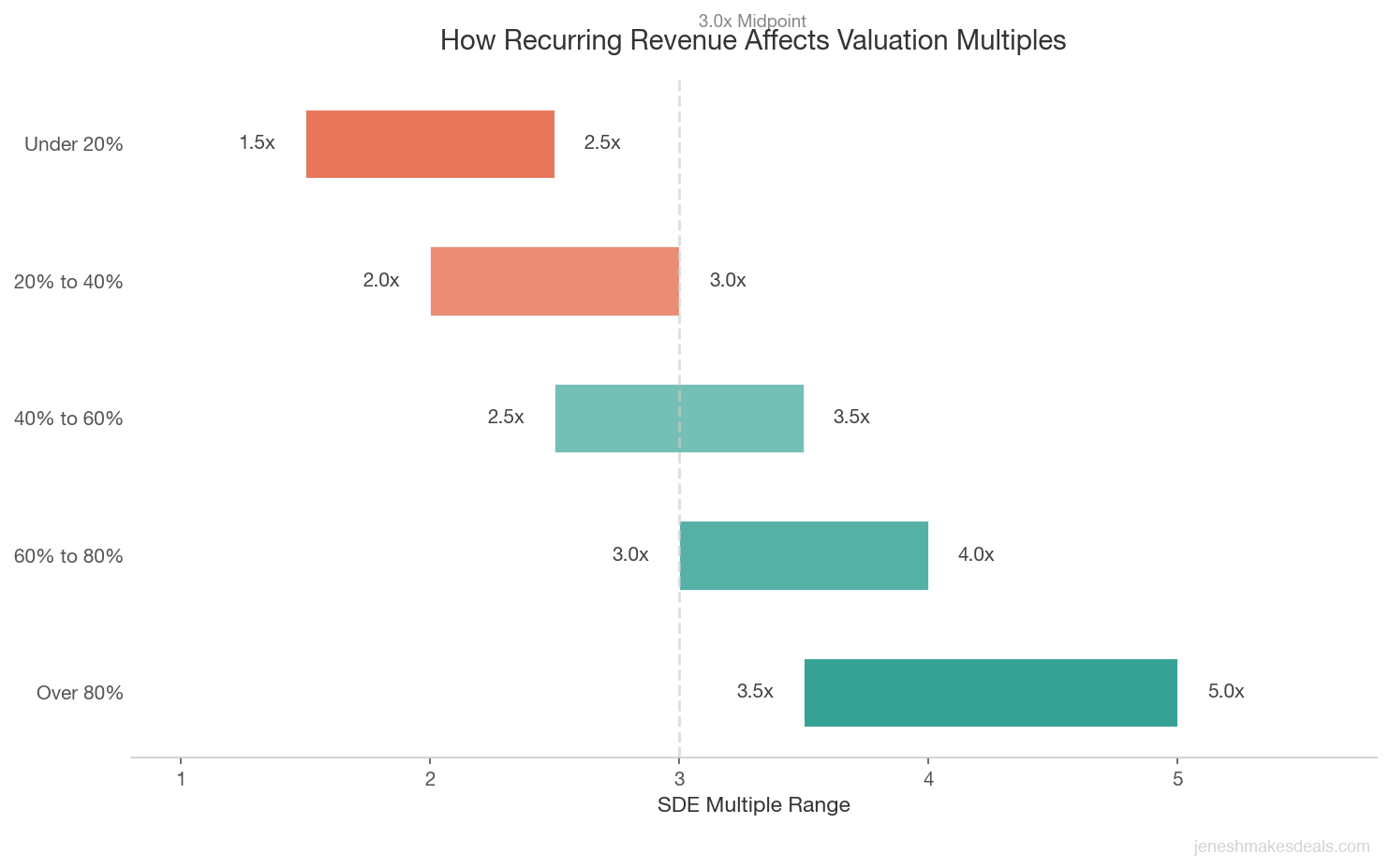
Let me show you how this plays out in real scenarios.
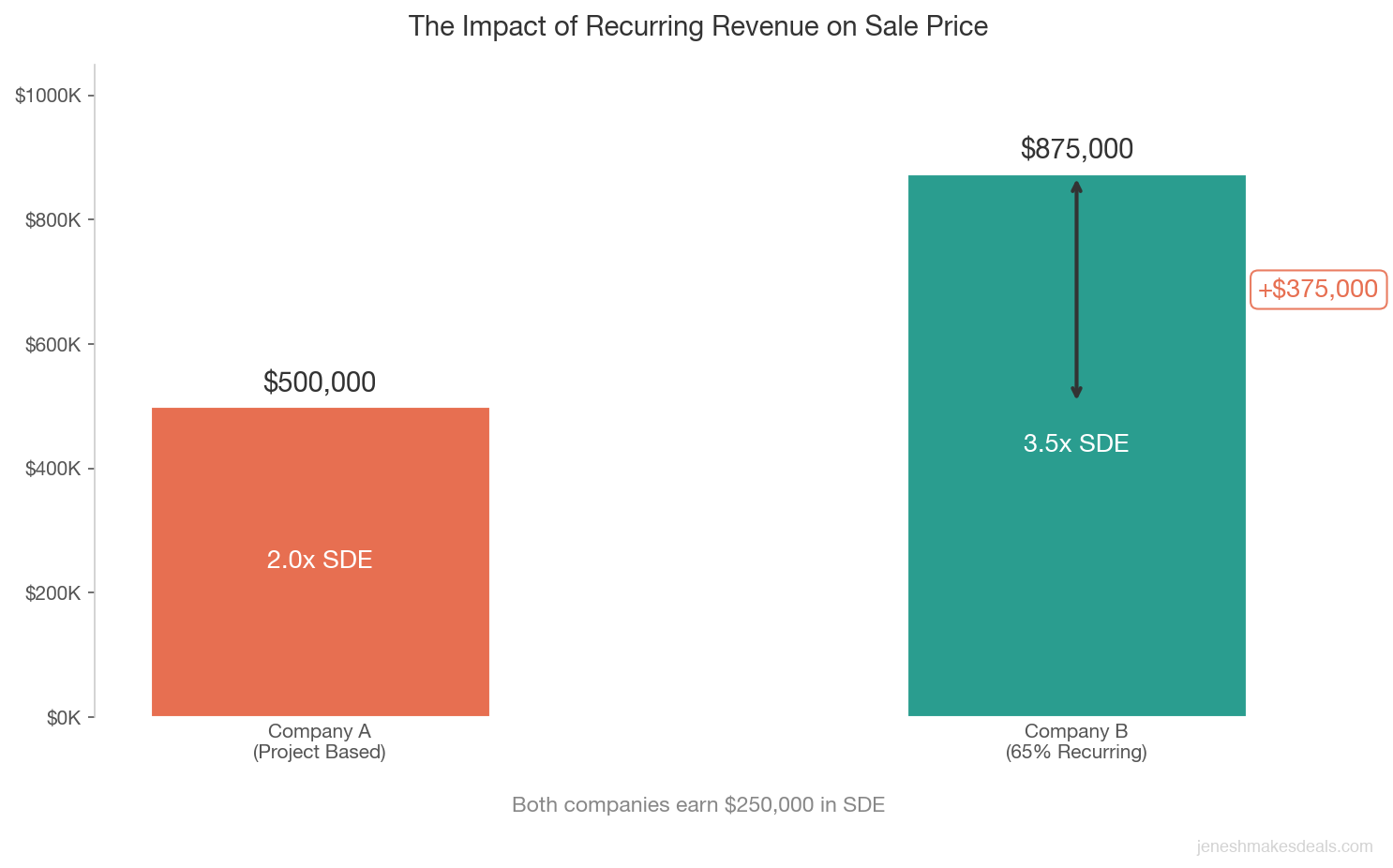
Example 1: Two cleaning companies, same SDE, different models.
Company A does $250,000 in SDE. Revenue is 100% project based. Residential deep cleaning jobs, mostly one time or sporadic repeat customers. No contracts. The buyer has to rebuild the sales pipeline constantly. This business might sell for 2.0x SDE, or $500,000.
Company B also does $250,000 in SDE. But 65% of revenue comes from commercial cleaning contracts with an average term of 2 years, and churn is under 2% monthly. The buyer knows that roughly $160,000 of next year's SDE is essentially locked in. This business might sell for 3.5x SDE, or $875,000.
Same earnings. A $375,000 difference in sale price. That's the power of recurring revenue.
Example 2: IT managed services company with monthly retainers.
I worked with an IT services firm doing $400,000 in SDE. About 75% of their revenue came from monthly managed services retainers, averaging $2,500 per client per month. They had 38 clients, average tenure of 4.2 years, and monthly churn under 1.5%.
This business attracted three competing offers and sold for 4.2x SDE, or $1,680,000. The buyers were willing to pay that premium because the revenue was predictable, the clients were loyal, and the contracts had 90 day cancellation clauses that gave the new owner a runway to build relationships.
Compare that to a project based IT consulting firm at the same SDE level. Without recurring revenue, that business would likely sell in the 2.0x to 2.5x range, somewhere between $800,000 and $1,000,000.
The difference between a project based business and one with strong recurring revenue isn't just a higher price. It's the difference between one buyer making a cautious offer and three buyers competing to win the deal.
Thinking about selling your service business? Get a free consultation to understand where your recurring revenue stands.
How to Present Recurring Revenue Data to Buyers
Knowing you have recurring revenue isn't enough. You need to present it in a way that gives buyers confidence. I've seen sellers leave hundreds of thousands of dollars on the table simply because they didn't organize their data properly.
Here's exactly what you should prepare.
A recurring revenue summary sheet. This is a one page document that shows:
- Total recurring revenue (monthly and annual)
- Recurring revenue as a percentage of total revenue
- Number of recurring clients
- Average monthly revenue per recurring client
- Average client tenure (in months)
- Monthly churn rate (last 12 months)
- Net revenue retention rate
A client aging report. Break your recurring clients into cohorts by how long they've been customers. Something like this:
| Client Tenure | Number of Clients | Monthly Revenue | % of Recurring Revenue |
|---|---|---|---|
| Less than 1 year | 12 | $18,000 | 22% |
| 1 to 3 years | 25 | $37,500 | 46% |
| 3 to 5 years | 8 | $16,000 | 20% |
| Over 5 years | 5 | $10,000 | 12% |
This tells buyers that your recurring base isn't just deep, it's mature. Long tenured clients signal strong relationships that are likely to survive the ownership transition.
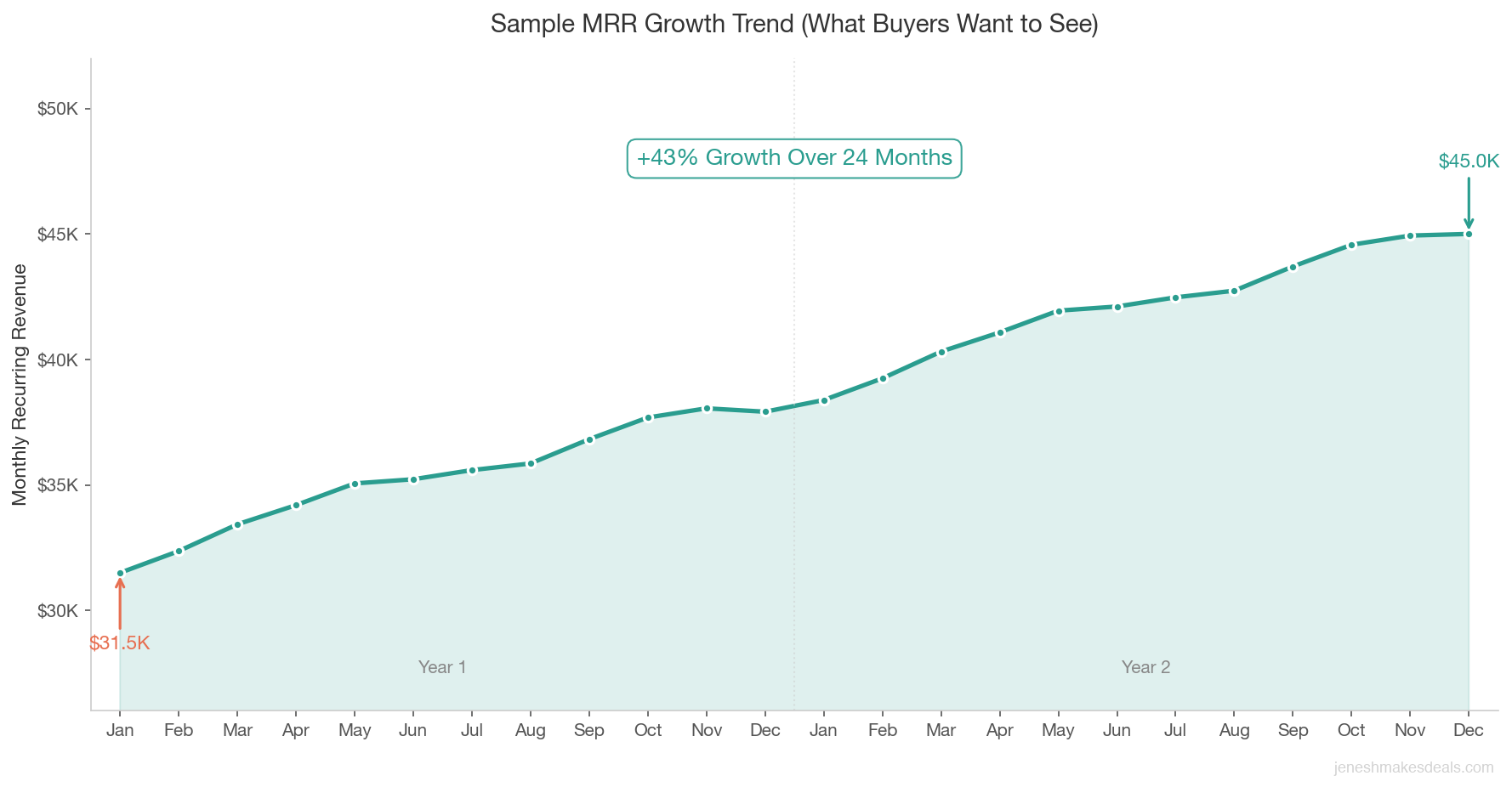
A monthly recurring revenue trend chart. Show 24 months of monthly recurring revenue plotted over time. Buyers want to see a line that trends up and to the right. If there are dips, be ready to explain them. Seasonal businesses might show predictable dips that are perfectly normal.
Contract details. For your largest recurring clients (top 10 to 15), provide:
- Contract start date and term length
- Auto renewal terms
- Cancellation notice period
- Any rate increase clauses
- Last renewal date
Customer concentration analysis. Show the revenue distribution. Prove that no single client dominates your recurring revenue base. A pie chart or simple table showing the top 5 clients as a percentage of recurring revenue goes a long way.
The more organized and transparent this data is, the more confident a buyer becomes. And confident buyers pay higher prices.
The sellers who get top dollar aren't always the ones with the best numbers. They're the ones who present their numbers the best. A clean recurring revenue package with trend charts, cohort data, and contract summaries tells a buyer you run a disciplined operation, and that's worth paying a premium for.
What to Do If You Don't Have Much Recurring Revenue
If you're reading this and thinking, "My business doesn't have much recurring revenue," don't panic. You have time to fix this before you sell. Most service businesses can build recurring revenue with the right approach.
Here are strategies I've seen work across different service industries.
Create maintenance or service plans. This works for almost any service business. HVAC companies sell seasonal tune up plans. Cleaning companies offer weekly or biweekly contracts. Pest control firms sell quarterly treatment agreements. Landscaping companies bundle mowing, fertilization, and seasonal cleanup into annual contracts.
The key is packaging services your customers already buy into a predictable agreement. You're not creating new services. You're formalizing existing relationships.
Offer a discount for commitment. Give customers a 10% to 15% discount for signing an annual agreement instead of paying per service. The math works in your favor because you reduce customer acquisition costs and increase lifetime value, even at a lower per service price.
Build a retainer model. If you run a consulting, marketing, or professional services firm, move clients from project based billing to monthly retainers. Position it as guaranteed priority access and a fixed monthly cost they can budget for. Most clients prefer the predictability just as much as you do.
Add a subscription layer to a project based business. A remodeling company might not have recurring revenue from renovation projects. But they can offer an annual home maintenance inspection program. A web design agency can sell monthly website management packages. Think about what comes after the initial project and turn that into a subscription.
Lock in contracts with your best customers. If you have customers who've been buying from you regularly for years, approach them about formalizing the relationship. Many will happily sign a contract in exchange for rate protection or priority scheduling. Start with your top 20 customers and work down.
Give yourself 12 to 18 months. Building recurring revenue takes time. If you're thinking about selling in the next year or two, start converting customers now. A buyer wants to see at least 12 months of recurring revenue history to take it seriously. Six months of data is better than nothing, but 18 to 24 months is ideal.
If you're planning to sell within two years, building recurring revenue should be your number one priority starting today. Every month you wait is a month of data you won't have when buyers start asking questions.
Not sure where your business stands today? Use our valuation calculator to see how different levels of recurring revenue affect your price.
Common Mistakes Sellers Make with Recurring Revenue
I've seen smart business owners make these mistakes repeatedly. Avoid them and you'll be in much better shape during negotiations.
Mistake 1: Inflating recurring revenue numbers. Some sellers count every customer who's purchased more than once as "recurring." Buyers will audit this. If your definition of recurring doesn't hold up under scrutiny, you've destroyed trust with the buyer and possibly killed the deal.
Mistake 2: Ignoring churn until due diligence. Sellers love to talk about how many customers they have. Buyers want to know how many they've lost. If you don't track churn, start now. And if your churn is high, work on fixing it before going to market. A churn rate over 5% monthly will spook most buyers.
Mistake 3: Not differentiating between contract types. Lumping all recurring revenue together misses the nuance buyers care about. A 3 year commercial contract is worth more than a month to month retainer. Break your recurring revenue down by contract type and term length so buyers can see the full picture.
Mistake 4: Hiding customer concentration. If your biggest client represents 30% of revenue, the buyer will find out during due diligence. Don't hide it. Address it proactively and explain what you're doing to diversify. Better yet, diversify before you sell.
Mistake 5: Not having written contracts. I've worked with service businesses that operate entirely on handshake agreements. The customer pays every month, the work gets done, everyone's happy. But from a buyer's perspective, no written contract means no recurring revenue. It's just repeat revenue, and it's worth less. Get your agreements in writing.
Mistake 6: Overlooking rate increase history. If you haven't raised prices on your recurring clients in 3 years, a buyer sees that as both a risk and an opportunity. The risk is that a price increase might trigger cancellations. The opportunity is built in margin expansion. Either way, document your pricing history so buyers can make informed projections.
Mistake 7: Presenting messy data. If a buyer asks for your recurring revenue breakdown and you need two weeks to pull it together from spreadsheets and invoices, that's a problem. It signals that you don't track this metric closely, which makes buyers wonder what else you're not tracking. Have your data clean and ready before you go to market.
Buyers don't penalize you for having imperfect numbers. They penalize you for not knowing your numbers. Track churn, retention, and concentration monthly so you can answer any question a buyer throws at you.
Building a Recurring Revenue Story That Sells
The best sellers don't just present data. They tell a story about their recurring revenue that helps buyers see the future.
Here's the story framework I coach my clients to use:
Start with the base. "We have $45,000 in monthly recurring revenue from 52 clients under contract. That's $540,000 annually, representing 68% of our total revenue."
Show the trend. "Over the past 24 months, our recurring revenue has grown from $32,000 to $45,000 per month. That's 41% growth without any major sales initiatives."
Prove the stickiness. "Our average client has been with us for 3.4 years. Monthly churn is 1.8%. Our net revenue retention is 108% because existing clients tend to add services over time."
Address concentration. "Our largest client represents 11% of recurring revenue. Our top 5 clients represent 34%. No single client loss would materially impact the business."
Project the future. "Based on our current growth rate and churn, a new owner can expect recurring revenue to reach $52,000 to $55,000 per month within 12 months, assuming no changes to the sales process."
That story, backed by clean data, is what gets you a premium multiple.
Ready to get your business valued by someone who understands recurring revenue? Schedule a free consultation and I'll walk you through exactly where you stand.
The Bottom Line
Recurring revenue is the most valuable asset in a service business sale. It reduces buyer risk, increases valuation multiples, and makes your business dramatically easier to sell.
But it only works if the numbers are real, organized, and presented clearly. Buyers are sophisticated. They'll dig into your churn rates, contract terms, customer concentration, and revenue trends. The sellers who prepare for this scrutiny get rewarded with higher prices and faster closings.
If you're planning to sell in the next 1 to 3 years, start building recurring revenue now. Convert repeat customers to contracts. Create service plans. Track your metrics monthly. And when you're ready to go to market, have your recurring revenue story ready to tell.
The difference between a 2.5x and a 4.0x multiple on a $300,000 SDE business is $450,000. That's worth the effort.
Want to know what your service business is worth today? Use our free valuation tools to get a starting estimate, then reach out for a full consultation.
Related Articles

April 30, 2026
How Long Does It Really Take to Sell a Business
Most sellers are shocked by how long it takes. Here's the honest timeline from listing to closing, and what actually speeds things up.

April 26, 2026
How to Structure an Earnout That Works for Seller and Buyer
Most earnouts fail because they're poorly structured. Here's how to build earnout terms that protect both sides of the deal.

April 24, 2026
How to Value Intellectual Property in a Business Sale
Your IP could be worth more than your equipment. Learn how patents, trademarks, and trade secrets affect your business valuation.
About the Author
Jenesh Napit is an experienced business broker specializing in business acquisitions, valuations, and exit planning. With a Bachelor's degree in Economics and Finance and years of experience helping clients successfully buy and sell businesses, he provides expert guidance throughout the entire transaction process. As a verified business broker on BizBuySell and member of Hedgestone Business Advisors, he brings deep expertise in business valuation, SBA financing, due diligence, and negotiation strategies.
You might also be interested in
Free Business Calculators
Try our business valuation calculator and ROI calculator to estimate values and returns instantly.
How to Buy a Business Guide
Download our comprehensive free guide covering everything you need to know about buying a business.
Our Services
Explore our professional business brokerage services including valuations and buyer representation.
More Articles
Browse our complete collection of business brokerage insights and expertise.