

When most business owners think about what their company is worth, they think about equipment, inventory, and revenue. Those things matter. But for many small businesses, the most valuable asset isn't anything you can see or touch. It's goodwill.
Goodwill is the difference between what a buyer pays for your business and the value of its tangible assets. It represents everything that makes your business worth more than the sum of its parts: your reputation, your customer relationships, your brand, your processes, your workforce, and the earnings power that all of those things create together.
I've worked with sellers who were shocked to learn that 60% to 80% of their sale price was goodwill. And I've worked with others who were disappointed that their goodwill was worth less than they expected because their business was too dependent on them personally. Understanding how goodwill works, how it's valued, and how to build it is one of the most important things you can do before selling your business.
What Goodwill Actually Means in a Business Sale
Let's start with a simple example. Say you're selling a plumbing business. The tangible assets include two service trucks worth $40,000 each, $15,000 in parts inventory, and $10,000 in tools and equipment. That's $105,000 in tangible assets.
But a buyer pays $450,000 for the business. Where does the other $345,000 come from? That's goodwill. It represents the value of your established customer base, your reputation in the community, your phone number that rings 20 times a day, your online reviews, your trained technicians who know the routes, and the systems that keep everything running.
The buyer isn't paying $345,000 for something imaginary. They're paying for the ability to step into a business that already generates revenue and profit. Without goodwill, they'd have to start from scratch: building a brand, finding customers, training employees, and developing systems. That takes years and costs far more than $345,000.
In accounting terms, goodwill is classified as an intangible asset. It shows up on the balance sheet after an acquisition as the difference between the purchase price and the fair market value of identifiable assets minus liabilities. But for practical purposes, goodwill is simply the premium a buyer pays for a going concern versus buying just the assets.
Personal Goodwill vs Business Goodwill
This distinction is critical and something many sellers don't understand until it's too late. There are two types of goodwill, and they have very different implications for your sale.
Business goodwill (also called enterprise goodwill) belongs to the company. It includes the business's reputation, brand name, customer relationships that are tied to the business rather than an individual, proprietary processes, trade names, and organizational systems. Business goodwill transfers to the buyer regardless of whether the owner stays or goes.
Personal goodwill belongs to the owner. It's the value that exists because of your personal reputation, your individual relationships with customers, your specific skills, or your presence in the business. If customers call because they want "Dave the plumber" and won't accept anyone else, that's personal goodwill.
Why does this matter? Two big reasons.
First, personal goodwill is harder to transfer. If 50% of your business value is tied to your personal reputation and relationships, the buyer takes on significant risk. What happens when you leave? Will those customers stay? Most buyers will either demand a lower price or structure the deal with an earnout to protect against this risk.
Second, personal goodwill has significant tax advantages for sellers. In many asset sale structures, the portion of the purchase price allocated to personal goodwill is taxed as capital gains rather than ordinary income. Depending on your tax bracket, this can save you tens of thousands of dollars. This is a conversation to have with your tax advisor early in the process.
Need help figuring out what your business is worth? Use our free business valuation calculator to get a quick estimate based on your industry's typical multiples.
How Goodwill Is Calculated
There's no single formula for calculating goodwill. The method used depends on the type of business, the industry, and the preferences of the parties involved. Here are the most common approaches.
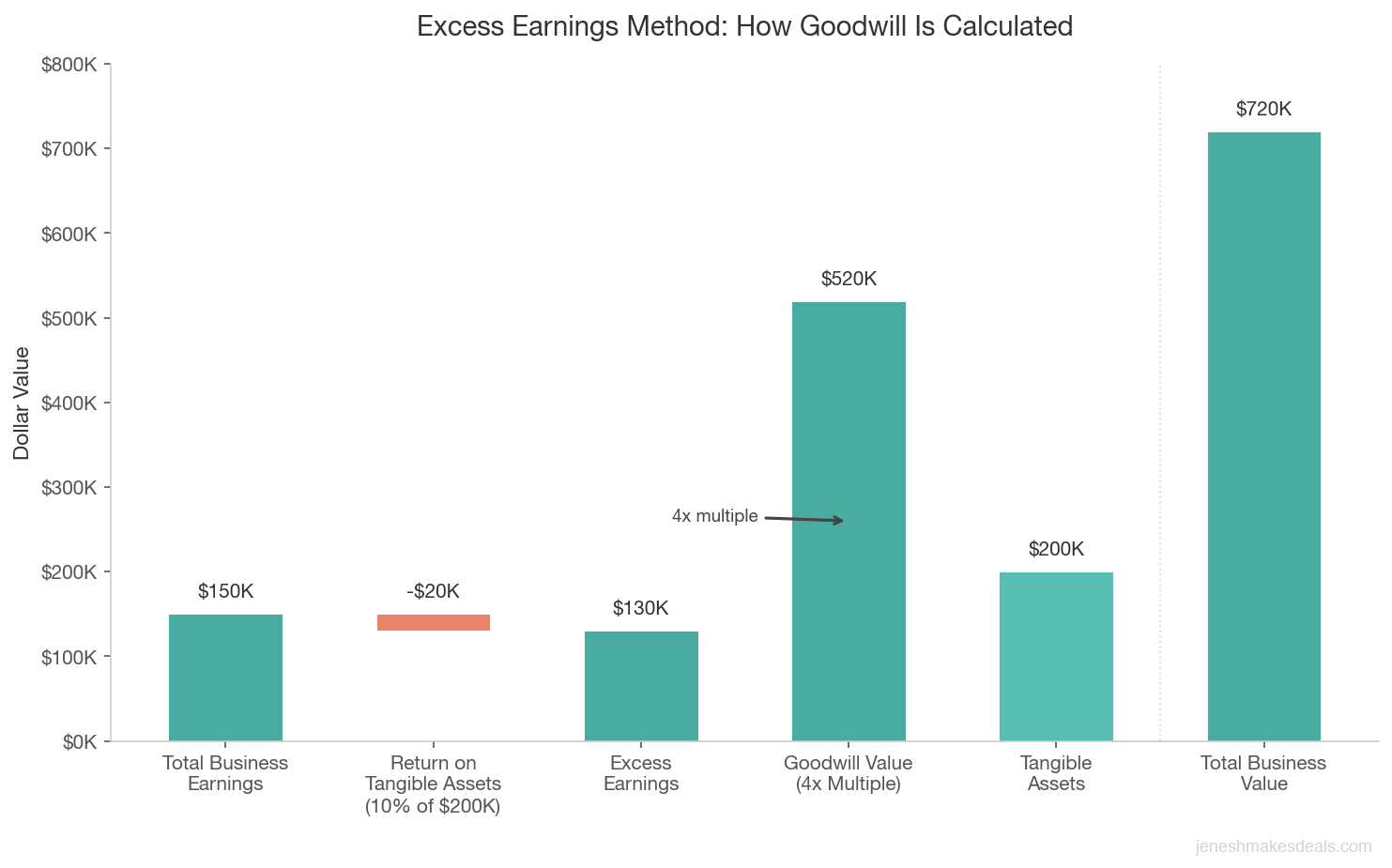
Excess earnings method. This is the most widely used approach for small business goodwill. It works like this:
- Determine the fair market value of all tangible assets
- Calculate a reasonable rate of return on those tangible assets (typically 8% to 15%)
- Subtract that return from the total earnings of the business
- The remaining "excess earnings" represent the return generated by intangible assets, which is your goodwill
- Capitalize those excess earnings using an appropriate multiplier
For example: Your business has $200,000 in tangible assets. A reasonable return on those assets is 10%, or $20,000. Your business generates adjusted earnings of $150,000. The excess earnings are $130,000 ($150,000 minus $20,000). If you capitalize those at a rate that produces a 4x multiple, the goodwill is worth $520,000.
Market comparison method. This looks at what similar businesses have actually sold for and backs into a goodwill number. If comparable plumbing businesses in your area sell for 2.5x to 3x SDE, and your tangible assets represent $100,000 of a $400,000 sale price, the implied goodwill is $300,000.
Capitalization of earnings method. This values the entire business based on its earnings and then subtracts tangible asset values to arrive at goodwill. If your business earns $200,000 in adjusted EBITDA and the appropriate capitalization rate for your industry is 25% (a 4x multiple), the total business value is $800,000. Subtract $150,000 in tangible assets and you get $650,000 in goodwill.
Residual method. The simplest approach. Take the total purchase price, subtract the fair market value of all identifiable tangible and intangible assets (customer lists, non compete agreements, trade names, etc.), and what's left is goodwill. This is the method used for accounting purposes after the deal closes.
What Drives Goodwill Value Up
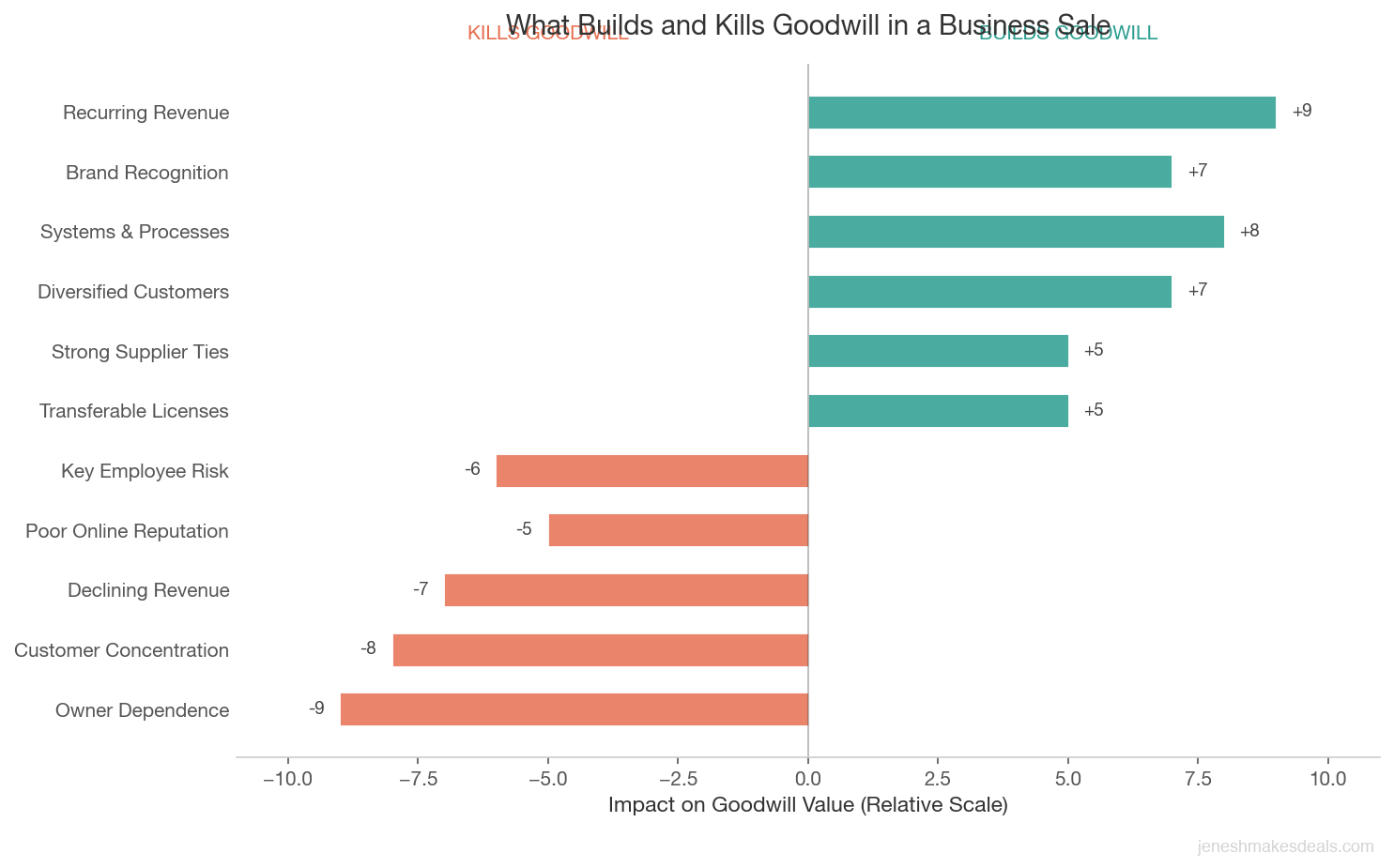
Not all goodwill is created equal. Some businesses have strong goodwill that commands premium valuations. Others have weak goodwill that barely registers. Here's what makes the difference.
Recurring revenue and customer retention. A business where 80% of revenue comes from repeat customers on annual contracts has far more goodwill than one that relies on new customer acquisition every month. Recurring revenue is predictable, and predictability is what buyers pay premiums for.
Brand recognition and reputation. If people in your market know your name and associate it with quality, that's valuable goodwill. Online reviews, word of mouth referrals, and brand awareness all contribute. A business with 500 five star Google reviews has more goodwill than an identical business with 12 reviews.
Systems and processes. Can the business run without you? If you've documented your operations, built training programs, and created systems that employees follow consistently, the goodwill transfers cleanly. If everything lives in your head, the goodwill is fragile.
Trained and stable workforce. Experienced employees who know their jobs and plan to stay after the sale are a major goodwill driver. High turnover and a thin bench suggest that the business is harder to operate, which reduces goodwill.
Diversified customer base. No single customer should represent more than 10% to 15% of revenue. High customer concentration is a goodwill killer because losing one customer could dramatically change the business's economics.
Strong supplier relationships. Favorable pricing, priority fulfillment, and long term contracts with suppliers all contribute to goodwill. A buyer inheriting great vendor relationships starts with a cost advantage.
Transferable licenses and permits. If your business requires special licenses, permits, or certifications, the ability to transfer those to the buyer adds goodwill. If they can't be transferred and the buyer has to reapply, that's risk and delay.
What Kills Goodwill Value
Just as certain factors build goodwill, others destroy it. Here are the most common goodwill killers I see.
Owner dependence. This is the number one goodwill killer for small businesses. If the owner is the primary salesperson, the main customer relationship holder, and the operational decision maker, the goodwill is essentially personal goodwill that may not transfer. Buyers know this and will pay less.
Customer concentration. When one or two customers represent 30% or more of revenue, buyers see enormous risk. Lose that customer and the business economics change dramatically. This significantly discounts the goodwill component.
Declining revenue trends. Goodwill assumes the business will continue to generate earnings at current or growing levels. If revenue has been declining for two or three years, the goodwill is shrinking along with it. Buyers will value future earnings, not past performance.
Poor online reputation. In 2026, your online presence is part of your goodwill. Negative reviews, an outdated website, or a weak social media presence signal to buyers that the brand needs work. That reduces what they're willing to pay for goodwill.
Key employee risk. If your best employees are likely to leave after the sale, the goodwill associated with their expertise and customer relationships leaves with them. Buyers will ask about employee retention plans and may reduce their offer if the team seems unstable.
Lack of documentation. If your processes, recipes, procedures, pricing formulas, or customer databases aren't well documented, the goodwill is harder to transfer. Undocumented goodwill is worth less than documented goodwill.
Ready to talk about maximizing your business value? Contact us for a free consultation and we'll help you identify what's driving your goodwill and how to protect it.
How to Build Goodwill Before Selling
If you're planning to sell in the next one to two years, there's a lot you can do to strengthen your goodwill. Here's what I recommend to every seller I work with.
Reduce owner dependence. This is the single most impactful thing you can do. Start delegating customer relationships, hiring or promoting a manager to handle daily operations, and stepping back from the day to day. The less the business needs you, the more the goodwill is worth.
Document everything. Create an operations manual that covers how every major function of the business works. Include hiring procedures, customer onboarding processes, pricing strategies, vendor management, quality control steps, and anything else a new owner would need to know. This converts personal knowledge into business goodwill.
Lock in key customers. If you can, move your largest customers to long term contracts or service agreements. Even a simple 12 month commitment significantly reduces the risk that customers will leave after the sale.
Diversify your customer base. If you have concentration risk, actively work to bring on new customers. Even reducing your top customer from 25% of revenue to 18% makes a meaningful difference in how buyers perceive risk.
Invest in your brand. Update your website, encourage customers to leave reviews, maintain an active social media presence, and invest in marketing that builds awareness. These are goodwill investments that directly affect what buyers are willing to pay.
Retain and develop your team. Make sure your key employees are fairly compensated and motivated to stay. Consider retention agreements or stay bonuses tied to the sale. A stable team that wants to stay is a powerful goodwill signal.
Clean up your financials. Remove personal expenses from the business, keep clean books, and make sure your reported earnings are accurate and defensible. Strong financials support a strong goodwill valuation.
Goodwill Allocation and Tax Implications
How goodwill is allocated in the purchase agreement has significant tax consequences for both buyers and sellers. This is one area where professional tax advice is essential.
For sellers in an asset sale, the portion of the purchase price allocated to goodwill is generally taxed at long term capital gains rates (currently 15% to 20% for most sellers) rather than ordinary income rates. This is a big deal. On a $500,000 goodwill allocation, the tax difference between capital gains and ordinary income could be $50,000 to $100,000.
For buyers, goodwill acquired in an asset sale can be amortized over 15 years under Section 197 of the Internal Revenue Code. This means the buyer gets to deduct a portion of the goodwill cost each year, reducing their taxable income. A $300,000 goodwill allocation generates $20,000 per year in amortization deductions for 15 years.
Because of these tax implications, buyers and sellers often have different preferences for how the purchase price is allocated. Sellers generally want more allocated to goodwill (capital gains treatment). Buyers sometimes prefer more allocated to tangible assets or non compete agreements (faster depreciation or amortization).
The allocation is negotiated as part of the purchase agreement and must be reported consistently by both parties on IRS Form 8594. Having your tax advisor involved in this negotiation is critical.
How Buyers Evaluate Goodwill
Understanding how buyers think about goodwill helps you prepare for their questions and concerns. Here's what goes through a buyer's mind.
Is this goodwill transferable? The buyer's biggest question. They want evidence that the business will continue to perform after the owner leaves. Customer contracts, documented processes, strong management teams, and brand recognition all support transferability.
How long will the goodwill last? Goodwill isn't permanent. A strong brand in a declining industry might have limited useful life. A customer base that's aging without new customers being added is also concerning. Buyers want goodwill that will sustain earnings for years, not months.
Is the goodwill defended? Do you have non compete agreements, trade secrets, or other protections that prevent competitors from eroding your goodwill? A business with a strong competitive moat has more durable goodwill.
Does the goodwill justify the price? At the end of the day, the buyer is asking whether the premium they're paying over tangible asset value is justified by the earnings the goodwill generates. If you're asking 3x earnings for a business in an industry where the norm is 2x, you need exceptionally strong goodwill factors to support that premium.
Goodwill by Industry: What to Expect
Different industries have different goodwill characteristics. Here's a general overview.
| Industry | Typical Goodwill as % of Sale Price | Key Goodwill Drivers |
|---|---|---|
| Professional practices (dental, CPA) | 70% to 85% | Patient/client relationships, reputation, referral network |
| Service businesses (HVAC, plumbing) | 50% to 70% | Customer base, brand, trained technicians, recurring revenue |
| Restaurants | 40% to 60% | Location, brand, recipes, customer loyalty, online reviews |
| Retail | 30% to 50% | Location, brand, customer traffic, supplier relationships |
| Manufacturing | 20% to 40% | Customer contracts, proprietary processes, workforce skills |
| E-commerce | 60% to 80% | Traffic, brand, supplier relationships, content, SEO rankings |
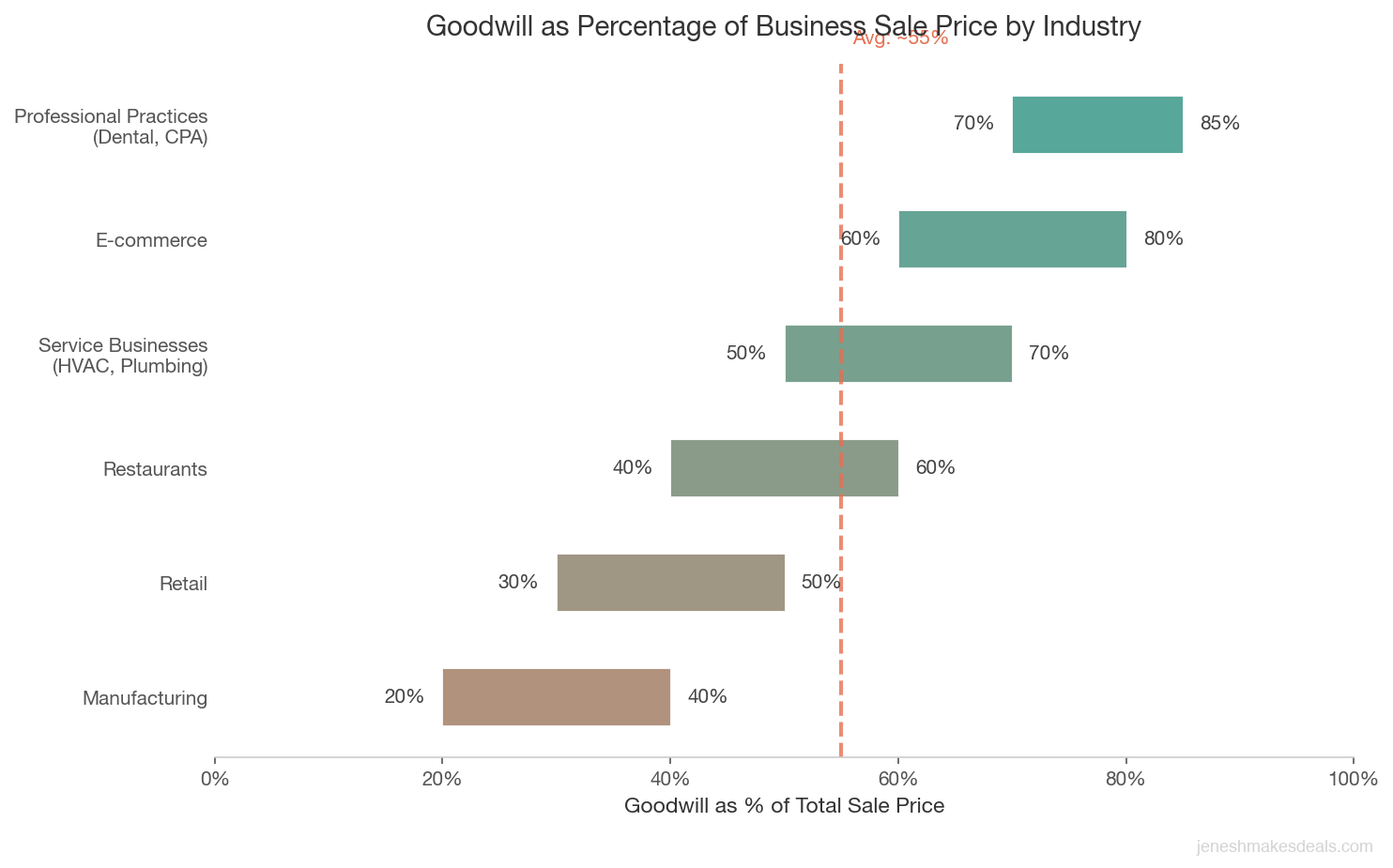
These are general ranges. Your specific business could be higher or lower depending on the factors we've discussed.
The Bottom Line on Goodwill
Goodwill is real, it's valuable, and it's probably the biggest component of what a buyer will pay for your business. But it's also fragile. It takes years to build and can be damaged quickly by owner dependence, customer losses, or reputation problems.
If you're planning to sell, start thinking about your goodwill now. Every action you take to reduce owner dependence, diversify your customer base, strengthen your brand, and document your processes directly increases the goodwill component of your sale price.
And when it comes time to negotiate, make sure you have professionals, a good broker, a CPA experienced in M&A transactions, and an attorney, helping you allocate the goodwill in a way that minimizes your tax burden while keeping the deal fair for both parties.
Thinking about selling your business? Contact us for a free consultation and we'll help you understand what's driving your goodwill and how to maximize it before going to market.
Want a quick estimate of your business value? Try our free business valuation calculator to see where you stand.
Related Articles

April 30, 2026
How Long Does It Really Take to Sell a Business
Most sellers are shocked by how long it takes. Here's the honest timeline from listing to closing, and what actually speeds things up.

April 26, 2026
How to Structure an Earnout That Works for Seller and Buyer
Most earnouts fail because they're poorly structured. Here's how to build earnout terms that protect both sides of the deal.

April 24, 2026
How to Value Intellectual Property in a Business Sale
Your IP could be worth more than your equipment. Learn how patents, trademarks, and trade secrets affect your business valuation.
About the Author
Jenesh Napit is an experienced business broker specializing in business acquisitions, valuations, and exit planning. With a Bachelor's degree in Economics and Finance and years of experience helping clients successfully buy and sell businesses, he provides expert guidance throughout the entire transaction process. As a verified business broker on BizBuySell and member of Hedgestone Business Advisors, he brings deep expertise in business valuation, SBA financing, due diligence, and negotiation strategies.
You might also be interested in
Free Business Calculators
Try our business valuation calculator and ROI calculator to estimate values and returns instantly.
How to Buy a Business Guide
Download our comprehensive free guide covering everything you need to know about buying a business.
Our Services
Explore our professional business brokerage services including valuations and buyer representation.
More Articles
Browse our complete collection of business brokerage insights and expertise.