

Most business owners spend months preparing their financials before a sale. They clean up the books, organize tax returns, and get their revenue numbers looking sharp. But I've watched deals fall apart over something far less glamorous: supplier contracts.
Your supplier agreements are the backbone of your cost structure. If a buyer can't confirm that those relationships will survive the ownership change, the entire deal is at risk. I've seen it happen more than once, and it's always painful when it could have been prevented with a little preparation.
Here's what you need to know about handling supplier contracts when you're selling your business.
Why Supplier Contracts Matter More Than You Think
Buyers care about predictability. When someone is paying six or seven figures for a business, they want to know that the cost of goods sold isn't going to jump 30% the week after closing. Supplier contracts are the proof that costs will stay stable.
Think about it from the buyer's perspective. They're building financial projections based on your historical margins. If your supplier pricing is locked in through a contract, those projections are solid. If your pricing is based on a handshake deal with a vendor you've known for 15 years, the buyer has no idea what happens when a new owner calls to place an order.
Supplier contracts also tell a buyer about the health of your business relationships. Long term agreements with favorable terms signal a well run operation. Month to month arrangements with no written agreements signal risk. And risk always lowers your sale price.
A buyer who can verify that supplier costs will remain stable after closing is a buyer who will pay full price. Uncertainty in the supply chain always gets priced against the seller.
Here's what buyers specifically look for in your supplier agreements:
- Pricing terms and escalation clauses (are costs locked in or subject to annual increases?)
- Contract duration (how long until renewal or renegotiation?)
- Minimum purchase requirements (does the business have volume commitments?)
- Payment terms (net 30, net 60, or prepayment?)
- Change of control provisions (can the supplier terminate if ownership changes?)
- Exclusivity arrangements (is the business locked into a single supplier?)
If you can hand a buyer a binder full of signed, current supplier agreements with clear terms, you've just removed a major source of uncertainty. That's worth real money at the negotiating table.
Want to know what your business could be worth with strong supplier agreements in place? Try our free valuation calculator to get a starting estimate.
Asset Sale vs Stock Sale: How Deal Structure Affects Your Contracts
The way your deal is structured has a direct impact on what happens to your supplier contracts. This is one of those areas where the difference between an asset sale and a stock sale really matters.
Stock Sales
In a stock sale, the buyer purchases the ownership of your business entity. The entity itself doesn't change. From a contract standpoint, this is generally simpler because the legal party to the contract (your LLC or corporation) continues to exist. The contracts technically don't need to be reassigned because the counterparty hasn't changed.
That said, "simpler" doesn't mean "automatic." Many supplier contracts contain change of control clauses that are triggered even in a stock sale. I'll cover those in detail in the next section.
Asset Sales
In an asset sale, the buyer purchases specific assets from your company. Since the buyer is a different legal entity, every supplier contract needs to be formally assigned or renegotiated. The original contract is between your company and the supplier. The buyer's new entity isn't a party to that agreement.
This means the buyer needs the supplier's consent to assign each contract. Some suppliers will agree without hesitation. Others will use it as an opportunity to renegotiate terms. And a few might decline to work with the new owner altogether.
Here's a comparison of how the two structures affect supplier contracts:
| Factor | Asset Sale | Stock Sale |
|---|---|---|
| Contract assignment | Required for every contract | Usually not required |
| Supplier consent | Must be obtained | May still be needed (change of control) |
| Renegotiation risk | Higher | Lower |
| Supplier notification | Required before or at closing | Depends on contract terms |
| Timeline impact | Can add weeks to closing | Typically faster |
| New terms risk | Supplier may demand new pricing | Existing terms usually survive |
Most small business sales are structured as asset sales. If that's your situation, build extra time into your deal timeline for the contract assignment process. I typically recommend 30 to 60 days depending on how many suppliers you're dealing with.
Change of Control Clauses and What They Mean for Your Sale
A change of control clause is a provision in a contract that gives one party certain rights (usually the right to terminate) when the other party undergoes a change in ownership. These clauses exist in supplier contracts, customer contracts, leases, and loan agreements.
For a business sale, change of control clauses are one of the biggest contract related risks. Here's why.
Let's say you have a five year supply agreement with a key raw materials vendor. The pricing is 15% below market because you negotiated the deal back when the vendor was trying to grow their customer base. That agreement is a real asset. But buried on page 12 is a clause that says the vendor can terminate with 30 days notice if more than 50% of the business ownership changes hands.
Now your buyer has a problem. The supply agreement they're counting on might not survive the sale. And if that vendor supplies 40% of your materials, the buyer's entire financial model is in question.
Change of control clauses come in a few varieties:
| Clause Type | What It Means | Severity |
|---|---|---|
| Termination rights | Supplier can end the contract outright | High |
| Consent requirements | Supplier must approve the new owner before the contract continues | Medium |
| Renegotiation triggers | Contract stays in place but pricing or terms reset to market rates | Medium |
| Notification requirements | You must tell the supplier about the change, but they can't terminate | Low |
The critical step is identifying every change of control clause in every supplier contract before you go to market. I can't stress this enough. Finding out about a problematic clause during due diligence, after you've already accepted an offer, puts you in the worst possible negotiating position.
Every change of control clause you discover before listing is a problem you can solve on your own terms. Every one you discover during due diligence is a problem the buyer will use against you.
How to Audit Your Supplier Contracts Before Listing
Before you list your business for sale, you need a complete picture of your supplier contract landscape. This audit should happen during your preparation phase, ideally three to six months before you plan to go to market.
Here's the process I walk my clients through:
Step 1: Create a Master Supplier List
Pull together every supplier and vendor your business works with. Include raw materials providers, equipment vendors, software subscriptions, logistics partners, insurance carriers, and professional service providers. Don't forget the smaller ones. A $500 per month software contract with a change of control clause can still create headaches.
Step 2: Gather Every Written Agreement
For each supplier, locate the current contract, master service agreement, purchase order terms, or whatever written documentation governs the relationship. If you don't have a written agreement, note that too. A verbal or handshake relationship is itself a finding that needs to be addressed.
Step 3: Review Key Provisions
For each contract, document:
- Start date and expiration date
- Auto renewal terms
- Pricing and escalation clauses
- Minimum purchase commitments
- Change of control or assignment provisions
- Termination provisions (for cause and for convenience)
- Personal guarantees
- Exclusivity terms
- Notice requirements
Step 4: Flag Risk Items
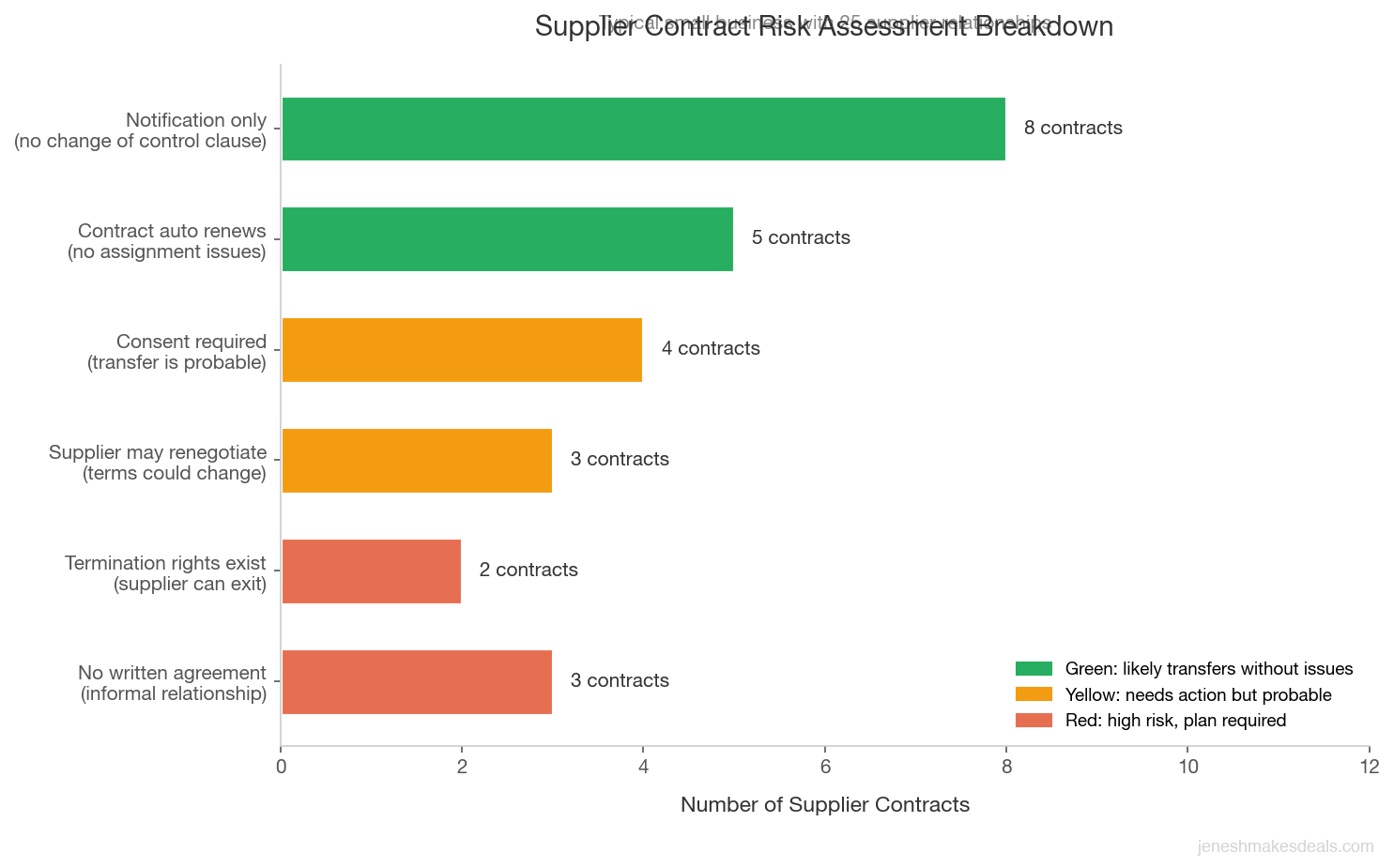
Organize your findings into three categories:
- Green: No change of control clause, or clause requires only notification. Contract will likely transfer without issues.
- Yellow: Consent required from supplier. Transfer is probable but needs action.
- Red: Supplier has termination rights, contract has unfavorable terms that could be renegotiated against you, or the relationship is entirely informal with no written agreement.
Step 5: Develop a Plan for Each Red and Yellow Item
For each flagged contract, decide how you'll address it. Some options include renegotiating the contract now to remove the change of control clause, getting pre approval from the supplier, finding alternative suppliers as a backup, or accepting the risk and disclosing it to buyers.
Not sure what else you should be reviewing before selling? Check out our due diligence resources for a full breakdown of what buyers will examine.
Personal Guarantees on Supplier Accounts
This one catches a lot of sellers off guard. When you first opened your business, your suppliers probably required a personal guarantee before extending credit terms. You signed it, got your net 30 terms, and forgot about it.
But that personal guarantee doesn't automatically go away when you sell the business. Even in a stock sale where the entity continues, your personal guarantee typically remains in effect until the supplier formally releases you.
Here's what you need to do:
- Identify every account with a personal guarantee. Check your initial account applications and credit agreements. If you can't find the paperwork, call the supplier and ask.
- Negotiate release of your guarantee at closing. This should be a condition of the sale. The buyer takes over the account and provides their own guarantee (or the supplier agrees to extend credit without one).
- Get the release in writing. A verbal assurance from a sales rep is worthless. You need a formal release letter from the supplier's credit department.
If a supplier won't release your guarantee without the new owner establishing their own credit history, you may need to negotiate a transition period. I've seen arrangements where the seller's guarantee stays in place for 90 days while the buyer builds a payment track record. Just make sure this is documented in the purchase agreement and that the buyer is obligated to cooperate in getting you released.
Leaving a personal guarantee in place after you've sold the business is a serious liability. If the new owner mismanages the relationship and runs up a balance, the supplier is coming after you.
Personal guarantees are the silent liability that catches sellers months after closing. I tell every client the same thing: if your name is still on a supplier guarantee the day after you sell, you have not finished selling your business.
Exclusive Supplier Agreements and Their Impact on Value
Exclusive supplier agreements are a double edged sword in a business sale. On one hand, they can be a real asset. On the other, they can be a significant risk factor.
When Exclusivity Adds Value
If your business has an exclusive distribution agreement for a popular product line in your territory, that's a competitive advantage. No one else in your market can sell that product. Buyers will pay a premium for that kind of protected revenue stream.
Similarly, if you've locked in exclusive pricing from a supplier that gives you a cost advantage over competitors, that agreement directly supports your margins and makes the business more valuable.
When Exclusivity Hurts Value
If an exclusive agreement means you can only buy from one supplier and that supplier's pricing isn't competitive, you're locked into higher costs. Buyers will see this as a constraint. They'll either discount their offer to account for the higher costs or ask you to renegotiate the agreement before closing.
Exclusive agreements also create concentration risk, which I'll cover in the next section. If you're required to source 100% of a critical input from one vendor, you're one supply chain disruption away from serious problems.
What to Do Before Listing
Review every exclusive agreement and ask yourself:
- Does this exclusivity benefit my business or constrain it?
- What happens if I (or the buyer) want to exit this agreement?
- Are the terms still competitive with what's available in the market?
- Will the supplier extend the same exclusivity to a new owner?
If an exclusive agreement is a positive for the business, highlight it in your marketing materials. If it's a negative, work on renegotiating or restructuring it before you go to market.
Supplier Concentration Risk: The Hidden Deal Killer
Supplier concentration is when a large percentage of your supply comes from a single vendor. If 60% or more of your critical materials or inventory comes from one supplier, buyers are going to flag it. Hard.
Here's why. If that one supplier raises prices, goes out of business, or decides not to work with the new owner, the business is in serious trouble. Buyers model worst case scenarios. A concentrated supply chain is a worst case scenario waiting to happen.
I worked with a manufacturing client a few years back who had 70% of their raw materials coming from a single overseas supplier. The business had great margins and steady revenue. But every buyer who looked at the deal asked the same question: what happens if that supplier goes away?
We ended up qualifying two additional suppliers before listing the business. The owner placed small test orders with each one to establish the relationship and verify quality. By the time we went to market, the business had three qualified suppliers for its key materials instead of one.
The result? The business sold for a higher multiple than comparable deals because the buyer felt confident in the supply chain.
Diversifying your supply chain before listing is one of the highest return on investment moves a seller can make. It costs relatively little in time and effort, but it removes a risk factor that buyers will otherwise use to justify a lower offer.
Here's a general framework for how buyers view supplier concentration:
| Concentration Level | Buyer Perception | Impact on Value |
|---|---|---|
| Under 20% from any one supplier | Low risk | Neutral to positive |
| 20% to 40% from one supplier | Moderate risk | Slight discount |
| 40% to 60% from one supplier | High risk | Meaningful discount |
| Over 60% from one supplier | Critical risk | Significant discount or deal breaker |
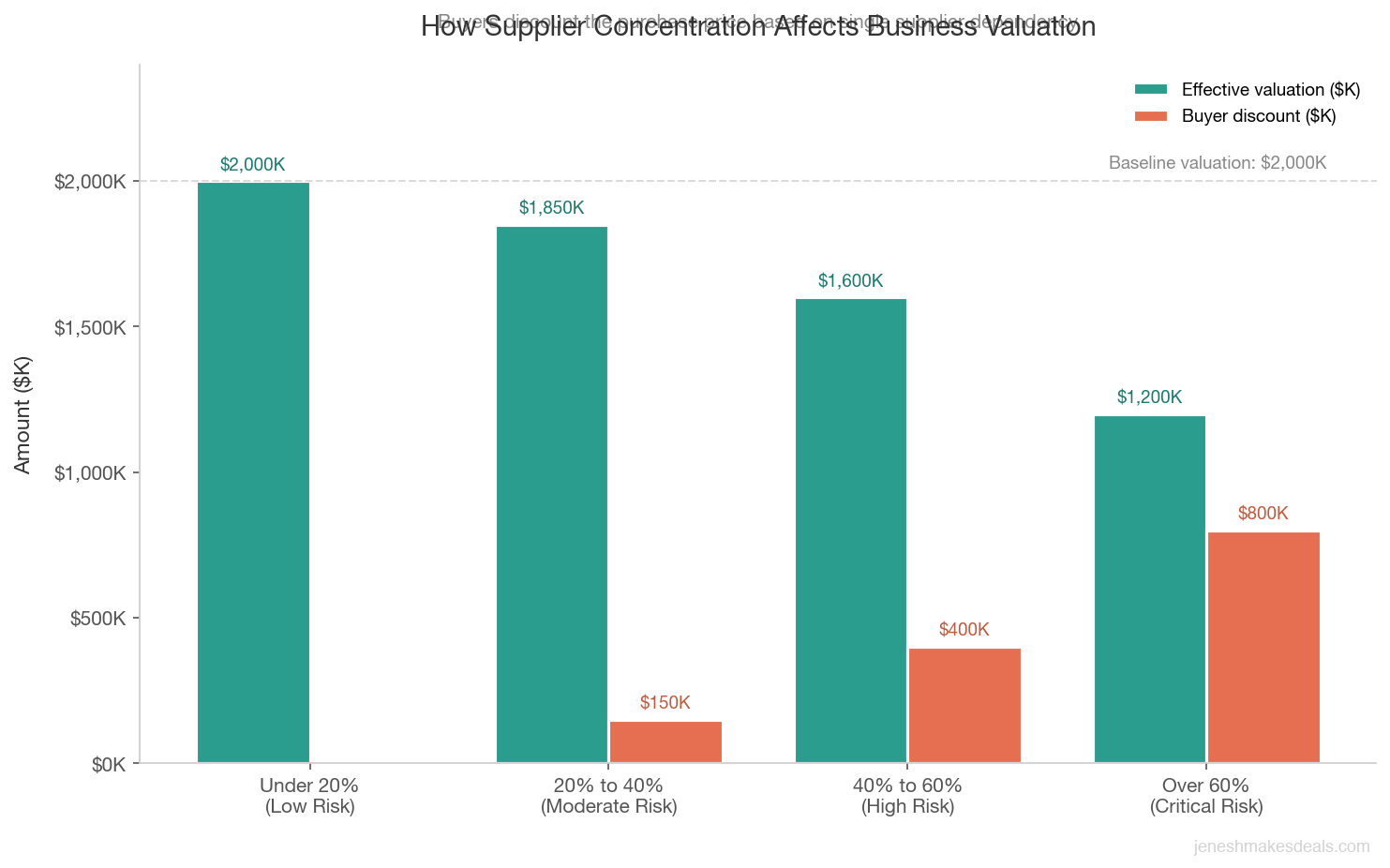
If you have concentration risk, start diversifying now. Don't wait until you're in due diligence. It takes time to qualify new suppliers, test their products, and establish credit terms. Six to twelve months before listing is ideal.
Curious how supplier concentration might affect your business value? Get a free valuation estimate to see where you stand.
How to Approach Suppliers About a Pending Sale
This is where things get sensitive. You need to talk to your suppliers about the sale at some point, but telling them too early can create problems. Suppliers may worry about the stability of the relationship. They might tighten credit terms. Word could leak to competitors or customers.
Here's my approach, and it's the same process I recommend to every client.
Before You List: Don't Tell Anyone
During the preparation phase, keep the sale confidential. You can audit your contracts, identify risk items, and even renegotiate problematic terms without disclosing that a sale is planned. If a supplier asks why you're reviewing contracts, tell them you're doing an annual vendor review. That's both true and unremarkable.
During Due Diligence: Selective Disclosure
Once you have a signed letter of intent with a buyer, you'll need to involve key suppliers in the process. The buyer will want to confirm that critical supply agreements will transfer. But you still want to limit who knows.
Start with your most critical suppliers, the ones with change of control clauses or the ones who represent a large share of your supply spend. Approach them directly and explain the situation. Frame it positively: the new owner is committed to the business and wants to continue the relationship.
Most suppliers will be cooperative. They want to keep the account. The key is to approach them with confidence and a clear plan rather than surprising them with a last minute request.
At Closing: Formal Notification
For suppliers without change of control clauses or consent requirements, you can wait until closing to send a formal notification letter. This letter should introduce the new owner, confirm that the business relationship will continue, and provide updated contact and payment information.
What to Avoid
- Don't tell all suppliers at once. Stagger your notifications based on importance and risk level.
- Don't let the buyer contact your suppliers directly without your involvement, at least not until closing. You own those relationships. You should be the one managing the conversation.
- Don't assume your suppliers will be fine with it. Even long standing relationships can get complicated when ownership changes. Have a backup plan for each critical supplier.
What Happens to Vendor Terms and Credit After the Sale
One thing sellers often forget to discuss with buyers is what happens to vendor terms after closing. Just because you have net 60 payment terms with a supplier doesn't mean the new owner will get those same terms.
Vendor credit is based on the relationship and payment history. In an asset sale, the buyer is a new entity with no track record. Suppliers may require:
- Prepayment or cash on delivery until the new owner establishes credit
- A personal guarantee from the new owner
- Reduced credit limits that increase over time
- Shorter payment terms (net 15 instead of net 30)
This is a working capital issue for the buyer. If they're used to modeling the business with net 60 terms and they actually get net 15 for the first six months, they need more cash on hand to operate. Smart buyers account for this in their financial projections. But you should be prepared to discuss it, because it will come up.
In a stock sale, vendor terms are more likely to carry over since the legal entity hasn't changed. But even here, suppliers who learn about the ownership change may review the account and adjust terms.
The best approach is to work with your buyer to develop a vendor transition plan. For each major supplier:
- Introduce the buyer to the supplier before closing (for critical vendors)
- Have the buyer apply for credit in their own name
- Negotiate a transition period where existing terms remain in place
- Document the expected timeline for full credit transfer
This kind of proactive planning makes the transition smoother and reduces the risk of cash flow disruptions in the first few months after closing.
Timing: When to Notify Suppliers and How to Manage the Transition
Getting the timing right on supplier notification is one of the trickiest parts of selling a business. Tell them too early and you risk leaks, uncertainty, and potential credit tightening. Tell them too late and you might not get the consents you need before closing.
Here's the timeline I recommend:
| Phase | Timing | Action |
|---|---|---|
| Preparation | 6+ months before listing | Audit all contracts, identify risk items, renegotiate if needed |
| Pre market | 3 months before listing | Resolve any red flag items, diversify concentrated supply |
| LOI signed | Day 1 of due diligence | Identify which suppliers need to be contacted |
| Due diligence | Weeks 2 to 4 | Approach critical suppliers with change of control clauses |
| Pre closing | 1 to 2 weeks before closing | Obtain formal consent letters, execute assignment agreements |
| Closing day | At closing | Send notification letters to all remaining suppliers |
| Post closing | First 30 days | Buyer establishes direct relationships, transitions credit |
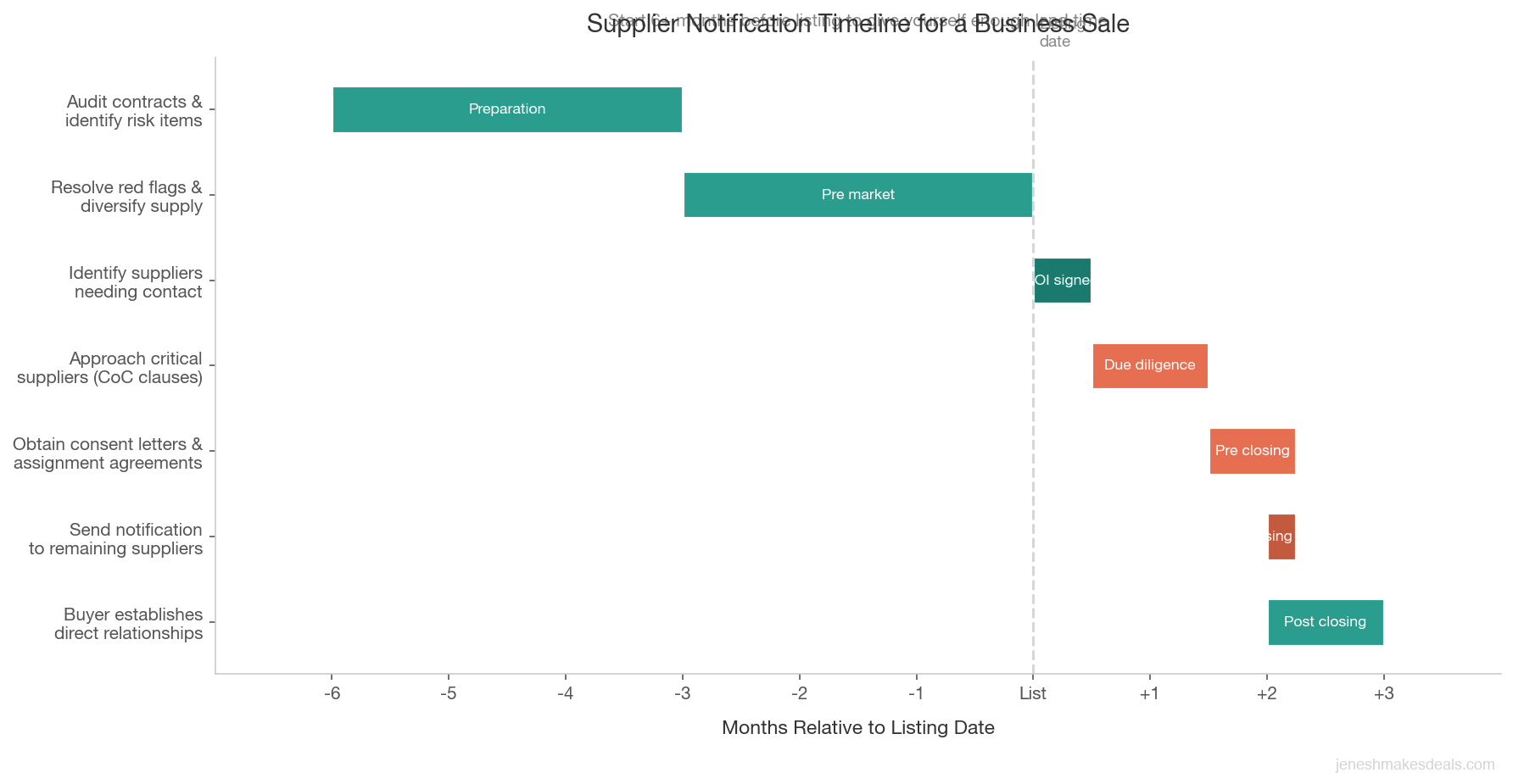
The purchase agreement should specify exactly which supplier consents are required as a condition to closing. If a critical supplier consent can't be obtained, the buyer should have the right to walk away or renegotiate the price. This protects both parties.
Ready to start preparing your business for sale? Schedule a free consultation and I'll help you build a supplier transition plan that protects your deal.
Real World Example: The Change of Control Clause That Almost Killed a Deal
Let me tell you about a deal I worked on that almost fell apart because of a single supplier contract.
My client was selling a specialty food manufacturing business. Revenue was around $3.2 million annually with healthy margins. The business had been operating for 12 years and had a solid customer base. We found a qualified buyer, agreed on a price of $1.4 million, and moved into due diligence.
Everything looked good until the buyer's attorney started reviewing supplier contracts.
The business's primary ingredient supplier provided a proprietary spice blend that was central to three of the company's best selling products. The supplier held the recipe. Nobody else could replicate it. This single supplier accounted for about 45% of the company's raw material costs.
And buried in the supply agreement was a change of control clause that gave the supplier the right to terminate with 60 days notice upon a change in ownership of more than 25%.
The buyer panicked. Without that spice blend, three of the company's top revenue products couldn't be produced. The financial model didn't work without those products.
Here's what we did.
First, we called the supplier directly. My client had a strong relationship with them. He'd been a loyal customer for over a decade, always paid on time, and had gradually increased his order volume year over year. We set up a meeting with the supplier's ownership and introduced the buyer.
Second, we asked the supplier what they needed to feel comfortable. Their concern wasn't unreasonable. They'd had a bad experience with another customer who changed ownership and the new owner switched to a cheaper alternative. They wanted assurance that the new buyer would continue the relationship.
Third, we negotiated a new agreement. The supplier agreed to a three year contract with the new owner, locked in at current pricing with a 3% annual escalation cap. In exchange, the buyer committed to minimum annual purchase volumes.
The deal closed 45 days later than originally planned, but it closed. And both the buyer and the supplier ended up in a better position than before because the new contract provided more certainty for everyone.
The lesson here is simple. Don't ignore supplier contracts. Don't assume they'll transfer smoothly. And don't wait until due diligence to find out what's in them.
The best time to audit your supplier contracts is six months before you list. The worst time is when your buyer's attorney finds a problem you didn't know existed.
If the seller in this story had audited his contracts six months earlier, he could have addressed the change of control clause before going to market. The deal would have closed on schedule and without the stress.
Putting It All Together: Your Supplier Contract Checklist
Before you list your business for sale, work through this checklist:
- Gather every supplier contract and organize them in one place
- Read every agreement and flag change of control clauses, assignment restrictions, and termination provisions
- Identify personal guarantees and plan for their release at closing
- Assess concentration risk and start diversifying if any single supplier accounts for more than 30% of critical inputs
- Review exclusive agreements and determine whether they add or reduce value
- Renegotiate problem contracts while you still have time and bargaining power
- Prepare a supplier summary for buyers that shows contract terms, pricing, and relationship history
- Build a transition timeline that maps out when each supplier will be notified and what consents are needed
Getting this right takes work. But it's the kind of work that protects your sale price and keeps your deal from falling apart at the finish line.
Have questions about preparing your business for sale? Reach out for a free consultation and let's make sure your supplier contracts won't surprise anyone.
Supplier contracts aren't the most exciting part of selling a business. But they're one of the most important. A buyer who feels confident about the supply chain is a buyer who's ready to close. And that's what you want.
Related Articles

May 1, 2026
What Happens to Accounts Receivable When You Sell
AR is one of the most negotiated items in any business sale. Here's exactly how it's handled, valued, and who collects it after closing.

April 28, 2026
What Is Representations and Warranties Insurance
R&W insurance protects buyers and sellers in business sales by covering breaches of reps in purchase agreements. Here's how it works.

April 27, 2026
How to Handle Inventory in a Business Sale
Inventory can make or break a business sale. Here's how to value it, negotiate it, and avoid the disputes that kill deals at closing.
About the Author
Jenesh Napit is an experienced business broker specializing in business acquisitions, valuations, and exit planning. With a Bachelor's degree in Economics and Finance and years of experience helping clients successfully buy and sell businesses, he provides expert guidance throughout the entire transaction process. As a verified business broker on BizBuySell and member of Hedgestone Business Advisors, he brings deep expertise in business valuation, SBA financing, due diligence, and negotiation strategies.
You might also be interested in
Free Business Calculators
Try our business valuation calculator and ROI calculator to estimate values and returns instantly.
How to Buy a Business Guide
Download our comprehensive free guide covering everything you need to know about buying a business.
Our Services
Explore our professional business brokerage services including valuations and buyer representation.
More Articles
Browse our complete collection of business brokerage insights and expertise.