
A $25,000 robot barista that serves 120 cups per hour, needs no breaks, and never calls in sick. That is what your coffee shop is now competing against [1].
The robotic coffee barista market hit $1.34 billion in 2024 and is growing at 18.6% per year [2]. Starbucks is rolling out AI across 11,000+ North American stores [3]. Dutch Bros is building an AI ordering co pilot [4]. And the average independent coffee shop owner? Still relying on a punch card and a chalkboard menu.
I have worked with coffee shop owners for years. I know how personal these businesses are. You built something real: regulars who know your name, a team you trained from scratch, a space that feels like yours. But the market does not care about your story. It cares about margins, multiples, and defensibility. On all three, independents are losing ground fast.
Here is what the data shows:
- Valuation multiples are already falling. The average coffee shop earnings multiple dropped to 2.23x in 2025, down 5% from the prior year [5].
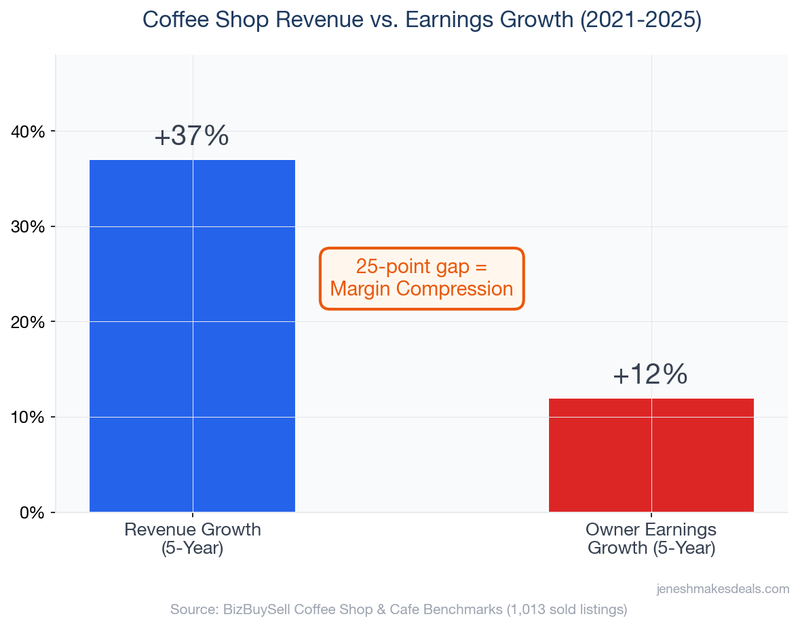
- Margins are getting crushed. Revenue grew 37% over the past five years, but owner earnings grew only 12% [5]. That is textbook margin compression.
- Industry growth is decelerating hard. The U.S. coffee shop market grew at 6.9% CAGR from 2020 to 2025. The projected rate from 2025 to 2030 is just 1.3% [6].
- Coffee bean prices hit an all time record. The arabica "C price" surpassed $4 per pound for the first time ever in February 2025 [7]. Retail coffee prices jumped 21.7%, the biggest increase since 1997.
- Chains are pulling away. Chain coffee stores in the U.S. jumped 19% to over 34,500 in the past six years [8], and 82% of restaurant executives plan to increase AI investment this year [9].
- The sale process takes 9 to 12 months. The median coffee shop sits on the market for 150 days before you even add prep time and closing [5].
"Same stores. Same signs. Different owners." One industry analyst predicts 67% global coffee ownership change by 2027 [10]. The consolidation wave is here.
If you own a coffee shop and plan to sell within three years, the math says sell now. Every quarter you wait, multiples compress, costs rise, and buyers get pickier. This post breaks down why 2026 is your last good exit window, and what to do about it.
The AI Arms Race You Cannot Win
Starbucks Deep Brew: What $3 Billion in AI Looks Like
Starbucks is not experimenting with AI. They are deploying it at scale. Their proprietary platform, Deep Brew, launched in 2019 and became the most advanced AI system in the coffee industry by 2025.
Here is what Deep Brew does:
- Processes data from 75 million+ rewards members [11]
- Drives personalization delivering a 30%+ ROI boost, 23% higher customer engagement, and 14% higher average check sizes [11][12]
- Cuts overstock by 30%, stockouts by 25%, and overall waste by 8% [3]
- Avoids $11.4 million in production costs through optimization [3]
- Powers FlavorGPT, a generative AI tool that reduced R&D waste by 28% [3]
- Deploys Green Dot Assist, an AI assistant for in store baristas rolling out in fiscal 2026 [3]
- Uses Nomad Go inventory across 11,000+ North American locations, completing checks up to 8x faster with computer vision [13]
Starbucks is targeting $3 billion in cumulative cost savings by 2027 with Deep Brew as a core driver [3]. Their delivery business surpassed $1 billion in sales in fiscal 2025, climbing nearly 30% in Q4 [14]. Average delivery orders are nearly double in store purchases. That is revenue that used to walk through your door, pulled into a digital channel where most independents have zero presence.
You are not competing against the Starbucks down the street. You are competing against a $3 billion AI platform that knows what each customer wants before they walk in and ensures consistency across 35,000+ stores globally. That gap widens every quarter.
Dutch Bros: The Fast Follower
Dutch Bros now operates over 1,000 U.S. shops with plans to double by 2029 [4]. They are testing AI to increase drive thru throughput, have order ahead technology in 400+ shops, and hosted a hackathon with Arizona State University to build an AI ordering co pilot [4]. Their AI powered HR tools delivered a 212% increase in team productivity.
Robotic Baristas: The $25,000 Replacement
The robotic barista market hit $1.34 billion in 2024, growing at 18.6% per year to a projected $6.22 billion by 2033 [2]. The traditional coffee shop market? Growing at 1.3% per year [6]. That is a 16x growth rate differential.
The players are real:
| Company | What They Do | Key Stats |
|---|---|---|
| Cafe X | Fully autonomous kiosks | 600 drinks per day per unit, $6M in sales, expanding to Asia |
| Anno Robot | AI robotic arms | 60+ global markets, 98% consistency, 12 to 18 month payback |
| Costa BaristaBots | Automated kiosks (Coca Cola backed) | Rebranded from Briggo acquisition |
| BRUW + Nova Robotics | AI driven pouring control | Acquisition completed July 2025 |
| Xbot Robotics | Fully autonomous vending kiosks | $25,000 robot serving 120 cups per hour, shown at CES 2026 [1] |
These kiosks offer 24/7 operation with zero labor costs, 98% recipe consistency, and 12 to 18 month payback periods from labor savings alone. No retail real estate. No sick days. No health insurance.
Your average indie shop runs 13.8% profit margins [15] with 75% of owners citing staffing as their biggest concern and labor eating 20 to 30% of revenue. Robotic baristas attack every one of those pain points.
I spoke with a coffee shop owner in Hoboken last month. Two locations, solid foot traffic, decent reviews. He said he was not worried about robots because "people come for the experience." I asked what happens when a robotic kiosk opens in the office building across the street at half the price with zero wait time. He did not have an answer.
AI Loyalty Is Replacing Punch Cards
The Deloitte survey of 375 global restaurant executives found 82% plan to increase AI investments [9] and 31% cite enhanced loyalty programs as a top desired outcome. Scooter's Coffee already uses AI driven offers to analyze customer behavior. 56% of Starbucks transactions now occur through mobile or digital channels [12], and their AI drives 14% higher average check sizes through personalization. You are not going to match that with a stamp card.
Not sure what your coffee shop is worth in this market? Run your numbers through our free valuation calculator to get a starting estimate based on current SDE multiples.
How Bad Is the Margin Squeeze for Coffee Shops?
Coffee Bean Prices at Historic Highs
The cost of your core ingredient has exploded:
- Arabica prices hit $3.48 per pound in January 2025, a 79% increase year over year [7]
- The "C price" surpassed $4 per pound for the first time ever in February 2025 [7]
- Current prices sit in the $3.20 to $3.55 per pound range as of early 2026
- Retail coffee prices rose 21.7% in August 2025 compared to the prior year, the biggest jump since 1997 [7]
- Trump's 50% tariff on Brazilian coffee imports is a primary factor. Brazil supplies roughly one third of U.S. coffee [7]
- Robusta coffee surged to its highest price in nearly five decades
You cannot raise menu prices fast enough to keep up. Over the five year period from 2021 to 2025, median revenue on BizBuySell increased 37%, but owner discretionary earnings increased only 12% [5]. Revenue is going up. Profits are not keeping pace.
Labor Costs Are Structural, Not Cyclical
This is not a temporary staffing shortage. This is a permanent cost increase:
- 75% of independent coffee shop owners cite staffing as their biggest concern [15]
- Labor typically runs 20 to 30% of revenue for independent shops
- California's fast food minimum wage reached $20 per hour. Washington state's is $16.66 per hour
- A $1 wage increase was associated with a 14% higher risk of closure for lower rated restaurants
That last stat should stop you cold. Every dollar your labor costs go up increases your risk of closing entirely.
Example: Your single location shop does $375,000 in revenue with labor at 25% ($93,750 per year). A $2 per hour increase across eight employees (at 30 hours per week average) adds roughly $25,000 per year. That is a direct hit to your SDE, dropping it from $78,780 to roughly $53,780. At the current 2.23x multiple, your business just lost about $55,700 in sale value from one wage increase alone. If you have not run the numbers on your own shop, our business valuation calculator shows you exactly where you stand based on current multiples.
The Margin Math
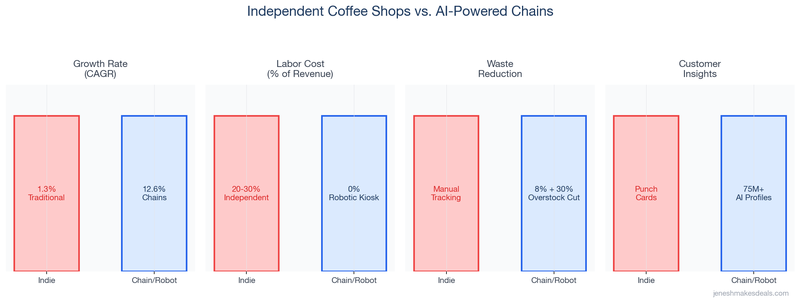
| Metric | Your Shop (Typical Independent) | What Chains Get with AI |
|---|---|---|
| Profit margin | 13.8% average | 30%+ ROI boost from AI personalization |
| Waste reduction | Manual tracking | 8% overall waste reduction, 30% less overstock |
| Staffing cost | 20 to 30% of revenue | Robotic kiosks: 0% labor cost |
| Inventory efficiency | Weekly manual counts | AI counts 8x faster across 11,000 stores |
| Customer insights | Punch card loyalty | AI analyzes 75M+ customer profiles |
The gap between what you do manually and what chains do with AI is widening every month. Your business becomes less competitive and less valuable because of it. If you are thinking about selling within the next few years, check out our guide to maximizing your business value before you list.
Want to talk through your options? Schedule a confidential call to discuss your coffee shop's exit strategy. No pressure, just a real conversation about the numbers.
What Is Your Coffee Shop Actually Worth Right Now?
Current Valuation Multiples
BizBuySell data based on 1,013 sold coffee shop listings [5] gives us the real numbers:
| Metric | Value |
|---|---|
| Median Sale Price | $150,000 |
| Median Asking Price | $175,000 |
| Median Revenue | $375,000 |
| Median Owner Earnings (SDE) | $78,780 |
| Average Earnings Multiple | 2.20x |
| Average Revenue Multiple | 0.46x |
| Median Days on Market | 150 days |
The broader range from Peak Business Valuation:
| Multiple Type | Range |
|---|---|
| SDE Multiples | 2.03x to 3.26x |
| EBITDA Multiples | 2.47x to 3.86x |
| Revenue Multiples | 0.36x to 0.81x |
These numbers align with the 2026 valuation multiples data we track across 30+ industries. Coffee shops sit near the bottom of the range compared to industries with recurring revenue and defensible margins.
The Downward Trend
Here is what most owners do not realize: multiples are already compressing.
In 2023 and 2024, multiples for surviving coffee shops increased about 15%, driven by steady acquisition prices despite slowing earnings. Post pandemic, average values rose 38% from $127,500 to $176,500. That was the good news.
The bad news: 2025 saw a 5% decline in average valuation multiples, with the average earnings multiple dropping to 2.23x [5]. That 5% decline is the beginning, not the end. Industry growth is decelerating from 6.9% to 1.3% CAGR [6]. When buyers see a market approaching flat growth, they pay lower multiples. Growth commands premiums. Near flat growth commands discounts.
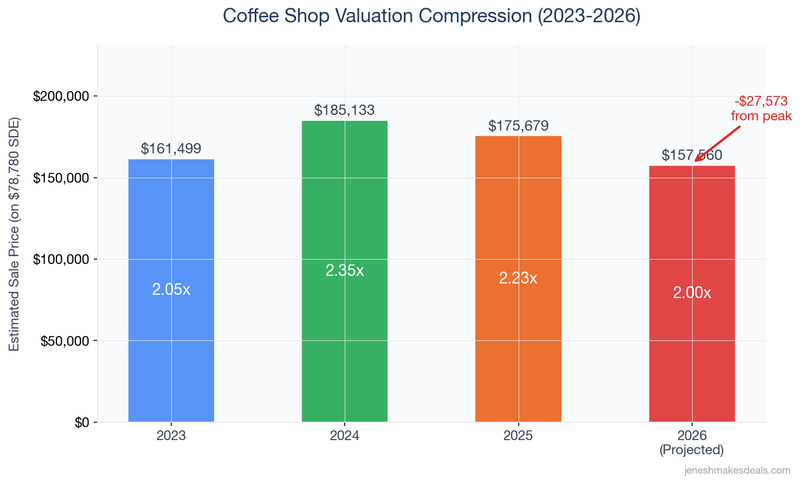
Example: If you sold in 2024 at a 2.35x multiple on $78,780 SDE, you got about $185,133. At the 2025 average of 2.23x, that same SDE gets you $175,679. Wait for multiples to compress to 2.0x and you are looking at $157,560. Now factor in rising costs cutting your SDE by 10% (to $70,900) at a 2.0x multiple: $141,800. That is a $43,333 loss from what you could have gotten in 2024. Every quarter of delay has a price tag.
See where your numbers fall. Use our free valuation calculator to estimate your coffee shop's current market value based on your actual SDE.
Why Is the Competitive Picture Getting Uglier?
Chains Are Growing. Independents Are Not.
The U.S. coffee shop industry represents approximately $74.3 billion in revenue in 2025 [6]. Chain coffee stores jumped 19% to more than 34,500 over the past six years [8]. 7 Brew's sales surged 163% in 2024. A record 59% of U.S. coffee purchases now happen at drive thrus, up from 55% the prior year.
IBISWorld data shows a net decline of 5.5% in coffee and snack shops from 2020 (about 85,800) to 2025 [6]. Shops are closing faster than they are opening. Independents held 70.2% of the global cafe market in 2024, but chained outlets are growing at a projected 12.6% CAGR through 2030. That share shift is accelerating.
Even Starbucks Is Closing Stores
Starbucks is closing about 400 stores nationwide as part of a $1 billion restructuring plan [16]. They closed 42 locations in New York City alone, losing their spot as the largest coffee chain in Manhattan to Dunkin'. If Starbucks is closing stores with $3 billion in AI investment and 75 million loyalty members, what does that tell you about your single location shop?
Starbucks' share of spending at all U.S. coffee shops fell from 52% in 2023 to 48% in 2025 [8]. The market is not growing fast enough to support everyone. Independents without AI, scale, or drive thrus are the most exposed.
Demand Is Real, But the Business Model Is Under Pressure
Coffee demand is not the problem. 66% of Americans drink coffee daily, up from 62% in 2020 [8]. Coffee was the only QSR segment to sustain positive visit growth through summer 2025.
But consumers are getting it from drive thrus, mobile orders, and automated kiosks. Only 30% of industry leaders reported positive trading conditions in 2025, down 50% from 2024. Just one in five expect improvement. People want coffee. The question is whether your business model captures that demand or AI enabled chains capture it instead. If you bought your coffee shop as a first time business purchase, the landscape has changed since you signed the deal.
How Is Private Equity Reshaping Coffee Ownership?
The Big Deals Are Happening Now
PE and strategic buyers are actively consolidating the coffee industry:
| Company | Buyer | Deal Value | Year | Key Detail |
|---|---|---|---|---|
| Philz Coffee (77 units) | Freeman Spogli (PE) | ~$145M | Aug 2025 | Common stockholders received nothing [10] |
| JDE Peet's | Keurig Dr Pepper | $18B | 2025 to 2026 | Backed by $7B from Apollo and KKR. Creating world's largest pure play coffee company |
| Black Rock Coffee Bar (158 units) | IPO (Nasdaq: BRCB) | $294M raised, $956M valuation | Sept 2025 | 10% same store sales growth, first coffee chain IPO since Dutch Bros in 2021 |
| Briggo (robotic kiosks) | Costa Coffee (Coca Cola) | Undisclosed | 2020 | Rebranded as Costa BaristaBots |
| Nova Robotics | BRUW | Undisclosed | July 2025 | AI pouring control integration |
Blue Bottle, Intelligentsia, and Stumptown are all owned by multinational conglomerates or PE groups.
The Philz Coffee Warning
The Philz deal should alarm every independent owner. Freeman Spogli acquired 77 locations for approximately $145 million in August 2025. Common stockholders, including employees who had purchased stock, received nothing [10]. That is what happens when PE enters a market. The owners who benefit are the ones who sell early, before consolidation compresses their options.
The Broader M&A Picture
PwC reports deal value jumped 45% in 2025, totaling over $1.6 trillion across 10,000+ transactions [17]. Cafe and Coffee Retailers ranked #3 in buyer search activity on BizBuySell [5]. Buyer demand exists, but the market is "active but not generous." Buyers move fast only on businesses that show clear, defensible value.
I had a buyer last quarter looking at three coffee shops in northern New Jersey. He passed on two within a week. One had no POS data beyond Square receipts. The other had the owner behind the counter six days a week. The third had documented SOPs, a loyalty app, and a manager running the floor. That one got an offer at asking price. Same revenue range. Completely different outcomes. Understanding what a broker charges and how the process works can make the difference between a smooth exit and a listing that sits.
If you are ready to explore selling, the first step is a conversation. Tell us about your business and we will give you an honest assessment of where you stand.
Why Does Timing Matter for Your Coffee Shop Exit?
Eight Converging Factors
I do not make the "sell now" argument lightly. But the data all points the same direction:
- Market growth decelerating from 6.9% to 1.3% CAGR [6]. Buyers pay premium multiples for growth. Near flat growth gets discounts.
- Earnings multiples already declining. 5% drop in 2025, from about 2.35x to 2.23x [5].
- Margin squeeze accelerating. Record coffee bean prices ($4+ per pound) [7], 50% tariffs on Brazilian imports, rising labor costs.
- AI giving chains insurmountable advantages. Starbucks' Deep Brew delivers 30%+ ROI [11]. Independents cannot replicate this.
- Buyer expectations rising. Buyers in 2026 scrutinize digital readiness and operational infrastructure [17].
- Interest rates remain elevated. 42% of small business owners expected rates to fall in 2025. They did not.
- Robotic alternatives becoming mainstream. A $25,000 robot serving 120 cups per hour threatens human operated shops [1].
- Starbucks closing 400+ stores [16]. If the biggest player is pulling back, the market is sending a signal.
The NYC Taxi Medallion Analogy
I use this with every owner who tells me they want to "wait and see."
NYC taxi medallion values peaked at over $1.2 million. Uber arrived in NYC in May 2011. By 2018, a medallion was worth $170,000. That is an 85% collapse that triggered bankruptcies and caused a $744.9 million loss to the National Credit Union Share Insurance Fund.
Owners who sold in 2012 or 2013, even at "just" $800,000 to $1 million, made out vastly better than those who held. The disruption was visible early. Most assumed regulations would protect them. They did not.
Same dynamic in coffee. The disruption is visible now. Act on what you see, or wait until the market forces your hand. We have seen this pattern in SaaS and other industries where AI is compressing exit windows.
The Timeline Pressure
The sale process takes time. BizBuySell median is 150 days on market [5]. Restaurant sector median is 189 days. Add 3 to 6 weeks of pre market preparation and 60 to 90 days of due diligence and financing. Total: 9 to 12 months.
If you decide to sell today, February 2026, you are realistically closing in Q4 2026 or Q1 2027. If multiples keep compressing at 5% per year, every quarter of delay costs real money. And if a recession, tariff escalation, or competitive shock hits during the process, the deal could stall entirely. Not sure whether to go it alone or hire help? Read our guide on whether you should use a broker to sell your business before you commit to a path.
What Do Buyers Actually Want in 2026?
The buyer profile has changed. Here is what gets a coffee shop sold at a premium versus what gets discounted:
| Premium Factors | Discount Factors |
|---|---|
| Drive thru capability | Dine in only, no mobile ordering |
| POS with data analytics | Cash register, no digital records |
| Loyalty app or digital engagement | Paper punch cards only |
| Multiple revenue streams (delivery, catering) | Coffee drinks only |
| Documented systems and processes | Owner dependent operations |
| Lease with 5+ years remaining | Lease expiring within 2 years |
| Growing or stable same store sales | Declining foot traffic |
| Low owner dependence | Owner makes every drink |
The median sale to ask ratio is 94% [5]. Sellers get close to asking price when the business is positioned correctly. The businesses that sit for 189+ days are the ones missing these fundamentals.
68% of independent owners reported stable or increased revenue in 2024 [15]. Sounds healthy, but it is misleading. Revenue grew 37% over five years while earnings grew only 12%. A buyer looking at your trailing 12 months sees revenue holding steady and margins thinning. That is a business they discount.
If your shop does not have basic digital ordering and some form of electronic loyalty, you are already behind. You do not need a $50,000 tech stack. But you need more than a chalkboard and a punch card. Buyers in 2026 walk away from shops that feel stuck in 2015.
What Should You Do Next?
If you own a coffee shop and you have thought about selling, here is your action plan. The order matters.
-
Get a real valuation now, not next quarter. The average coffee shop sells for $150,000 at a 2.20x earnings multiple [5]. But your shop is not average. You need your actual SDE, your actual multiple range, and what your business is worth today versus 12 months from now. Use our free business valuation calculator for a starting estimate, then get a professional opinion through our business valuation service. The difference between selling at 2.5x and 2.0x on $78,780 SDE is $39,390. That is real money.
-
Fix the three things that kill valuations before you list. Buyers want systems, not stories. Document your operations. Get off the line (if you are still making drinks yourself, your business is worth less because it depends on you). Clean up your financials so a buyer sees trailing 12 months of clear P&L data, not a shoebox of receipts.
-
Understand your timeline and work backward. The sale process takes 9 to 12 months from decision to close. If you want to close by Q4 2026, you need to start now. Multiples are compressing every quarter. Start the prep today and list by mid 2026.
-
Talk to a broker who understands food service M&A. Cafe and Coffee Retailers ranked #3 in buyer search activity on BizBuySell [5]. Buyer demand exists. But positioning your business to capture it, pricing it correctly, and finding the right buyer requires someone who knows this market. Contact us for a confidential conversation about your exit options.
-
Stop investing in things that do not increase sale value. I sat with an owner in Westchester last fall who had just spent $40,000 renovating her seating area. But her financials were a mess and she was still making every espresso herself. That renovation added almost nothing to her sale price. Every dollar you spend should either increase your SDE or make your business more attractive to buyers.
Ready to find out what your coffee shop is worth? Start with our free valuation calculator for a quick estimate, or tell us about your business for a full confidential assessment.
The Bottom Line
The coffee industry is not dying. 66% of Americans drink coffee daily [8]. Specialty coffee is growing at 9.5% per year toward $81.8 billion by 2030 [6].
But the independent coffee shop business model is under assault from every direction. AI is giving chains advantages you cannot replicate. Robotic baristas are attacking your cost structure. Bean prices are at historic highs. Labor costs are structural and rising. Multiples are compressing.
The businesses that sold in 2024 at 2.35x multiples did better than the ones selling in 2025 at 2.23x. The trend is not reversing.
Your coffee shop is worth real money to a real buyer today. The question is whether you capture that value now or watch the number shrink. If you are thinking about selling in the next one to three years, start now. Not next quarter. Now.
Want a straight answer about what your coffee shop is worth? Use our free valuation calculator or contact us directly for a confidential conversation about your exit options.
Sources
[1] Xbot Robotics, CES 2026 demonstration: $25,000 fully autonomous robot barista serving 120 cups per hour.
[2] Grand View Research, "Robotic Coffee Barista Market Size Report, 2024-2033." Market valued at $1.34 billion in 2024, projected to reach $6.22 billion by 2033 at 18.6% CAGR.
[3] Starbucks Corporation, Fiscal Year 2025 earnings reports and Deep Brew AI platform disclosures. $3 billion cumulative cost savings target by 2027; FlavorGPT, Green Dot Assist, and Nomad Go deployments. investor.starbucks.com
[4] Dutch Bros Inc., investor presentations and SEC filings, 2025. 1,000+ U.S. locations; Broista Co Pilot Spark Challenge with ASU, October 2025. investors.dutchbros.com
[5] BizBuySell, "Insight Report: Coffee Shop and Cafe Benchmarks," based on 1,013 sold listings. Median sale price $150,000; average earnings multiple 2.23x (down 5% in 2025); median days on market 150. bizbuysell.com
[6] IBISWorld, "Coffee and Snack Shops in the US," Industry Report 72221, 2025. $74.3 billion market; 6.9% CAGR (2020-2025) decelerating to 1.3% projected CAGR (2025-2030); net 5.5% decline in establishments. ibisworld.com
[7] International Coffee Organization and USDA data, 2025. Arabica C price surpassed $4/lb in February 2025; retail coffee prices rose 21.7% YoY (biggest jump since 1997); 50% tariff on Brazilian imports. ico.org
[8] Technomic, "U.S. Coffee Market Tracker," 2025. Chain coffee stores up 19% to 34,500+; Starbucks spending share fell from 52% (2023) to 48% (2025); 66% of Americans drink coffee daily. technomic.com
[9] Deloitte, "2025 Restaurant Industry AI Survey," survey of 375 global restaurant executives. 82% plan to increase AI investment; 31% cite loyalty programs as top AI use case. deloitte.com
[10] Freeman Spogli & Co., Philz Coffee acquisition, August 2025. 77 locations acquired for approximately $145 million; common stockholders received nothing.
[11] Starbucks Deep Brew AI platform performance data, 2025. 30%+ ROI from personalization; 23% higher engagement; 14% higher average check; 75M+ rewards members analyzed. stories.starbucks.com
[12] National Coffee Association, "National Coffee Data Trends," 2025. 56% of Starbucks transactions through mobile/digital channels. ncausa.org
[13] Starbucks, Nomad Go AI inventory system deployment across 11,000+ North American locations. Inventory checks completed up to 8x faster using computer vision.
[14] Starbucks Corporation, FY2025 Q4 earnings. Delivery business surpassed $1 billion in sales; delivery sales climbed nearly 30% in Q4.
[15] National Coffee Association and industry surveys, 2025. Independent coffee shop profit margin: 13.8% average; 75% of owners cite staffing as top concern; 68% reported stable or increased revenue in 2024.
[16] Starbucks Corporation, 2025 restructuring plan. Approximately 400 store closures nationwide as part of $1 billion restructuring; 42 closures in New York City.
[17] PwC, "Global M&A Trends 2025." Deal value jumped 45% in 2025, totaling $1.6 trillion+ across 10,000+ transactions. Market described as "active but not generous." pwc.com
Related Articles
March 28, 2026
Why Business Owners Need to Sell 2 Years Before They Retire
Most owners wait too long to sell. Here is why starting the exit process 2 years before retirement leads to better prices and smoother transitions.

February 1, 2026
What Happens After You Hire a Business Broker: Full Timeline
The real selling a business timeline from listing to close. Here is what your broker does at each stage and what to expect month by month.
January 31, 2026
7 Ways to Sell Your Business: What Works in 2026
From Facebook Marketplace to private equity, here are 7 ways to sell your business. What works, what doesn't, and what sellers get wrong.
About the Author
Jenesh Napit is an experienced business broker specializing in business acquisitions, valuations, and exit planning. With a Bachelor's degree in Economics and Finance and years of experience helping clients successfully buy and sell businesses, he provides expert guidance throughout the entire transaction process. As a verified business broker on BizBuySell and member of Hedgestone Business Advisors, he brings deep expertise in business valuation, SBA financing, due diligence, and negotiation strategies.
You might also be interested in
Free Business Calculators
Try our business valuation calculator and ROI calculator to estimate values and returns instantly.
How to Buy a Business Guide
Download our comprehensive free guide covering everything you need to know about buying a business.
Our Services
Explore our professional business brokerage services including valuations and buyer representation.
More Articles
Browse our complete collection of business brokerage insights and expertise.