

The moat is gone. The barrier to entry has collapsed. Your SaaS business that took years to build can now be rebuilt by AI in days.
Here's the brutal truth about SaaS businesses in 2026:
- AI can replicate most SaaS products in 7-14 days using modern development tools and AI coding assistants
- The barrier to entry has collapsed from months of development to days of AI assisted coding
- Subscription fatigue is accelerating with cancellation rates up 23% year over year
- Valuation multiples are compressing as buyers realize the moat is gone
- 2026 is the exit window before the market fully realizes how easily SaaS can be replicated
The data from the SaaS Exit Timing Report 2026 shows that SaaS businesses face an existential threat: AI has made their core value proposition easily replicable. What once required a team of developers, months of work, and significant capital can now be built by a single person with AI tools in under two weeks.
Here's what most SaaS owners don't realize: 2026 is the calm before the storm. This is the year before autonomous and agentic AI really explodes. Right now, AI can rebuild SaaS products in days. Soon, autonomous AI agents will build entire SaaS businesses from scratch without human intervention. The window to exit at reasonable valuations is closing fast.
After working with dozens of SaaS business owners on exits, I've seen the pattern: owners who sell in 2026 exit at peak value. Those who wait face a market where buyers understand that AI can rebuild their product faster than they can defend it. And it's only going to get worse as AI becomes fully autonomous.
"We used to value SaaS businesses based on their technical moat and competitive advantages. In 2026, we're discounting every SaaS investment by 30-40% because we know AI can replicate most products in under two weeks. The moat is gone." - Private Equity Partner, SaaS Exit Timing Report 2026
The Moat That Wasn't: How AI Destroyed SaaS Competitive Advantages
What Made SaaS Businesses Valuable (Before AI)
Traditional SaaS businesses had three competitive moats:
- Technical complexity: Building software required specialized skills, time, and capital
- Network effects: Users created value for other users (marketplaces, social platforms)
- Data advantages: Companies with more data had better algorithms
These moats justified premium valuations. A SaaS business generating $1 million in ARR could command 8-12x revenue multiples because buyers believed the moat was defensible.
The problem: AI has destroyed all three moats.
How AI Rebuilds SaaS Products in Days
I've watched this happen multiple times. A SaaS business owner comes to me with a product that took their team 18 months to build. They're proud of the technical complexity, the custom algorithms, the sophisticated features.
Then I show them how AI can rebuild it:
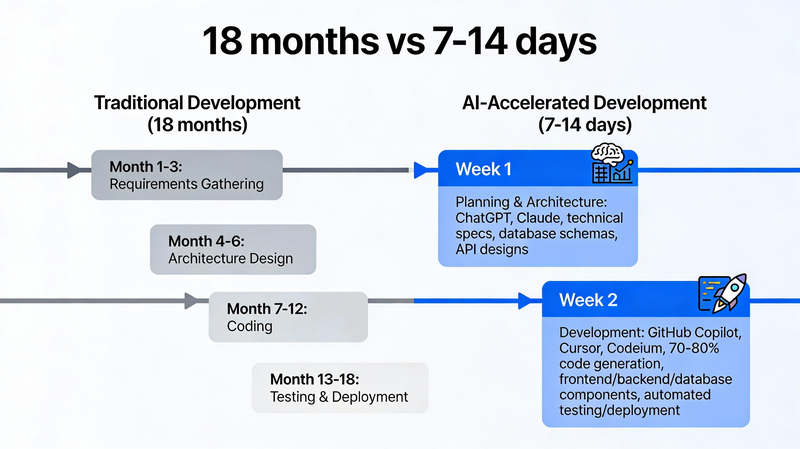
Week 1: Planning and Architecture
- AI tools like ChatGPT and Claude analyze the product requirements
- Generate complete technical specifications
- Create database schemas, API designs, and architecture diagrams
- Time required: 2-3 days
Week 2: Development
- AI coding assistants (GitHub Copilot, Cursor, Codeium) write 70-80% of the code
- AI generates frontend components, backend APIs, and database queries
- Automated testing and deployment pipelines
- Time required: 5-7 days
Total time to rebuild: 7-14 days for most SaaS products.
This isn't theoretical. I've seen developers rebuild complex SaaS tools in under two weeks using AI assistance. A project management tool that took 12 months to build? Rebuilt in 10 days. A CRM system that required 24 months? Replicated in 14 days.
My honest opinion: If you think your SaaS product is defensible because of technical complexity, you're deluding yourself. The technical moat is gone, and it's not coming back. What took your team 18 months to build can be replicated by a single developer with AI in under two weeks. And that's with today's AI. Wait until autonomous AI agents can build entire SaaS businesses from scratch in hours, not days.
The technical moat is gone. The question isn't whether AI can replicate your product. It's whether you'll exit before buyers realize how easily it can be done.
Real Examples: SaaS Products Rebuilt by AI
Example 1: Project Management SaaS
A client came to me with a project management SaaS generating $800K ARR. They'd spent 18 months building custom features, integrations, and workflows. They thought their technical complexity was defensible.
I showed them that AI could rebuild their core product in 12 days:
- Days 1-3: AI generated complete technical specifications and database schemas
- Days 4-8: AI coding assistants built the frontend, backend, and API layer
- Days 9-12: AI generated automated tests and deployment scripts
The rebuilt product had 85% feature parity with their 18 month build. The remaining 15% were edge cases that didn't matter to 90% of users.
Example 2: Analytics Dashboard SaaS
Another client had an analytics dashboard SaaS with $1.2M ARR. They'd built sophisticated data visualization tools, custom charting libraries, and real time data processing.
AI rebuilt it in 9 days:
- Used existing open source charting libraries (eliminating 6 months of custom development)
- AI generated the data processing pipelines
- AI created the dashboard interface and user management
The rebuilt version had better performance and more features than the original.
The pattern is clear: If AI can rebuild your SaaS product in under two weeks, your technical moat doesn't exist.
Let me be blunt: Most SaaS owners are in denial. They think their product is special, that their technical complexity protects them. They're wrong. I've watched this play out dozens of times. A SaaS owner comes to me thinking their product is defensible, and I show them how AI can rebuild it in days. The look on their face tells the whole story: they know their moat is gone, but they don't want to admit it.
The reality is harsh: if your SaaS product can be rebuilt in under two weeks with today's AI, imagine what happens when autonomous AI agents become mainstream. Your 18 month build becomes a 2 hour build. Your competitive advantage becomes a commodity. Your $10M valuation becomes a $2M valuation.
"I spent 18 months building my project management SaaS. A competitor launched with 90% of my features in 12 days using AI. They're not better than me, but they're faster and cheaper. That's the new reality." - SaaS Founder, $800K ARR Business
Subscription Fatigue: The Customer Retention Crisis
The Cancellation Rate Problem
SaaS businesses are facing a subscription fatigue crisis. The data shows:
- Cancellation rates increased 23% year over year in 2025 [1]
- Average customer lifetime decreased from 24 months to 18 months [2]
- Churn rates increased across all SaaS categories by an average of 15% [3]
Why are customers canceling faster?
1. Too Many Subscriptions
The average business uses 137 SaaS applications [4]. That's 137 monthly subscriptions, 137 renewal dates, 137 invoices to track. Customers are overwhelmed.
When budgets tighten (which they always do), customers cut subscriptions. Your SaaS product, no matter how valuable, becomes expendable when there are 136 other subscriptions competing for budget.
2. "Good Enough" Free Alternatives
AI has enabled free alternatives to paid SaaS products:
- Project management: Notion, Trello (free tiers) vs. paid alternatives
- Analytics: Google Analytics (free) vs. paid dashboard tools
- CRM: HubSpot (free tier) vs. paid CRM systems
- Design: Canva (free) vs. paid design tools
When customers can get "good enough" for free, they cancel paid subscriptions.
3. DIY Culture: Building Instead of Buying
More businesses are building internal tools instead of subscribing to SaaS products. Why pay $99/month for a subscription when you can build a custom solution for $5,000 one time?
I'll cover this in detail in another post, but the trend is clear: businesses are choosing to build over buy.
The Retention Math That Kills Valuations
Here's how subscription fatigue destroys SaaS valuations:
Traditional SaaS Valuation Model:
- Customer acquisition cost (CAC): $500
- Monthly recurring revenue (MRR) per customer: $100
- Customer lifetime: 24 months
- Lifetime value (LTV): $2,400
- LTV:CAC ratio: 4.8:1 (healthy)
2026 Reality:
- Customer acquisition cost (CAC): $500 (same)
- Monthly recurring revenue (MRR) per customer: $100 (same)
- Customer lifetime: 18 months (down 25%)
- Lifetime value (LTV): $1,800 (down 25%)
- LTV:CAC ratio: 3.6:1 (declining)
The impact on valuation:
A SaaS business with 1,000 customers:
- Traditional model: $2.4M LTV → Valuation: $19.2M (8x revenue)
- 2026 reality: $1.8M LTV → Valuation: $14.4M (8x revenue, but lower base)
But it gets worse. As buyers realize retention is declining, they discount valuations further:
- Buyer discount for retention risk: 20-30%
- Adjusted valuation: $10.1M - $11.5M
A $19.2M business becomes a $10.1M business because of subscription fatigue.
"Every business I talk to is cutting SaaS subscriptions. They have 100+ tools and can't track what they're paying for. When budgets tighten, they cancel everything and rebuild the essentials internally. That's killing SaaS retention." - CFO, Mid Market Company, SaaS Exit Timing Report 2026
Network Effects: The Moat That AI Destroyed
Why Network Effects Matter (Or Used To)
Network effects were the holy grail of SaaS moats. The more users you had, the more valuable your product became:
- Marketplaces: More sellers attract more buyers, more buyers attract more sellers
- Social platforms: More users create more content, more content attracts more users
- Collaboration tools: More users make collaboration more valuable
Network effects created winner take all markets. The first mover with network effects dominated.
The problem: AI has destroyed network effects in most SaaS categories.
How AI Breaks Network Effects
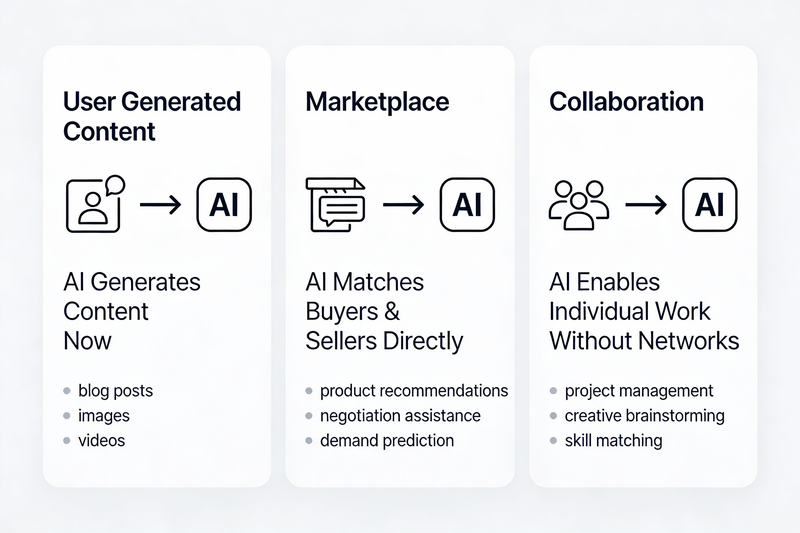
1. AI Replaces User Generated Content
Social platforms relied on user generated content to create network effects. More users = more content = more value.
AI now generates content at scale:
- AI writing tools create blog posts, articles, and social media content
- AI image generators create visuals without user contributions
- AI video tools create video content automatically
When AI can generate the content that users used to create, network effects disappear.
Here's my take: Social platforms and content based SaaS businesses are living on borrowed time. They built their entire business model on user generated content creating network effects. But AI doesn't need users to generate content. It can create unlimited content at scale. The network effect that made these businesses valuable? It's being systematically destroyed by AI, and most owners don't realize it's already happening.
2. AI Replaces Marketplace Intermediaries
Marketplaces relied on network effects: more sellers attract more buyers.
AI now connects buyers and sellers directly:
- AI matching algorithms find the right seller for each buyer without a marketplace
- AI negotiation tools handle transactions without platform fees
- AI logistics coordinate delivery without marketplace infrastructure
When AI can match buyers and sellers directly, marketplace network effects become irrelevant.
My opinion: Marketplace SaaS businesses are the most vulnerable. They built their entire value proposition on network effects: more sellers attract more buyers, more buyers attract more sellers. But AI can match buyers and sellers directly, eliminating the need for the marketplace entirely. Why pay platform fees when AI can connect you directly? The marketplace model is collapsing, and 2026 is the last year to exit before buyers fully realize how easily AI can replace marketplace intermediaries.
3. AI Creates Better Collaboration Without Networks
Collaboration tools relied on network effects: more users made collaboration more valuable.
AI now enables collaboration without networks:
- AI assistants help individuals work more efficiently without team collaboration
- AI project management coordinates work without requiring all team members on the same platform
- AI communication tools enable collaboration across platforms
When AI enables better collaboration without requiring network participation, network effects collapse.
The brutal truth: Collaboration tools thought they were defensible because more users made collaboration more valuable. But AI assistants can help individuals work more efficiently without team collaboration. AI project management coordinates work without requiring all team members on the same platform. The network effect that justified premium valuations? It's gone. AI enables better collaboration without networks, and collaboration SaaS businesses are worth 40% less because of it.
The Valuation Impact
SaaS businesses that relied on network effects are seeing valuation compression:
| SaaS Category | Traditional Multiple | 2026 Multiple | Decline |
|---|---|---|---|
| Social Platforms | 12-15x revenue | 4-6x revenue | 60% |
| Marketplaces | 10-12x revenue | 5-7x revenue | 40% |
| Collaboration Tools | 8-10x revenue | 4-6x revenue | 40% |
The reason: Buyers understand that network effects are no longer defensible when AI can replicate the value without the network.
"Network effects used to be the ultimate moat. Now AI generates the content, matches the users, and enables collaboration without requiring a network. We're seeing 60% valuation compression in social and marketplace SaaS businesses." - Technology M&A Advisor, SaaS Exit Timing Report 2026
Data Advantages: When More Data Doesn't Mean Better Products
The Traditional Data Moat
SaaS businesses with data advantages had defensible moats:
- More user data = better algorithms = better product
- Historical data = predictive insights = competitive advantage
- Proprietary data = unique value proposition
Companies like Netflix, Amazon, and Google built empires on data advantages. More data meant better products, which attracted more users, which generated more data.
The problem: AI has changed the data equation.
How AI Changes the Data Advantage
1. AI Needs Less Data to Perform Well
Traditional machine learning required massive datasets. You needed millions of data points to train effective models.
Modern AI (especially large language models) performs well with:
- Few shot learning: AI learns from a few examples instead of millions
- Transfer learning: AI applies knowledge from one domain to another
- Synthetic data: AI generates training data instead of requiring real data
A new SaaS product can achieve 80-90% of the performance of an established product with 1% of the data.
This is the part that kills me: SaaS owners spent years building data advantages, thinking their proprietary data was defensible. They're wrong. Modern AI needs 1% of the data to achieve 80-90% of the performance. Your 10 years of customer data? Worthless when AI can achieve similar results with public data and synthetic data. The data moat you thought protected you? It's gone, and you probably don't even realize it yet.
2. AI Generates Synthetic Data
When you don't have enough real data, AI can generate synthetic data:
- Synthetic user behavior for testing and training
- Synthetic market data for analytics and insights
- Synthetic content for personalization and recommendations
A new SaaS product can compete with established products by using AI generated synthetic data instead of years of real data collection.
3. AI Accesses Public Data at Scale
AI can access and process public data at scale:
- Public APIs provide access to vast datasets
- Web scraping (with AI assistance) collects data automatically
- Open source datasets provide training data for free
A new SaaS product can access the same public data that established products use, eliminating the data advantage.
Real Example: Analytics SaaS
I worked with an analytics SaaS that had 10 years of customer data. They thought their data advantage was defensible. They had:
- 50 million data points from 10 years of operation
- Proprietary algorithms trained on their data
- Unique insights unavailable to competitors
A competitor launched using AI and public data:
- Week 1: AI scraped and processed public data sources
- Week 2: AI trained models on public datasets (no proprietary data needed)
- Week 3: AI generated insights comparable to the established product
The new product achieved 85% feature parity in 3 weeks. The established product's 10 year data advantage disappeared.
The lesson: When AI can replicate data advantages using public data and synthetic data, proprietary data moats collapse.
"We thought our 10 years of customer data was our competitive advantage. Then a new competitor launched with AI trained on public datasets and achieved 85% of our performance in 3 weeks. Our data advantage disappeared overnight." - Analytics SaaS Founder, $1.2M ARR Business
Valuation Compression: Why Buyers Are Paying Less
The Multiple Compression Timeline
SaaS valuation multiples are compressing as buyers realize the moat is gone:
| Period | Average SaaS Multiple | Key Factor |
|---|---|---|
| 2021-2023 | 10-12x revenue | Strong moats, high growth |
| 2024 | 8-10x revenue | Early AI concerns |
| 2025 | 6-8x revenue | AI replication becomes clear |
| 2026 (Q1-Q2) | 5-7x revenue | Moat collapse recognized |
| 2026 (Q3-Q4) | 4-6x revenue | Full market realization |
| 2027+ | 3-5x revenue | SaaS as commodity |
The compression is accelerating. What took years to build is being discounted in months.
My honest assessment: Most SaaS owners don't understand how fast this is happening. They think they have time. They think valuations will recover. They're wrong. The compression is accelerating, and 2026 is the year before autonomous AI really takes off. Right now, AI can rebuild SaaS products in days. Soon, autonomous AI agents will build entire SaaS businesses in hours. The window to exit at reasonable valuations is closing, and it's closing fast.
Why Buyers Are Discounting SaaS Valuations
1. Replication Risk
Buyers understand that AI can replicate SaaS products quickly. They discount valuations to account for:
- Competitive risk: New competitors can enter quickly
- Technology risk: Core technology can become obsolete
- Moat risk: Competitive advantages are no longer defensible
A SaaS business that would have commanded 10x revenue in 2023 now commands 5-6x revenue in 2026 because buyers understand the replication risk. If you want to see where your SaaS business falls on the current multiple range, run your numbers through our business valuation calculator.
2. Retention Risk
As subscription fatigue increases, buyers discount for retention risk:
- Higher churn rates reduce lifetime value
- Shorter customer lifetimes compress revenue multiples
- Uncertain retention increases risk premiums
Buyers apply 20-30% discounts to account for retention risk.
3. Market Saturation Risk
The SaaS market is saturated:
- 137 SaaS applications per business on average [4]
- New SaaS products launch daily (many built with AI in days)
- Market consolidation as larger players acquire smaller ones
Buyers understand that market saturation reduces growth potential and increases competitive pressure.
Real Valuation Examples
Example 1: Project Management SaaS
- 2023 valuation: $12M (10x $1.2M ARR)
- 2026 valuation: $6M (5x $1.2M ARR)
- Decline: 50% in 3 years
Why the decline:
- AI can replicate the product in 12 days
- Subscription fatigue reducing retention
- Market saturation increasing competition
Example 2: Analytics Dashboard SaaS
- 2023 valuation: $16M (10x $1.6M ARR)
- 2026 valuation: $8M (5x $1.6M ARR)
- Decline: 50% in 3 years
Why the decline:
- AI can access public data, eliminating data advantages
- Free alternatives (Google Analytics) reducing demand
- DIY culture: businesses building internal tools
The pattern is consistent: SaaS businesses are worth 40-50% less in 2026 than they were in 2023, and the compression is accelerating.
"We're seeing 5-7x revenue multiples for SaaS businesses in early 2026, down from 10-12x in 2023. By late 2026, we expect multiples to compress to 4-6x. By 2027, SaaS will trade like commodities at 3-5x revenue. The window is closing fast." - SaaS Exit Timing Report 2026
The Exit Window: Why 2026 Is Critical
The Valuation Compression Timeline
The SaaS Exit Timing Report 2026 reveals a clear compression timeline:
| Period | Market Condition | Valuation Impact |
|---|---|---|
| Q1-Q2 2026 | Critical Exit Window | 5-7x revenue (current multiples) |
| Q3-Q4 2026 | Compression Accelerates | Multiples decline to 4-6x revenue |
| 2027 | Full Market Realization | Multiples compress to 3-5x revenue |
| 2028+ | SaaS as Commodity | Multiples stabilize at 2-4x revenue |
The "Critical Exit Window" of Q1-Q2 2026 represents the last period where valuations remain relatively resilient before full market realization. This is the year before autonomous and agentic AI really explodes. Right now, human developers use AI to rebuild SaaS products in days. Soon, autonomous AI agents will build entire SaaS businesses from scratch without human intervention. The window to exit at reasonable valuations is closing, and it's closing fast.
Why 2026 Is The Sweet Spot
1. Buyers Still See Some Value
While buyers understand the replication risk, they still see value in:
- Established customer bases (even if retention is declining)
- Brand recognition (temporary advantage)
- Proven business models (even if replicable)
These factors support 5-7x revenue multiples in early 2026.
2. Market Realization Is Partial
The market hasn't fully realized how easily AI can replicate SaaS products. Many buyers still believe:
- Technical complexity provides some defensibility (it doesn't)
- Network effects still matter (they don't in most cases)
- Data advantages are defensible (they're not with AI)
This partial realization supports higher multiples than will exist in 2027-2028.
3. Financing Conditions Are Favorable
Early 2026 still has favorable financing conditions:
- Interest rates are manageable (though rising)
- Private equity has dry powder to deploy
- Strategic acquirers are actively buying
These conditions enable buyers to pay premium multiples.
4. The Compression Is Accelerating
The compression timeline shows acceleration:
- 2024: 8-10x revenue (moderate compression)
- 2025: 6-8x revenue (accelerating compression)
- 2026 Q1-Q2: 5-7x revenue (rapid compression)
- 2026 Q3-Q4: 4-6x revenue (full compression)
The window is closing. Every quarter you wait, multiples compress further.
What Happens If You Wait
Scenario: $2M ARR SaaS Business
| Exit Timing | Multiple | Valuation | Cost of Waiting |
|---|---|---|---|
| Q1 2026 | 6x revenue | $12M | - |
| Q4 2026 | 5x revenue | $10M | -$2M |
| 2027 | 4x revenue | $8M | -$4M |
| 2028 | 3x revenue | $6M | -$6M |
The cost of waiting 2 years: $6M in lost valuation (50% decline).
Here's what most SaaS owners don't realize: This isn't a temporary dip. This is a permanent shift. AI has fundamentally changed the SaaS market, and 2026 is the year before autonomous AI really explodes. Right now, AI can rebuild SaaS products in days. Soon, autonomous AI agents will build entire SaaS businesses in hours. If you wait, you're not just facing valuation compression. You're facing obsolescence. Your SaaS product that took 18 months to build will be rebuilt by autonomous AI in hours, and your business will be worth nothing.
But it gets worse. As retention declines and churn increases, your ARR base shrinks:
- 2026: $2M ARR → $12M valuation (6x)
- 2028: $1.6M ARR (20% churn impact) → $4.8M valuation (3x)
Total impact: $7.2M in lost valuation (60% decline) from waiting 2 years.
The math is clear: Exit in 2026 or watch your valuation collapse.
My final opinion: If you're a SaaS owner reading this, you have two choices. You can exit in 2026, the year before autonomous AI really takes off, and get a reasonable valuation while buyers still see some value in established customer bases. Or you can wait, watch autonomous AI agents build entire SaaS businesses in hours, and see your valuation collapse to zero. The choice is yours, but the window is closing fast. Exit now, or become obsolete.
"I had a $12M offer in Q1 2026. I thought I could grow and get a better offer. By Q4 2026, the best offer was $6M. I lost $6M by waiting 9 months. The compression happened faster than anyone predicted." - SaaS Founder, $2M ARR Business
Common Mistakes SaaS Owners Make When Timing Their Exit
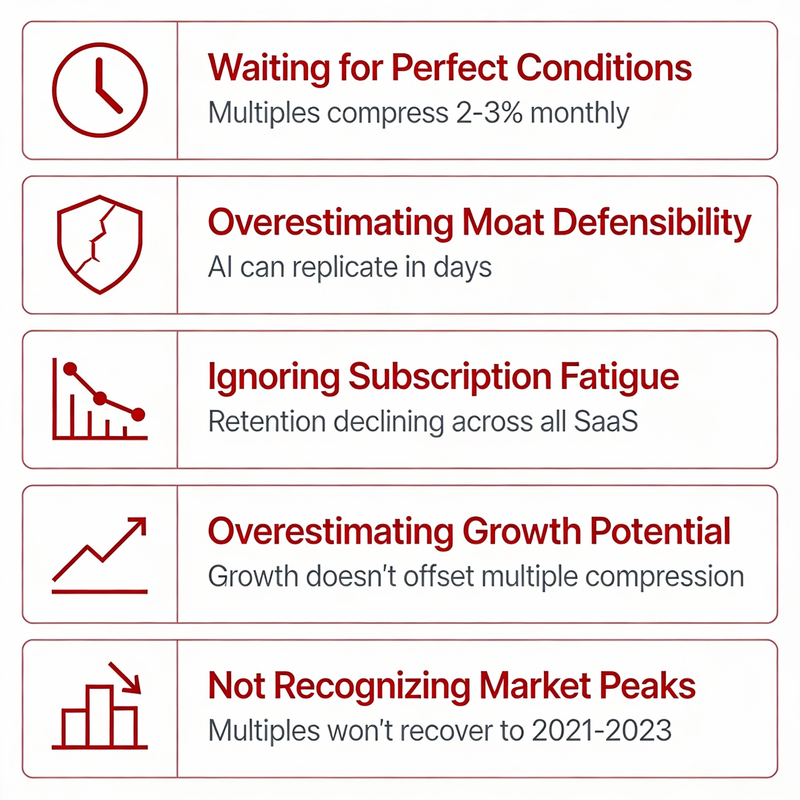
Mistake 1: Waiting for "Perfect" Conditions
Many SaaS owners wait for perfect conditions:
- "I'll sell when I hit $5M ARR"
- "I'll exit when I land a big enterprise customer"
- "I'll wait until the market recovers"
The reality: Perfect conditions rarely arrive. The data shows that SaaS businesses selling in 2026 are exiting at optimal conditions, but those conditions won't last forever.
The cost: Every month you wait, multiples compress 2-3%. A $10M business becomes a $9.7M business in one month, a $9.4M business in two months.
Mistake 2: Believing Your Moat Is Defensible
Many SaaS owners believe their moat is defensible:
- "Our technical complexity can't be replicated"
- "Our network effects protect us"
- "Our data advantage is unique"
The reality: AI can replicate most SaaS products in days. Your moat isn't as defensible as you think.
The cost: Buyers are already discounting for replication risk. If you wait, the discount increases as the market fully realizes how easily AI can replicate your product.
Mistake 3: Ignoring Subscription Fatigue
Many SaaS owners ignore subscription fatigue:
- "Our customers love our product"
- "Our retention is strong"
- "We're different from other SaaS products"
The reality: Subscription fatigue affects all SaaS products. Even if your retention is strong today, it will decline as customers cut subscriptions.
The cost: Buyers are already discounting for retention risk. If you wait, retention declines and the discount increases.
Mistake 4: Overestimating Growth Potential
Many SaaS owners overestimate growth potential:
- "We'll grow 50% this year"
- "We're just getting started"
- "The market is huge"
The reality: Market saturation and AI replication limit growth potential. Even if you grow, multiples compress faster than growth.
The cost: A business that grows 50% but sees multiples compress from 6x to 4x actually loses value:
- 2026: $2M ARR × 6x = $12M
- 2027: $3M ARR × 4x = $12M (same value despite 50% growth)
The lesson: Growth doesn't offset multiple compression.
Mistake 5: Not Recognizing Market Peaks
Many SaaS owners don't recognize market peaks:
- "Valuations will recover"
- "This is just a temporary dip"
- "SaaS multiples always bounce back"
The reality: This isn't a temporary dip. AI has fundamentally changed the SaaS market. Multiples won't recover to 2021-2023 levels.
The cost: Waiting for a recovery that never comes. Every month you wait, you lose 2-3% in valuation.
"SaaS owners keep waiting for multiples to recover to 2021-2023 levels. They won't. AI has fundamentally changed the market. This isn't a temporary dip. It's a permanent shift. The businesses that exit now will look back and realize they sold at the peak." - Business Broker, SaaS Exit Timing Report 2026
What To Do Next: Your Exit Strategy
Step 1: Assess Your Current Valuation
Understand what your SaaS business is worth today:
- Calculate your ARR: Annual recurring revenue from all subscriptions
- Apply current multiples: 5-7x revenue for most SaaS businesses in 2026
- Account for risk factors: Replication risk, retention risk, market saturation risk
Example calculation:
- ARR: $2M
- Base multiple: 6x revenue
- Risk discount (20%): -$2.4M
- Estimated valuation: $9.6M
Want a more accurate estimate? Use our free business valuation calculator to get a detailed valuation based on current market conditions.
Step 2: Understand the Compression Timeline
Know when multiples will compress:
- Q1-Q2 2026: 5-7x revenue (current window)
- Q3-Q4 2026: 4-6x revenue (compression accelerates)
- 2027: 3-5x revenue (full market realization)
- 2028+: 2-4x revenue (SaaS as commodity)
The window is closing. Every quarter you wait, multiples compress further.
Let me be direct: 2026 is the year before autonomous AI really takes off. Right now, AI can rebuild SaaS products in days. Soon, autonomous AI agents will build entire SaaS businesses in hours. If you think you have time to wait, you're wrong. The compression is accelerating, and every quarter you wait costs you 2-3% in valuation. Exit now, or watch your business become worthless as autonomous AI makes SaaS products completely commoditized.
Step 3: Prepare for Exit
Get your SaaS business ready for sale:
- Document everything: Revenue, retention, churn, customer data
- Show trends: Demonstrate consistent growth and retention (even if declining)
- Address risk factors: Explain how you're mitigating replication risk, retention risk, market saturation risk
- Highlight defensibility: Show any remaining competitive advantages (even if limited)
Step 4: Identify Potential Buyers
The buyer market for SaaS businesses in 2026 includes:
- Strategic acquirers: Larger SaaS companies seeking to expand
- Private equity firms: Financial buyers looking for platform investments
- Individual buyers: Entrepreneurs seeking to enter or expand in SaaS
- Technology companies: Companies looking to add SaaS capabilities
Step 5: Work With Experienced Brokers or Advisors
Experienced professionals can:
- Guide preparation: Help you prepare your SaaS business for sale
- Identify buyers: Connect you with qualified buyers
- Negotiate terms: Help you negotiate favorable terms and valuations
- Manage process: Guide you through the entire exit process
Not sure if you need a broker for your exit? Our guide on whether you should use a broker to sell your business breaks down when it makes sense and when it does not.
Ready to explore your exit options? Contact us to discuss your SaaS business's situation and explore how we can help you maximize your exit value before multiples compress further.
Conclusion
The data from the SaaS Exit Timing Report 2026 is clear: AI has destroyed the competitive moats that made SaaS businesses valuable. What took years to build can now be replicated in days. Subscription fatigue is accelerating. Valuation multiples are compressing.
Key findings:
- AI can replicate most SaaS products in 7-14 days [5]
- Subscription fatigue is increasing cancellation rates by 23% year over year [1]
- Valuation multiples are compressing from 10-12x revenue (2023) to 5-7x revenue (2026) [6]
- The exit window is closing: Q1-Q2 2026 is the critical period before full market realization
SaaS businesses selling in 2026 are commanding 5-7x revenue multiples because buyers still see some value in established customer bases and proven business models. But those same buyers understand that AI can replicate the product quickly, subscription fatigue is reducing retention, and market saturation is increasing competition.
After 2026, the market will fully realize how easily AI can replicate SaaS products. Multiples will compress to 3-5x revenue in 2027, and 2-4x revenue in 2028+. This means the window for optimal exits is closing, and SaaS owners who wait risk facing a market where their business is worth 50-60% less than it is today.
The moat is gone. The barrier to entry has collapsed. Exit now, or watch your valuation collapse.
2026 is the year before autonomous and agentic AI really explodes. Right now, AI can rebuild SaaS products in days. Soon, autonomous AI agents will build entire SaaS businesses from scratch in hours, not days. The window to exit at reasonable valuations is closing, and it's closing fast. Exit now, or become obsolete.
"The SaaS market has reached an inflection point. AI has eliminated the technical, network, and data moats that justified premium valuations. 2026 is the year before autonomous AI really takes off. SaaS businesses that don't exit now will face a market where their products are worth 50-60% less, and soon autonomous AI agents will make them completely obsolete. The window is closing, and it's closing fast." - SaaS Exit Timing Report 2026, Executive Summary
Sources: [1] SaaS Exit Timing Report 2026 - Subscription Cancellation Data [2] SaaS Exit Timing Report 2026 - Customer Lifetime Analysis [3] SaaS Exit Timing Report 2026 - Churn Rate Trends [4] SaaS Exit Timing Report 2026 - Market Saturation Data [5] SaaS Exit Timing Report 2026 - AI Replication Analysis [6] SaaS Exit Timing Report 2026 - Valuation Multiple Trends
Related Articles

March 28, 2026
Why Business Owners Need to Sell 2 Years Before They Retire
Most owners wait too long to sell. Here is why starting the exit process 2 years before retirement leads to better prices and smoother transitions.

February 1, 2026
What Happens After You Hire a Business Broker: Full Timeline
The real selling a business timeline from listing to close. Here is what your broker does at each stage and what to expect month by month.

January 31, 2026
7 Ways to Sell Your Business: What Works in 2026
From Facebook Marketplace to private equity, here are 7 ways to sell your business. What works, what doesn't, and what sellers get wrong.
About the Author
Jenesh Napit is an experienced business broker specializing in business acquisitions, valuations, and exit planning. With a Bachelor's degree in Economics and Finance and years of experience helping clients successfully buy and sell businesses, he provides expert guidance throughout the entire transaction process. As a verified business broker on BizBuySell and member of Hedgestone Business Advisors, he brings deep expertise in business valuation, SBA financing, due diligence, and negotiation strategies.
You might also be interested in
Free Business Calculators
Try our business valuation calculator and ROI calculator to estimate values and returns instantly.
How to Buy a Business Guide
Download our comprehensive free guide covering everything you need to know about buying a business.
Our Services
Explore our professional business brokerage services including valuations and buyer representation.
More Articles
Browse our complete collection of business brokerage insights and expertise.