

I have been through dozens of franchise sales, and they almost always take longer and involve more moving parts than sellers expect. Not because franchises are harder to sell as businesses, but because there is a third party sitting between you and your buyer: the franchisor. They have opinions, approvals, fees, and timelines. If you do not know how the process works before you start, those surprises can blow up a perfectly good deal.
Selling an independent business is more straightforward. You set the terms, you negotiate, you close. No one has to sign off on your buyer except you. That flexibility is one of the most underrated advantages of owning an independent business, and you will not appreciate it until you try to sell a franchise.
This guide covers both sides in detail. Whether you own a Subway, a ServiceMaster franchise, or an independent restaurant you built from scratch, understanding how the sale process differs will help you plan better, price better, and avoid the mistakes that turn a clean sale into a nightmare.
The Structural Difference That Changes Everything
When you sell an independent business, you own all of it. The brand, the systems, the customer relationships, the lease. You can sell it to whoever will pay you the most.
When you sell a franchise, you are selling the right to operate under someone else's brand and systems. The franchisor granted you that right through your franchise agreement, and that agreement has rules about what happens when you want to exit. Most franchise agreements include at least three things that independent owners never deal with: a right of first refusal for the franchisor, a formal buyer approval process, and a transfer fee.
Those three elements do not kill deals, but they add cost, time, and uncertainty that you need to account for from the moment you decide to sell. I have seen deals where the franchisor exercised their right of first refusal six weeks into a negotiation, leaving both the seller and the prospective buyer with nothing to show for months of work. That is not a hypothetical. It happened with a Subway unit I was involved in and it was painful for everyone.
How Franchise Businesses Are Valued Differently
The valuation process for a franchise follows the same general framework as any small business. You start with your seller's discretionary earnings (SDE), apply a multiple, and adjust from there. But franchises introduce a few valuation factors that are unique.
Royalty costs reduce your SDE. Most franchise agreements require ongoing royalties of 4 to 8% of gross revenue. On a $1.2M revenue location with a 6% royalty, you are paying $72,000 per year off the top. That expense comes out of your earnings before you calculate SDE, which directly reduces the number a multiple gets applied to.
Brand recognition can support a premium. A well known national franchise brand brings a built in customer base and marketing infrastructure. For certain brands, buyers will pay a slight premium because they see the brand as de risking the purchase. McDonald's, Chick fil A, and other top tier brands often trade above what a comparable independent restaurant would fetch.
Transfer approval affects marketability. If the buyer pool for your franchise is artificially narrow because the franchisor has strict approval criteria, that limits demand, which limits price. I have worked with franchises where the franchisor rejected three different qualified buyers before approving a fourth. Each rejection reset the timeline and cost the seller negotiating power.
Remaining term on the franchise agreement matters. If your franchise agreement has 3 years left, buyers will discount heavily because they may not be able to extend. If it has 8 to 10 years plus renewal options, that is a positive. Always check your remaining term before listing because it directly affects what buyers will pay.
As a rough benchmark, here is how franchise and independent businesses in similar industries typically compare on SDE multiples:
| Business Type | Typical SDE Multiple | Notes |
|---|---|---|
| Well known franchise (national brand) | 2.0 to 3.5x | Brand recognition, systems, proven model |
| Mid tier franchise (regional brand) | 1.5 to 2.5x | Depends on brand strength and remaining term |
| Struggling or niche franchise | 1.0 to 1.8x | Limited buyer pool, franchisor scrutiny |
| Independent business (strong financials) | 2.0 to 4.0x | Flexibility, no franchisor fees or restrictions |
| Independent business (owner dependent) | 1.5 to 2.5x | Key person risk discounts value |
The overlap is real. A well run independent business with documented systems and recurring revenue can easily outvalue an average franchise unit, even from a major brand.
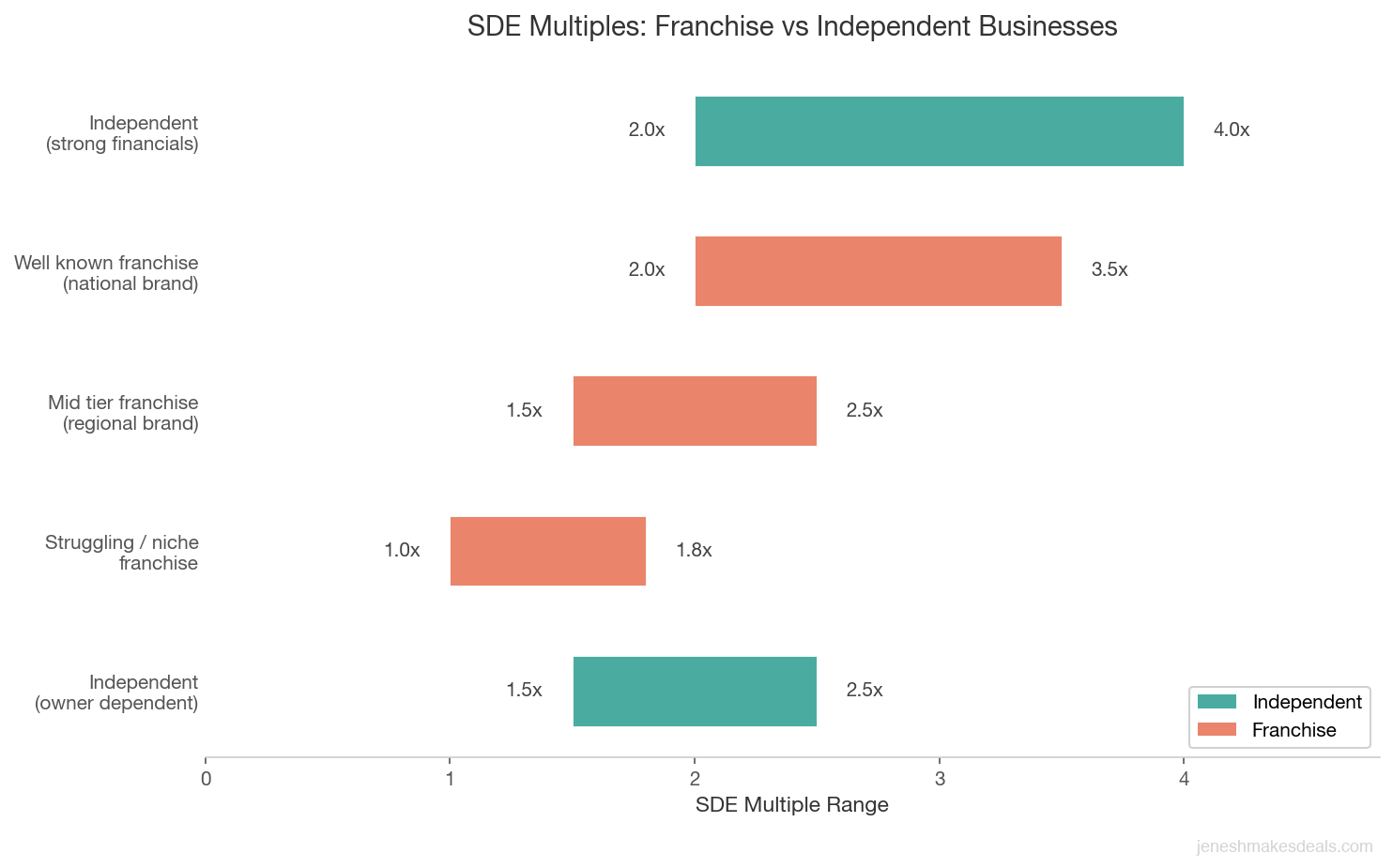
A well run independent business with documented systems and recurring revenue can command SDE multiples of 2.0 to 4.0x, matching or exceeding well known national franchise brands that typically trade at 2.0 to 3.5x.
If you want a baseline for your business, run the numbers through our business valuation calculator before doing anything else.
The Franchise Transfer Approval Process
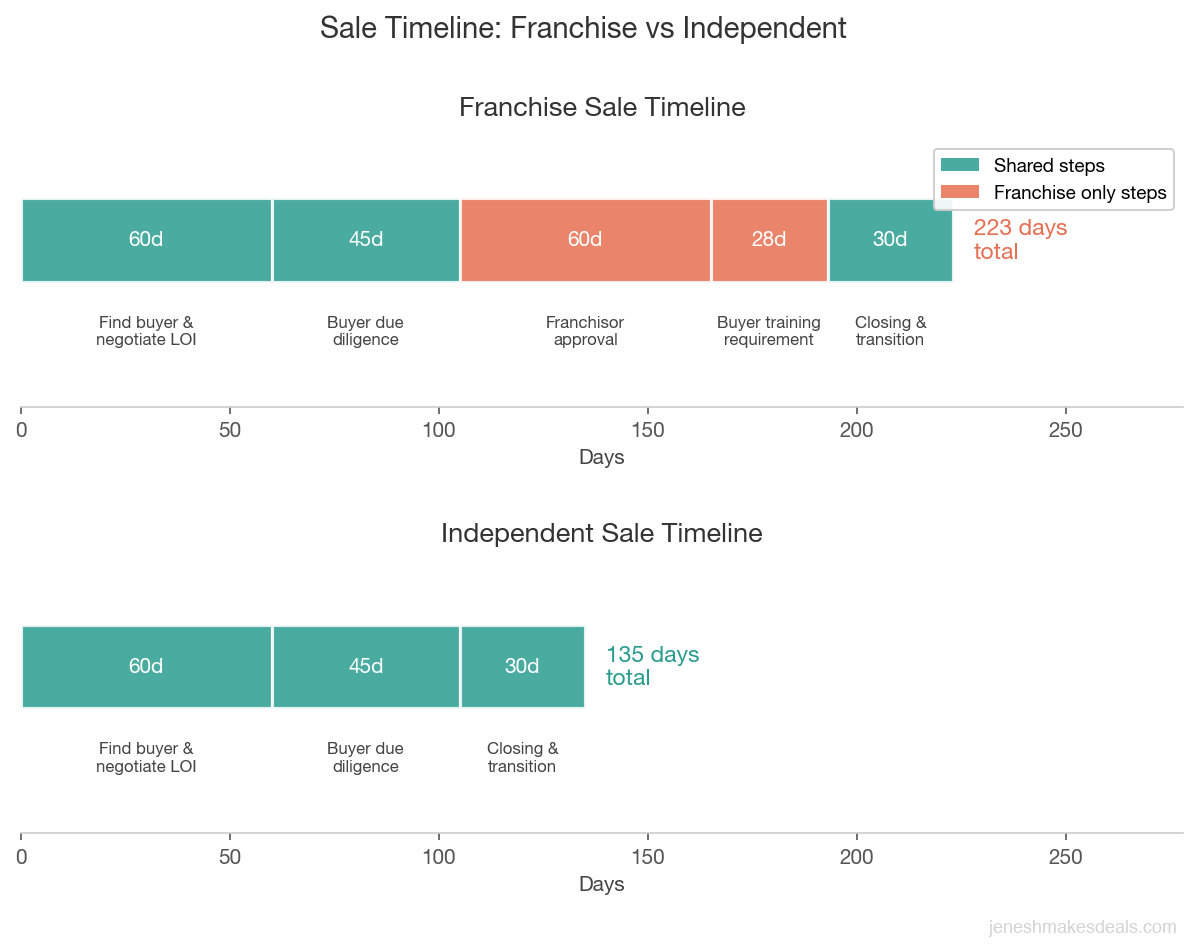
This is the part franchise owners underestimate the most. When you find a buyer, you cannot simply sign a purchase agreement and close. Your buyer has to be approved by the franchisor, and that approval process can take weeks or months.
Here is what a typical franchise transfer approval looks like:
Step 1: Notify the franchisor. Once you have a signed letter of intent, you formally notify the franchisor of your intent to transfer the franchise. Most franchise agreements require this notification within a set number of days of executing an LOI.
Step 2: Buyer submits application. Your buyer completes the franchisor's formal application, which typically includes a personal financial statement, background check authorization, and business history. This is identical to the process a new franchisee goes through when buying a new territory, just applied to a transfer.
Step 3: Franchisor review period. The franchisor reviews the application and may request additional information. Most franchise agreements give the franchisor 30 to 60 days to approve or deny. In practice, the process often runs 45 to 90 days when you include the time needed to collect all documents and complete background checks.
Step 4: Approval or denial. The franchisor either approves the buyer, requests modifications (such as additional equity or a co guarantor), or denies the application. Denials are rare for financially qualified buyers, but they happen, especially if the buyer has no relevant industry experience for certain franchise types.
Step 5: Training requirement. Most franchisors require the new owner to complete initial training before the transfer is finalized. This can be anywhere from one week of online training to six weeks at a corporate training center. The buyer needs to factor this into their timeline and sometimes their financing.
Compare that to selling an independent business, where Step 1 through Step 5 is replaced by: agree on terms, sign a purchase agreement, close.
Right of First Refusal: The Wildcard That Can Derail Your Sale
Most franchise agreements give the franchisor a right of first refusal (ROFR) on any transfer. In plain terms: you find a buyer, you negotiate a price and terms, you have a fully executed purchase agreement, and then you have to present all of that to the franchisor. They have a set window (often 30 days) to step in and buy the business themselves on those same terms.
Franchisors rarely exercise the ROFR. Running hundreds of individual locations is not most franchisors' business model. But "rarely" is not "never," and the situations where they do exercise it tend to involve high value locations that the franchisor wants to bring back in house, underperforming locations they want to prevent from being sold to a buyer they do not want in the system, or strategic territories they want to reacquire.
If the franchisor exercises the ROFR, your buyer walks away with nothing after months of due diligence and legal fees. That is an uncomfortable conversation to have with a buyer who has already lined up financing and given notice at their job.
The practical implication: when you are negotiating with a buyer, they need to know the ROFR exists and factor it into their risk. Some buyers will not pursue franchise acquisitions at all because of this. That is a real part of why franchise buyer pools are smaller than independent business buyer pools.
Disclose the right of first refusal to every prospective buyer from day one. Buyers who discover it midway through negotiations often walk away on principle, even if the franchisor is unlikely to exercise it.
Transfer Fees and What They Actually Cost You
Every franchise agreement has a transfer fee, and they are almost never negotiable. Here is the range you will see across common franchise types:
| Franchise Category | Typical Transfer Fee |
|---|---|
| Food and beverage (fast food, QSR) | $5,000 to $25,000 |
| Service franchises (cleaning, home services) | $3,000 to $15,000 |
| Fitness and wellness | $10,000 to $30,000 |
| Senior care and healthcare | $15,000 to $35,000 |
| Business services and retail | $5,000 to $20,000 |
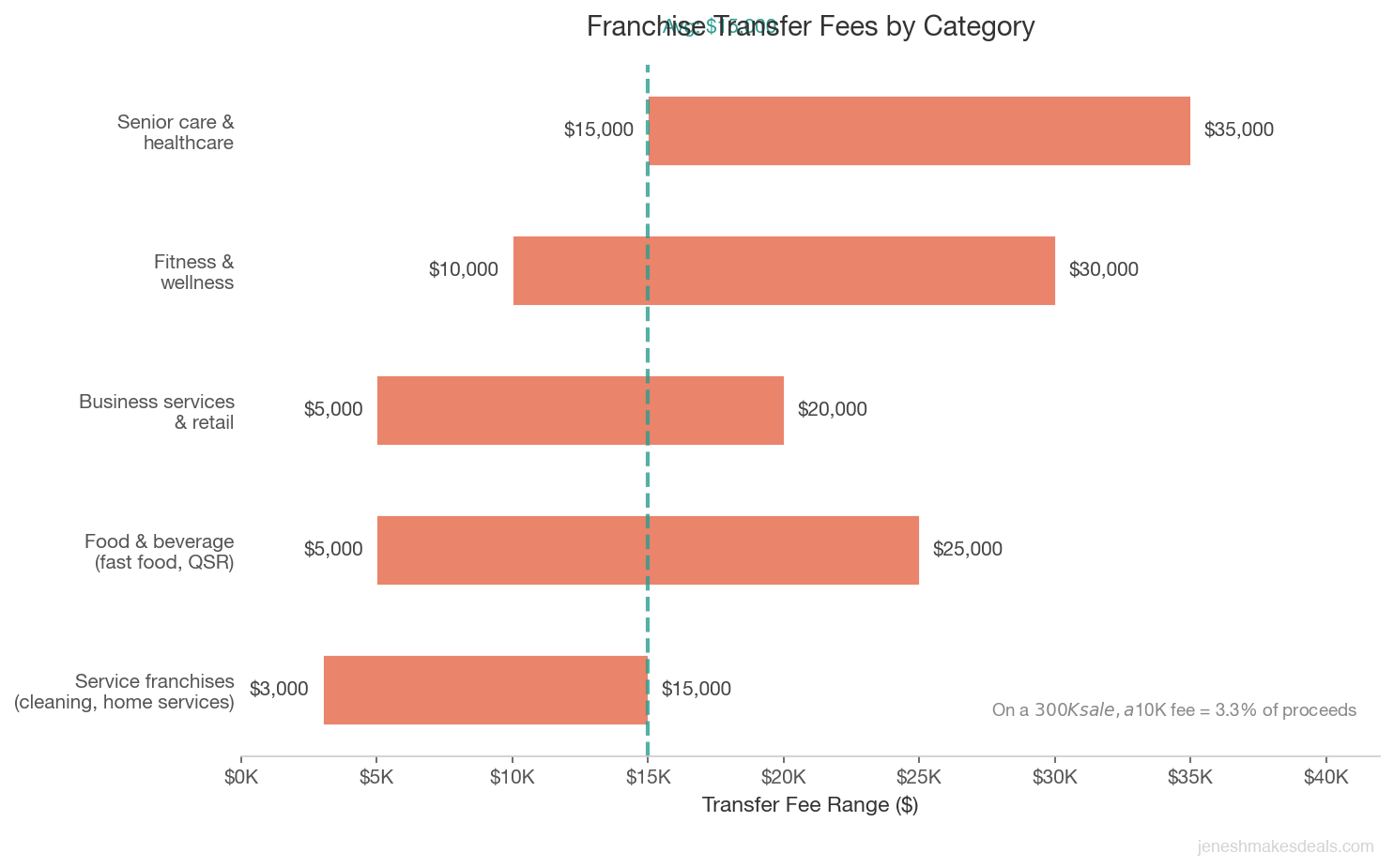
On a $300,000 sale, a $10,000 transfer fee is 3.3% of your proceeds. That is real money, and it comes off the top. Some franchise agreements also require the seller to be current on all royalty payments and franchise fees before the transfer will be approved. If you have any arrears, those need to be resolved before closing.
Beyond the transfer fee, the buyer may also be required to pay for their own training program, which can range from $1,000 to $10,000 or more depending on the franchise. In some agreements, the training cost is split between buyer and seller. Know your specific agreement's terms before you start negotiations.
The Buyer Qualification Process for Franchises
Finding a buyer for a franchise is not just about finding someone with the money. The franchisor has minimum qualifications that every buyer must meet. These typically include a minimum net worth (often $200,000 to $500,000 for food franchises), liquid capital requirements (usually 10 to 20% of the purchase price available in unencumbered cash), and for certain franchise types, specific industry experience or management credentials.
This effectively shrinks the buyer pool compared to an independent business. For an independent restaurant, any qualified buyer with the cash can purchase it. For a franchise restaurant, you need a buyer who meets the franchisor's financial criteria and who the franchisor is willing to approve. That is a meaningful difference when you are trying to generate competitive offers.
| Qualification Criteria | Franchise Buyer | Independent Buyer |
|---|---|---|
| Minimum net worth | $200,000 to $500,000 (set by franchisor) | No set minimum |
| Liquid capital | 10 to 20% of purchase price in cash | Depends on financing |
| Industry experience | Sometimes required by franchisor | Preferred but not required |
| Background check | Required by franchisor | Typically not required |
| Credit score threshold | Set by franchisor | Set by lender only |
| Franchisor interview | Yes | Not applicable |
For buyers, I always tell them to get pre qualified with the franchisor early in the process, before they even submit a formal offer. Some franchisors offer informal preliminary reviews where they will let you know if a buyer profile generally meets their criteria. Use that if it is available because there is no point getting to a signed LOI with a buyer who is going to be denied at the application stage.
If you are a buyer evaluating a franchise acquisition and you want to understand the financing side, our guide to financing a business acquisition covers the SBA loan options that work especially well for franchise purchases.
Training and Transition Requirements from the Franchisor
The transition period for a franchise sale is more structured than for an independent business, but that structure can actually work in your favor.
Most franchisors require the seller to remain involved during a defined transition period, usually 2 to 8 weeks, to train the new owner on day to day operations. For the buyer, this is valuable. They are not just getting the physical business. They are getting a handoff from someone who knows the systems, the staff, and the local market.
For the seller, this training obligation is something you need to plan for. You cannot close on a Thursday and disappear by Friday. You owe your buyer a proper transition, and in many franchise agreements, the training obligation is a contractual condition of the transfer.
The franchisor also typically provides their own training program for the incoming owner. This dual layer of training, seller transition plus corporate training, is one of the things that genuinely makes franchise acquisitions more accessible for buyers who are new to a particular industry.
Marketing and Listing Differences
Here is something most franchise sellers do not know: many franchise agreements restrict where and how you can advertise your business for sale. Some agreements require you to notify the franchisor before any public marketing. Others prohibit you from listing on general business sale marketplaces without written approval.
This limits your marketing options compared to an independent business, where you can list on BizBuySell, BizQuest, reach out to your network, or market any way you want.
In practice, most franchisors do not actively block sellers from using business sale marketplaces. But the listings need to be handled carefully. You cannot use the franchisor's trademarks and branding in your marketing materials without permission. You typically need to market the opportunity as "an established [brand] franchise location" rather than promoting the brand name directly in ways that violate trademark terms.
A good business broker who has sold franchises before will know how to handle this. If you hire a broker with no franchise experience, you risk creating an inadvertent FDD compliance issue before your sale even gets started.
For sellers in the $200K to $2M range where most franchise units trade, I always recommend marketing both to franchise specific buyers, people who are already in the franchise system or considering that brand, and to general small business buyers who can be qualified by the franchisor. Casting a wider net first gives you the most negotiating power.
Why Franchise Sales Fall Through
Franchise deals fall apart at a higher rate than independent business deals, and the reasons are almost always structural rather than financial.
Buyer fails franchisor approval. The most common deal killer. A buyer clears your due diligence process, gets financing approved, and then the franchisor denies their application because of a credit issue, insufficient net worth, or an industry background check that came back problematic. At that point, you start over.
Franchisor exercises ROFR. Rare, but it happens. The buyer walks and you may have to renegotiate with the franchisor at those same terms or start the sale process again.
Franchise agreement is about to expire. If a buyer's lender discovers the franchise agreement has only 2 or 3 years left, the loan may be denied. SBA lenders typically require the franchise agreement to extend at least as long as the loan term. An agreement with 3 years remaining will not support a 10 year SBA loan.
Transfer fee surprises. Some buyers learn about the transfer fee for the first time during due diligence and try to renegotiate the purchase price to offset it. If you have not disclosed it upfront, you have created a bad faith negotiation moment that can collapse the deal.
Timing mismatch. The franchisor's approval process takes 60 days. The buyer's SBA loan approval takes 90 days. Your lease has 90 days to close or the landlord can terminate. Everyone is working on different clocks and the deal dies in the administrative chaos.
The solution to most of these is preparation. Know your franchise agreement inside out before you list, disclose the transfer fee from day one, check your franchise agreement expiration date, and get a pre approval sense from the franchisor before you invest months in a specific buyer.
Franchise deals fail at a higher rate than independent deals, and the causes are almost always structural, not financial. Buyer fails franchisor approval, the ROFR gets exercised, or the franchise agreement is about to expire. Preparation before listing eliminates most of these risks.
Independent Business Advantages in a Sale
If you own an independent business, the sale process has real advantages that franchise owners often do not appreciate until they try to sell.
No franchisor approval. You can sell to anyone who qualifies financially. Your buyer pool is wider and the timeline is not waiting on a third party's review process.
No transfer fee. Whatever you negotiate, you keep. There is no percentage going to a corporate entity.
No royalty drag on SDE. Your earnings are your earnings. There is no ongoing royalty expense reducing the number that gets a multiple applied to it.
Full price flexibility. You set the terms. If you want to offer seller financing, you can. If you want to include the real estate, you can structure it any way that makes sense for you and the buyer without needing anyone else's permission.
Proprietary value. A strong independent business with documented systems, a loyal customer base, and transferable relationships can command multiples that rival or beat franchise units, especially if it has been built to run without the owner.
The trade off is that independent businesses do not have the brand name that makes some buyers more comfortable. Some buyers specifically seek franchise units because they see the corporate support system as a safety net. For those buyers, an independent business requires more convincing. That is just a reality of the market.
Franchise vs Independent: The Full Sale Process Comparison
| Factor | Franchise Sale | Independent Sale |
|---|---|---|
| Franchisor approval required | Yes, 30 to 90 days | No |
| Right of first refusal | Usually yes | No |
| Transfer fee | $3,000 to $35,000 | None |
| Buyer qualification criteria | Franchisor requirements plus financial | Financial only |
| Marketing restrictions | May require franchisor approval | None |
| Typical sale timeline | 6 to 12 months | 3 to 8 months |
| Training obligation | Usually mandated by franchisor | Negotiated between buyer and seller |
| SDE impact | Reduced by royalties (4 to 8% of revenue) | Full earnings |
| Buyer pool size | Narrower (must meet brand criteria) | Wider |
| Deal fall through risk | Higher (multiple approval layers) | Lower |
| Franchise agreement term | Must be reviewed and renewable | Not applicable |
| Recurring buyer demand | Brand recognition drives some buyers | Depends on business reputation |
Tips for Franchise Owners Preparing to Sell
Read your franchise agreement before anything else. Specifically, look for the transfer provisions, the ROFR clause, the notice requirements, and the transfer fee amount. Know exactly what triggers franchisor approval and how long they have to respond. If you have not looked at that document in years, this is the time.
Check your franchise agreement expiration date. If it expires within 5 years, start the renewal conversation with your franchisor now, before you list. Buyers and their lenders want to see runway. A franchise agreement with 10 years plus renewal options is a much easier sell than one with 3 years remaining.
Get your financials in order 12 months before listing. Three years of clean, add back adjusted profit and loss statements are the minimum for any serious buyer. For a franchise, also have your royalty payment history documented. Buyers will ask and franchisors will verify.
Pay off any arrears to the franchisor. Unpaid royalties, unpaid marketing fund contributions, or any outstanding fees will block your transfer approval. Clean this up before you engage a broker.
Disclose the transfer fee and ROFR to prospective buyers upfront. Do not let these be surprises. Buyers who learn about the ROFR halfway through negotiations sometimes walk away on principle, not because they thought the franchisor would actually exercise it, but because they feel like information was withheld. Transparency from day one keeps deals alive.
Find a broker with franchise sale experience. Franchise transactions have specific legal and process requirements that a generalist broker may not handle well. Ask any broker you interview how many franchise transfers they have closed and what brands they have worked with.
Time your listing around the franchise system. If your franchisor has a major brand relaunch, new product rollout, or system remodeling requirement coming up, that affects buyer interest and value. A buyer who knows they will need to invest $75,000 in a required remodel two years post close will adjust their offer accordingly.
If you are ready to start thinking about your exit, the best first step is a free consultation. I will review your franchise agreement with you, help you understand what your location is worth in the current market, and map out a realistic timeline that accounts for the franchisor approval process.
One More Thing for Independent Owners
If you own an independent business and you have been thinking about whether to franchise before selling, let me give you a direct answer: do not franchise in order to sell. The franchising process takes years and significant capital. It creates a completely different legal and operational structure. And it does not automatically increase your sale price because buyers of independent businesses and buyers of franchise units are different buyer pools.
What does increase your sale value is documented systems, recurring revenue, and low owner dependency. Those are the things I consistently see drive multiples above average in independent business sales. Build those, and your independent business will sell on competitive terms without needing a franchise attached to it.
If you want to use our business valuation calculator to see where your independent or franchise business stands today, that is a good place to start building your exit strategy around real numbers.
Frequently Asked Questions
How long does it take to sell a franchise business?
Most franchise sales take 6 to 12 months from listing to close. The extended timeline compared to independent businesses (3 to 8 months) is primarily because the buyer approval process with the franchisor adds 45 to 90 days to the deal. SBA financing for franchise acquisitions also has its own approval timeline. If you are planning to sell, build at least 9 months into your timeline to avoid pressure to accept a lower offer.
Can the franchisor block the sale of my franchise?
Yes and no. Franchisors can deny a specific buyer if they do not meet the minimum financial or experience requirements. They can also exercise their right of first refusal and buy the franchise themselves at the price you negotiated. They cannot prevent you from selling indefinitely or force you to accept a price you do not agree to. In practice, most franchise transfers are approved when the buyer is financially qualified. Denials are more common when buyers lack liquid capital or have credit issues.
Do I need a business broker to sell a franchise?
You do not legally need one, but for a franchise sale I strongly recommend using a broker with franchise transfer experience. The combination of franchisor approval requirements, FDD compliance issues in marketing, transfer fee negotiations, and SBA financing complexity creates enough moving parts that sellers who go it alone often make procedural mistakes that delay or kill their deals. A broker who has closed franchise transfers before will know how to sequence the process.
Is a franchise worth more or less than an independent business?
It depends entirely on the franchise brand, unit performance, and remaining agreement term. A top tier brand franchise in a high traffic location will trade above a comparable independent. A struggling or niche franchise with 3 years left on the agreement may trade below what a well run independent would fetch. The franchisor's royalty structure also directly reduces the SDE that multiples are applied to, which matters in the valuation math.
What happens to the franchise agreement when I sell?
The existing franchise agreement is either assigned to the new buyer or terminated and replaced with a new one, depending on how the franchisor handles transfers. Many franchisors issue the new owner a new franchise agreement under the current terms rather than assigning the old one. This means the new owner gets the current royalty structure and terms, which may be different from yours if your agreement is older. Check with your franchisor on this before listing because it affects what buyers are committing to.
Whether you're selling a franchise or an independent business, tell us about your business and we'll walk you through the process for your situation.
Related Articles

April 21, 2026
What Is a Management Buyout and Is It Right for Your Business?
A management buyout lets your team buy the business. Learn how MBOs work, what they cost, and when they make sense for sellers.

April 13, 2026
How to Find the Right Business Broker for Your Industry
Not all brokers know your industry. Here's how to find one who actually understands your business and can get you top dollar.

March 27, 2026
How to Find Businesses for Sale in 2026
Most buyers search the wrong places. Here's where to actually find businesses for sale and how to avoid wasting months on dead ends.
About the Author
Jenesh Napit is an experienced business broker specializing in business acquisitions, valuations, and exit planning. With a Bachelor's degree in Economics and Finance and years of experience helping clients successfully buy and sell businesses, he provides expert guidance throughout the entire transaction process. As a verified business broker on BizBuySell and member of Hedgestone Business Advisors, he brings deep expertise in business valuation, SBA financing, due diligence, and negotiation strategies.
You might also be interested in
Free Business Calculators
Try our business valuation calculator and ROI calculator to estimate values and returns instantly.
How to Buy a Business Guide
Download our comprehensive free guide covering everything you need to know about buying a business.
Our Services
Explore our professional business brokerage services including valuations and buyer representation.
More Articles
Browse our complete collection of business brokerage insights and expertise.