

You signed the listing agreement. You shook hands with your business broker. Now what?
Most sellers picture a simple sequence: list the business, find a buyer, cash a check. The reality is a 6 to 12 month process with distinct phases, dozens of moving parts, and at least three moments where the whole deal can fall apart. After walking hundreds of business owners through this process, I can tell you the sellers who understand the timeline up front handle it better than the ones who go in blind.
If you are still deciding whether to use a broker, this timeline will show you exactly what you are paying for. And if you have already hired one, this is your roadmap so nothing catches you off guard.
Here is the complete business broker process from day one to closing day, broken down month by month.
The Big Picture: How Long Does It Take to Sell a Business?
The honest answer is 6 to 12 months, with the average sitting around 10 months as of 2025. But that number hides a lot of variation.
| Business Size | Typical Time to Sell | Success Rate |
|---|---|---|
| Under $1M revenue | 4 to 6 months | 10 to 15% |
| $1M to $5M revenue | 6 to 10 months | 20 to 25% |
| Over $10M revenue | 12 to 18 months | 60 to 70% |
The selling a business timeline depends on three things: how well prepared you are going in, how realistic your price expectations are, and how strong the buyer market is for your type of business. Technology and healthcare companies often sell in 3 to 6 months because buyer demand is high. Manufacturing and distribution can take 8 to 14 months due to complex asset evaluations.
Want to see where your business falls? Use our business sale timeline estimator to get a personalized timeline based on your industry, preparation level, and deal size.
Here is a data point that should get your attention: businesses that complete 12 or more months of pre sale preparation achieve 65 to 75% success rates compared to the industry average of 20 to 30%. Preparation is not a formality. It is the single biggest factor in whether your business actually sells.
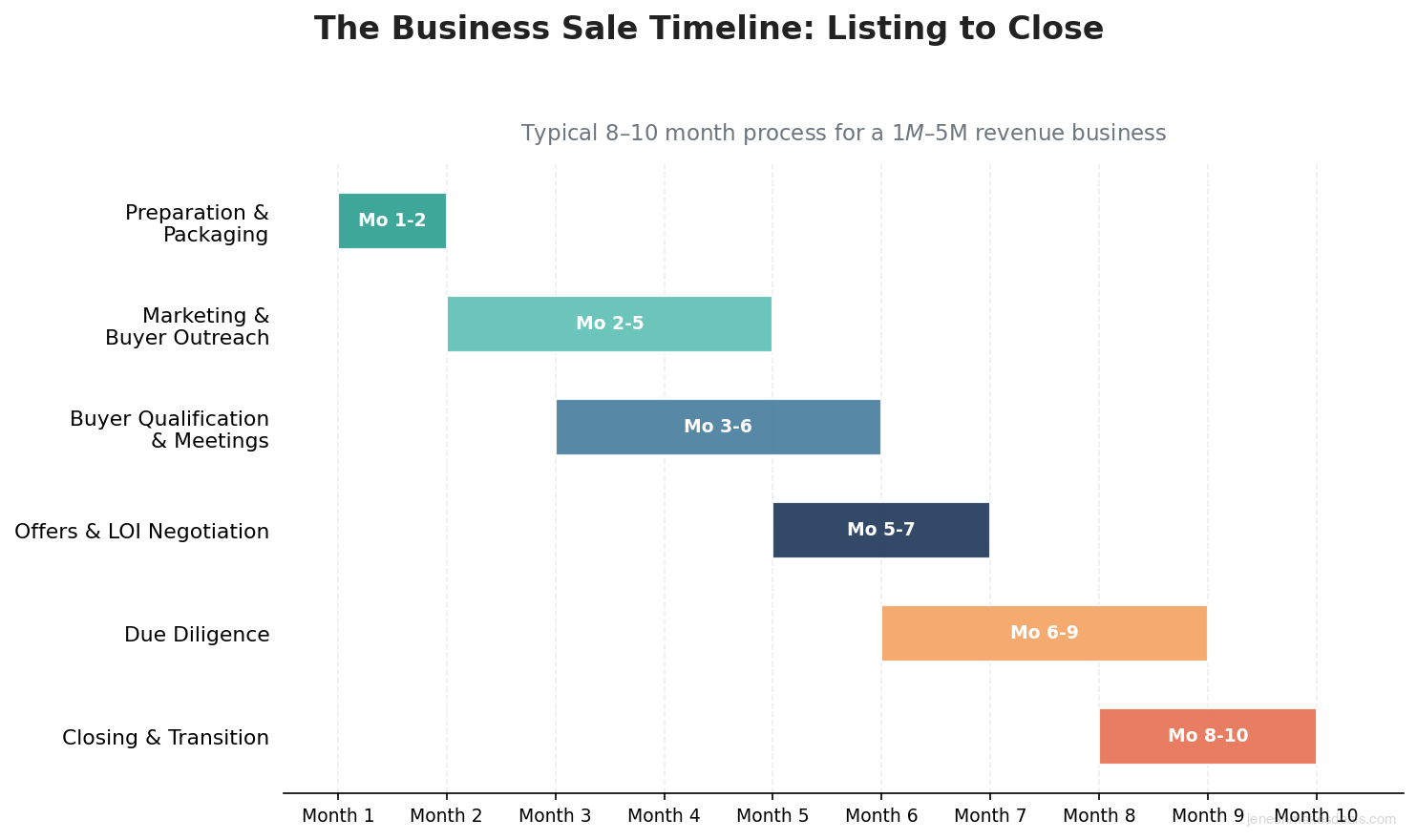 The typical business sale moves through six overlapping phases. Most sellers underestimate how long the marketing and due diligence phases take.
Month 1 to 2: Preparation and Packaging
This is where your broker earns a significant portion of their fee, and where most sellers are surprised by how much work happens before a single buyer sees the listing.
The Valuation
Your broker evaluates your business using multiple methods: analyzing financial performance over the past 3 to 5 years, comparing to similar businesses that recently sold, assessing tangible and intangible assets, and identifying the value drivers buyers actually care about.
Professional valuations cost $5,000 to $15,000 and typically return 3 to 5 times that investment through improved sale outcomes. Here is why that matters. Sellers with third party valuations receive offers 40% faster, and they achieve 92% of asking price compared to 78% without one.
Want to get a quick estimate before your broker does a full valuation? Use our free business valuation calculator to see where your business might land.
Financial Packaging
Your broker needs clean, organized financials. This is the documentation package you will assemble together:
- Profit and loss statements for the last 3 to 5 years
- Balance sheets (year end and most recent monthly)
- Tax returns (federal and state, 3 years minimum)
- Cash flow statements tracking inflows and outflows
- Accounts receivable and payable aging reports
- Asset and equipment lists with values and condition
The critical step is "recasting" your financials. Your broker adds back owner perks, one time expenses, and non recurring items to show the true earning power of the business. This is what buyers and lenders actually evaluate when determining what your company is worth.
Having all of this organized before going to market can reduce the time to receive offers by 40%.
The CIM (Confidential Information Memorandum)
The CIM is the main marketing document for your business. Think of it as the pitch book that qualified buyers review before deciding whether to pursue a deal. A well built CIM includes:
- Executive summary with high level financial overview
- Business history, structure, and ownership
- Market analysis and competitive positioning
- Products, services, and customer information (anonymized)
- Facilities, equipment, and technology systems
- Growth projections and future opportunities
- Asking price, what is included, seller financing availability, and transition terms
Your broker creates this document, but you review it for accuracy. CIMs are watermarked, tracked with unique identification numbers, and shared only after buyers sign an NDA. Your business name, exact address, and customer names are kept confidential at this stage.
"I was shocked at the level of detail that went into the CIM. It wasn't a flyer, it was a 15 page book about my business. That's when I realized my broker was taking this seriously." , Restaurant owner, New York
Your role during this phase: Provide financial documents, fill out detailed questionnaires about operations, review and approve the CIM. Expect to spend 8 to 12 hours total.
Month 2 to 5: Marketing and Buyer Outreach
With the CIM ready, your broker launches the marketing campaign. This is what a business broker does behind the scenes that most sellers never see.
Where Your Business Gets Listed
Brokers use a multi channel approach to reach qualified buyers:
- BizBuySell is the largest business for sale marketplace. 56 to 59% of active buyers on the platform are first time buyers looking for their first acquisition.
- BizQuest and DealStream are additional listing platforms that expand reach
- Proprietary buyer databases. Most established brokers maintain databases of pre qualified buyers. Some firms maintain 3,000 or more active buyers.
- Targeted outreach campaigns. Top advisors achieve 45 to 60% email open rates and 12 to 18% response rates with targeted campaigns, compared to 8 to 12% open rates for generic blasts.
- Co brokerage networks where regional broker groups share listings
- LinkedIn and industry events for professional networking and buyer sourcing
The best deals often happen off market through a broker's direct network, not from public listings. This is one of the core reasons sellers hire brokers instead of listing on a marketplace alone. If you are curious about the difference, I compared broker vs marketplace approaches in a separate post.
 Your broker handles the marketing, buyer screening, and negotiations while you focus on running the business.
What Happens With Inquiries
A typical listing generates 30 to 50 initial inquiries. But most of those are not real buyers. Your broker's job is to separate the serious from the curious.
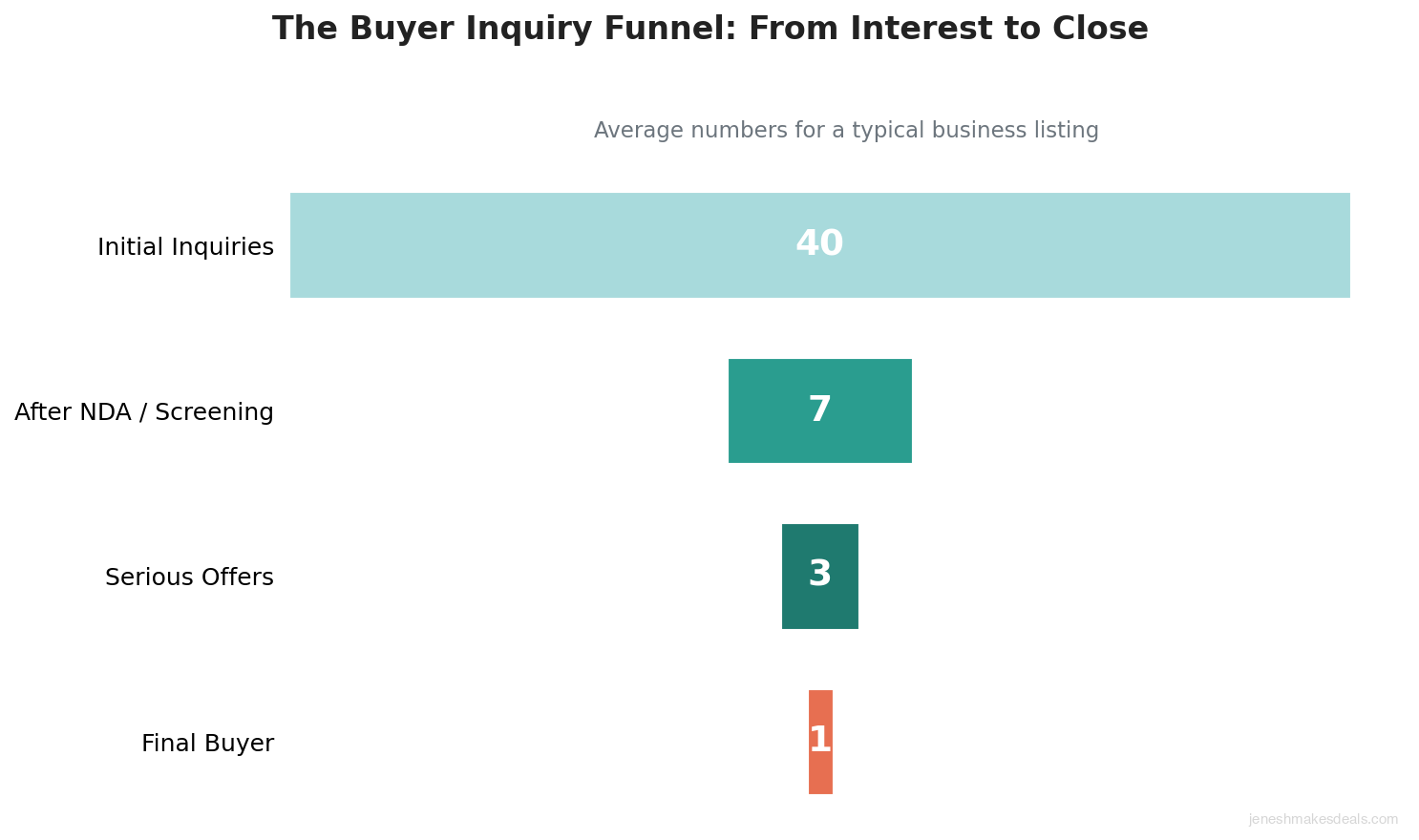 Out of every 40 inquiries, only about 7 make it past the NDA and screening phase. Your broker filters so you don't waste time on unqualified buyers.
Your role during this phase: Keep running your business. Your broker handles all buyer inquiries, NDA management, and initial screening. You may get weekly updates, but your involvement is minimal. Expect about 2 to 3 hours per week.
Month 3 to 6: Buyer Qualification and Meetings
This is where the funnel narrows from inquiries to qualified prospects.
How Brokers Screen Buyers
Before any confidential information is shared, your broker requires every prospective buyer to:
- Sign an NDA. Non negotiable. No NDA, no information.
- Demonstrate financial capability. Proof of funds, pre approval letters, or documentation showing they can finance the purchase.
- Show relevant experience. Industry background, education, certifications, or management experience relevant to running the business.
- Confirm timeline alignment. Their purchase timeline matches your selling timeline.
- Verify no competitive conflicts. Especially important if the buyer works for a competitor.
Buyers are categorized as cold, warm, or hot prospects. Only qualified buyers receive the CIM. Without a broker, you might spend 60 or more hours fielding calls and attending 20 unqualified meetings. With a broker, that shrinks to 10 to 15 hours total across 3 to 5 qualified meetings.
Face to Face Meetings
Once a buyer has reviewed the CIM and wants to proceed, your broker arranges a face to face meeting. This is where you come back into the picture. Typically you will meet 3 to 5 qualified buyers in person.
These meetings are not negotiations. They are introductions. The buyer wants to understand the business from the person who built it. They want to see if the chemistry works and whether your story matches the CIM.
"My broker told me to just be myself in the buyer meetings. Don't oversell. Just answer honestly. The right buyer will see the value. He was right. The buyer who closed told me later that my honesty in that first meeting is what made him pursue the deal." , HVAC company owner, Texas
Your role during this phase: Attend 3 to 5 buyer meetings (1 to 2 hours each). Answer questions honestly. Let your broker handle follow up and next steps. Expect about 3 to 5 hours per week during peak meeting periods.
Month 5 to 7: Offers, LOI, and Negotiation
When a qualified buyer is ready to move forward, they submit a Letter of Intent. This is the first formal expression of their interest, and it changes the dynamic of the entire process.
What Is in a Letter of Intent?
The LOI is typically a non binding document that outlines the key deal terms:
- Purchase price (fixed or formula based)
- Payment structure (cash, financing, seller note, earnout)
- Assets and liabilities included in the deal
- Exclusivity period (binding, prevents you from entertaining other offers)
- Due diligence timeline and scope
- Closing timeline
- Contingencies (financing approval, landlord consent, etc.)
- Non compete terms
- Transition and training period
Most LOI terms are non binding except exclusivity, confidentiality, and the obligation to negotiate in good faith. Those provisions are typically binding.
The Negotiation
The offer submission and negotiation phase typically takes 1 to 2 weeks. Your broker guides you through reviewing the offer and negotiating changes to price, terms, or structure.
Key negotiation points include purchase price, payment timing, down payment amount, seller financing terms, non compete scope and duration, transition period length, and asset allocation (which affects your taxes significantly).
A good broker settles the major deal terms, especially price, early in the LOI to avoid vague agreements that unravel later. In deals under $2M, over negotiating minor details can burn out both parties and kill the deal.
Understanding what brokers charge helps you evaluate whether their negotiation work justifies the commission. In most cases, a skilled broker more than earns their fee during this phase alone.
Your role during this phase: Review offers with your broker, make decisions on price and terms, sign the LOI. This is an emotionally charged period. Expect 5 to 8 hours total.
Month 6 to 9: Due Diligence (The Deal Killer Phase)
Due diligence is where the buyer verifies everything you have claimed about your business. It is also where approximately 55% of deals that enter this phase fail to reach closing.
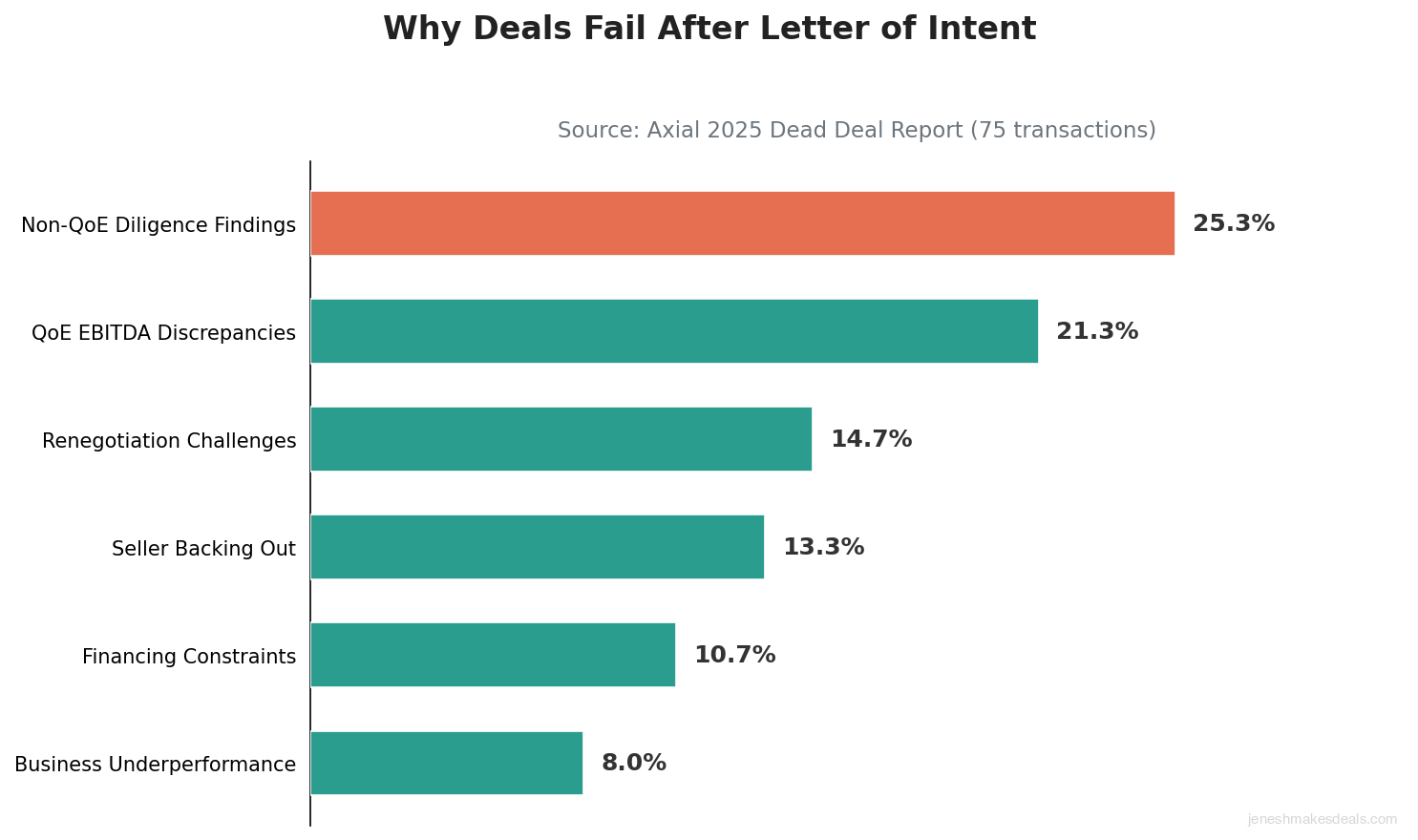 More than half of deals fail during due diligence. Financial discrepancies and undisclosed issues are the top killers. Source: Axial 2025 Dead Deal Report.
What Buyers Examine
The due diligence process covers four major areas:
Financial analysis. Three to five years of financial statements, tax returns, accounts receivable and payable aging, revenue breakdowns by customer, working capital analysis, and a Quality of Earnings (QoE) report that independently verifies your claimed EBITDA.
Legal and regulatory. Corporate documents, all material contracts (customer, vendor, partner), lease agreements, litigation history, licenses, permits, and intellectual property.
Operational. Employee roster and compensation, key vendor and customer lists, inventory data, systems and process documentation, equipment condition.
Strategic. Customer concentration, competitive positioning, growth trajectory, management team quality, and market conditions.
How Long It Takes
Due diligence takes 2 to 6 weeks for cash deals and 4 to 6 or more weeks for financed deals. If the buyer is using an SBA loan, add another 90 to 120 days for loan approval. Axial's 2025 Dead Deal Report found that deals spend an average of 106 days under exclusivity before breaking.
Why Deals Die Here
The top reasons deals fall apart during due diligence:
| Reason | % of Failures |
|---|---|
| Non QoE diligence findings (legal, customer concentration, contracts) | 25.3% |
| QoE EBITDA discrepancies | 21.3% |
| Renegotiation challenges | 14.7% |
| Seller backing out | 13.3% |
| Financing constraints | 10.7% |
| Business underperformance during sale | 8.0% |
Common specific deal breakers include customer concentration above 25% (found in 42% of deals), declining revenue adjusted for inflation (38%), key employee departure risks (31%), and undisclosed legal issues (18%).
A notable trend from 2025 data: QoE EBITDA discrepancies more than doubled from 10.6% in 2023 to 21.3% in 2025. Buyers are getting more sophisticated about verifying the numbers.
"The buyer's accountant found a $180,000 discrepancy in my add backs. My broker and I had already caught it and prepared an explanation, so it didn't kill the deal. But if we hadn't done the prep work, that would have been a walkaway moment." , Manufacturing business owner, Ohio
Your role during this phase: Answer buyer questions, provide additional documentation as requested, maintain business performance. This is the most time intensive phase. Expect 8 to 15 hours per week. Your broker coordinates the entire document flow and manages relationships with attorneys, accountants, and lenders.
Feeling overwhelmed by the process? Contact us and I will walk you through exactly what to expect for your specific situation. Every business sale is different, and having someone in your corner makes all the difference.
Month 8 to 10: Closing and Transition
Once due diligence is complete and financing is approved, the buyer's legal team drafts the formal purchase agreement. Your attorney and broker review it together to ensure the final terms match what was agreed in the LOI.
Asset Sale vs Stock Sale
This structural decision has major implications:
| Factor | Asset Sale | Stock Sale |
|---|---|---|
| What transfers | Selected assets and liabilities | The entire legal entity |
| Buyer liability | Limited to purchased assets | Inherits all liabilities |
| Seller tax treatment | Ordinary income on some assets | Capital gains rates |
| Buyer tax treatment | Stepped up basis, more depreciation | No stepped up basis |
| Contract transfers | Must be reassigned individually | Automatic continuation |
| Typical preference | Buyers prefer | Sellers prefer |
Most small business sales are asset sales. Sole proprietorships, partnerships, and LLCs can only be sold through asset transactions. S Corps and C Corps can use either method.
Escrow and Getting Paid
Buyers typically withhold 5 to 10% of the purchase price in an escrow account for 12 to 18 months after closing. If the seller has made misrepresentations, the buyer can draw from escrow. If no claims arise, funds are released. You can negotiate staged releases, such as 50% at 6 months and 50% at 12 months.
Closing Day
The actual closing includes transferring funds, signing ownership documents, handing over keys, alarm codes, passwords, social media accounts, customer lists, and vendor contacts. For asset sales, you will dissolve or rename your entity. For stock sales, entity ownership documents are updated.
The Transition Period
You typically stay on for 30 to 90 days after closing to train the new owner and facilitate handoffs. This period covers introducing the new owner to key customers and vendors, walking through daily operations, transferring institutional knowledge, and ensuring the business continues running smoothly.
 Closing day is the finish line, but the transition period afterward is what protects the value of the deal for both sides.
Employees are usually informed at or just before closing. Key managers may be brought in earlier if the buyer wants to meet them during due diligence. Customers are notified after closing, with the buyer and seller often jointly communicating the transition.
Your role during this phase: Review and sign purchase agreement, attend closing, stay on for the transition period. Expect 10 to 20 hours total for paperwork and closing, plus 20 to 40 hours per week during the transition.
The 7 Things That Delay or Kill Deals
After hundreds of transactions, these are the most common deal killers I see:
1. Disorganized financials. Messy books are the number one cause of delays. Solution: invest $3,000 to $8,000 in a professional financial statement review before listing.
2. Unrealistic pricing. A $1.5M EBITDA company listed at 6.5x sat for 14 months before reducing to 4.8x and receiving multiple bids within 60 days. Trust your broker's pricing guidance.
3. Buyer financing delays. SBA loans take 90 to 120 days, and 40% of sub $3M acquisition loan applications fail to receive approval. Screen for buyer capitalization early.
4. Emotional hesitation. Sellers often are not emotionally ready to let go. Resolve commitment questions before listing and have clear post sale plans.
5. Landlord and lease issues. Lease transfers create unexpected delays, especially when landlords require personal guarantees from buyers. Communicate with your landlord early.
6. Undisclosed problems surfacing in due diligence. One seller's largest customer (12% of revenue) was planning to leave, and it caused an immediate halt. Conduct a pre due diligence self audit.
7. Slow response times. The longer it takes to respond to buyer questions, the more risk enters the process. Have documents organized in a virtual data room before going to market.
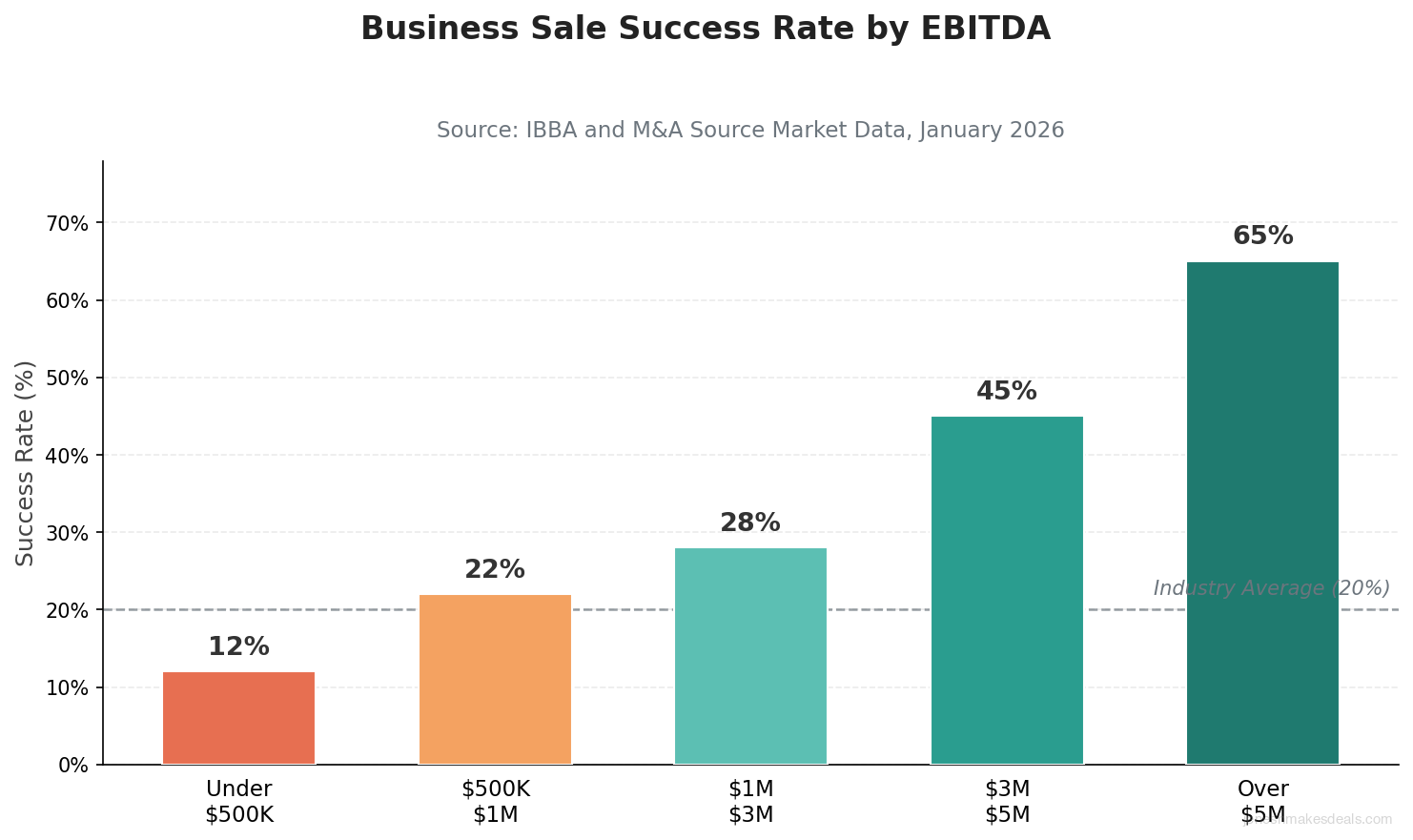 Larger businesses close at dramatically higher rates. Preparation and pricing are the biggest factors sellers can control. Source: IBBA and M&A Source Market Data, January 2026.
Your Role at Each Stage: A Quick Reference
Here is what your broker handles versus what you need to be personally involved in:
What Your Broker Handles
- Business valuation and pricing strategy
- Creating all marketing materials (blind profile, CIM)
- Listing on platforms and running marketing campaigns
- Fielding all buyer inquiries and managing NDAs
- Screening and qualifying buyers
- Scheduling and managing buyer meetings
- Handling negotiations and counteroffers
- Coordinating due diligence document flow
- Managing relationships with attorneys, accountants, and lenders
- Troubleshooting deal issues and overseeing the closing
Where You Need to Show Up
- Providing financial documents and answering operational questions
- Reviewing and approving the CIM
- Meeting 3 to 5 qualified buyers face to face
- Making decisions on offers, price, and deal structure
- Answering buyer questions during due diligence
- Running the business and maintaining performance throughout
- Developing the transition plan and training the new owner
Expect to invest about 5 hours per week during the process with a broker, compared to 20 or more hours per week without one. There will be peak periods, especially during due diligence, where more time is required.
The Difference Between a Volume Broker and a Top Tier Advisor
Not all brokers deliver the same results. The data on broker quality is stark:
| Metric | Volume Broker | Top Tier Advisor |
|---|---|---|
| Acceptance rate | 90 to 95% of inquiries | 30 to 40% of inquiries |
| Pre market vetting | 1 to 2 hours | 20 to 40 hours |
| Success rate | 20 to 30% | 80 to 90% |
| Average days on market | 180 to 240 | 90 to 120 |
A volume broker takes every listing and hopes for the best. A top tier advisor is selective, invests significant time in preparation, and closes at dramatically higher rates. When evaluating brokers, ask about their success rate and average time on market. Those numbers tell you more than any sales pitch.
For context on what a business broker does and how to evaluate one, I have covered both topics in detail.
Common Mistakes Sellers Make During the Process
Neglecting the business during the sale. Eight percent of broken LOIs fail because the business underperforms during diligence. Buyers are watching your numbers in real time. Keep your foot on the gas.
Not disclosing known issues. If you have a problem, whether it is a customer concentration issue, pending litigation, or a key employee who is thinking about leaving, disclose it early. Problems discovered during due diligence feel like deception. Problems disclosed up front feel like transparency.
Over negotiating small points. In deals under $2M, spending three weeks arguing about the non compete radius or the exact allocation of office furniture can kill the momentum. Focus on the material terms and let the small stuff go.
Telling employees or customers too early. Confidentiality is paramount. If employees hear rumors, they may leave. If customers get nervous, revenue can drop. Both will tank your deal. Let your broker manage the confidentiality strategy.
Not being emotionally prepared. This is the one no one talks about. Selling your business is one of the most significant financial and emotional events of your life. Have a plan for what comes after. Sellers who know their next chapter handle the process better than those who do not.
What to Do Next
If you are thinking about selling your business, here is what I recommend starting with:
- Get a professional valuation. Understand what your business is worth in today's market. Our guide on maximizing your business value walks through what buyers pay premiums for.
- Organize your financials. Get 3 years of tax returns and financial statements cleaned up with proper add backs. This single step can reduce your time to close by months.
- Start the conversation with a broker early. The best outcomes happen when sellers engage a broker 6 to 12 months before they want to close, not when they are already burned out and ready to walk away.
- Prepare yourself emotionally. Talk to other business owners who have sold. Understand the timeline. Know that it is a marathon, not a sprint.
Ready to understand what your business is worth and map out your selling timeline? Contact us for a free confidential consultation. I will walk you through the process specific to your business and industry.
Looking for capital to strengthen your business before listing? Explore our unsecured funding programs that can provide up to $500,000 with no collateral required. Sometimes a small investment in operations or financials before going to market pays for itself many times over.
Sources
- Business Brokers of America. "How Long Does It Take to Sell My Business?" 2025.
- Unbroker. "How Long Does It Really Take to Sell a Business in 2025?" 2025.
- BizScout. "How Long Does It Take to Sell a Business Explained with Key Variables." 2025.
- DueDilio. "Business Sale Failure Rate 2026: Why 80% of Listings Fail." 2026.
- Green & Co. "Timeline of a Business Sale Transaction: From Offer to Closing." 2025.
- Viking Mergers. "How Long Does It Take to Sell a Business? 5 Variables to Consider." 2025.
- JeneshMakesDeals.com. "What Is a Business Broker's Role in Selling a Business." 2025.
- Flippa. "What Documents Do I Need to Sell a Business? Full List." 2025.
- Oracle Legal Group. "7 Financial Documents Needed to Sell a Business." 2025.
- Vertex Planning Partners. "Key Financial Documents to Prepare Before Selling Your Business." 2025.
- Sunbelt Atlanta. "Preparing a Confidential Information Memorandum (CIM)." 2025.
- BizBuySell. "Creating a Confidential Information Memorandum to Sell Your Business." 2025.
- Axial. "2025 Dead Deal Report: Post LOI Transaction Failures." 2025.
- Bay State Business Brokers. "How Long Does It Take to Sell a Business?" 2025.
- Playbook Advisory. "Letter of Intent for Business Acquisition: Best Practices in 2025." 2025.
- DealRoom. "What Is a Letter of Intent (LOI) in M&A and How to Write One." 2025.
- RoseBiz. "10 Scenarios That Can Delay or Kill Your Deal." 2025.
- Pacifica Advisors. "Avoiding Delay: Ten Mistakes Businesses Make When Selling." 2025.
- Edison Business Advisors. "A How to Guide on Transitioning Ownership of a Business After a Sale." 2025.
- IBBA and M&A Source. "Market Pulse Survey and Deal Data." January 2026.
Frequently Asked Questions
How long does it take to sell a business with a broker?
The typical business sale takes 6 to 12 months from listing to close, with the average around 10 months. Businesses under $1M revenue tend to sell in 4 to 6 months but have lower success rates (10 to 15%). Companies over $10M revenue take 12 to 18 months but close at rates of 60 to 70%. The biggest variable is preparation. Businesses with 12 or more months of pre sale prep achieve success rates 2 to 3 times the industry average.
What does a business broker actually do during the sale?
A business broker handles valuation, creates all marketing materials including the CIM, lists the business across platforms, fields and screens all buyer inquiries, manages NDAs, schedules buyer meetings, handles offer negotiations, coordinates due diligence, and oversees the closing process. Most sellers spend about 5 hours per week on the process with a broker, compared to 20 or more hours without one.
What percentage of businesses listed for sale actually sell?
The overall success rate for privately held businesses listed for sale is approximately 20 to 30%. The failure rate is heavily influenced by business size: companies under $500K EBITDA have an 85 to 90% failure rate, while those over $5M EBITDA close at 60 to 70%. Top tier brokers who are selective about listings achieve 80 to 90% success rates.
Why do business deals fall apart during due diligence?
About 55% of deals that enter due diligence fail to close. The top reasons are non QoE diligence findings like legal issues and customer concentration (25.3%), EBITDA discrepancies found in Quality of Earnings reports (21.3%), renegotiation disagreements (14.7%), seller backing out (13.3%), and financing constraints (10.7%). Customer concentration above 25% is found in 42% of deals and is one of the most common specific deal breakers.
What documents do I need to sell my business?
You will need 3 to 5 years of profit and loss statements, balance sheets, cash flow statements, and tax returns. You also need accounts receivable and payable aging reports, asset and equipment lists, lease agreements, customer contracts, employee rosters, business licenses, insurance policies, and standard operating procedures. Having this organized before listing can reduce your time to receive offers by 40%.
Related Articles

March 28, 2026
Why Business Owners Need to Sell 2 Years Before They Retire
Most owners wait too long to sell. Here is why starting the exit process 2 years before retirement leads to better prices and smoother transitions.

January 31, 2026
7 Ways to Sell Your Business: What Works in 2026
From Facebook Marketplace to private equity, here are 7 ways to sell your business. What works, what doesn't, and what sellers get wrong.

January 29, 2026
How to Sell Your Business Fast in 2026
Want to sell your business fast in 2026? Real timelines, pricing strategies, and what makes buyers move quickly.
About the Author
Jenesh Napit is an experienced business broker specializing in business acquisitions, valuations, and exit planning. With a Bachelor's degree in Economics and Finance and years of experience helping clients successfully buy and sell businesses, he provides expert guidance throughout the entire transaction process. As a verified business broker on BizBuySell and member of Hedgestone Business Advisors, he brings deep expertise in business valuation, SBA financing, due diligence, and negotiation strategies.
You might also be interested in
Free Business Calculators
Try our business valuation calculator and ROI calculator to estimate values and returns instantly.
How to Buy a Business Guide
Download our comprehensive free guide covering everything you need to know about buying a business.
Our Services
Explore our professional business brokerage services including valuations and buyer representation.
More Articles
Browse our complete collection of business brokerage insights and expertise.