

Choosing the best business broker is one of the highest stakes decisions you will make during a sale, and most owners get it wrong. They pick the first name that shows up on Google, go with whoever a friend recommended, or sign with whoever quotes the highest valuation. That is like choosing a surgeon because they had good parking.
The wrong broker can leave tens of thousands of dollars on the table, waste 12 months of your life on a listing that never sells, or worse, blow up a deal that should have closed. The right broker gets you to the closing table at the right price in a reasonable timeframe.
After working with business owners on both sides of transactions, I have seen what separates the brokers who close deals from the ones who collect listings. If you are still deciding whether you even need a broker, start there first. But if you have already decided to hire one, here are the 5 things that actually matter when choosing a business broker, and the questions to ask to evaluate each one.
The Business Broker Industry: What You Are Working With
Before you start interviewing brokers, it helps to understand the landscape. There are roughly 3,200 brokerage firms in the U.S. and an estimated 5,000 to 10,000 full time business brokers. The industry generates about $1.8 billion in annual revenue, and only about 20% of businesses that sell do so through a broker.
Here is the uncomfortable truth: in 39 out of 50 states, no license is required to become a business broker. The industry has low barriers to entry and high turnover. Many people enter expecting quick commissions, underestimate the knowledge required, and quit within a few years. The pattern mirrors residential real estate: a small core of productive full time professionals surrounded by a larger pool of low volume part timers working on straight commission.
That means your job when hiring a business broker is not just finding one. It is filtering out the 80% who will not get the job done.
Thing 1: Deal Size Specialization
This is the single most important factor most sellers overlook. A broker who closes $200K deals operates in a completely different world than one who handles $2M deals, and both are different from an M&A advisor working $10M or more transactions.
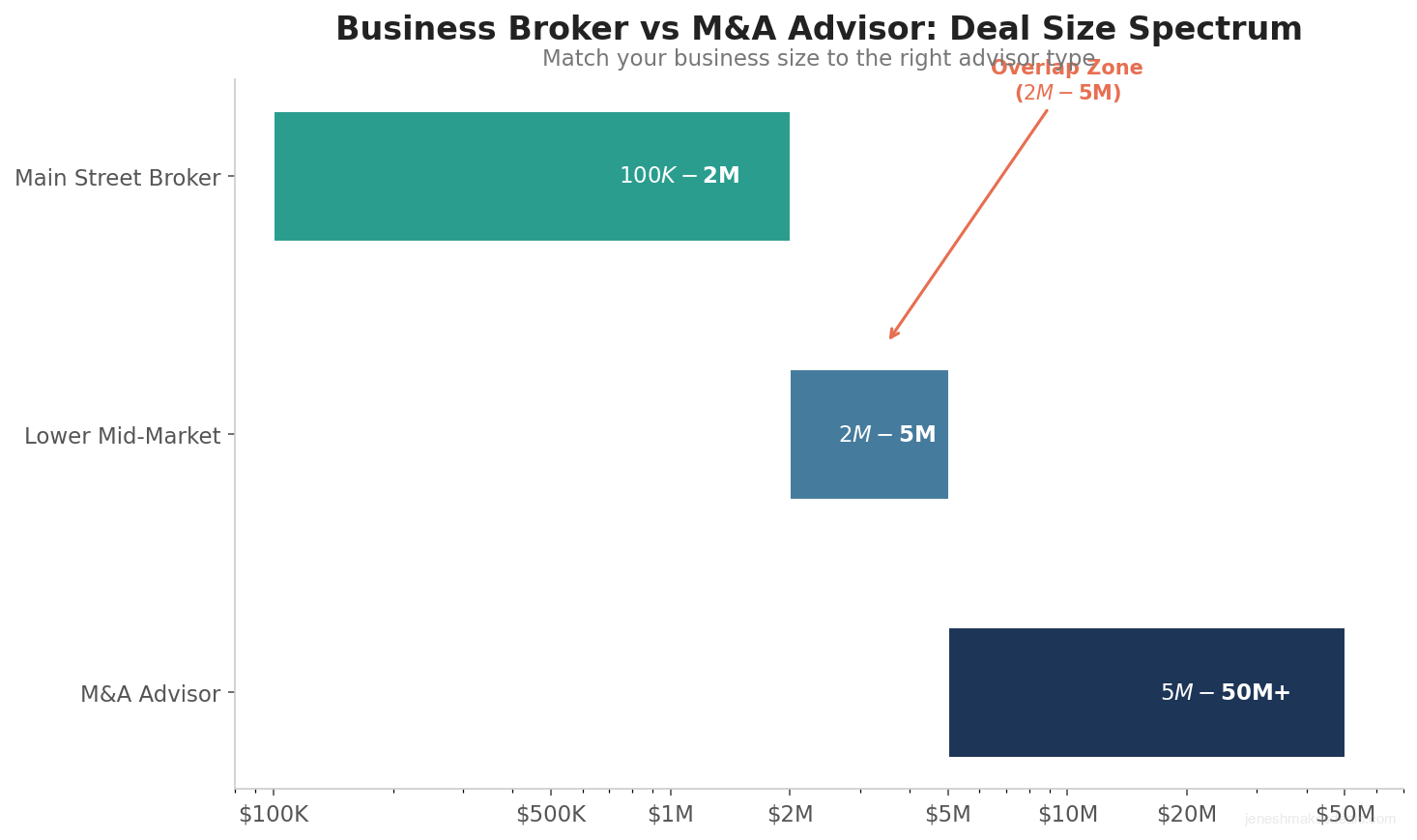 Match your business size to the right advisor type. The $2M to $5M range is where broker and M&A advisor capabilities overlap.
Here is how to tell the difference:
| Dimension | $200K Broker | $2M Broker | $10M+ Advisor |
|---|---|---|---|
| Team | Solo or very small | Small team with analyst support | Firm with analysts, research staff |
| Marketing | Simple online listings | Robust CIMs, targeted outreach | Detailed books, formal bid processes |
| Fee model | Flat 8 to 12%, no retainer | Double Lehman, possible small retainer | Tiered success fee plus monthly retainer |
| Buyer network | Local individual operators | Regional individuals, search funds | PE firms, strategics, family offices |
| Typical experience | May be newer, possibly part time | 5 to 10+ years, full time | 10 to 20+ years, often ex investment banking |
The question to ask: "Can you show me closed transactions in the last 24 months that match my business in size, margins, and industry?"
A broker whose recent closings are all under $500K is not the right lead advisor on a $5M exit, regardless of what their pitch deck says. And an M&A advisor charging retainers and minimum fees of $50,000 or more is not the right fit for a $300K business.
"I interviewed three brokers. Two told me they could handle my $3M business, but when I asked for recent comparable deals, one had never closed anything above $800K. The third broker showed me four deals between $2M and $5M in my industry in the last year. That made the decision easy." , Logistics company owner, Georgia
Thing 2: Industry or Vertical Experience
A broker who just sold a plumbing company will understand recurring service agreements, technician retention, and fleet valuation. A broker who has never been near the trades will spend weeks learning what your buyers already know.
Industry experience shows up in three places:
Valuation accuracy. A broker who knows your industry understands the multiples buyers actually pay, not just what the textbooks say. They know that a plumbing company with a strong service agreement base commands a premium over one that relies on new construction, because they have seen it in real transactions.
Buyer network. Industry specific brokers maintain relationships with the buyers who acquire businesses like yours. They know which private equity firms are rolling up companies in your space, which strategic acquirers are actively looking, and which search fund operators are targeting your vertical.
Credibility during negotiations. When a broker can speak intelligently about your industry during buyer meetings and due diligence, it builds confidence on both sides of the table. When they cannot, it raises questions about whether they are the right advisor.
The question to ask: "How many businesses in my industry have you sold in the last 3 years? Can I speak with one of those sellers?"
You do not need a broker who exclusively works in your industry. But you need one who has enough experience in your space to understand the value drivers and buyer landscape. If they have never sold a business remotely similar to yours, you are paying them to learn on your dime.
Thing 3: Their Actual Marketing Plan
This is where the gap between good brokers and mediocre ones becomes obvious. A weak broker lists your business on BizBuySell, puts up a blind ad, and waits for the phone to ring. A strong broker runs a multi channel campaign that puts your business in front of qualified, funded buyers.
 The quality of your broker's marketing materials, especially the CIM, directly predicts how buyers perceive your business.
When you interview brokers, ask them to walk you through their marketing plan for your specific business. Here is what a good plan includes:
A professional CIM (Confidential Information Memorandum). This is the pitch book that qualified buyers review. It should include normalized financials with clear add backs, a business overview, market analysis, growth opportunities, and deal terms. Ask to see anonymized samples of past CIMs. The quality gap from broker to broker is stark, and it directly predicts how your business will be perceived.
Targeted buyer outreach. The best deals often happen off market through a broker's direct network, not from public listings. Top advisors achieve 45 to 60% email open rates and 12 to 18% response rates with targeted campaigns, compared to 8 to 12% for generic blasts. Ask how many buyers are in their database and how they segment them.
Multiple listing channels. Beyond BizBuySell, a good broker lists on BizQuest, DealStream, and industry specific platforms. They also leverage co brokerage networks, LinkedIn outreach, and in some cases direct mail to strategic acquirers.
Buyer screening and momentum. Good brokers screen buyers financially and operationally before sharing sensitive information. They manage the inquiry funnel, keep both sides on track, and resolve issues before they become deal killers.
The question to ask: "Can I see an anonymized CIM you created for a business similar to mine? Walk me through how you would market my business specifically."
A broker who cannot answer this in detail, with evidence, is a broker who will list your business and hope for the best. Using a broker with a strong marketing approach can reduce time on market by 3 to 6 months compared to a passive listing.
Want to understand what your business might be worth before meeting with brokers? Use our free business valuation calculator to get a baseline estimate so you can evaluate their valuation against your own.
Thing 4: Fee Structure Transparency
Business broker fees vary significantly, and the structure matters as much as the percentage. Understanding broker fees and commission structures before you start interviewing will put you in a much stronger position.
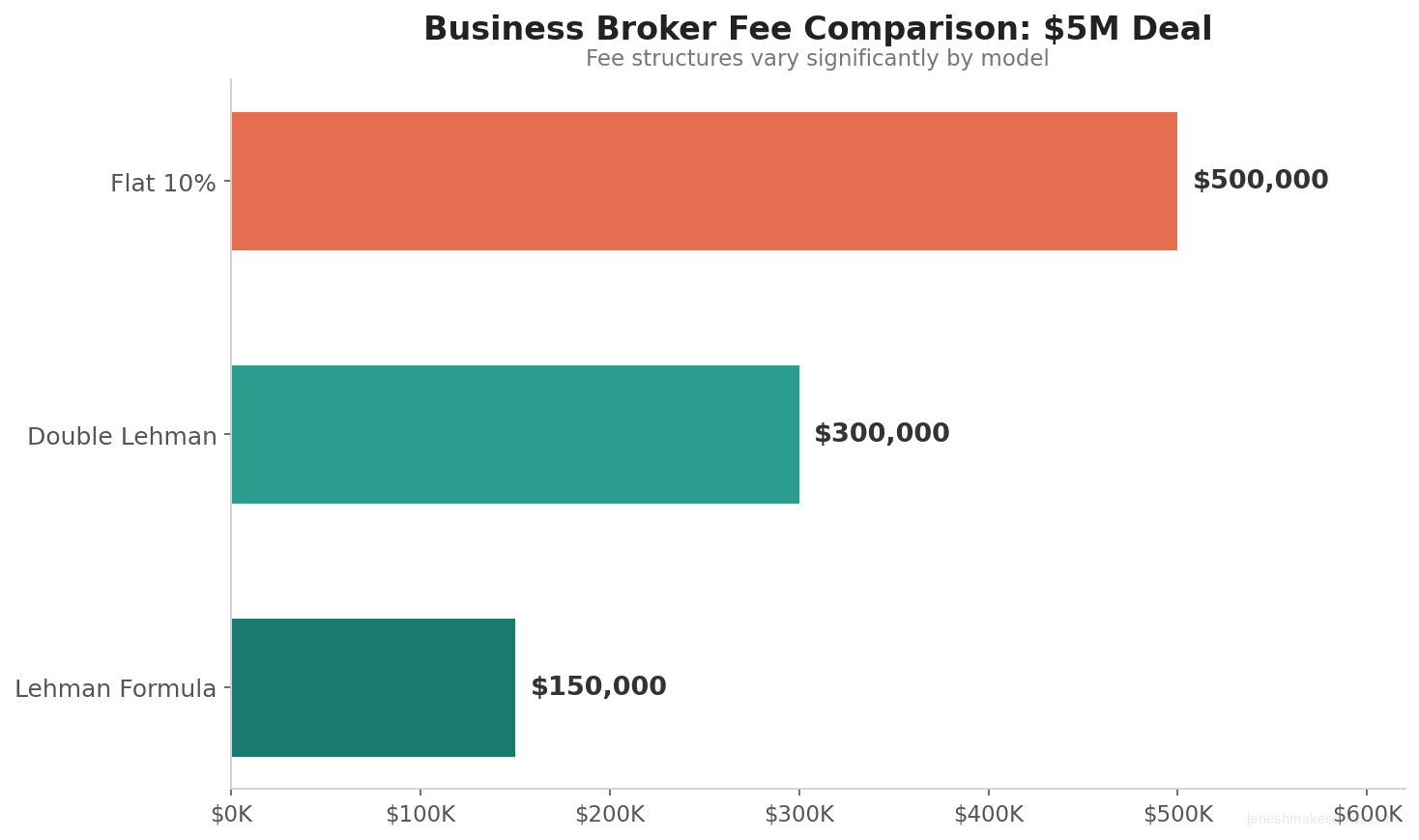 On the same $5M deal, the fee difference between structures can be $350,000. Make sure you understand what you are paying.
Here is how the main structures break down:
Small Businesses (Under $5M)
- Flat commission: 8 to 12% for businesses under $1M
- Double Lehman formula for $1M to $5M deals: 10% on the first $1M, declining to 2% above $4M
- Minimum fees: $10,000 to $25,000 regardless of sale price
- Most work on straight commission with no retainer
Mid Sized Businesses ($5M to $100M)
- Up front retainers: A few thousand to $50,000 or more
- Minimum success fees: $50,000 to $250,000
- Lehman Formula: 5% on the first $1M, declining to 1% above $4M
What to Watch For
Straight commission creates misaligned incentives. It incentivizes the broker to sell quickly with minimal effort rather than maximize your price. A broker who closes at $1.8M instead of pushing for $2.2M loses very little commission but you lose $400,000.
Up front fees are not inherently bad if they correspond to specific deliverables like CIM preparation, valuation, and marketing campaigns. The more experienced the broker, the more likely they charge them.
Beware firms charging $30,000 or more for a basic valuation that independent appraisers would provide for under $2,500. This is a common red flag.
The question to ask: "Walk me through every fee, up front, monthly, and at closing. Are retainers credited against the success fee? What is your minimum fee?"
Get everything in writing before you sign anything. A broker who is vague about fees during the sales pitch will be even more opaque when disputes arise later.
Thing 5: Track Record and References You Can Actually Call
Designations, marketing materials, and fee structures all matter. But nothing replaces talking to someone who has been through the process with this broker.
 References from past clients whose businesses resembled yours in size and industry are the most valuable signal when choosing a broker.
Designations Worth Knowing
In an industry where most states require no license, designations signal a baseline of training and commitment:
- CBI (Certified Business Intermediary): The premier main street designation from the IBBA. Requires advanced coursework, a comprehensive exam, and verified transaction experience. Over 500 holders globally.
- M&AMI (Merger & Acquisition Master Intermediary): For mid market deals. Requires 3 years of full time M&A experience and 3 completed deals over $1.5M each. The only designation requiring both education and completed middle market transactions.
Important caveat: designations are a positive signal, but experience and references matter more than letters. An undesignated broker with 15 years of closed deals in your industry may outperform a newly minted CBI.
How to Verify the Track Record
- Ask for closed deals in your size range in the last 24 to 36 months
- Request 2 to 3 references from past clients whose businesses resembled yours
- Compare their actual deal sizes to their marketing claims
- Ask about their close rate on listings they accepted at their recommended price, not their overall close rate (the overall number is always inflated)
The practical takeaway on close rates: main street businesses sell about 18% of the time overall. Lower mid market closes around 30%. But top tier advisors who are selective about which listings they accept report close rates of 80% or higher. The difference is not magic. It is selectivity and preparation.
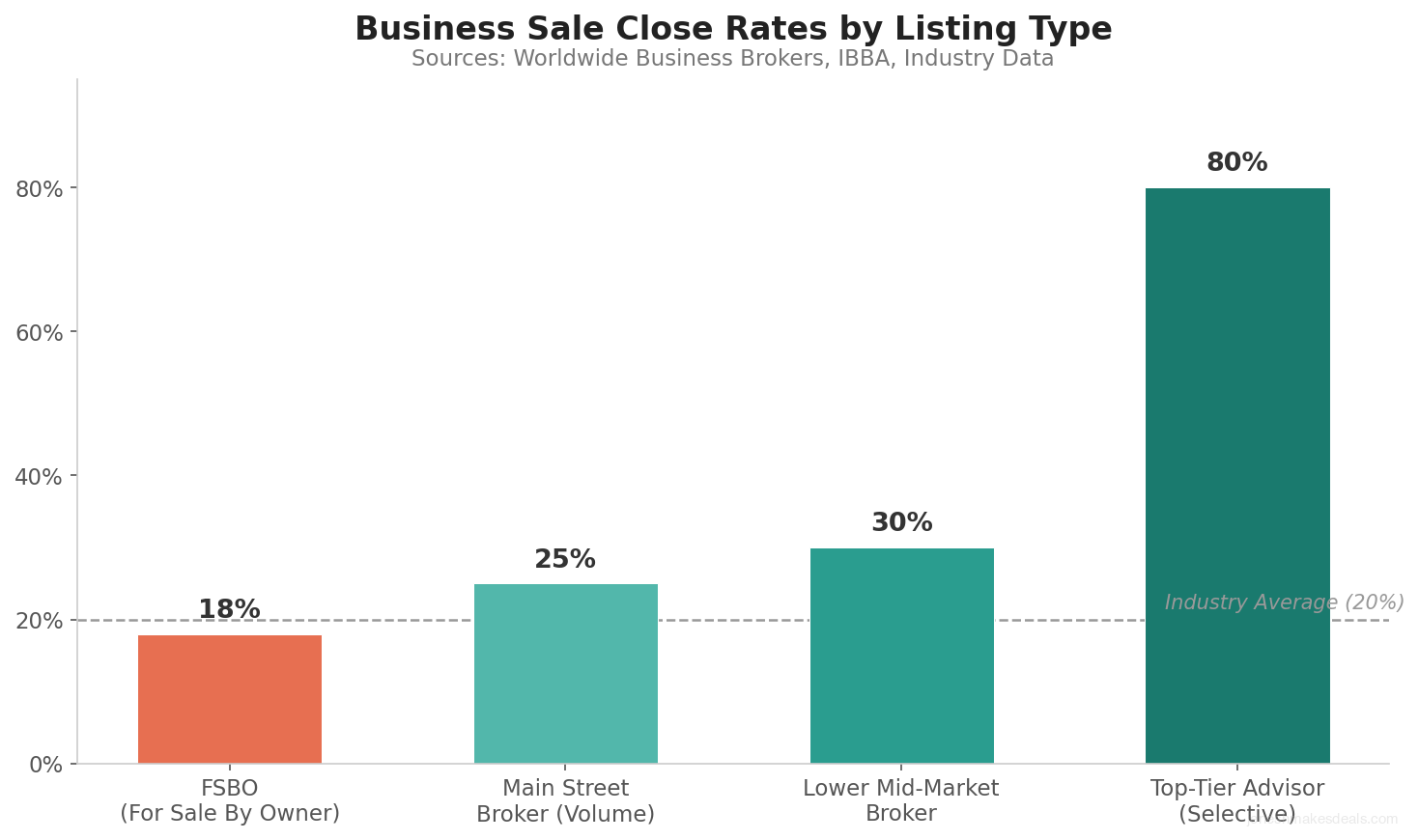 The close rate difference between a volume broker and a selective top tier advisor is dramatic. Selectivity and preparation drive the gap. Sources: Worldwide Business Brokers, IBBA.
The question to ask: "What is your close rate on listings you accepted at your recommended price? Can I speak with a past client who had a business similar to mine?"
"The broker I almost hired had a beautiful website and a great pitch. But he couldn't give me a single reference in my industry. The broker I went with had a less flashy presentation but handed me three phone numbers of business owners who had sold through him in the last two years. I called all three. That's what made the decision." , Auto repair shop owner, Florida
Red Flags That Should Make You Walk Away
Based on industry data and patterns I have seen firsthand, here are the warning signs that a broker is not worth your time:
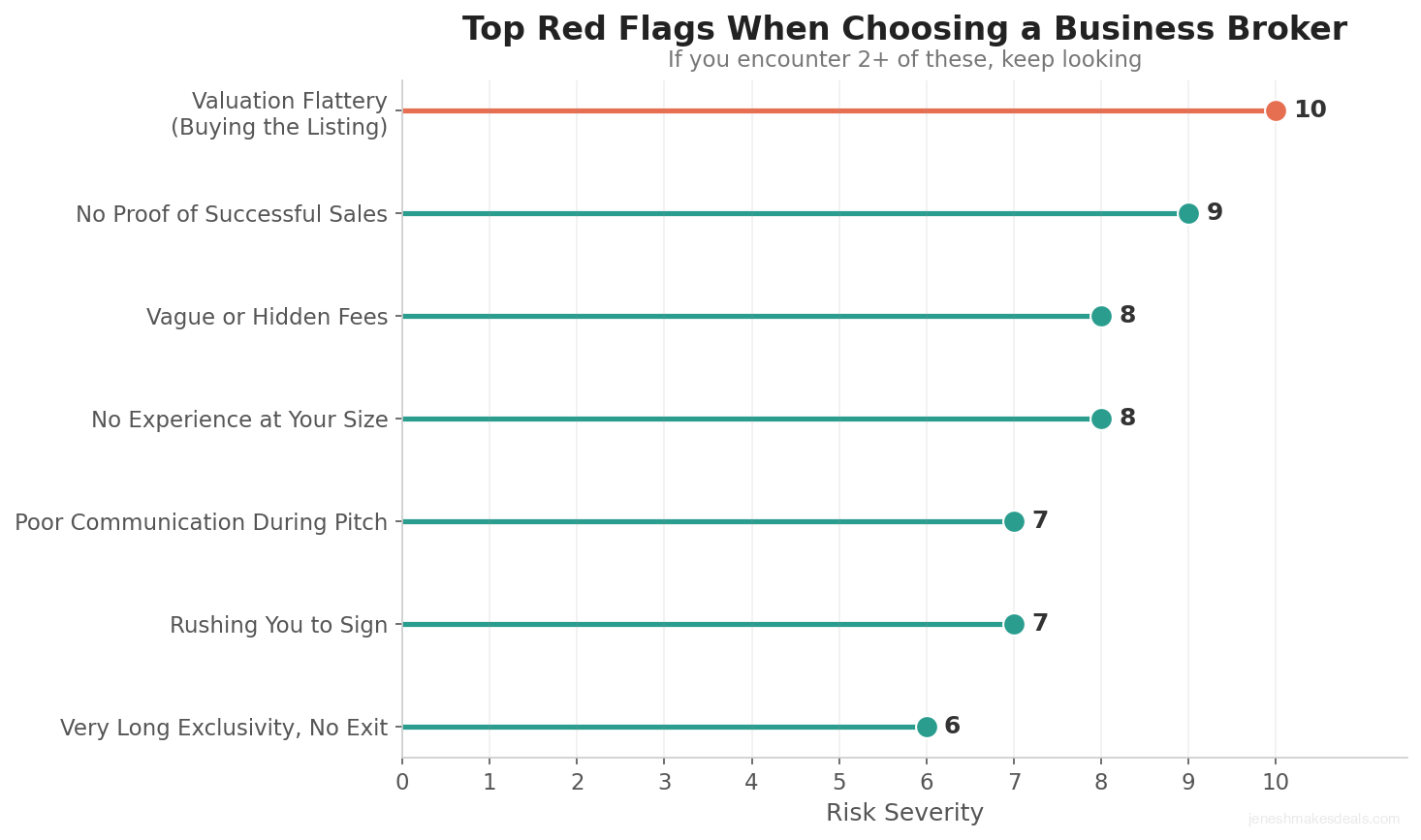 If you encounter two or more of these in a single broker conversation, keep looking. You have better options.
Valuation flattery without substance. They quote a high number that matches your hopes without walking through methodology, comparable transactions, or cash flow analysis. This is called "buying the listing" and it almost always leads to a listing that never sells. It is the number one reason businesses sit on the market for months.
No proof of successful sales. They cannot provide a list of closed deals or introduce you to past clients. "Confidentiality" is not a valid excuse for being unable to confirm completed transactions.
Vague or hidden fees. Unwillingness to put all fees explicitly in writing before you sign. If they are not transparent now, they will not be transparent when it matters.
No experience at your deal size. Their closed deals are dramatically smaller or larger than yours, but they pitch themselves as capable of anything.
Poor communication during the pitch. Slow replies, rescheduled calls, unprepared meetings. These patterns always worsen once you are locked into an exclusive contract.
Rushing you to sign. Pressuring you to commit quickly, discouraging you from speaking with other advisors, or suggesting they will "massage" numbers to make the business look better.
Very long exclusivity with no escape. Multi year lock ups without performance benchmarks or termination rights.
Flat commission regardless of sale price. This removes the broker's incentive to negotiate a higher price for you. If they get the same percentage whether they sell at $1.5M or $2M, guess which price requires less work.
Rule of thumb: If you encounter more than one of these in a single broker conversation, you likely have better options.
Not sure where to start the search? Contact us and I will help you understand what to look for in a broker for your specific business and industry.
The Listing Agreement: What to Watch For Before You Sign
The listing agreement is where incentives either align or misalign. Most brokers require a one year exclusive agreement, though shorter terms can sometimes be negotiated. Before you sign anything, have a transaction attorney review it.
What a Good Agreement Includes
- Reasonable exclusivity period: 6 to 12 months, consistent with normal sale timelines
- Clear, transparent fee schedule: Success fee percentages, retainers, minimums, and reimbursable expenses all spelled out, with retainers credited against the success fee
- Defined scope of work: What the broker will actually deliver, including valuation, CIM, marketing channels, buyer outreach, screening, and deal coordination
- Reasonable tail period: Typically 12 to 24 months after expiration, and the broker must provide a written list of buyers covered by the tail
- Termination for cause: You can terminate early if the broker materially fails to perform
- Definitive end date: No automatic renewals
What Should Raise Concerns
- Very long exclusivity (2 to 3 years) with no performance benchmarks or exit rights
- Large non refundable up front fees disconnected from specific deliverables
- Vague or overly broad tail clauses claiming a fee for almost any buyer who ever hears of the business
- A penalty clause requiring the full commission if you take the business off the market
- Any resistance to having your attorney review the agreement
"My attorney caught a clause that would have required me to pay the full commission even if I decided not to sell. The broker said it was 'standard.' My attorney said it was not. That one review saved me $80,000." , Dental practice owner, California
Common Mistakes Sellers Make When Hiring a Broker
Choosing based on the highest valuation. The broker who tells you your business is worth $3M when everyone else says $2M is not the best broker. They are the one who will list it at $3M, let it sit for 14 months, then tell you to reduce the price. One documented case: a $1.5M EBITDA company listed at 6.5x sat for 14 months before reducing to 4.8x and receiving multiple bids within 60 days.
Not interviewing multiple brokers. Interview at least three. The differences in experience, marketing approach, and communication style become obvious fast.
Ignoring the fee structure. A 10% flat commission on a $5M deal is $500,000. A Double Lehman on the same deal is $300,000. A Lehman formula is $150,000. The fee model matters as much as the percentage.
Skipping references. Calling two or three past clients takes 30 minutes and tells you more than any website or pitch meeting ever will.
Not having an attorney review the listing agreement. Brokers expect this. The ones who resist attorney review are telling you something.
Hiring based on personality over competence. A charming broker who cannot execute is worse than a dry one who closes deals. Focus on track record, not charisma.
What to Do Next
Choosing the right broker starts with knowing what your business is worth and understanding what you need from an advisor. Here is what I recommend:
- Get an independent valuation first. Walk into broker interviews with your own number. Our valuation calculator gives you a solid starting point, and a formal third party valuation typically costs $2,500 to $5,000.
- Interview at least three brokers. Use the five criteria above to structure your evaluation. Take notes and compare.
- Call references. Ask past clients about communication, timeline, marketing quality, and whether the final sale price matched expectations.
- Have your attorney review the listing agreement. Before you sign anything.
- Trust your gut on communication. If the broker is hard to reach during the pitch phase, it will only get worse after you sign.
For a broader look at what a business broker actually does and how they fit into the sale process, I have covered both topics in detail.
Ready to talk about selling your business? Contact us for a free confidential consultation. I will walk you through what to look for in a broker for your specific industry and business size, no strings attached.
Looking for capital to strengthen your business before going to market? Explore our unsecured funding programs that can provide up to $500,000 with no collateral required. Sometimes a small investment in operations or financials before listing pays for itself many times over.
Sources
- IBISWorld. "Business Brokers in the US: Number of Businesses Statistics." 2024.
- Marketdata/ResearchAndMarkets. "U.S. Business Brokers Industry Research Report 2024." Business Wire, 2024.
- Morgan & Westfield. "Business Broker and M&A Advisor Fees: A Comprehensive Guide." 2025.
- IBBA. "Membership and CBI Certification Data." 2024.
- Worldwide Business Brokers. "How Many Businesses Sell Once They're Brought to Market?" 2025.
- Morgan & Westfield. "Can a Business Broker's Success Rate Be Accurately Measured?" 2025.
- MidStreet. "10 Problems to Avoid When Hiring a Business Broker." 2025.
- Unbroker. "Red Flags When Choosing a Business Broker: Warning Signs." 2025.
- MidStreet. "10 Questions to Ask a Business Broker Before Signing a Listing Agreement." 2025.
- AMAA. "Cultivating Success: The Impact of Business Brokers on Closing Rates." 2025.
- BizScout. "How Long Does It Take to Sell a Business?" 2025.
- Morgan & Westfield. "How Long Does It Take to Sell a Business?" 2025.
- Sunbelt Texas. "Key Questions Before Signing a Listing Agreement with a Broker." 2025.
- Lake Country Advisors. "Key Questions to Ask Your Business Broker Before Signing a Contract." 2025.
- Morgan & Westfield. "Business Broker and M&A Advisor Agreements: A Complete Guide." 2025.
- MidStreet. "What Is an M&AMI Certification?" 2025.
- SellerForce. "How to Sell a Small Business by Owner: The Pros and Cons." 2025.
- IBBA. "Earn Your Certified Business Intermediary (CBI) Designation." 2025.
Frequently Asked Questions
How do I find a good business broker near me?
Start with the IBBA (International Business Brokers Association) directory and M&A Source for mid market advisors. Look for brokers with CBI or M&AMI designations, then verify their track record by asking for closed deals in your size range and industry in the last 24 months. Interview at least three brokers and call references. Geography matters less than deal size fit and industry experience, so do not limit your search to your immediate area.
How much does a business broker charge to sell a business?
For businesses under $1M, expect a flat commission of 8 to 12%. For $1M to $5M businesses, the Double Lehman formula is common (10% on the first $1M, declining to 2% above $4M). Mid market deals ($5M or more) typically involve retainers of a few thousand to $50,000 plus and success fees following the Lehman Formula. Minimum fees range from $10,000 to $25,000 for small deals and $50,000 to $250,000 for mid market.
What certifications should a business broker have?
The CBI (Certified Business Intermediary) from the IBBA is the premier designation for main street brokers. For mid market deals, look for M&AMI (Merger and Acquisition Master Intermediary) from M&A Source, which requires 3 years of full time experience and 3 completed deals over $1.5M each. However, designations are a positive signal, not a guarantee. A broker with 15 years of closed deals in your industry may outperform a newly certified one.
How long does it take to sell a business with a broker?
Most small to mid sized businesses take 6 to 12 months to sell, with the average around 10 months. Small retail and service businesses may sell in 4 to 8 months. Medium manufacturing businesses take 9 to 14 months. The biggest factors affecting timeline are realistic pricing (the number one driver of speed), organized financials, quality of the CIM, and seller cooperativeness.
Should I sign an exclusive listing agreement with a broker?
In most cases, yes. Exclusive agreements give the broker the motivation and security to invest significant time and resources into your sale, including creating a professional CIM, running targeted marketing, and managing buyer relationships. However, negotiate the terms: insist on 6 to 12 months (not multi year), clear termination rights if the broker underperforms, a defined tail period, and an attorney reviewed contract. Avoid agreements with penalty clauses for withdrawing.
Related Articles

April 29, 2026
Selling a Franchise Business vs an Independent Business
Selling a franchise is a fundamentally different process than selling an independent business. Here is what every franchise owner needs to know.

April 21, 2026
What Is a Management Buyout and Is It Right for Your Business?
A management buyout lets your team buy the business. Learn how MBOs work, what they cost, and when they make sense for sellers.

April 13, 2026
How to Find the Right Business Broker for Your Industry
Not all brokers know your industry. Here's how to find one who actually understands your business and can get you top dollar.
About the Author
Jenesh Napit is an experienced business broker specializing in business acquisitions, valuations, and exit planning. With a Bachelor's degree in Economics and Finance and years of experience helping clients successfully buy and sell businesses, he provides expert guidance throughout the entire transaction process. As a verified business broker on BizBuySell and member of Hedgestone Business Advisors, he brings deep expertise in business valuation, SBA financing, due diligence, and negotiation strategies.
You might also be interested in
Free Business Calculators
Try our business valuation calculator and ROI calculator to estimate values and returns instantly.
How to Buy a Business Guide
Download our comprehensive free guide covering everything you need to know about buying a business.
Our Services
Explore our professional business brokerage services including valuations and buyer representation.
More Articles
Browse our complete collection of business brokerage insights and expertise.