
How Much Is My Business Worth? A Small Business Owner's Guide for 2026

Every business owner eventually asks this question. Maybe you're thinking about selling in a year or two. Maybe someone made you an unsolicited offer and you have no idea if it's fair. Or maybe you just want to know where you stand.
The problem is that most owners get the answer wrong. And the direction they're wrong in matters.
I've seen owners turn down $1.2 million offers on businesses worth $900,000 because they "felt" it was worth more. I've also seen owners accept $400,000 for businesses that should have sold for $650,000 because they didn't know any better.
Both mistakes come from the same place: not understanding how buyers actually value businesses.
This guide is going to walk you through exactly how buyers and brokers determine what a business is worth in 2026. Not theory. Not formulas from a textbook. The actual process that leads to a real number with a real buyer writing a real check.
The Short Answer
Your business is most likely worth 2x to 4x your annual Seller's Discretionary Earnings (SDE). For businesses with more than $1 million in earnings, buyers typically use EBITDA multiples instead, which range from 3x to 6x.
That's the range. Where you land within it depends on about a dozen factors that we'll get into below.
But first, let's make sure we're calculating SDE correctly, because this is where most owners go wrong before they even get to the multiple.
What Is SDE and Why It's the Number That Matters
SDE stands for Seller's Discretionary Earnings. It represents the total financial benefit a single owner-operator takes from the business each year.
Here's the formula:
SDE = Net Profit + Owner's Salary + Owner's Benefits + Non-Recurring Expenses + Non-Cash Expenses
Let's say your business shows $80,000 in net profit on the tax return. Most owners stop there and think, "My business only makes $80,000." But that's not what a buyer sees.
A buyer adds back:
- Your salary: $120,000
- Your health insurance: $18,000
- Your car payment run through the business: $9,600
- That one-time equipment purchase last year: $25,000
- Depreciation (non-cash expense): $15,000
Now your SDE is $267,600. At a 3x multiple, that's a business worth roughly $800,000. A very different picture than "$80,000 in profit."
This is why I tell every owner: your tax return is designed to minimize your income, not showcase it. A buyer's job (with help from a broker) is to reverse-engineer the tax return to find the true earning power of the business.
Use our SDE calculator to run your own numbers.
How Multiples Work (And Why They Vary So Much)
Once you know your SDE, you multiply it by an industry-specific number to get your valuation range. But multiples aren't random. They reflect how risky or attractive a business is to a buyer.
Here's what 2026 multiples look like across common industries:
| Industry | Typical SDE Multiple | Why |
|---|---|---|
| HVAC / Plumbing | 3.0x - 5.0x | Licensed trades, recurring revenue, hard to replicate |
| Laundromats | 2.5x - 5.0x | Semi-passive income, equipment-based, location-dependent |
| Car Washes | 3.0x - 5.0x | Subscription models growing, real estate component |
| Manufacturing | 2.5x - 5.0x | Equipment value, contracts, skilled workforce |
| E-commerce | 2.0x - 4.0x | Scalable but traffic-dependent, brand matters |
| Commercial Cleaning | 2.0x - 4.0x | Recurring contracts, low barrier to entry |
| Landscaping | 2.0x - 4.0x | Seasonal, crew-dependent, equipment value |
| Restaurants | 1.5x - 3.0x | Thin margins, high competition, owner-dependent |
| Coffee Shops | 1.5x - 3.0x | Location-critical, brand loyalty, lower margins |
| Marketing Agencies | 2.0x - 4.0x | Client concentration risk, talent-dependent |
Notice the ranges. An HVAC company could sell for 3x or 5x SDE. That spread on a $300,000 SDE business is the difference between $900,000 and $1,500,000. That's $600,000 depending on where you fall.
So what determines where you land?
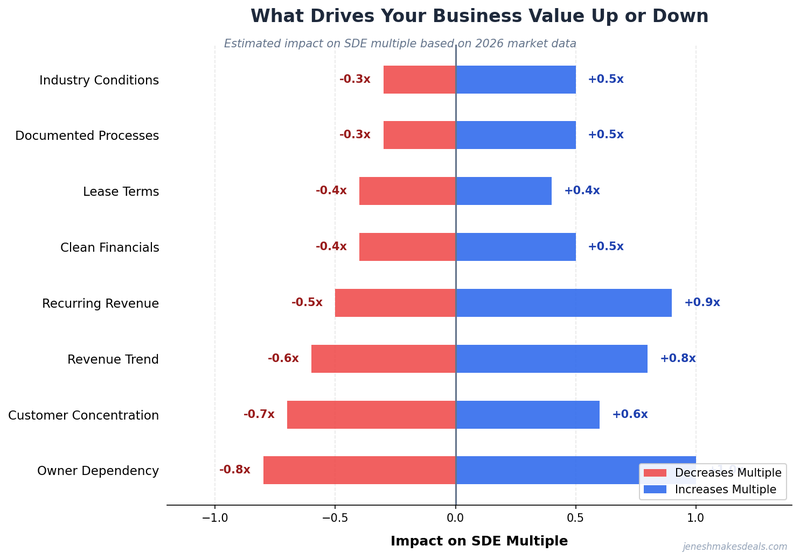
The 7 Factors That Move Your Multiple Up or Down
1. Revenue Trend (Up, Flat, or Declining?)
A business growing 10-15% per year commands a higher multiple than one that's been flat for three years. A declining business gets discounted heavily, sometimes below the low end of the range.
Buyers pay for momentum. If your revenue has been growing, make sure your financials clearly show that trend year over year.
2. Owner Dependency
This is the single biggest value killer I see. If the business can't function without you, buyers see a job, not an investment.
Signs of high owner dependency:
- You handle all the key customer relationships
- You make every operational decision
- There's no documented process for anything
- You work 60+ hours a week and the business still needs you
What moves the multiple up:
- A manager or key employee who runs day-to-day operations
- Documented systems and processes
- Customer relationships spread across the team
- The business runs when you take a two-week vacation
3. Customer Concentration
If one customer accounts for more than 20% of your revenue, that's a red flag for buyers. If one customer is 40%+ of revenue, expect a significant discount.
Why? Because if that customer leaves after the sale, the buyer just lost nearly half the business they paid for.
The fix: Diversify before you sell. Even getting your top customer below 15% of revenue can add a meaningful bump to your multiple.
4. Recurring Revenue
Monthly contracts, subscriptions, membership fees, and maintenance agreements are gold. They give buyers predictable cash flow and reduce risk.
An HVAC company with 500 annual maintenance contracts is worth significantly more than one doing the same revenue from one-time repair calls. Same revenue, different risk profile, different multiple.
5. Lease Situation
A short-term lease or one that expires soon scares buyers. They're buying your business but may lose the location in 18 months.
What buyers want: A lease with at least 5 years remaining, or a renewal option at reasonable terms. If your lease is coming up, negotiate an extension before listing your business.
6. Clean Financials
If a buyer's accountant or SBA lender can't verify your numbers quickly, the deal slows down or dies. Messy books don't just delay sales. They reduce your price because buyers factor in the risk that the real numbers are worse than what you're showing.
What "clean" looks like:
- 3 years of tax returns that match your P&L
- A clear SDE calculation with documented add-backs
- No major discrepancies between bank statements and reported income
- A bookkeeper or CPA who can answer questions
7. Industry and Market Conditions
Some industries are hot in 2026. Buyer demand for home services (HVAC, plumbing, electrical) is strong because of recurring revenue and licensing barriers. Restaurants are harder because margins are thin and post-pandemic buyer caution lingers.
SBA lending conditions also matter. With SBA 7(a) rates at 10.5% to 13% in 2026, buyers are more selective about what they'll pay. The businesses that get premium multiples are the ones where the cash flow clearly covers the debt service.
The Gap Between What Owners Think and What Buyers Pay
Here's something most brokers won't tell you upfront: the majority of business owners overestimate their business value by 20% to 40%.
It's not because owners are unrealistic. It's because they're calculating value based on what the business means to them: years of hard work, emotional investment, what they need for retirement. Buyers don't factor any of that in. They're looking at the numbers, the risk, and the return on their investment.
The owners who underestimate are usually looking at their tax returns and seeing low net profit without understanding add-backs and SDE. They don't realize how much value is hidden in the expenses they run through the business.
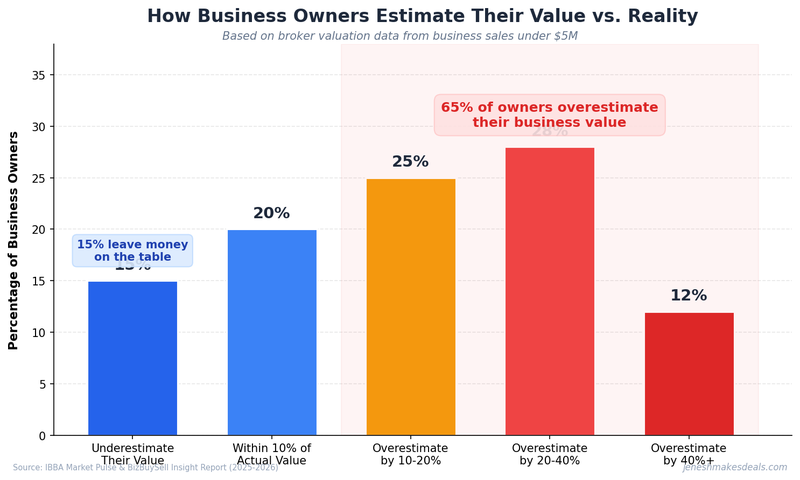
This is exactly why getting a professional valuation before you even think about listing is so important. Not so you can "prove" your number. So you can go into the process with an accurate number that attracts real buyers and leads to real offers.
Three Ways to Value Your Business Right Now
Method 1: SDE Multiple (Best for Businesses Under $1M SDE)
This is the standard for most small businesses.
Steps:
- Calculate your SDE (net profit + owner salary + add-backs)
- Find the typical multiple range for your industry
- Multiply SDE by the range to get your valuation range
Example: A landscaping business with $180,000 SDE at a 2.5x to 3.5x multiple = $450,000 to $630,000.
Try it with our industry-specific calculators. Or use our listing price estimator to see what asking price makes sense for your business.
Method 2: EBITDA Multiple (Best for Businesses Over $1M SDE)
Larger businesses use EBITDA (Earnings Before Interest, Taxes, Depreciation, and Amortization) because the buyer typically isn't the operator.
EBITDA multiples run higher (3x to 6x for most small-to-mid-market businesses) because they don't include the owner's salary as an add-back. The buyer is hiring a manager, not replacing the owner.
Method 3: Comparable Sales
What did similar businesses in your industry and geography actually sell for recently? This is the market-based approach, and it's what brokers rely on most heavily.
The challenge is that business sale prices aren't public like real estate. You can't just look up what the laundromat down the street sold for. Brokers have access to deal databases (BizComps, DealStats, PeerComps) that track actual transaction data. This is one of the biggest advantages of working with a broker. They know what businesses like yours are actually selling for, not just what they're listed at.
What a Professional Valuation Includes (That Online Calculators Don't)
Online calculators, including ours, give you a range based on your SDE and industry multiples. That's a good starting point. But a professional valuation from a broker goes deeper:
What a broker adds:
- Comparable sales analysis using actual deal data from the past 12-24 months
- Add-back review to make sure you're capturing all legitimate add-backs (most owners miss some)
- Risk factor assessment covering owner dependency, customer concentration, lease, team strength
- Local market adjustment because a restaurant in Manhattan trades at different multiples than one in Buffalo
- Buyer demand context based on who's actively looking in your industry and price range right now
- Deal structure impact because a business worth $800,000 on an all-cash basis might be worth $850,000 with SBA terms that let more buyers compete
A professional valuation takes 3 to 5 days and is typically free when you're working with a broker. The output isn't just a number. It's a pricing strategy that positions your business to sell at the highest price the market will support.
Common Mistakes That Cost Sellers Real Money
Mistake 1: Using Revenue Instead of SDE
"My business does $2 million in revenue, so it should be worth $2 million." I hear this constantly. Revenue alone tells you almost nothing about value. A $2 million revenue business with $100,000 SDE is worth far less than a $1 million revenue business with $300,000 SDE.
Buyers care about what they get to keep, not what comes in the door.
Mistake 2: Pricing Based on What You Need
"I need $750,000 to retire, so that's what my business is worth." The market doesn't care what you need. It cares what the business earns and what the risk profile looks like. Pricing based on personal needs instead of market data is the fastest way to sit on the market for a year with no offers.
Mistake 3: Ignoring Your Add-Backs
On the flip side, some owners sell themselves short because they only look at net profit. If you're paying yourself $150,000, running $30,000 in personal expenses through the business, and took a one-time $40,000 loss last year, that's $220,000 in add-backs that increase your SDE and your valuation.
Mistake 4: Comparing Yourself to the Wrong Businesses
"I heard the HVAC company across town sold for 5x." Maybe. But that company might have had 10 technicians, 800 maintenance contracts, and a manager running everything. If you're a one-person operation doing half the revenue, your multiple is going to be lower. Context matters more than the headline number.
Mistake 5: Waiting Too Long to Find Out
The best time to get a valuation is 1 to 2 years before you want to sell. Why? Because it gives you time to fix the things that are dragging your value down. Maybe your customer concentration is too high. Maybe your books need cleaning up. Maybe you need to hire a manager to reduce owner dependency.
Every one of those fixes takes time, but each one can add tens of thousands (or hundreds of thousands) to your sale price. Owners who wait until they're ready to list don't have time to optimize.
Is 2026 a Good Time to Find Out What Your Business Is Worth?
Yes. Here's what the 2026 market looks like for sellers:
What's working in your favor:
- Buyer demand is strong, especially in home services, healthcare, and food and beverage
- Private equity and search fund activity continues to grow, which adds competition for quality deals
- SBA lending is accessible, which means more buyers can get financing
- Baby boomer retirements are creating more buyer demand than seller supply in many industries
What to watch:
- SBA 7(a) rates at 10.5% to 13% mean buyers are more focused on cash flow coverage. Your DSCR (debt service coverage ratio) needs to be 1.25x or better. Use our DSCR calculator to check where you stand.
- Buyers are doing more due diligence than they were 2 to 3 years ago. Clean financials aren't optional anymore.
The sellers getting the best outcomes in 2026 are the ones who know their number before they go to market. They price correctly from day one, attract multiple buyers, and close faster.
What to Do Right Now
If you're just curious: Use our free business valuation calculators to get a quick range. Pick your industry, enter your SDE, and see where you land. It takes two minutes.
If you're thinking about selling in the next 1 to 2 years: Get a professional valuation. It's free, confidential, and gives you a real number based on actual market data. More importantly, it tells you what to fix now to get the highest price when you're ready.
If you're ready to sell now: Let's talk. I'll give you a straight answer about your business, what it's worth, and how long it will take to sell in the current market.
I work with business owners across New York and New Jersey who want to know exactly where they stand. No pressure, no sales pitch on the first call. Just an honest conversation about your business and your options.
Frequently Asked Questions
How accurate are online business valuation calculators?
They give you a reasonable starting range based on SDE and industry multiples. For a more precise number, you need a broker or appraiser who can factor in comparable sales, local market conditions, risk factors, and deal structure. Think of calculators as a starting point, not a final answer.
What's the difference between SDE and EBITDA?
SDE includes the owner's salary as an add-back and is used for businesses where the buyer will be the operator. EBITDA does not include owner salary and is used for larger businesses where the buyer will hire a manager. Most businesses under $1 million in earnings use SDE.
Can I increase my business value before selling?
Yes. The biggest levers are reducing owner dependency, diversifying your customer base, securing a long-term lease, cleaning up your financials, and building recurring revenue. Most of these take 6 to 18 months to fully implement, which is why getting a valuation early matters.
How much does a professional business valuation cost?
Most business brokers provide a free valuation as part of their listing process. A formal certified valuation from a business appraiser can cost $3,000 to $10,000 depending on the complexity. For most sellers, a broker's valuation is sufficient for pricing and going to market.
What if my business is losing money? Is it still worth something?
It depends. If the business has valuable assets (equipment, inventory, real estate, intellectual property), customer contracts, or a strong brand, it may still have value even with negative cash flow. A broker can help you identify what a buyer would pay for the assets and relationships, even if the business isn't currently profitable.
Do I need to tell my employees I'm getting a valuation?
No. A valuation is completely confidential. Your employees, customers, and competitors don't need to know. A good broker handles the entire process discreetly.
How long does it take to sell a business once I know the value?
The average business sale takes about 6 to 9 months from listing to close. Businesses that are priced correctly with clean financials and a broker managing the process can close in 90 to 120 days. Overpriced or unprepared businesses can take 12+ months or never sell at all.
Related Articles

April 30, 2026
How Long Does It Really Take to Sell a Business
Most sellers are shocked by how long it takes. Here's the honest timeline from listing to closing, and what actually speeds things up.

April 26, 2026
How to Structure an Earnout That Works for Seller and Buyer
Most earnouts fail because they're poorly structured. Here's how to build earnout terms that protect both sides of the deal.

April 24, 2026
How to Value Intellectual Property in a Business Sale
Your IP could be worth more than your equipment. Learn how patents, trademarks, and trade secrets affect your business valuation.
About the Author
Jenesh Napit is an experienced business broker specializing in business acquisitions, valuations, and exit planning. With a Bachelor's degree in Economics and Finance and years of experience helping clients successfully buy and sell businesses, he provides expert guidance throughout the entire transaction process. As a verified business broker on BizBuySell and member of Hedgestone Business Advisors, he brings deep expertise in business valuation, SBA financing, due diligence, and negotiation strategies.
You might also be interested in
Free Business Calculators
Try our business valuation calculator and ROI calculator to estimate values and returns instantly.
How to Buy a Business Guide
Download our comprehensive free guide covering everything you need to know about buying a business.
Our Services
Explore our professional business brokerage services including valuations and buyer representation.
More Articles
Browse our complete collection of business brokerage insights and expertise.