
The median coffee shop in the U.S. sold for $150,000 in 2025 [2]. But that number hides massive variation. A kiosk with a short lease might sell for $60,000. A well run, semi absentee shop with a drive thru and five year lease can sell for over $500,000.
The difference comes down to three things: how much cash your shop generates, what multiple a buyer applies to that cash flow, and whether your business has the specific traits that push multiples higher or lower.
I have worked with dozens of coffee shop owners navigating this exact question. Some were surprised their shop was worth more than they expected. Others were disappointed to learn that years of hard work behind the counter actually hurt their valuation because buyers saw a business that could not run without them.
In this guide, I'll walk you through the three methods buyers use to value coffee shops, show you real examples at every size from kiosks to strong performers, and break down exactly what factors push your multiple up or down. If you are thinking about selling, buying, or just want to know where you stand, this is the data you need.
Three Ways Buyers Value a Coffee Shop
There is no single formula for valuing a coffee shop. Buyers and brokers typically look at three methods, then weigh them together to arrive at a fair price. Understanding all three helps you evaluate offers or set a realistic asking price.
Method 1. SDE Multiple (Most Common)
Seller's Discretionary Earnings is the standard valuation metric for owner operated coffee shops. SDE represents the total financial benefit available to a single owner operator. You calculate it by starting with net profit, then adding back the owner's salary, benefits, depreciation, interest, and other expenses that would not continue under new ownership.
Based on transaction data from BizBuySell, Peak Business Valuation, and Jaken Equities, coffee shop SDE multiples typically range from 2.0x to 3.5x, with exceptional shops reaching 4.0x [1][2][3][4][5].
| Source | SDE Multiple Range |
|---|---|
| Peak Business Valuation [1] | 2.0x to 3.25x |
| BizBuySell (2025 average) [2] | 2.25x |
| Jaken Equities [3] | 2.0x to 3.5x (exceptional: 3.5x to 4.0x) |
| Dealstream (rule of thumb) [4] | 2.5x to 4.0x |
A quick example. If your coffee shop generates $100,000 in SDE and a buyer applies a 2.5x multiple, your business is worth approximately $250,000. The same shop at 3.0x is worth $300,000. That 0.5x difference on $100,000 in earnings is $50,000 in sale price. Small changes in multiples create big swings in what you walk away with.
Method 2. EBITDA Multiple
EBITDA multiples are more common when valuing larger coffee shops or multi location operators where an owner salary has already been accounted for in expenses. The key difference from SDE: EBITDA does not add back the owner's salary.
| Source | EBITDA Multiple Range |
|---|---|
| Peak Business Valuation [1] | 2.5x to 3.75x |
| Benchmark Business | 2.0x to 3.0x |
| Dealstream (rule of thumb) [4] | 3.5x to 6.0x |
EBITDA multiples look higher than SDE multiples because the earnings base is smaller. A 2.5x SDE multiple on a shop where the owner draws $60,000 is roughly equivalent to a 3.5x EBITDA multiple on the same business.
Method 3. Revenue Multiple
Revenue multiples are the quickest screening tool, but also the least precise because they ignore your cost structure entirely.
| Source | Revenue Multiple Range |
|---|---|
| Peak Business Valuation [1] | 0.36x to 0.81x |
| Jaken Equities [3] | 0.30x to 0.55x |
| BizBuySell (2025) [2] | 0.46x |
| Dealstream (rule of thumb) [4] | 0.3x to 0.8x |
Revenue multiples are most useful as a sanity check. If the SDE method says your shop is worth $300,000 but the revenue method puts it at $180,000, something needs a closer look, usually the profit margins.
Want a quick estimate of your coffee shop's value? Try our free coffee shop valuation calculator to run your numbers through current market multiples.
How to Calculate Your Coffee Shop's SDE
Getting your SDE right is the single most important step in valuing your business. Overstate it and you will scare off buyers. Understate it and you leave money on the table.
The Formula
SDE = Net Profit + Owner's Salary + Owner Payroll Taxes + Depreciation + Amortization + Interest + Personal Expenses + Non Recurring Expenses
Common Coffee Shop Add Backs
Not all add backs are created equal. Buyers and their accountants will scrutinize each one. Here is how they break down.
Standard add backs (rarely disputed):
- Owner's salary and bonuses
- Owner's payroll taxes
- Depreciation on equipment and leasehold improvements
- Amortization
- Interest expense
Discretionary add backs (typically accepted):
- Owner's health insurance and benefits
- Personal vehicle or auto lease expenses
- Owner's cell phone
- Family members on payroll above market rate
- Charitable donations made through the business
- Club or gym memberships
- Personal travel run through the business
Non recurring add backs:
- One time equipment repairs (espresso machine breakdown, for example)
- One time legal or accounting fees
- Storm damage repairs or signage replacement
- Initial marketing launch costs
Items buyers may contest:
- Business travel (buyers may argue it is necessary to maintain operations)
- Client entertainment expenses
- Marketing expenses above industry norms
A Real SDE Calculation Example
Here is what a typical coffee shop SDE build up looks like.
| Line Item | Amount |
|---|---|
| Net Profit | $38,000 |
| + Owner Salary | $52,000 |
| + Owner Health Insurance | $7,200 |
| + Interest Expense | $5,500 |
| + Depreciation | $11,000 |
| + One Time Espresso Machine Repair | $3,800 |
| = Total SDE | $117,500 |
At a 2.75x multiple, this coffee shop values at approximately $323,000 [3]. At 2.0x, it is $235,000. At 3.5x, it is $411,250. Same business, same earnings, wildly different outcomes based on the multiple. The rest of this guide explains what drives that multiple up or down.
BizBuySell Market Benchmarks for Coffee Shops
BizBuySell provides the largest dataset of small business transactions in the U.S. Here are the current benchmarks specific to coffee shops and cafes, based on over 1,013 sold listings [2].
| Metric | Value |
|---|---|
| Median sale price | $150,000 |
| Median asking price | $175,000 |
| Sale to asking ratio | 89% (Q3 2025) |
| Median revenue | $344,000 to $375,000 |
| Median owner earnings (SDE) | $75,000 to $78,780 |
| Average earnings multiple | 2.25x |
| Average revenue multiple | 0.46x to 0.49x |
| Median days on market | 142 to 150 days |
A few things stand out. First, coffee shops sell at about 89% of asking price [2]. If you list at $175,000, expect to close near $150,000 to $155,000. Second, the median SDE of $75,000 to $78,780 reflects an owner operator working full time [2]. Third, the 142 to 150 day median time on market means you should plan for roughly five months from listing to accepted offer, plus another two to three months for due diligence and closing [2].
Coffee shop transactions increased 5% in 2025, median sale prices jumped 18% year over year, and cafe and coffee retailers ranked as the #3 buyer search category on BizBuySell behind financial services and technology [2]. Buyer demand is real.
Thinking about selling your coffee shop? Contact us for a confidential conversation about what your shop could sell for in today's market.
Coffee Shops vs. Other Food Businesses
How do coffee shop valuations compare to restaurants, bars, and other food businesses? The comparison helps you understand where coffee shops fit in the broader market [2].
| Category | Median Sale Price | Median Revenue | Rev. Multiple | CF Multiple | Days on Market |
|---|---|---|---|---|---|
| Coffee Shops & Cafes | $150,000 | $344,000 | 0.49x | 2.35x | 142 |
| Restaurants | $225,000 | $720,000 | 0.38x | 2.18x | 179 |
| Bars, Pubs & Taverns | $300,000 | $790,000 | 0.52x | 2.85x | 184 |
| Donut Shops | $200,000 | $409,000 | 0.62x | 1.98x | 144 |
| Food Trucks | $71,000 | $214,180 | 0.54x | 1.60x | 120 |
| Ice Cream & Frozen Yogurt | $152,500 | $401,150 | 0.54x | 2.38x | 176 |
| Juice Bars | $80,000 | $286,500 | 0.46x | 2.20x | 110 |
Coffee shops have a lower median sale price than restaurants and bars, but they also sell faster (142 days vs. 179 to 184 days) [2]. The cash flow multiple of 2.35x is solid, sitting above restaurants, donut shops, food trucks, and juice bars. Only bars and taverns command a higher cash flow multiple at 2.85x [2].
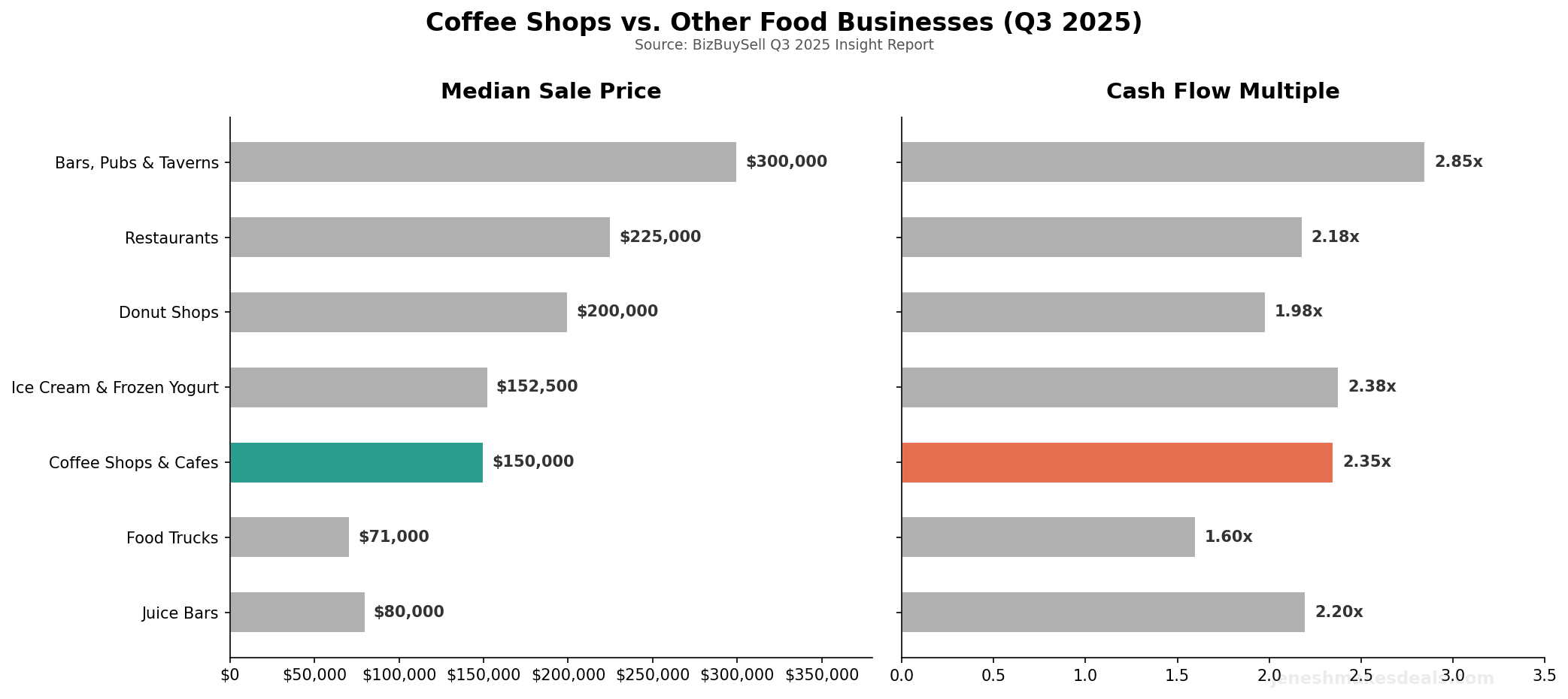
The revenue multiple of 0.49x is in the middle of the pack [2]. This makes sense because coffee shop margins are relatively strong at 60 to 70% gross on beverages [3], but revenue per location is lower than a full service restaurant.
For more context on how coffee shop multiples compare to other industries, check our coffee shop valuation guide with detailed multiple breakdowns.
What Pushes Your Multiple Higher
Not all coffee shops are valued the same. Understanding the premium factors can help you position your shop to sell at the top of the range, or identify shops that are undervalued when buying.
Drive Thru Capability
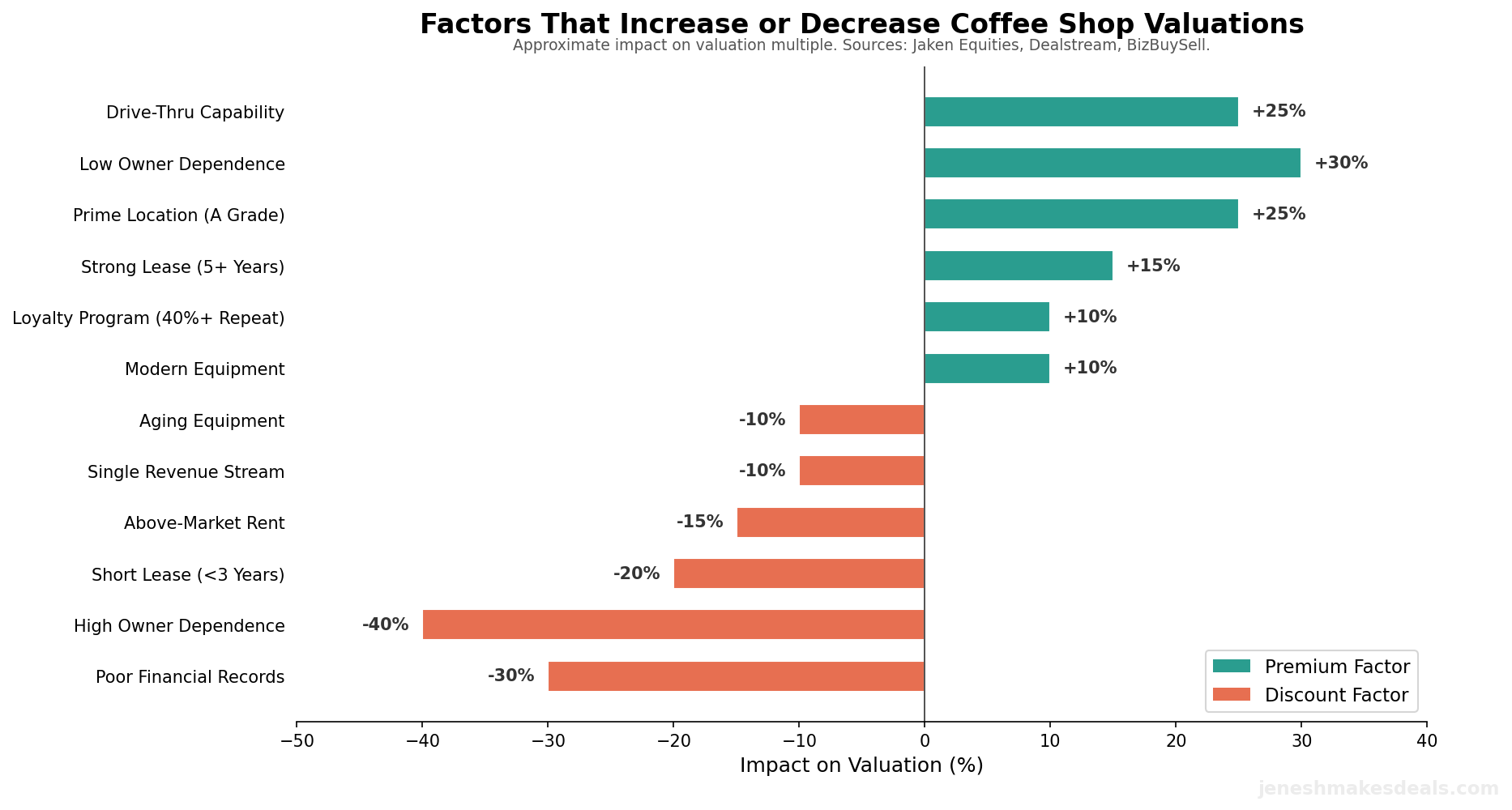
This is the biggest premium driver in today's market. A record 59% of U.S. coffee purchases now happen at drive thrus, up from 55% the prior year [6]. Drive thru chains like 7 Brew saw 163% sales growth in 2024 [7]. The unit economics are compelling: smaller footprints, fewer employees, faster service, and higher throughput per square foot. If your shop has a drive thru window, you are sitting on a premium asset.
Location Grade
High foot traffic areas like downtown districts, office buildings, transit hubs, and university campuses command 20 to 30% higher multiples, even for shops with average financial performance [3]. Affluent demographics that support premium pricing boost valuations further [3]. Suburban or rural locations may face discounts of 10 to 30% [4].
Lease Terms
Your lease is one of the first things a buyer reviews. Here is how it impacts your valuation [3].
| Lease Situation | Valuation Impact |
|---|---|
| 5+ years remaining with renewal options | Full multiples supported |
| 3 to 5 years remaining | Acceptable, slight uncertainty |
| 1 to 3 years remaining | 10 to 25% valuation discount |
| Under 12 months or month to month | 25 to 50% discount or deal failure |
The ideal rent to revenue ratio for a coffee shop is 6 to 8% of sales [3][4]. Above market rent directly reduces your business value.
Low Owner Dependence
This is often the single largest valuation adjustment buyers make. If your shop can operate for weeks without you, with a paid manager and documented systems, you will command significantly higher multiples [3]. High owner dependence, where you are the primary barista, scheduler, and problem solver, can result in 30 to 50% valuation discounts. Buyers price in the risk that cash flow will not survive the ownership transition.
Loyalty Programs and Repeat Business
Coffee shops demonstrating 40 to 60% repeat customers within 30 days through POS loyalty data prove strong customer loyalty worth valuation premiums [3]. Active loyalty programs with 20 to 40% participation rates signal an engaged customer base. Strong online reviews (4.3+ stars with 75+ reviews) and active social media also demonstrate brand strength [3].
Equipment Condition
Well maintained, modern espresso machines, grinders, refrigeration, and POS systems can boost multiples by 5 to 15% [4]. Outdated or poorly functioning equipment drags multiples down by a similar margin.
Revenue Diversification
Multiple revenue streams, including walk in retail, catering, wholesale accounts, online ordering, retail packaged goods like branded beans and merchandise, and subscription programs, reduce risk and demonstrate growth potential [3]. Buyers pay more for businesses that do not depend solely on walk in traffic.
Want to see how these factors affect your specific shop? Use our coffee shop valuation calculator to model different scenarios based on your numbers.
What Drags Your Multiple Down
If the premium factors represent what buyers pay up for, these are the things that make them offer less, or walk away entirely.
- Short or expiring lease. Anything under 3 years remaining triggers automatic discounts. Under 12 months can kill a deal outright [3].
- High owner dependence. If you are making drinks, opening the shop, and handling every problem yourself, buyers see a job, not a business. Discount: 30 to 50% [3].
- Declining revenue. Year over year sales decreases signal a deteriorating customer base. Buyers want stability or growth [3].
- Poor financial records. Missing documentation or inconsistent profit and loss statements reduce buyer confidence and can discount your value by 20 to 35% [3].
- Single revenue stream. Reliance solely on walk in retail increases risk [3].
- Above market rent. Erodes margins and directly depresses valuation [3].
- Oversaturated competition. Too many coffee shops in the immediate area means pricing pressure and customer churn [4].
- Aging or broken equipment. Signals near term capital needs that reduce net value to the buyer [4].
Every discount factor is fixable if you catch it early enough. That is why I recommend getting a valuation 12 to 18 months before you plan to list, not the week before. Our business valuation calculator gives you a starting estimate based on your SDE and current market multiples.
Real Valuation Examples at Every Size
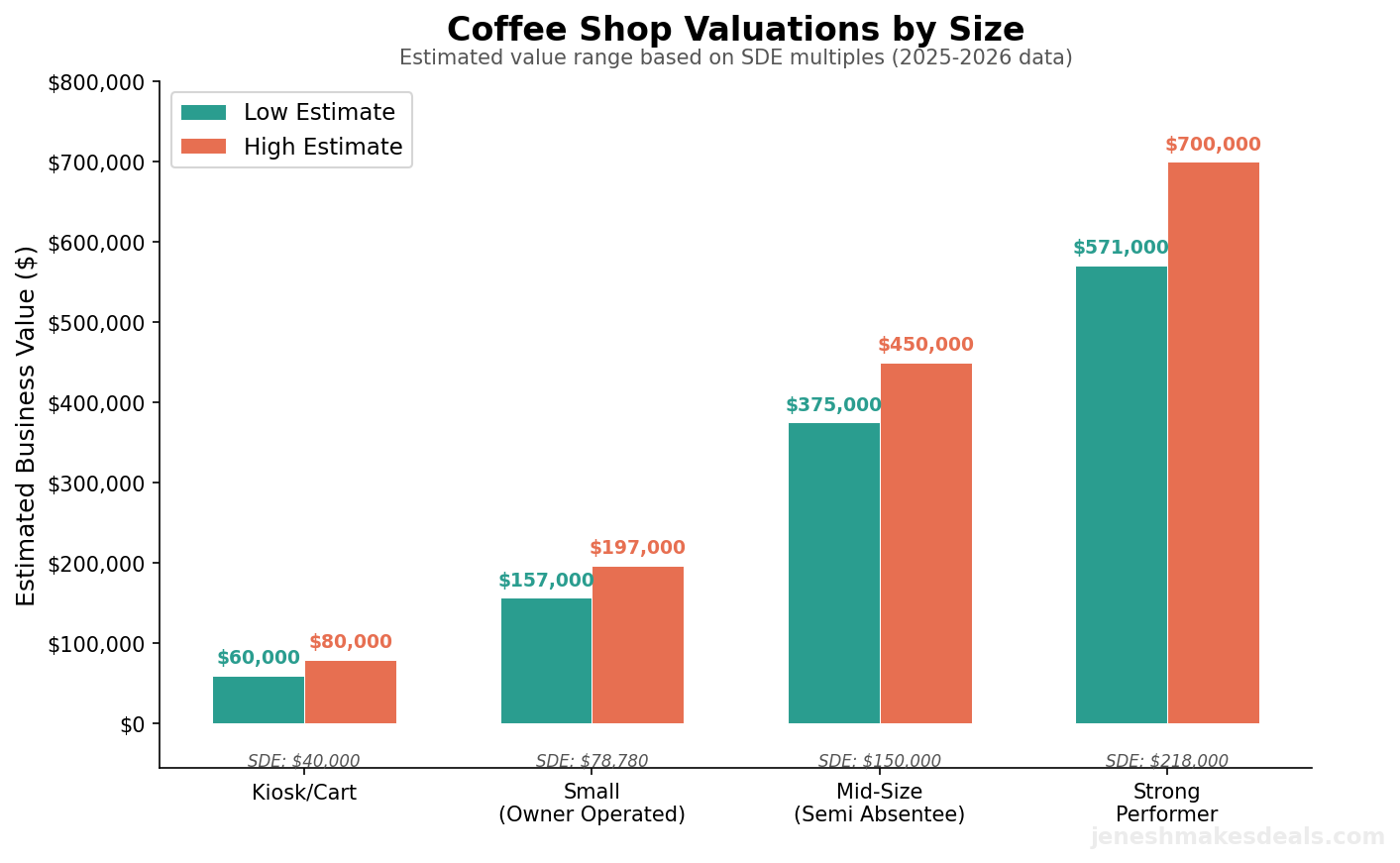
Abstract multiples only make sense when you see them applied to real numbers. Here are four examples spanning the full range of coffee shop sizes.
Micro Coffee Shop (Kiosk or Cart)
| Metric | Value |
|---|---|
| Annual Revenue | $120,000 |
| SDE | $40,000 |
| Multiple | 1.5x to 2.0x |
| Estimated Value | $60,000 to $80,000 |
Kiosks and micro cafes warrant 20 to 40% discounts due to limited throughput, small footprint, and minimal brand equity [4]. For comparison, the median food truck sells for $71,000 on BizBuySell [2].
Small Owner Operated Coffee Shop
| Metric | Value |
|---|---|
| Annual Revenue | $350,000 |
| SDE | $78,780 (BizBuySell median) [2] |
| Multiple | 2.0x to 2.5x |
| Estimated Value | $157,000 to $197,000 |
This is the median coffee shop transaction in the U.S. The owner works full time as barista and manager. BizBuySell's actual median sale price of $150,000 lines up with the lower end of this range, reflecting that most shops sell with some discount factors in play [2].
Mid Size Coffee Shop (Semi Absentee)
| Metric | Value |
|---|---|
| Annual Revenue | $500,000 |
| SDE | $150,000 |
| Multiple | 2.5x to 3.0x |
| Estimated Value | $375,000 to $450,000 |
Shops at this level typically have a working manager with the owner involved 15 to 25 hours per week. A strong lease and growing revenue push the multiple toward the higher end.
Strong Performing Coffee Shop
| Metric | Value |
|---|---|
| Annual Revenue | $500,000+ |
| SDE | $218,000 |
| Multiple | 2.75x to 3.25x |
| Estimated Value | $571,000+ |
This reflects a well run shop with good margins, manager operated daily, favorable lease, and growth trajectory [1]. Multi location operators with SDE of $300,000+ and professional management can command 3.0x to 3.5x multiples, pushing valuations into the $900,000 to $1 million range [3].
Franchise vs. Independent Coffee Shop Valuations
Franchise coffee shops generally command higher valuation multiples than independent operations. A peer reviewed study examining 2,159 business resales over 10 years found that franchise businesses sold at 1.5x higher prices than non franchise businesses [10].
Why Franchises Trade at a Premium
| Factor | Franchise Advantage |
|---|---|
| Books and records | Standardized accounting increases buyer and lender confidence [10] |
| Brand recognition | Known brands attract more buyers, creating bidding competition [10] |
| Training systems | Up to 8 to 9 weeks of franchisor training reduces transition risk [10] |
| SBA lending track record | Lenders can check default rates by brand [10] |
| Proven unit economics | Buyers know what to expect from the model [10] |
Typical Multiple Ranges
| Type | SDE Multiple | EBITDA Multiple |
|---|---|---|
| Independent (typical) | 2.0x to 2.5x | 2.0x to 3.0x |
| Independent (strong performer) | 2.5x to 3.5x | 3.0x to 3.75x |
| Franchise single unit (stable) | 2.5x to 3.5x | 2.5x to 3.5x |
| Franchise multi unit | 3.0x to 4.0x+ | 3.0x to 4.5x |
The franchise premium typically amounts to 0.5x to 1.0x higher SDE multiple compared to an otherwise identical independent shop [10]. But that premium shrinks when franchisor fees materially erode margins. Ongoing royalties of 6 to 8%, marketing fees of 2 to 4%, and required supplier markups of 15 to 30% above market can significantly compress cash flow.
All franchise buyers must be approved by the franchisor, which reduces the pool of qualified buyers and can limit your sale price. If you own a franchise, factor in transfer fees and approval timelines when planning your exit.
Profit Margin Benchmarks You Should Know
Understanding typical margins helps you assess whether your SDE is sustainable and whether it deserves a premium or discount multiple [3].
| Metric | Typical Range |
|---|---|
| Gross margin on beverages | 60 to 70% |
| Gross margin on baked goods and food | 40 to 55% |
| Blended gross margin (cafe with bakery) | 50 to 65% |
| Food and COGS cost ratio | 28 to 35% (beverage focused), 35 to 45% (bakery focused) |
| Labor costs | 30 to 40% of revenue |
| Occupancy costs (rent, utilities, CAM) | 8 to 15% of revenue |
| Net profit including owner comp | 10 to 18% |
Here is the concerning trend. Coffee shop revenue grew 37% over the five year period from 2021 through 2025, while owner discretionary earnings increased only 12% [2]. Shops have been unable to raise prices as fast as costs have risen. If your margins are holding steady or improving, that is a genuine competitive advantage worth highlighting to buyers.
Looking for funding to buy a coffee shop? Explore our unsecured funding programs that can provide up to $500,000 with no collateral required, perfect for bridging a down payment gap.
What Buyers Are Paying Premiums For Right Now
The buyer profile has shifted. Here is what is commanding the highest premiums in 2025 and 2026.
Drive thru format. The most significant premium driver. With 59% of coffee purchases at drive thrus [6] and chains like 7 Brew growing at extraordinary rates [7], buyers will pay substantial premiums for drive thru capability. Smaller footprints (as small as 350 sq. ft.), fewer employees, and higher throughput make this the most attractive coffee shop format for acquisition.
Technology integration. Self ordering kiosks, mobile app integration, and automated POS systems that reduce labor costs are commanding buyer attention. Cafes using integrated technology for ordering, payments, and inventory report reduced staffing needs and higher average order values. Buyers see technology as a hedge against rising labor costs.
Absentee or semi absentee operations. Shops running profitably with minimal owner involvement achieve the highest SDE multiples at 3.0x to 3.5x+ [3]. Owner independence is arguably the single most impactful factor on multiples because it proves cash flow will survive the ownership transition.
Demonstrated pricing power. Coffee commodity prices surged throughout 2025, with packaged coffee costs up 21% year over year [2]. Shops that successfully passed through price increases while maintaining customer volume demonstrate the pricing power buyers value. Shops that lost customers during price hikes face valuation headwinds.
Specialty focus. The specialty coffee segment accounts for over 60% of the U.S. market. Consumers, especially Millennials and Gen Z, will pay more for quality, origin transparency, and ethical sourcing. Coffee shops with a specialty positioning and strong brand story command premiums relative to commodity oriented shops.
For more context on how AI and automation are reshaping coffee shop valuations, read our analysis on why the exit window for coffee shop owners is closing.
Common Valuation Mistakes to Avoid
After working with dozens of coffee shop deals, I see the same mistakes over and over.
Confusing revenue with value. A shop doing $500,000 in revenue is not automatically worth more than one doing $350,000. What matters is SDE. If that $500,000 shop has bloated costs and generates $60,000 in SDE, it is worth less than the $350,000 shop generating $100,000 in SDE.
Ignoring the lease. I have seen owners invest $50,000 in renovations with 18 months left on their lease. That renovation adds almost nothing to sale value if the buyer cannot guarantee they will be in the space for five or more years. Always secure lease extensions before listing.
Overvaluing sentimental improvements. Your custom mural, imported Italian tile, and hand selected playlist do not move the multiple. Buyers care about SDE, lease terms, owner dependence, and growth trajectory. Everything else is noise.
Not cleaning up financials early enough. If you have been running personal expenses through the business for years, it takes time to document and normalize those add backs. Start 12 to 18 months before you plan to sell.
Assuming your shop is "different." Every owner thinks their shop is special. Many are. But the market values what it can measure. Documented systems, clean financials, trained staff, and proven cash flow are what move multiples. Your community reputation matters, but only when it translates to measurable customer retention and revenue stability.
What to Do Next
Whether you are selling, buying, or just curious, here is your action plan.
If You Are Selling
- Calculate your real SDE. Use the formula and add back list above. Be honest. Inflating your SDE will cost you credibility during due diligence and potentially kill the deal.
- Identify your premium and discount factors. Go through the lists in this guide. What is working in your favor? What is dragging you down? Fix the fixable items before listing.
- Get a professional valuation. The ranges in this guide give you a starting point, but every shop is different. Contact us for a confidential assessment of your specific situation.
- Plan your timeline. The median coffee shop takes 142 to 150 days to sell after listing, plus prep time and closing [2]. Budget 9 to 12 months from decision to closed deal. Understanding how much a business broker charges will help you budget for the full cost of selling.
If You Are Buying
- Verify the SDE independently. Do not take the seller's word for it. Have your accountant review tax returns, bank statements, and POS data for the trailing 24 months.
- Assess the premium and discount factors. A shop with strong SDE but a 14 month lease is not worth full multiples. Price your offer based on what is actually there.
- Check the competitive landscape. How many coffee shops are within a half mile? What chains are nearby or opening soon? Market saturation caps your upside.
- Understand the true cost of entry. The purchase price is not the only cost. Budget for working capital (typically two to three months of operating expenses), equipment upgrades, and transition costs.
Ready to find out what a coffee shop is worth? Use our free coffee shop valuation calculator to run your numbers. Or if you are ready to talk, schedule a confidential call and I will walk you through your options.
Need funding for your acquisition? Our unsecured funding programs can provide up to $500,000 with no collateral required.
The Market Outlook for 2026 and Beyond
The global coffee shop market was valued at $228 billion in 2025 and is projected to reach $290 billion by 2032, growing at 3.5% annually [8]. The U.S. coffee market alone is expected to reach $151 billion by 2034 at 5.8% growth [9].
Several dynamics are shaping valuations going forward:
- Cafe and coffee is the #3 buyer search category on BizBuySell, signaling strong acquisition demand [2]
- Drive thru dominance will increasingly split valuations between drive thru capable and dine in only formats [6]
- Coffee commodity price volatility continues to compress margins and test pricing power
- Technology adoption in ordering, inventory, and loyalty is becoming a baseline buyer expectation, not a bonus
- Franchise networks and chain formats with standardized systems are capturing market share, putting pressure on undifferentiated independent shops [8]
For sellers, the window remains favorable with strong buyer interest and rising median sale prices. For buyers, the most attractive targets combine drive thru capability, absentee management, strong leases, and demonstrated pricing power.
The coffee shop market is not slowing down. But the gap between premium and discount valuations is widening. The data driven shops with clean financials and documented systems are selling faster and for more money. The owner dependent shops with short leases and no technology are sitting on the market and taking discounts.
Know which side of that divide your shop is on. Then act accordingly.
Sources
[1] Peak Business Valuation, "Coffee Shop Valuation Multiples." SDE multiples: 2.0x to 3.25x; EBITDA multiples: 2.5x to 3.75x; Revenue multiples: 0.36x to 0.81x.
[2] BizBuySell, "Insight Report: Q3 2025" and "2025 Year in Review." Based on 1,013+ sold coffee shop listings. Median sale price $150,000; median revenue $344,000 to $375,000; median SDE $75,000 to $78,780; average earnings multiple 2.25x; 142 to 150 days on market. Cafe and coffee retailers ranked #3 in buyer search activity.
[3] Jaken Equities, "Bakery and Coffee Shop Business Valuation Multiples." SDE multiples 2.0x to 3.5x; SDE calculation example with $117,500 SDE at 2.75x = $323,000 valuation.
[4] Dealstream, "Coffee Shop Rules of Thumb: Industry Benchmarks." Revenue multiples 0.3x to 0.8x; SDE multiples 2.5x to 4.0x.
[5] Unbroker, "How to Calculate the Value of Your Cafe." Average cafe SDE multiple: 2.0x.
[6] National Coffee Association, "National Coffee Data Trends 2025." 59% of coffee purchases at drive thrus; 66% of Americans drink coffee daily.
[7] Intelligence.coffee, "Is Drive Thru the Future of Coffee?" 7 Brew sales growth 163% in 2024; Dutch Bros stock up 64%.
[8] Maximize Market Research, "Global Coffee Shop Market." Market valued at $228.12 billion in 2025, projected $290.23 billion by 2032 at 3.5% CAGR.
[9] Custom Market Insights, "US Coffee Market Size 2025 to 2034." Valued at $90.97 billion in 2025, projected $150.88 billion by 2034 at 5.8% CAGR.
[10] We Sell Restaurants, "Are Restaurant Franchise Resales More Valuable?" Peer reviewed study of 2,159 resales over 10 years found franchise businesses sold at 1.5x higher prices than non franchise.
Related Articles

April 30, 2026
How Long Does It Really Take to Sell a Business
Most sellers are shocked by how long it takes. Here's the honest timeline from listing to closing, and what actually speeds things up.

April 26, 2026
How to Structure an Earnout That Works for Seller and Buyer
Most earnouts fail because they're poorly structured. Here's how to build earnout terms that protect both sides of the deal.
April 24, 2026
How to Value Intellectual Property in a Business Sale
Your IP could be worth more than your equipment. Learn how patents, trademarks, and trade secrets affect your business valuation.
About the Author
Jenesh Napit is an experienced business broker specializing in business acquisitions, valuations, and exit planning. With a Bachelor's degree in Economics and Finance and years of experience helping clients successfully buy and sell businesses, he provides expert guidance throughout the entire transaction process. As a verified business broker on BizBuySell and member of Hedgestone Business Advisors, he brings deep expertise in business valuation, SBA financing, due diligence, and negotiation strategies.
You might also be interested in
Free Business Calculators
Try our business valuation calculator and ROI calculator to estimate values and returns instantly.
How to Buy a Business Guide
Download our comprehensive free guide covering everything you need to know about buying a business.
Our Services
Explore our professional business brokerage services including valuations and buyer representation.
More Articles
Browse our complete collection of business brokerage insights and expertise.