
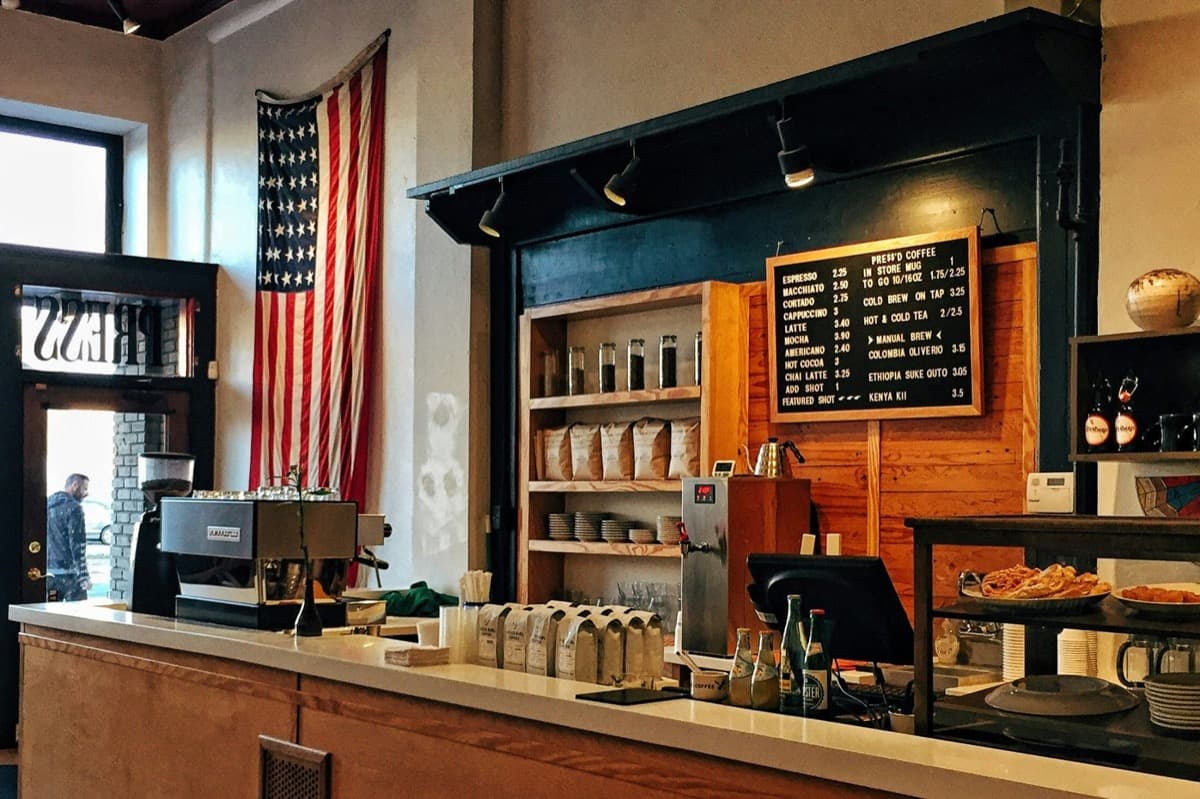
A coffee shop looks simple from the outside. People walk in, buy coffee, walk out. Recurring demand, predictable product, loyal customers. But the businesses that look simplest are the ones where small oversights compound into expensive problems after closing.
I have seen buyers lose $30,000 because they did not check whether the espresso machine needed replacing. I have seen deals collapse in the final week because the landlord refused to assign the lease. And I have seen owners discover, three months in, that 25% of their revenue depended on a single office building that was about to go remote.
Coffee shops are cash heavy, equipment intensive, and lease dependent [1]. Each of those traits creates specific risks that require specific due diligence. This guide covers the 12 areas you need to investigate, the red flags that should make you walk away, and the professional team that protects you from post closing surprises.
If you are buying a coffee shop, or even thinking about it, work through this checklist before you sign anything.
Financial Red Flags That Should Stop You Cold
Coffee shops handle a lot of cash, and cash heavy businesses create opportunities for revenue manipulation [1]. The most critical financial red flag is a discrepancy between POS system reports, bank deposits, and tax returns [4]. If those three numbers do not align, something is wrong.
What to Watch For
POS vs. tax return discrepancy. If the POS system shows higher revenue than what is reported on tax returns, the seller may be skimming cash. If tax returns show more, the POS data may be incomplete [4]. Either way, you cannot trust the numbers until they reconcile.
Inconsistent year over year metrics. Significant variability in revenue, cost of goods, or expense categories across years warrants deeper investigation [4]. One bad quarter is normal. Three years of erratic numbers is a pattern.
Inflated add backs. Sellers adjust earnings with add backs to inflate SDE [1]. The risky ones include owner labor you will need to replace with a paid manager, marketing the business actually depended on, and deferred repairs on aging equipment. If the add backs do not hold up under scrutiny, the business is worth less than the asking price.
Abnormally high cost of goods. Coffee focused shops should target COGS around 25 to 35% [1]. If COGS is at 55%, that signals pricing problems, waste, or supplier issues. I saw one deal where COGS was 48% because the previous owner had a bad supplier contract locked in for another year.
Negative operating cash flow. Even if the profit and loss statement looks profitable, negative cash flow means the business may need an immediate cash infusion after closing [3]. Profitable on paper and broke in the bank account is more common than you think.
Undisclosed debts or liens. Always conduct a UCC and lien search to ensure assets are not encumbered [3][10]. In some states, bulk sales laws require public notice to clear debts before a transfer [2].
Documents You Must Request
| Document | Purpose | What to Look For |
|---|---|---|
| 3 to 5 years tax returns | Verify reported income | Trends, consistency with POS |
| Monthly POS exports (12+ months) | Revenue by hour, day, and daypart | Seasonality, concentration risk |
| Bank statements (3+ years) | Cash flow verification | Deposits vs. reported sales |
| Profit and loss statements | Expense structure | Labor %, COGS %, rent % |
| Vendor invoices and supplier contracts | COGS validation | Price increases, rebates |
| Payroll registers and schedules | Labor cost verification | Owner hours, overtime, turnover |
| Sales tax filings | Cross check revenue | Should align with POS and bank deposits |
| Delivery platform statements | Third party revenue | Fee drag, chargebacks |
A "Proof of Cash" analysis, where you compare reported cash sales to actual bank deposits, has uncovered inconsistencies in restaurant acquisitions that led buyers to walk away entirely [1][4]. If the seller resists providing any of these documents, that is itself a red flag.
Want to understand what a coffee shop should be worth based on verified financials? Use our coffee shop valuation calculator to run the numbers once you have confirmed SDE.
The Lease: Your Biggest Hidden Risk
Lease structure drives downside risk more than almost any other factor in a coffee shop acquisition [5]. A profitable shop can become a bad deal if the landlord resets the economics at assignment or imposes costly conditions.
Critical Lease Items
Assignment clause and landlord consent. This is the single most important lease provision [5]. If the landlord must consent to assignment, they can deny the transfer, impose new conditions, or demand higher rent. Make landlord consent a gating condition in your letter of intent, not something you discover during closing.
Rent escalation clauses. Understand annual increases, percentage rent triggers, and how rent resets on assignment [5]. Rising property values can trigger tax hikes that are not reflected in the seller's historical financials.
CAM and NNN charges. Common area maintenance fees, property taxes, and insurance pass throughs can add 20 to 40% on top of base rent [5]. If base rent is $3,000 per month, CAM and NNN could push total occupancy costs to $4,200. Make sure you are underwriting the full number, not just base rent.
Use clauses. Verify that the lease permits your intended operations [5]. Adding food service, alcohol, a drive thru window, or changing signage may be restricted. If you have plans to expand the concept, the lease needs to allow it.
Remodel triggers on assignment. Some leases require the new tenant to bring the space up to current building standards upon assignment [5]. That can cost tens of thousands of dollars that nobody mentioned during negotiations.
Remaining lease term. A short remaining term (under 3 to 5 years) with no renewal option is a dealbreaker [5]. You need enough runway to recoup your investment. I will not let my clients close on a coffee shop with less than 5 years of lease remaining unless the landlord provides a written extension.
Exclusive use provisions. Coffee shops in retail centers should have exclusive use clauses preventing the landlord from leasing to a competing coffee concept [5]. If the clause exists, violation should trigger significant rent abatement (50 to 75%).
Personal guaranty. Negotiate to limit or eliminate personal guarantees, or at minimum establish a "burnoff" that reduces the guarantee over time as you prove yourself as a tenant.
Lease Impact on Valuation
| Lease Situation | Valuation Impact |
|---|---|
| 5+ years remaining with renewal options | Full multiples supported |
| 3 to 5 years remaining | Acceptable, slight uncertainty |
| 1 to 3 years remaining | 10 to 25% valuation discount |
| Under 12 months or month to month | 25 to 50% discount or deal failure |
The ideal rent to revenue ratio for a coffee shop is 6 to 8% of sales [1]. If occupancy costs exceed 15% of revenue, the lease is eating into your margins and suppressing the business value.
For more context on how lease terms affect coffee shop multiples, read our complete coffee shop valuation guide.
Equipment: Inspect It Like You Are Buying a Used Car
Coffee shops are equipment heavy businesses [1]. A professional equipment inspection before closing is essential to avoid surprise capital expenditures in your first year [5].
What to Check on Every Piece of Equipment
For each item, verify: age, brand and model, serial number, service history, maintenance records, whether it is owned or leased and financed, and remaining useful life [1][5].
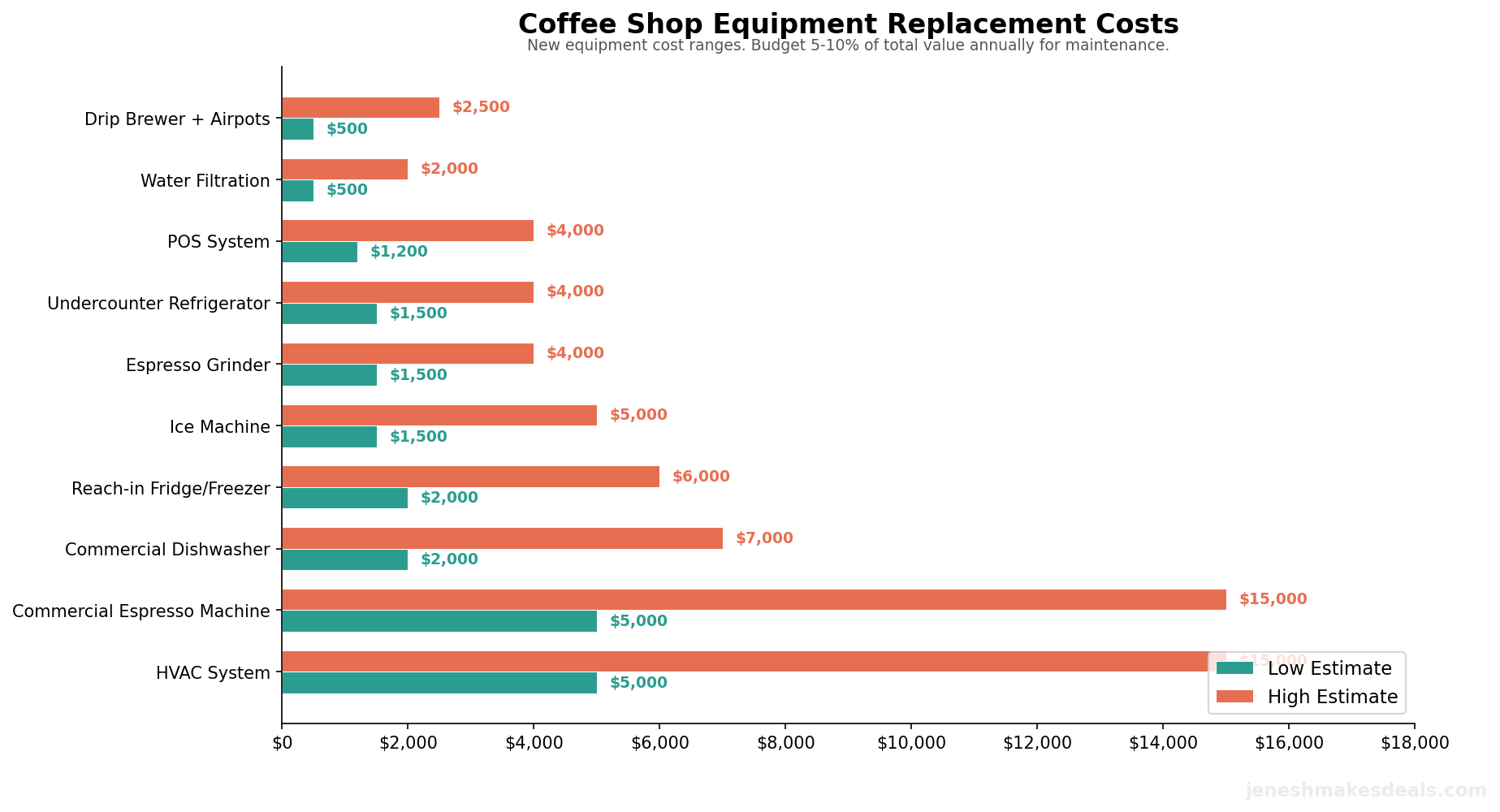
Key Equipment Costs
| Equipment | New Cost Range | Red Flags |
|---|---|---|
| Commercial espresso machine (2 group) | $5,000 to $15,000 | Inconsistent temperature, group head leaks, scale buildup, over 7 years old |
| High volume espresso machine | $20,000+ | Same as above plus check boiler condition |
| Espresso grinder | $1,500 to $4,000 | Inconsistent grind, motor noise, over 5 years old |
| Undercounter refrigerator | $1,500 to $4,000 each | Temperature fluctuation, compressor noise |
| Reach in fridge or freezer | $2,000 to $6,000 | Door seal condition, thermometer accuracy |
| Ice machine | $1,500 to $5,000 | Low production, odd tasting ice |
| Water filtration system | $500 to $2,000 | Scale buildup on downstream equipment |
| POS system (hardware) | $1,200 to $4,000 | Outdated software, slow processing |
| Commercial dishwasher | $2,000 to $7,000 | Inadequate sanitization temperatures |
| HVAC system | $5,000 to $15,000 | Inconsistent climate, high energy bills |
Total Equipment Budget by Shop Type
| Shop Type | Equipment Budget Range |
|---|---|
| Coffee cart or kiosk | $15,000 to $25,000 |
| Mid size cafe | $30,000 to $75,000 |
| Full service coffee house | $80,000 to $200,000+ |
Budget 5 to 10% of total equipment value annually for maintenance and repairs [1]. If equipment is approaching end of life, deduct estimated replacement costs from the purchase price or negotiate a capital reserve in the deal.
The espresso machine deserves special attention. Annual service runs $150 to $400 [5]. Over five years, $3,000 in repairs is common. Burr replacement on grinders costs $100 to $300 every 12 to 24 months. These are expected costs. The unexpected ones, like a full boiler replacement or compressor failure, are what kill your first year budget if you did not inspect properly.
Health Department Compliance
Health department compliance is non negotiable [6]. Buyers must request the complete inspection history and understand that a pre opening inspection is typically required when ownership changes.
Most Common Violations
- Temperature control failures. Improper holding temperatures for cold and hot foods, lack of temperature logs [6].
- Handwashing deficiencies. Inadequate hand wash stations, missing supplies, employees not washing hands properly [6].
- Cross contamination. Storing raw ingredients improperly, uncovered food, inadequate separation of food types [6].
- Equipment and surface cleanliness. Food contact surfaces not properly cleaned or sanitized, damaged equipment [6].
- Pest evidence. Droppings, damage to packaging, nesting materials. Any of these can trigger immediate closure [6].
- Chemical storage. Cleaning products stored near food preparation areas [6].
Violation Severity
| Severity | Examples | Consequences |
|---|---|---|
| Minor | Cracked floor tiles, missing hair nets, inadequate ventilation | Correction within 24 to 48 hours, follow up inspection [6] |
| Major | Equipment not sanitized, no hand wash basin, improper temperatures, pest activity | Significant fines, mandatory closure until resolved [6] |
| Imminent hazard | Active infestation, sewage backup, contaminated food | Immediate closure, permit may be revoked [6] |
Request all inspection reports for the past 3 to 5 years. Look for repeat violations, which indicate systemic operational problems rather than one off mistakes [6]. Establishments with repeated violations may face additional inspections, fines, or license revocation.
Staffing: The Underestimated Risk Factor
The food service industry has the highest turnover of any U.S. sector [7]. If you are buying a coffee shop, the staff situation can make or break your transition.
Industry Benchmarks
| Metric | Rate |
|---|---|
| Average restaurant employee turnover | ~75% annually [7] |
| Quick service restaurant turnover | Can exceed 130% [7] |
| Front of house staff turnover | 41% [7] |
| Back of house staff turnover | 43% [7] |
| Manager turnover | 28% [7] |
| "Good" turnover rate for restaurants | 50 to 60% [7] |
| Hospitality quit rate (2024) | 3.9% monthly [7] |
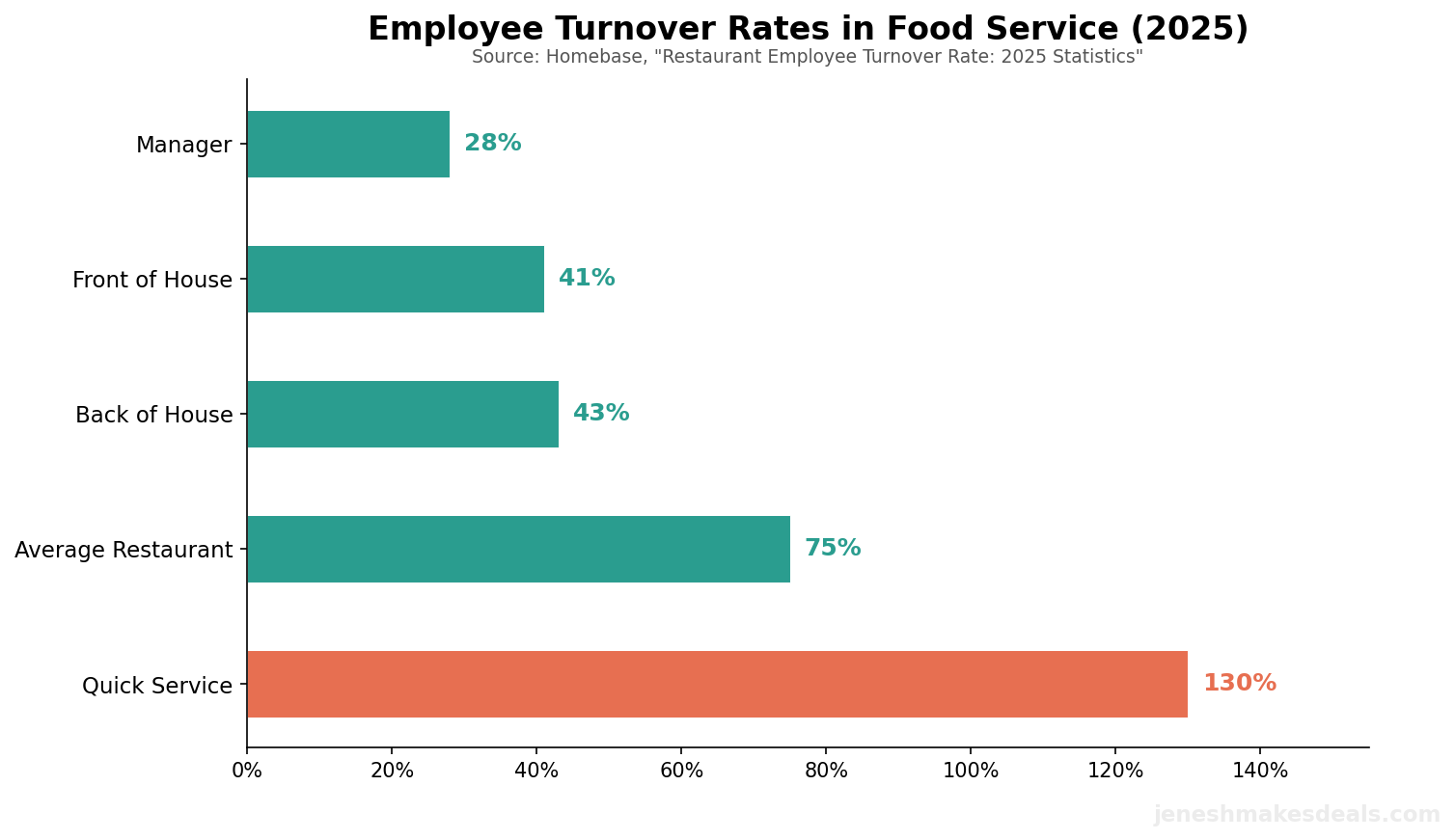
Coffee shop positions are considered "transient" jobs, attractive to students, people between jobs, and those pursuing other careers [7]. Even Starbucks, known for above average wages and health insurance, spends an estimated $3,000 to replace a single barista in recruiting and training costs.
What to Investigate
- Request an employee roster with hire dates, roles, wages, and tenure length.
- Calculate the shop's actual annual turnover rate and compare it to the 50 to 60% "good" benchmark [7].
- Interview key employees (with seller permission) to gauge morale, management quality, and likelihood of staying post acquisition.
- Identify whether the owner fills shifts, covers call outs, or handles roles that would require a paid replacement [1].
- Verify employment classification (W2 vs. 1099) to avoid misclassification liability.
Ownership transitions create uncertainty. Without proactive communication and retention incentives, key baristas and managers may leave during the most vulnerable period. Budget for retention bonuses for critical staff, even a few hundred dollars per person can make the difference.
How to Verify Actual Foot Traffic and Sales
Foot traffic is necessary but not sufficient. It only matters if the location converts that traffic into repeat, paying customers.
Sit and observe. Spend several full days at the shop during different times and days of the week. Count transactions, note customer behavior, and assess employee performance [1]. This is one of the most effective methods for detecting discrepancies between claimed and actual revenue.
Hourly POS analysis. Request POS exports broken down by hour and day for at least 12 months [1]. Map the revenue story by daypart (morning, lunch, afternoon) to understand when the shop actually makes money.
POS to bank deposit reconciliation. Verify that daily POS totals (net of tips, delivery platforms, and gift cards) tie to bank deposits [1][4]. Discrepancies indicate cash leakage or revenue manipulation.
Delivery platform statements. Request statements from all delivery apps and reconcile with POS and bank data [1]. Calculate net delivery revenue, not gross. Platforms charge 15 to 30% commissions that buyers who underwrite gross revenue will significantly overestimate profitability.
Analyze nearby demand generators. Identify the core customer type: commuter, student, office worker, neighborhood regular, or tourist [5]. Evaluate whether that demand source is stable. A coffee shop next to a coworking space that just lost its anchor tenant is a different proposition than one next to a hospital.
Competitor mapping. Map all competing coffee shops, chains, bakeries, and convenience stores within walking and driving distance [5]. Recent or planned openings could threaten revenue.
Weekday vs. weekend and seasonal patterns. Look for concentration risk around school calendars, tourism cycles, or single nearby employers [1].
Thinking about buying a coffee shop? Contact us for a confidential conversation about how to structure your due diligence and what to look for in your target market.
What Buyers Miss That Causes Post Closing Problems
Even experienced buyers overlook critical issues. Here are the most common sources of post closing regret.
Owner dependency. Many coffee shops run on the owner's unpaid labor [1]. If the owner opens every morning, covers call outs, manages inventory, and personally knows every regular, the business's profitability is inseparable from their presence. Budget to replace owner hours with paid management, often $40,000 to $60,000+ per year, and adjust the valuation accordingly.
Lease assignment denial. A deal can collapse after weeks of due diligence if the landlord refuses to consent to assignment or demands punitive new terms [5]. Treat this as a gating item at the LOI stage.
Working capital shortfall. Even in an asset purchase, the shop needs operating cash for inventory, prepaid rent, payroll timing, and deposit requirements [1]. Buyers who spend everything on the purchase price often scramble to fund day one operations.
Customer concentration. A significant portion of revenue may depend on one nearby office building, a campus, or a few wholesale accounts [1]. If that anchor disappears, revenue collapses. I saw one deal where a customer representing roughly 25% of revenue left within 90 days of closing.
Delivery platform fee drag. Third party delivery platforms can charge 15 to 30% commissions [1]. If delivery represents 20% of revenue, that fee drag significantly erodes margins. Underwrite net delivery revenue, not gross.
Deferred equipment replacement. Sellers nearing exit often defer maintenance and equipment replacement [5]. What looks like "low capex" in the financials may actually mean the espresso machine, refrigeration, or HVAC needs imminent replacement.
Employee turnover spike. Ownership transitions create uncertainty [7]. Without proactive communication and retention incentives, key baristas and managers may leave, degrading service quality during the most critical period.
24 Questions to Ask the Seller
These questions should be asked during the initial management call and throughout due diligence. The answers, and how willing the seller is to provide documentation, are themselves diagnostic.
Business and Motivation
- Why are you selling?
- How did you arrive at the asking price? What valuation method was used?
- How long have you owned the business, and what has the revenue trend been during your ownership?
- What are your daily and weekly hours at the shop? What would it cost to replace your labor?
Financials
- Can you provide 3 to 5 years of tax returns, monthly P&L statements, and bank statements?
- What percentage of revenue is cash vs. card vs. delivery platforms?
- Are there any outstanding debts, liens, pending lawsuits, or vendor disputes? [2][3]
- What are the top 5 expense categories, and have any changed significantly in the past 2 years?
- What is COGS as a percentage of revenue, and who are your primary suppliers?
Lease and Location
- How much time remains on the lease, and what are the renewal terms?
- Does the lease allow assignment? Has the landlord been contacted about the sale?
- What are the total occupancy costs (base rent + CAM + NNN + utilities)?
- Are there any planned developments, road construction, or zoning changes nearby?
Operations and Staff
- What is the current staffing model? Provide a roster with tenure, roles, and wages.
- What is the annual employee turnover rate?
- Are all employees properly classified (W2 vs. 1099)?
- Are there any pending HR complaints, wage disputes, or OSHA issues?
Equipment and Compliance
- Provide an asset list with age, serial numbers, maintenance records, and lease or financing status for all equipment.
- When was the espresso machine last professionally serviced?
- Provide all health department inspection reports for the past 3 to 5 years.
- Are all permits and licenses current and transferable?
Transition
- What training and transition period are you willing to provide post closing?
- Will you sign a non compete agreement?
- Are there documented recipes, SOPs, and vendor contact lists?
What Your Due Diligence Team Should Cost
The cost of professional due diligence depends on deal size and complexity. For a typical coffee shop acquisition in the $100,000 to $500,000 range, costs are scaled accordingly.
Cost by Professional
| Professional | Role | Estimated Cost |
|---|---|---|
| CPA or Accountant | Financial review, tax analysis, earnings normalization | $2,000 to $5,000 (light review), $5,000 to $15,000 (deeper) [8] |
| Quality of Earnings provider | Full QoE report for larger deals | $10,000 to $25,000 [8] |
| Transaction Attorney | Purchase agreement, lease review, lien searches | $5,000 to $12,500 (deals under $1M) [9] |
| Equipment appraiser or technician | Independent equipment inspection | $500 to $2,000 |
| General contractor or inspector | Physical space assessment (HVAC, plumbing, electrical) | $500 to $1,500 |
Total Budget by Deal Size
| Deal Size | Recommended DD Budget |
|---|---|
| Under $250K | $5,000 to $15,000 [8] |
| $250K to $500K | $10,000 to $25,000 [8] |
| $500K to $1M | $15,000 to $40,000 [8] |
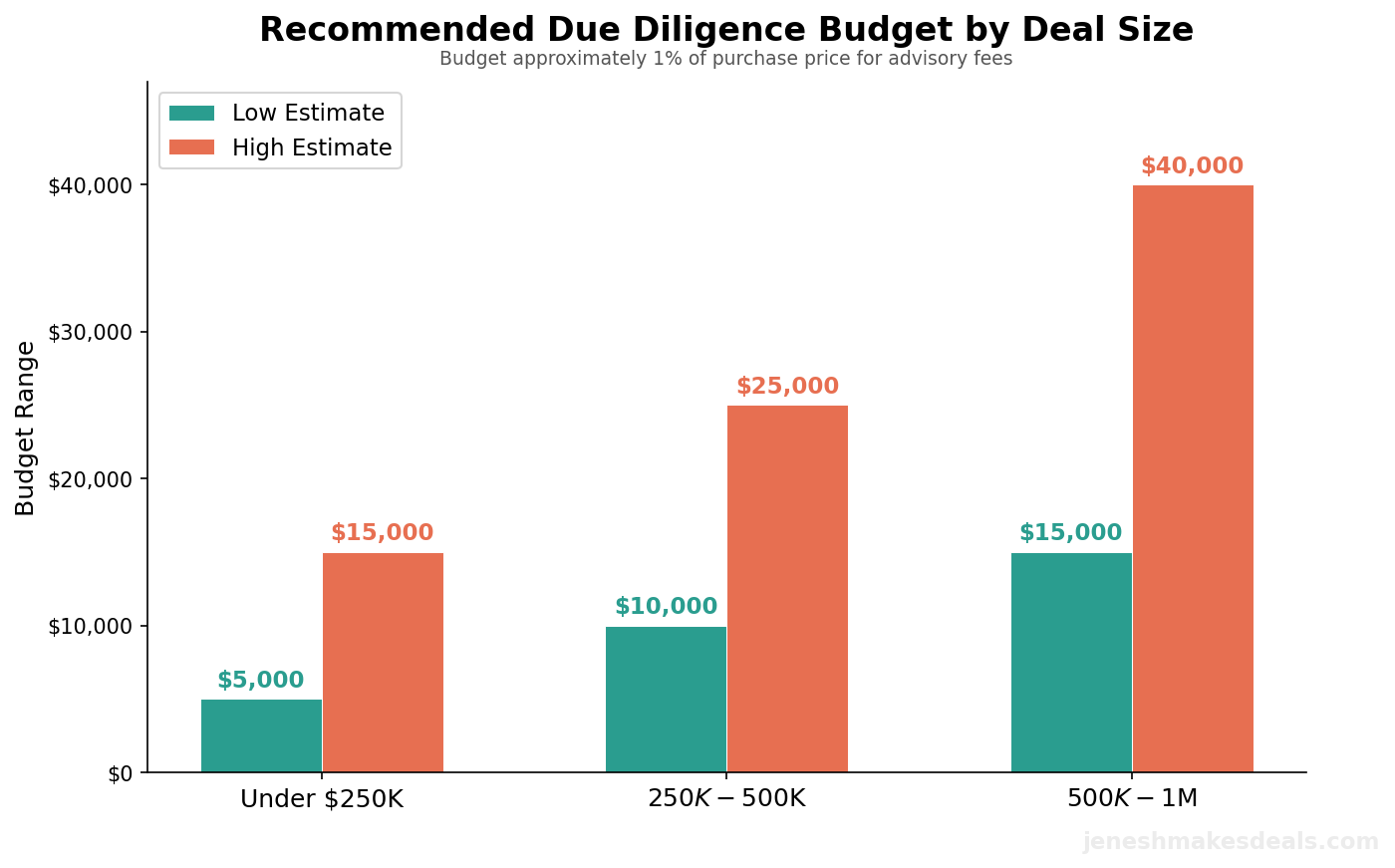
A common rule of thumb is to allocate approximately 1% of the purchase price for advisory fees [8]. The due diligence period typically runs 30 to 90 days, with 3 to 4 weeks being common for a straightforward cafe acquisition.
Need funding to cover due diligence and acquisition costs? Explore our unsecured funding programs that can provide up to $500,000 with no collateral required.
The Complete Due Diligence Checklist
Here is every area you need to cover, what to request, and what can go wrong.
| Area | What to Request | What Can Go Wrong |
|---|---|---|
| Revenue proof | POS exports, bank statements, sales tax filings | Underreported sales, seasonality, promo distortion [1][4] |
| COGS and vendors | Supplier invoices, price lists, rebates | Margin erosion from price increases [1] |
| Labor | Payroll registers, schedules, contractor agreements | Owner labor understated, turnover risk [1][7] |
| Lease and premises | Full lease, amendments, estoppels, assignment terms | Landlord denies assignment or raises costs [5] |
| Equipment and capex | Asset list, serial numbers, maintenance records | Hidden replacements, leased equipment [1][5] |
| Licenses and compliance | Health permits, business licenses, signage approvals | Lapsed permits or transfer delays [6] |
| Delivery and third party | Platform statements, fees, chargebacks | Fee drag, review dependence [1] |
| Legal and liens | Corporate docs, litigation, UCC and lien search | Assets encumbered, unpaid obligations [2][3] |
| Financial quality | Accountant workpapers, bank reconciliations | Add backs do not hold up [4] |
| Transition | Training plan, vendor intros, recipes and SOPs | Knowledge stays with seller [1] |
| Customer base | Loyalty data, repeat rates, concentration analysis | Anchor customer loss post close [1] |
| Health and safety | Inspection reports (3 to 5 years), violation history | Repeat violations, pre opening inspection required [6] |
What to Do Next
- Download or bookmark this checklist. Use it as your working document throughout the due diligence process. Check off each area as you complete it.
- Assemble your professional team early. Find a CPA, attorney, and equipment inspector before you get deep into a deal. Having your team ready means you can move quickly when you find the right shop.
- Get your financing pre qualified. Know your borrowing capacity before you start looking. SBA 7(a) loans with 10 to 20% down are the most common path for coffee shop acquisitions.
- Know what the shop should be worth. Use our free coffee shop valuation calculator to model different SDE scenarios and understand fair pricing before you make an offer.
- Talk to someone who has done this before. Contact us for a confidential conversation about your acquisition target. I will help you identify the red flags and opportunities specific to your deal.
Looking for funding to close your deal? Our unsecured funding programs can provide up to $500,000 with no collateral required, covering down payments, working capital, or due diligence costs.
Sources
[1] BizTrader, "Coffee Shops: Unit Economics and Locations." Due diligence checklist covering revenue verification, COGS, labor, lease, equipment, compliance, and delivery platform analysis for coffee shop acquisitions.
[2] BizBen Blog, "How to Buy a Coffee Shop: 5 Red Flags You Must Avoid." Undisclosed loans, liens, and vendor disputes; California bulk sales law requirements.
[3] Kumo, "10 Financial Red Flags in SMB Acquisitions." Undisclosed debts, pending lawsuits, unpaid taxes, regulatory violations, and negative operating cash flow indicators.
[4] Newburg CPA, "Business Acquisitions Due Diligence: Financial Red Flags." POS vs. tax return discrepancies, unreliable financial records, inconsistent year over year metrics.
[5] DealStream, "Coffee Shop Due Diligence Guide." Financial verification, lease analysis, equipment inspection, and staffing assessment for coffee shop buyers.
[6] Lightspeed, "How to Ace a Restaurant Health Inspection." Common violation categories including temperature control, handwashing, cross contamination, and equipment cleanliness.
[7] Homebase, "Restaurant Employee Turnover Rate: 2025 Statistics." Average restaurant turnover ~75% annually; quick service can exceed 130%; manager turnover at 28%.
[8] Peony.ink, "Due Diligence Cost Breakdown in 2025." DD costs 0.2 to 4% of deal value; boutique QoE firms $15,000 to $25,000; light CPA review $2,000 to $5,000.
[9] Exit Promise, "Business Broker Fees and Other Business Sale Expenses." Legal fees $5,000 to $12,500 for deals under $1M.
[10] Beresford Booth, "Coffee Deal Gone Cold: Learn from M&A Missteps." Wake Up, Inc. v. Roasters Holdings case: misrepresented financials, improper asset transfers, corporate veil pierced.
Related Articles

May 1, 2026
What Happens to Accounts Receivable When You Sell
AR is one of the most negotiated items in any business sale. Here's exactly how it's handled, valued, and who collects it after closing.

April 28, 2026
What Is Representations and Warranties Insurance
R&W insurance protects buyers and sellers in business sales by covering breaches of reps in purchase agreements. Here's how it works.

April 27, 2026
How to Handle Inventory in a Business Sale
Inventory can make or break a business sale. Here's how to value it, negotiate it, and avoid the disputes that kill deals at closing.
About the Author
Jenesh Napit is an experienced business broker specializing in business acquisitions, valuations, and exit planning. With a Bachelor's degree in Economics and Finance and years of experience helping clients successfully buy and sell businesses, he provides expert guidance throughout the entire transaction process. As a verified business broker on BizBuySell and member of Hedgestone Business Advisors, he brings deep expertise in business valuation, SBA financing, due diligence, and negotiation strategies.
You might also be interested in
Free Business Calculators
Try our business valuation calculator and ROI calculator to estimate values and returns instantly.
How to Buy a Business Guide
Download our comprehensive free guide covering everything you need to know about buying a business.
Our Services
Explore our professional business brokerage services including valuations and buyer representation.
More Articles
Browse our complete collection of business brokerage insights and expertise.