
Starting a coffee shop from scratch costs $80,000 to $400,000 [1], takes 6 to 14 months before you serve your first customer [3], and carries roughly a 50% chance of failure within five years [1]. Buying an existing coffee shop can cost the same or less out of pocket with SBA financing, generates revenue from day one, and carries a 90% five year survival rate [6].
Those numbers should frame every decision you make about entering the coffee shop business. But the reality is more nuanced than "buy beats build." Your budget, your vision, your market, and your risk tolerance all factor in. Some entrepreneurs need to build from scratch because the concept in their head does not exist yet. Others are better served buying a proven operation and making it their own.
I have worked with dozens of people on both sides of this decision. The ones who succeed almost always share one trait: they went in with realistic numbers, not wishful thinking. This guide gives you those numbers. I'll break down the real costs at every budget level, compare financing options, show you failure rates and ROI timelines, and help you figure out which path makes sense for your situation.
What Does It Actually Cost to Start a Coffee Shop?
The range is enormous, and that is part of the problem. Too many aspiring owners see the low end ($80,000) and assume they can make it work on a shoestring. You can, but only with a very specific format and a lot of sweat equity.
Startup Costs by Format
| Coffee Shop Format | Low Estimate | High Estimate |
|---|---|---|
| Mobile cart or food truck | $50,000 | $175,000 |
| Coffee kiosk or stand | $90,000 | $150,000 |
| Drive thru only | $100,000 | $250,000 |
| Traditional cafe with seating | $100,000 | $350,000 |
| Seating + drive thru (hybrid) | $120,000 | $400,000 |
| Franchise model | $200,000 | $500,000+ |
| Traditional 1,500 sq ft sit down | $300,000 | $625,000 |
Sources: [1][7][8]
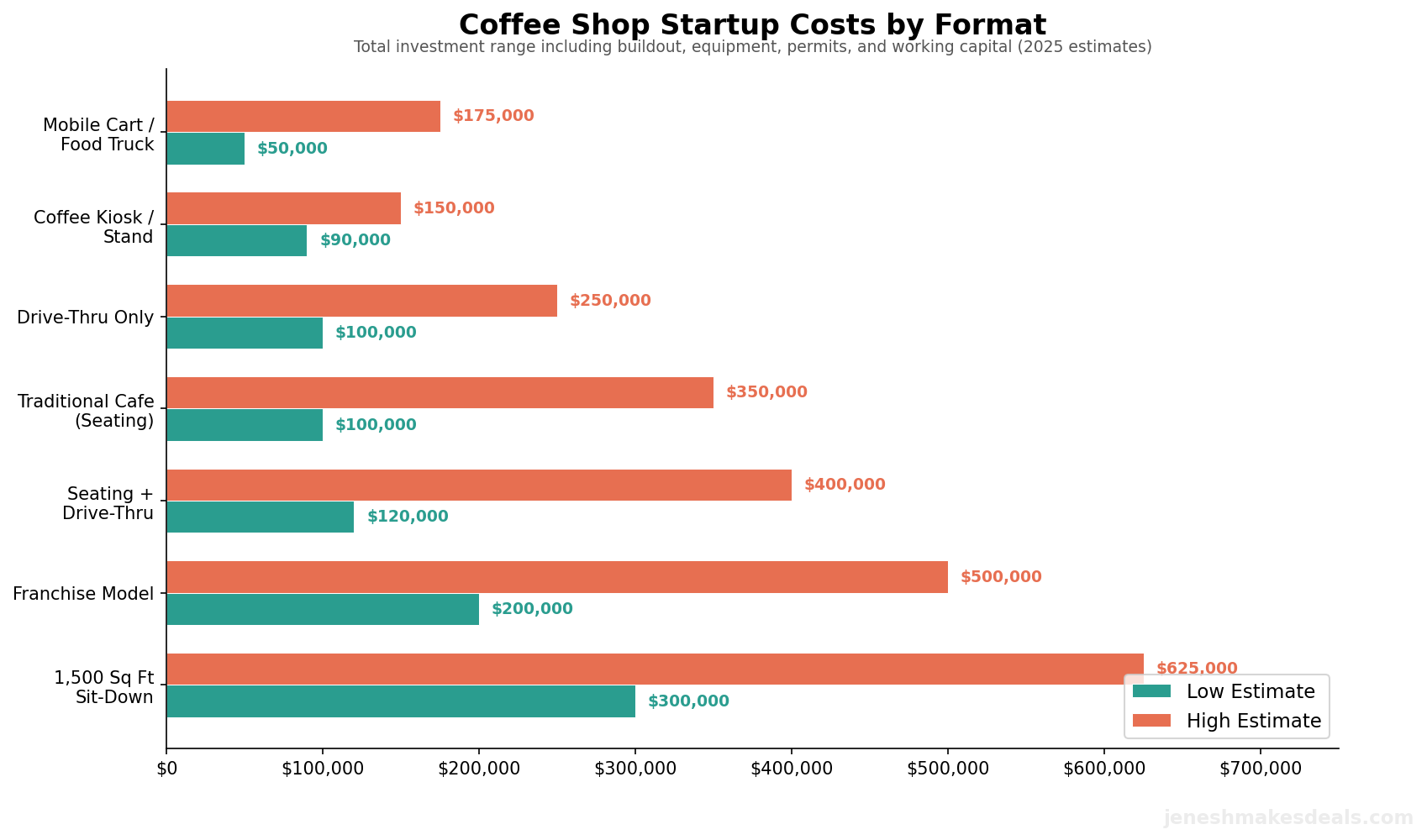
These ranges include lease deposits, buildout, equipment, initial inventory, permits, marketing, and working capital. A lean, small format cafe can get started around $80,000, while full service concepts with food menus push well past $400,000 [1].
Where the Money Goes
The major startup expense categories break down like this.
| Cost Category | Estimated Range |
|---|---|
| Buildout and renovation | $50,000 to $200,000+ |
| Kitchen and brewing equipment | $30,000 to $300,000 |
| Interior design and furniture | $10,000 to $50,000 |
| Licenses, permits, and legal | $1,000 to $7,000 |
| Initial inventory and supplies | $5,000 to $15,000 |
| Technology (POS, software) | $1,200 to $4,000 |
| Pre opening staffing and training | $10,000 to $25,000 |
| Marketing (pre launch + 6 months) | $3,000 to $12,000 |
| Working capital (3 to 6 months) | $15,000 to $60,000 |
Source: [1]
Working capital is the most underestimated line item. Industry consultants recommend reserving 3 to 6 months of operating expenses as a financial buffer because most shops do not break even immediately [1][7]. I have seen owners burn through their working capital in two months because they planned for best case revenue and got reality instead.
Buildout Costs Per Square Foot
Construction and renovation represent one of the largest and most variable costs. The national average for retail store fit outs is $155 per square foot according to Cushman and Wakefield's 2025 guide, up 4% year over year [9]. Coffee shops run higher because of specialized plumbing, HVAC, and electrical requirements.
| Location | Cost Per Sq Ft |
|---|---|
| Southeast U.S. (lowest cost region) | ~$117 |
| National retail average | ~$155 |
| Coffee shop general range | $150 to $300 |
| Northern California (highest region) | ~$211 |
| NYC cafe (900 sq ft, full buildout) | ~$230 |
| Small spaces (under 500 sq ft) | Up to $360 |
Source: [9]
Smaller spaces paradoxically cost more per square foot because fixed costs like plumbing, bathrooms, and HVAC do not scale linearly downward. If you can find a space that previously housed a cafe or restaurant, you can save significantly on infrastructure costs.
Thinking about opening a coffee shop? Use our free business valuation calculator to compare the cost of starting from scratch versus buying an existing operation at current market multiples.
What Does It Cost to Buy an Existing Coffee Shop?
The median coffee shop in the U.S. sold for $150,000 in 2025 based on over 1,013 transactions tracked by BizBuySell [12]. But your out of pocket cost can be much lower than the purchase price thanks to SBA financing.
Acquisition Price Ranges
Coffee shops typically sell at 2.0x to 3.5x annual SDE (Seller's Discretionary Earnings), with the BizBuySell average at 2.25x [4][10][12]. Here is what that looks like at different earnings levels.
| Shop SDE | Multiple Range | Acquisition Price |
|---|---|---|
| $40,000 | 1.5x to 2.0x | $60,000 to $80,000 |
| $75,000 | 2.0x to 2.5x | $150,000 to $187,500 |
| $100,000 | 2.25x to 2.75x | $225,000 to $275,000 |
| $150,000 | 2.5x to 3.0x | $375,000 to $450,000 |
| $218,000 | 2.75x to 3.25x | $600,000+ |
Your Actual Out of Pocket Cost
With SBA 7(a) financing, the minimum down payment is 10% [5]. Most lenders require 10 to 20% for acquisitions (compared to 20 to 30% for startups) [5]. Here is what the real cash outlay looks like.
| Purchase Price | Down Payment (10 to 20%) | Working Capital Reserve | Total Cash Needed |
|---|---|---|---|
| $150,000 | $15,000 to $30,000 | $10,000 to $15,000 | $25,000 to $45,000 |
| $250,000 | $25,000 to $50,000 | $15,000 to $20,000 | $40,000 to $70,000 |
| $400,000 | $40,000 to $80,000 | $20,000 to $30,000 | $60,000 to $110,000 |
Compare that to the $80,000 to $400,000 in total capital you need to start from scratch, where 100% of it is at risk. With an acquisition, you are putting $25,000 to $110,000 of your own money on the table and leveraging the bank's money for the rest, backed by a business that already generates revenue.
For a deeper look at how coffee shop multiples work and what drives them up or down, read our complete coffee shop valuation guide.
SBA Financing: Startups vs. Acquisitions
SBA 7(a) loans are the most common financing vehicle for both paths [2]. The official terms are similar, but the real world experience is very different.
| Loan Feature | Startup | Acquisition |
|---|---|---|
| Maximum amount | $5,000,000 | $5,000,000 |
| SBA minimum down payment | 10% | 10% |
| Typical lender down payment | 10 to 30% | 10 to 20% |
| Interest rate | Prime + 2.25 to 2.75% | Prime + 2.25 to 2.75% |
| Credit score required | 680+ preferred | 680+ preferred |
| Repayment term | Up to 10 years | Up to 10 years |
| Debt to equity ratio | 3:1 required | More flexible |
Sources: [2][5]
Why Lenders Prefer Acquisitions
On paper, the SBA requires the same 10% minimum equity injection for both startups and acquisitions [5][13]. In practice, the experiences diverge significantly.
Startups face tougher scrutiny because they lack operating history. Lenders often require 20 to 30% down, especially for first time food service operators [5]. The SBA mandates a 3:1 debt to equity ratio for startups, which limits how much you can borrow relative to your own investment.
Acquisitions benefit from proven cash flow, existing financial records, and tangible assets as collateral. Many acquisition buyers secure 80 to 90% financing through SBA 7(a) [2]. Lenders view the historical revenue as strong evidence of repayment capacity. The approval process is typically smoother and faster.
One important 2025 change to know: seller notes must now be on full standby (no payments) for 10 years, the full term of the SBA loan, rather than the previous 24 month standby period [13].
Need help financing your coffee shop purchase? Explore our unsecured funding programs that can provide up to $500,000 with no collateral required, ideal for covering a down payment or working capital gap.
The Number That Should Change Your Mind: Failure Rates
This is where the data most powerfully separates the two paths.
Startup Failure Rates
The numbers vary by source and methodology, but the picture is consistent.
- SBA data: 50% of all startups fail within five years [6]
- Restroworks: Approximately 30% of coffee shops close within their first year, and roughly 50% within three years [1]
- National Restaurant Association: Average restaurant failure rate of 30%
- UC Berkeley study: 17% of restaurants fail in their first year
- Datassential (2025): The first year restaurant failure rate dropped to just 0.9% in 2025, the lowest since at least 2018. Quick service segments including coffee shops had failure rates around 1% [11]
The wide range (0.9% to 30% first year failure) reflects definitional differences. Datassential tracks permanent closures of individual locations [11], while other sources define failure more broadly. The 50% five year number from SBA data is the most cited and, in my experience, the most realistic for coffee shops.
Acquisition Survival Rates
Acquired businesses demonstrate dramatically higher survival rates. According to SBA data and industry sources, purchased businesses have approximately a 90% five year survival rate, compared to roughly 50% for startups over the same period [6].
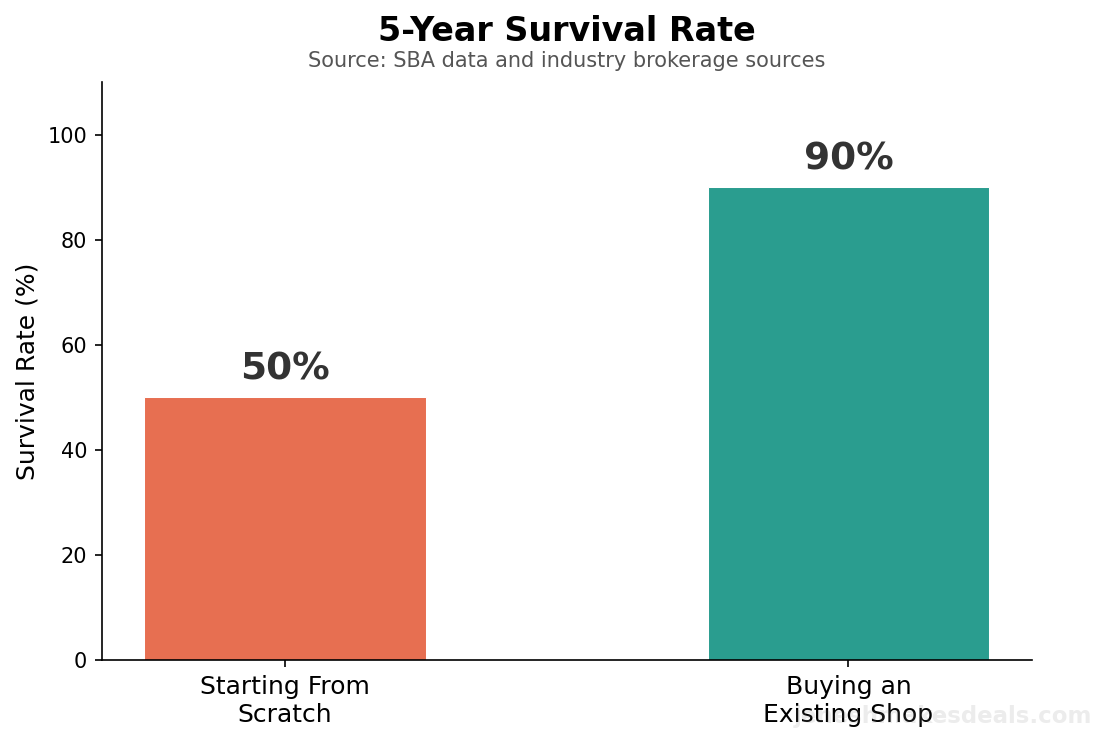
The survival advantage comes from several factors. Proven product market fit. Existing customer loyalty. Trained staff. Established supplier relationships. Visible financial history that enables better decision making from day one. When you buy, you are not guessing whether the location works or whether people want your product. Somebody already proved it.
I have seen this play out repeatedly. A first time buyer purchased a cafe in Montclair for $165,000. It had been open for seven years with stable revenue. He made changes, improved the menu, added online ordering, and grew revenue 15% in his first year. Compare that to an aspiring owner I spoke with who spent $280,000 building a new shop in a nearby town. She was still operating at a loss 14 months in, trying to build a customer base from zero.
Time to Profitability: When You Actually Start Making Money
Starting From Scratch
The path to profitability follows a predictable pattern, and it is not fast.
- Months 1 to 3: Learning curve. Operating at a loss. Systems are being built, staff is training, customer base is nonexistent.
- Months 4 to 8: Operations improve. Losses shrink as repeat customers emerge and workflow efficiency increases.
- Months 9 to 12: Break even becomes possible for well run shops in good locations [3].
- Year 2+: Actual profit potential begins. High performing independents can reach 12 to 18% net margins.
- Year 3 to 4: Capital recovery begins. Texas Coffee School advises not expecting full break even on the first location for 3 to 4 years [8].
Buying an Existing Shop
Acquired shops deliver cash flow from day one. The new owner inherits a functioning operation with established revenue, eliminating the months or years of cash burning startup phase.
- Day 1: Revenue generation begins. The business is already generating $200 to $2,000+ per day depending on size and location.
- Months 1 to 6: Transition period. You learn operations, make initial improvements, and retain the customer base.
- Months 6 to 12: Optimization takes effect. Operational improvements and cost efficiencies increase margins.
- Year 1 to 2: If purchased at reasonable multiples with proper financing, positive ROI on the acquisition investment typically begins within 18 to 24 months.
Want to know what an existing coffee shop in your area is worth? Use our coffee shop valuation calculator to estimate values based on current SDE multiples.
ROI Comparison: Year 1 Through Year 3
Let me put real numbers on a $300,000 investment scenario to show how the math works.
Starting From Scratch ($300K Total Investment)
| Metric | Year 1 | Year 2 | Year 3 |
|---|---|---|---|
| Annual revenue | $180,000 | $280,000 | $350,000 |
| Net profit margin | Negative to 0% | 5 to 10% | 10 to 15% |
| Net profit (loss) | ($9,000) to $0 | $14,000 to $28,000 | $35,000 to $52,500 |
| Cumulative cash flow | ($9,000) to $0 | $5,000 to $28,000 | $40,000 to $80,500 |
| ROI on $300K invested | Negative to 0% | 2 to 9% cumulative | 13 to 27% cumulative |
Year 1 for a new shop is typically a loss or break even at best. Meaningful returns do not start accumulating until Year 2 or 3. Most coffee shops achieve positive cumulative ROI within 2 to 3 years.
Buying an Existing Shop ($300K Purchase, $60K Down, SBA Financed)
| Metric | Year 1 | Year 2 | Year 3 |
|---|---|---|---|
| Annual revenue (existing) | $400,000 | $440,000 | $480,000 |
| Net profit margin | 8 to 12% | 10 to 15% | 12 to 18% |
| Net profit (before debt) | $32,000 to $48,000 | $44,000 to $66,000 | $57,600 to $86,400 |
| Annual debt service (~$36K) | ($36,000) | ($36,000) | ($36,000) |
| Free cash flow after debt | ($4,000) to $12,000 | $8,000 to $30,000 | $21,600 to $50,400 |
| ROI on $60K equity invested | Negative to 20% | 7 to 70% cumulative | 43 to 154% cumulative |
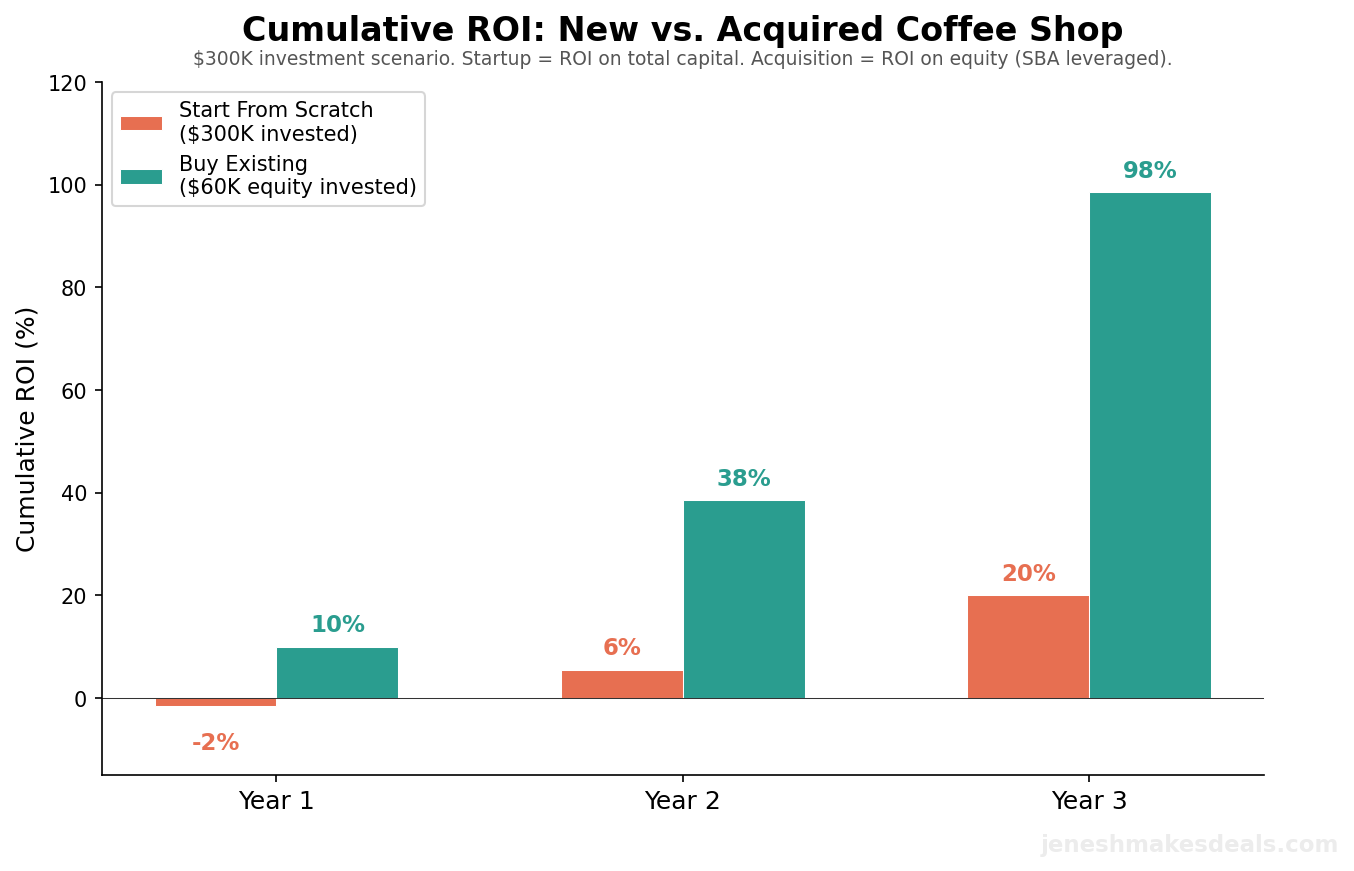
The key insight is the difference between return on total capital versus return on equity. The startup investor puts $300,000 at risk. The acquisition buyer puts $60,000 at risk and leverages the bank's money. A buyer who puts $60,000 down on a $300,000 business that generates $48,000 in Year 1 profit sees a dramatically different return profile than someone who invested $300,000 in cash for a new shop generating $0 in Year 1.
Real Cost Breakdowns at Three Budget Levels
Budget: $200K
Starting from scratch. A small cafe (400 to 800 sq ft) in a secondary market [1]. Roughly $60,000 to $80,000 for buildout, $30,000 to $50,000 for equipment (coffee only menu), $15,000 for permits and legal, $15,000 for initial inventory and marketing, and $30,000 to $40,000 for working capital. This is a lean operation, likely owner operated with 1 to 2 employees.
Buying an existing shop. A coffee shop with SDE of approximately $60,000 to $100,000 [4][10]. With SBA financing (10 to 20% down = $20,000 to $40,000 out of pocket), the buyer targets a $200,000 asking price while preserving working capital. At $80,000 SDE, the buyer potentially earns a livable income from year one while servicing debt.
Budget: $500K
Starting from scratch. A full service cafe (1,000 to 1,500 sq ft) in a good urban location. $150,000 to $200,000 for buildout, $80,000 to $120,000 for equipment with full food menu, $30,000 for design and permits, $50,000 to $75,000 for working capital, and remaining funds for marketing and contingency. This enables hiring a small team of 4 to 6 employees.
Buying an existing shop. A well established shop with SDE of $150,000 to $250,000 [4][10]. At a 2.5x to 3.0x multiple, this represents a business generating $400,000 to $700,000+ in annual revenue with strong brand recognition and possibly semi absentee ownership potential. With SBA financing ($50,000 to $100,000 down), the buyer inherits a proven operation with meaningful cash flow above debt service.
Budget: $800K+
Starting from scratch. A premium, high traffic cafe or multi concept space (1,500 to 2,500 sq ft) in a prime urban location [8]. High end finishes ($250,000 to $400,000), premium equipment ($100,000 to $150,000), comprehensive marketing launch, and robust working capital reserves. This could include a hybrid concept (cafe + bar, cafe + bakery) or a drive thru.
Buying an existing shop. A high performing business with SDE of $240,000 to $400,000+ [4][10]. At a 3.0x to 3.25x multiple, this is a premium operation, potentially a multi location chain, a high volume flagship, or a cafe with significant additional revenue from catering, wholesale, or retail beans. These businesses often have management teams in place enabling semi absentee ownership. With SBA financing ($80,000 to $160,000 down), the buyer acquires a business that comfortably services debt and delivers six figure owner earnings.
Equipment Strategy: New vs. Used
Equipment typically accounts for 60 to 70% of total startup investment when combined with buildout. The total equipment budget ranges from $30,000 for a simple coffee only setup to $300,000 for a full service cafe with food [1].
Core Equipment Costs
| Equipment | New Price Range |
|---|---|
| Commercial espresso machine | $5,000 to $20,000 |
| Commercial grinders | $500 to $2,500 |
| Full brewing equipment package | $25,000 to $35,000 |
| Additional (fridges, blenders, ice, water) | $15,000 to $25,000 |
| Total coffee only setup | Under $40,000 |
| Total full cafe with food service | $80,000 to $300,000 |
Source: [1]
The Smart Equipment Strategy
Used or refurbished commercial espresso machines can cost 30 to 60% less than new, with some sources citing savings up to 70%. But do not go used on everything.
Buy new for core brewing equipment (espresso machine, grinders). Downtime on these machines directly kills revenue. The manufacturer warranty and latest technology are worth the premium.
Buy used for supplemental equipment like refrigerators, blenders, shelving, and furniture. These items depreciate quickly but function reliably for years. A blended strategy, new for mission critical and used for secondary equipment, can save $15,000 to $40,000 on a typical buildout [7].
When buying an existing shop, the equipment is already in place and already depreciated. This is a hidden advantage of acquisitions. You inherit a fully equipped operation without the $30,000 to $300,000 equipment bill.
Common Mistakes to Avoid
If You Are Starting From Scratch
Underestimating the timeline. The total journey from concept to opening day takes 6 to 14 months [3]. Permit applications alone take 2 to 4 months [3]. Construction overruns and delays are the norm. Budget an extra 2 to 3 months beyond your plan.
Skimping on working capital. I have seen more coffee shops fail from cash flow problems in months 3 to 6 than from bad coffee or poor locations. Reserve 3 to 6 months of operating expenses minimum. If that means opening a smaller shop, open a smaller shop.
Ignoring buildout realities. Converting a space that never had food service to a cafe can cost $50,000 to $150,000 for plumbing, electrical, HVAC, and hood systems alone, before any cosmetic work [9]. Always prioritize spaces that already have food service infrastructure.
Planning for best case revenue. Your financial projections should model the worst case scenario, not the best. If you need $20,000 per month in revenue to break even, plan for $12,000 per month in your first quarter and see if the numbers still work.
If You Are Buying
Not verifying the SDE independently. The seller's claimed SDE and the actual SDE are sometimes very different numbers. Have your accountant review tax returns, bank statements, and POS data for the trailing 24 months. Do not rely on the seller's spreadsheet.
Ignoring the lease. A coffee shop with 14 months left on its lease is not worth full multiples regardless of how strong the financials look [10]. Always review lease terms and negotiate extensions before closing.
Overpaying because you fell in love. The charming neighborhood cafe with the perfect aesthetic might have terrible financials. Let the numbers drive the price, not the vibe.
Skipping due diligence on the equipment. If the espresso machine is 15 years old and the refrigeration needs replacing, those are costs you will absorb post purchase. Get an equipment assessment and factor replacement costs into your offer price.
The Side by Side Summary
| Factor | Starting From Scratch | Buying Existing |
|---|---|---|
| Total cost | $80,000 to $400,000+ [1] | $60,000 to $600,000+ (purchase price) [12] |
| Out of pocket (with SBA) | Full amount at risk | 10 to 20% down payment [5] |
| Time to first customer | 6 to 14 months [3] | Day 1 |
| Time to break even | 9 to 18 months [3] | Immediate (revenue) |
| Capital recovery | 3 to 4 years [8] | 1.5 to 3 years |
| 5 year survival rate | ~50% [1] | ~90% [6] |
| Year 3 cumulative ROI | 13 to 27% | 43 to 154% on equity |
| Creative control | Complete | Inherited, modifiable over time |
| Risk level | Higher | Lower |
| Financing ease | Harder (20 to 30% down typical) [5] | Easier (10 to 20% down typical) [5] |
What to Do Next
If the Numbers Point You Toward Buying
- Figure out your budget. How much cash can you put toward a down payment? With SBA financing, a $30,000 to $60,000 down payment can get you into a $150,000 to $300,000 coffee shop with proven cash flow [5][12].
- Understand what you are buying. Read our coffee shop valuation guide to learn how SDE multiples work, what factors drive premiums and discounts, and what a fair price looks like.
- Get pre qualified for financing. Talk to an SBA preferred lender before you start looking at businesses. Knowing your borrowing capacity up front saves months of wasted effort.
- Start your search. Contact us and tell us what you are looking for. We can help you identify coffee shops for sale in your target market and evaluate whether the asking price makes sense.
If the Numbers Point You Toward Starting
- Build a realistic budget. Use the cost breakdowns in this guide as your baseline. Add 20% for contingencies. Seriously.
- Secure your financing first. Know exactly how much capital you have access to before signing a lease. SBA Microloans ($500 to $50,000) can supplement your startup budget for smaller formats.
- Find the right space. Prioritize locations with existing food service infrastructure to minimize buildout costs. Every $50,000 you save on plumbing and HVAC is $50,000 more in working capital.
- Plan for 12 months of losses. If your financial plan does not account for a year of negative or break even cash flow, it is not a realistic plan.
Either Way
Run the numbers before you commit. Use our free business valuation calculator to compare what existing shops are selling for versus what it would cost to build something equivalent.
Explore all your funding options. Our unsecured funding programs can provide up to $500,000 with no collateral required, whether you are buying or building.
Talk to someone who has seen both paths. Schedule a call with us and I will give you an honest assessment of which approach makes the most sense for your budget, market, and goals.
Sources
[1] Restroworks, "Coffee Shop Startup Costs in 2025: Complete Guide." Total startup ranges $80,000 to $400,000+ by format; 30% of coffee shops close within first year, 50% within three years.
[2] Indiana Equity Brokers, "SBA Loans for Business Acquisition: The Complete 2025 Guide." SBA 7(a) terms, 75 to 90% guarantee, up to $5 million, 10 year terms.
[3] Homebase, "How to Start a Coffee Shop: Complete 2026 Guide." Permit timeline 2 to 4 months; break even 9 to 12 months; total concept to open 6 to 14 months.
[4] Peak Business Valuation, "Valuation Multiples for a Coffee and Snack Shop." SDE multiples: 2.0x to 3.25x; EBITDA multiples: 2.5x to 3.75x.
[5] LendingTree, "SBA Loan Down Payment Guidelines." Down payment 10 to 30%; minimum 10% for both startups and acquisitions.
[6] Upstate Business Journal, "Buying Existing Businesses Offers Advantage Over Startups." 90% five year survival rate for acquired businesses vs. 50% for startups.
[7] Crimson Cup, "How Much Does It Cost to Open a Coffee Shop in 2025?" Seating + drive thru: $120,000 to $400,000; kiosk: $90,000 to $150,000.
[8] Texas Coffee School, "How Much Does It Cost to Open a Coffee Shop?" Traditional 1,500 sq ft: $300,000 to $625,000; 3 to 4 years to full break even on first location.
[9] Cushman and Wakefield, "2025 U.S. Retail Fit Out Cost Guide." National average $155 per square foot, up 4% year over year.
[10] Jaken Equities, "Bakery and Coffee Shop Business Valuation Multiples." SDE multiples 2.0x to 3.5x; exceptional operations 3.5x to 4.0x.
[11] Datassential, "Restaurant Failure Rate Plunges in 2025." First year failure rate dropped to 0.9%, the lowest since 2018.
[12] BizBuySell, "Insight Report: Q3 2025." Median coffee shop sale price $150,000; median SDE $75,000 to $78,780; over 1,013 sold listings.
[13] SBA, "2025 SBA Loan SOP and Rule Changes." Seller notes now require full 10 year standby; 10% down payment minimum for all transaction types.
Related Articles
April 29, 2026
Selling a Franchise Business vs an Independent Business
Selling a franchise is a fundamentally different process than selling an independent business. Here is what every franchise owner needs to know.
April 21, 2026
What Is a Management Buyout and Is It Right for Your Business?
A management buyout lets your team buy the business. Learn how MBOs work, what they cost, and when they make sense for sellers.

April 13, 2026
How to Find the Right Business Broker for Your Industry
Not all brokers know your industry. Here's how to find one who actually understands your business and can get you top dollar.
About the Author
Jenesh Napit is an experienced business broker specializing in business acquisitions, valuations, and exit planning. With a Bachelor's degree in Economics and Finance and years of experience helping clients successfully buy and sell businesses, he provides expert guidance throughout the entire transaction process. As a verified business broker on BizBuySell and member of Hedgestone Business Advisors, he brings deep expertise in business valuation, SBA financing, due diligence, and negotiation strategies.
You might also be interested in
Free Business Calculators
Try our business valuation calculator and ROI calculator to estimate values and returns instantly.
How to Buy a Business Guide
Download our comprehensive free guide covering everything you need to know about buying a business.
Our Services
Explore our professional business brokerage services including valuations and buyer representation.
More Articles
Browse our complete collection of business brokerage insights and expertise.