

Most business owners do not know the difference between a business broker and an M&A advisor, and the confusion costs them. I have seen a landscaping company owner with $600K in revenue hire an M&A advisory firm that charged a $35,000 retainer and then struggled to find buyers interested in a deal that small. I have also seen a $5M manufacturing company list with a main street broker whose marketing plan was a BizBuySell listing and a prayer.
The mismatch in both cases was expensive. The landscaping owner spent five figures on fees before pulling the engagement. The manufacturer sold for significantly less than a comparable company that used an M&A advisor with a competitive bidding process.
If you are thinking about selling your business, the first question is not "who should I hire?" It is "what kind of advisor matches my business?" A business broker and an M&A advisor are not the same thing. The right choice depends almost entirely on your business size, complexity, and who your likely buyers are.
If you are still figuring out whether a broker is right for you at all, start there. But if you have already decided to use a professional advisor, this is the comparison that matters.
The Real Difference in One Sentence
A business broker lists your business and waits for buyers to find it. An M&A advisor builds a targeted campaign to find buyers and makes them compete for it.
That is an oversimplification, but it captures the core distinction. Everything else, the fees, the timeline, the buyer pool, the marketing materials, flows from this fundamental difference in approach. Understanding what business brokers do is the starting point, and then you can evaluate whether your business needs something more.
Here is how they compare across every dimension that matters.
Side by Side: The Full Comparison
| Dimension | Business Broker | M&A Advisor |
|---|---|---|
| Deal size | $100K to $5M | $5M to $250M |
| Seller revenue | Under $5M | $5M to $250M |
| Fee structure | 8 to 12% commission, no retainer | Retainer ($5K to $50K+) plus success fee |
| Minimum fee | $10K to $25K | $50K to $250K |
| How they find buyers | Marketplace listings (BizBuySell, BizQuest) | Targeted outreach to 500 to 6,000+ buyers |
| Buyer type | Individual entrepreneurs, small investors | PE firms, strategic acquirers, family offices |
| CIM length | 5 to 15 pages | 30 to 80+ pages |
| Negotiation style | One buyer at a time | Competitive bidding with multiple rounds |
| Timeline | 3 to 9 months | 6 to 18 months |
| Close rate | 20 to 30% of listings | Higher (selective intake) |
| Geographic focus | Local and regional | National and international |
| Typical credentials | CBI, real estate license | CM&AA, M&AMI, CFA, MBA |
This table is the quick reference. The sections below explain why each difference matters and what it means for your sale.
Deal Size: Where Each One Makes Sense
This is the most important factor when choosing between a business broker or investment banker level advisor. A broker who closes $200K deals operates in a completely different world than an M&A advisor running $10M transactions. The services, buyer pools, and processes are designed for different levels of complexity.
| Your Business | Revenue | EBITDA | Best Advisor |
|---|---|---|---|
| Main street (simple operations) | Under $2M | Under $500K | Business broker |
| Gray zone (moderate complexity) | $2M to $5M | $500K to $1M | Either, depends on complexity |
| Lower middle market | Over $5M | Over $1M | M&A advisor |
| Middle market and above | Over $100M | Over $25M | Investment banker |
There are roughly 3,200 brokerage firms and 5,000 to 10,000 full time business brokers in the U.S. The M&A advisory market is smaller, with an estimated few thousand dedicated advisors. Investment bankers are a different category entirely, regulated by the SEC and FINRA, and typically handle deals above $100M.
The $2M to $5M zone is where the decision gets interesting. I will cover that overlap in its own section below.
Fee Comparison: What You Actually Pay
The fee structures are fundamentally different, and understanding business broker fee structures before you start interviewing will save you from surprises.
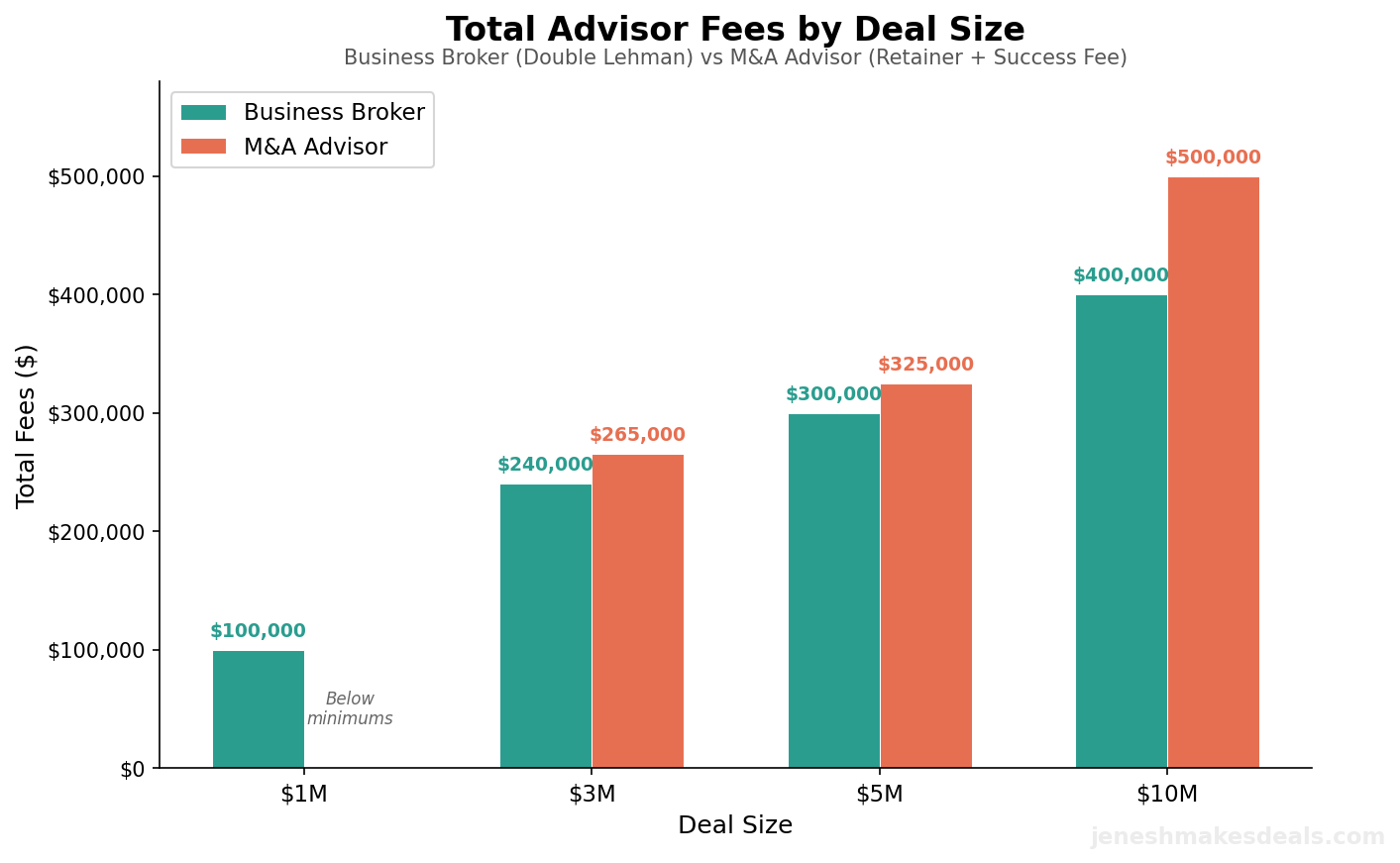 Total fees vary dramatically by advisor type and deal size. At $1M the difference is minimal. At $10M the gap widens significantly.
Business Broker Fees
Most brokers work on straight commission with no up front costs.
- Under $1M: Flat 8 to 12% commission
- $1M to $5M: Double Lehman formula (10% on first $1M, declining to 2% above $4M)
- Minimum fees: $10,000 to $25,000
On a $5M deal using the Double Lehman, the total fee is $300,000 (6% blended rate). On a $1M deal, a 10% commission is $100,000.
M&A Advisor Fees
M&A advisors charge a retainer fee plus a success fee. The retainer funds the real work: CIM preparation, business valuation, buyer research, and targeted outreach.
- Retainers: $5,000 to $50,000+ up front, sometimes monthly
- Success fees: 4 to 11% depending on deal size
- Minimum total fees: $50,000 to $250,000
On a $5M deal, an M&A advisor might charge a $25,000 retainer plus a 6% success fee ($300,000), for a total of $325,000. On a $10M deal, the success fee drops to 4 to 6%, but the retainer and minimum fee are higher.
The Lehman Formula Explained
The original Lehman formula (5-4-3-2-1) was developed by Lehman Brothers and produces a $150,000 fee on a $5M deal (3% blended). The Double Lehman (10-8-6-4-2) has largely replaced the original. About 50% of advisors and brokers use a version of the Lehman formula, 33% use flat percentages, and 17% use accelerator models.
The Real Cost Calculation
The fee comparison only tells half the story. A broker who charges 10% but sells your business for $800K nets you $720K. An M&A advisor who charges a $50,000 retainer plus 5% but sells for $1.2M nets you $1.09M. The advisor's fee was higher, but your net was $370K more.
Want to know where your business falls on the size spectrum? Use our business valuation calculator to get a baseline estimate of your business value, which will help you determine whether a broker or M&A advisor is the better fit.
How They Find Buyers: Listing vs Targeted Outreach
This is where the difference between a business broker and an M&A advisor for small business sales becomes most consequential.
Business Broker: List and Wait
Brokers primarily use marketplace listings: BizBuySell, BizQuest, BusinessesForSale.com. They create a listing, field inquiries, screen buyers, and negotiate with one buyer at a time. Some brokers maintain an internal buyer database and send targeted emails, but the approach is fundamentally reactive.
The buyer pool is mostly individual entrepreneurs and small investors looking to buy themselves an income. Geographic focus is local and regional. Successful brokers may carry 10 to 25+ listings simultaneously, selling 20 to 30% of what they list.
M&A Advisor: Targeted Outreach
M&A advisors run a proactive, multi phase process:
- Create a one page blind teaser
- Distribute to 500 to 6,000+ potential buyers
- Require NDAs before sharing the full CIM
- Screen and qualify interested parties
- Arrange management presentations with shortlisted buyers
- Run competitive bidding with multiple rounds
The buyer pool includes private equity firms, corporate acquirers, international strategic buyers, and family offices. Geographic focus is national and international.
 M&A advisors coordinate management presentations where your leadership team meets directly with serious buyers, a process that rarely happens in brokered transactions.
The difference is structural. IBBA data shows that businesses over $5M draw 3+ offers in 80% of cases when properly marketed by an advisor. That competitive tension is what drives prices up.
The CIM: 15 Pages vs 80 Pages
Both brokers and M&A advisors prepare a Confidential Information Memorandum, but the documents differ in scope and purpose.
Broker CIM (Often Called a CBR)
- Length: 5 to 15 pages
- Content: Business overview, basic P&L summary, asking price, brief operations description
- Financial depth: 1 to 2 years of financials, simple SDE adjustments
- Valuation method: Rule of thumb multiples or simple comparable sales
- Preparation time: Days to a few weeks
M&A Advisor CIM
- Length: 30 to 80+ pages, often with a separate one page blind teaser
- Content: Detailed company history, product and service breakdown, org chart, competitive analysis, customer concentration analysis, growth opportunities, management bios
- Financial depth: 3 to 5 years of historical P&L, balance sheets, adjusted EBITDA with detailed add backs, quality of earnings analysis
- Valuation method: DCF models, precedent transactions, comparable company analysis
- Preparation time: 2 to 6 weeks
A well prepared M&A quality CIM sets a professional tone, builds credibility with sophisticated buyers, and provides enough information for informed bids. It also reduces surprises during due diligence, which means less renegotiation and fewer blown deals.
Sale Price: What the Data Shows
This is where the numbers make the strongest case for matching the right advisor to your deal.
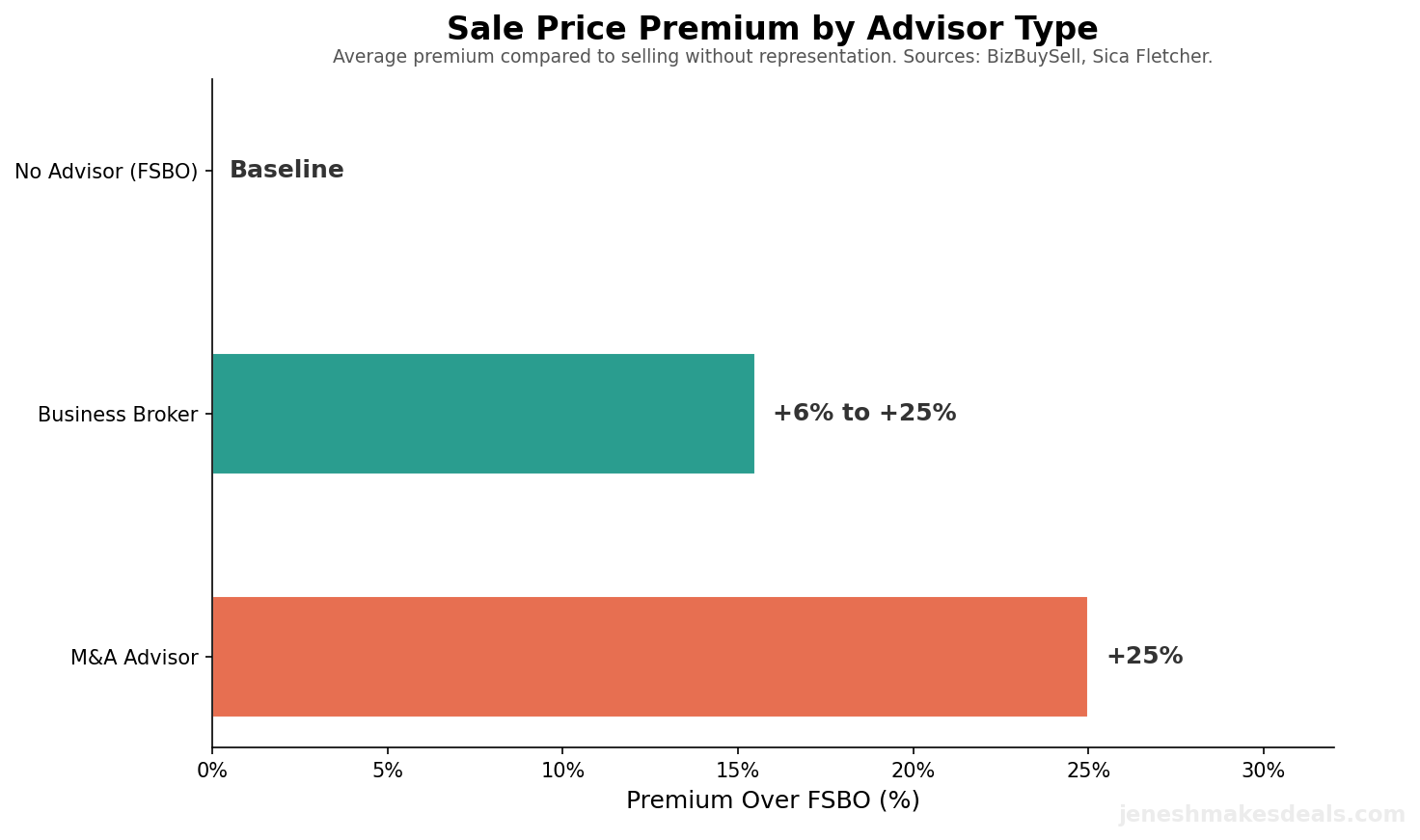 Businesses sold with M&A advisor representation trade at approximately 25% higher multiples than those without. Even using a broker provides a measurable premium over selling on your own.
Brokered Deals
BizBuySell data going back to 1992 shows that small businesses sold through brokers close at approximately 84% of asking price. If your business is listed at $1M, expect to close around $840K.
However, businesses sold with any form of professional representation, including brokers, achieve 6 to 25% higher valuations than those sold directly by owners. Even a basic broker provides value through buyer qualification, negotiation, and deal management.
M&A Advised Deals
M&A advisors typically do not set an asking price at all. Instead, they let the competitive bidding process determine value. The result is often a sale at or above the advisor's internal valuation estimate.
Since 2020, deals with M&A advisor representation have traded at multiples approximately 25% higher on average than those without professional representation. The competitive bidding process, where multiple qualified buyers compete, is a structural advantage that a one buyer at a time negotiation simply cannot replicate.
Why the Premium Exists
The premium comes from three things:
- More qualified buyers see your business. 500 to 6,000+ targeted contacts vs a marketplace listing
- Competition drives prices up. Multiple bidders create urgency and negotiating leverage
- Better preparation reduces deal risk. A detailed CIM and quality of earnings analysis means fewer surprises that blow up deals during due diligence
"I listed my $4M business with a broker and got one offer at $3.2M after six months. My neighbor sold a similar business for $4.8M using an M&A advisor who brought in three competing buyers. The advisor's fee was higher, but my neighbor netted $1.2M more than I did." , Manufacturing company owner, Ohio
Transaction Timeline: Speed vs Process
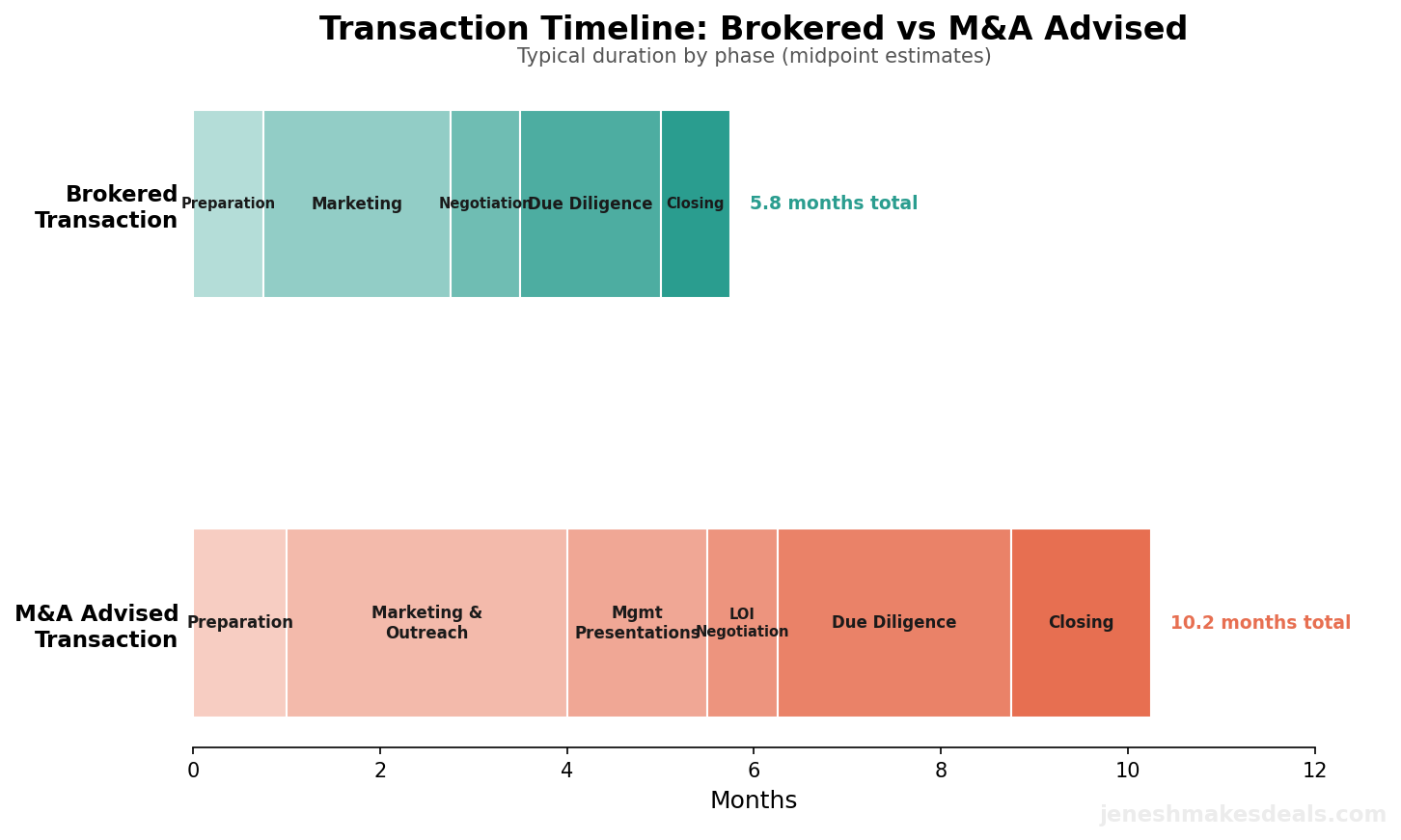 M&A advised deals take longer, but the extra time typically translates into materially higher sale proceeds.
Brokered Transaction: 3 to 9 Months
| Phase | Duration |
|---|---|
| Preparation (valuation, listing, CBR) | 1 to 3 weeks |
| Marketing (list on marketplaces, field inquiries) | 1 to 3 months |
| Negotiation (one or two buyers) | 2 to 4 weeks |
| Due diligence (basic financial review) | 4 to 8 weeks |
| Closing (asset purchase agreement, escrow) | 2 to 4 weeks |
Brokers typically have listing contracts of 6 to 12 months. Many brokered transactions close in 3 to 6 months, but since brokers sell only 20 to 30% of their listings, many businesses sit much longer.
M&A Advised Transaction: 6 to 18 Months
| Phase | Duration |
|---|---|
| Preparation (valuation, CIM, data room) | 2 to 6 weeks |
| Marketing and outreach (teasers, NDAs, CIM delivery) | 2 to 4 months |
| Management presentations | 1 to 2 months |
| LOI negotiation (multiple rounds) | 2 to 4 weeks |
| Due diligence (QoE, legal, tax, environmental) | 2 to 3 months |
| Closing (purchase agreement, R&W insurance, escrow) | 1 to 2 months |
The average M&A advised transaction takes 9 to 10 months from engagement to closing. A full auction process takes 6 to 10 months but yields the most bids and highest value.
Why M&A Deals Take Longer
The extended timeline reflects a more thorough process: broader outreach (hundreds of buyers vs a handful), multiple bidding rounds, management presentations, due diligence with specialized advisors (quality of earnings, IP, environmental), and complex purchase agreement negotiations with detailed representations and warranties. The extra time typically translates into higher net sale proceeds.
The Overlap Zone: $2M to $5M Businesses
If your business falls in the $2M to $5M range, you are in what the industry calls "no man's land." Experienced brokers shade upward into this range, and entry level M&A advisors shade downward. The right choice depends more on deal complexity than raw deal size.
Consider an M&A advisor even at the lower end if:
- Your likely buyers are PE firms or strategic acquirers, not individuals
- The deal involves earnouts, rollover equity, or complex deal structures
- Your industry is specialized (SaaS, healthcare, manufacturing with IP)
- Environmental compliance, union contracts, or regulatory issues complicate the deal
- Your business has complex products or serves large corporate clients
A broker is likely sufficient if:
- Your buyers will be individual operators or small investors
- The business is straightforward with simple operations
- The deal will be a clean asset sale
- Your industry does not require specialized buyer knowledge
Most middle market PE firms want a minimum of $2M EBITDA, solid margins, and year over year growth before they will consider a business. If PE is your target buyer class, an M&A advisor is essential to accessing that network.
Not sure where your business falls? Contact us and I will help you figure out whether a broker or M&A advisor makes more sense for your specific situation.
Lower Middle Market Advisory: The Hybrid Model
A growing category of firms straddles the line between brokers and M&A advisors. These lower middle market advisory firms focus on companies valued between $1M and $100M, too complex for traditional brokers but too small for major investment banks.
They combine the best of both approaches:
- From brokers: Accessible fee structures, willingness to list on marketplaces
- From M&A advisors: Competitive bidding processes, detailed CIMs, PE and strategic buyer networks
These firms typically maintain proprietary buyer databases of 5,000 to 10,000+ contacts, charge moderate retainers ($5,000 to $35,000) plus success fees using the Lehman or Double Lehman formulas, and staff teams of 2 to 5 professionals per deal.
If your business is in the $2M to $10M range, this hybrid model may be the best fit. You get the targeted outreach and competitive process of an M&A advisor without the minimum fees and overhead of a large investment bank.
Common Mistakes When Choosing the Wrong Advisor
Dismissing professional help entirely. Businesses sold without any professional representation leave 15 to 30% of value on the table. That is far more than the commission would have cost.
Using an M&A advisor when a broker would suffice. For businesses under $500K, most established M&A advisors will not even take the engagement because the economics do not work. You will waste time and money trying to hire the wrong level of advisor.
Hiring a broker for a complex deal. Using a main street broker for a $5M+ company with multiple locations, PE attractive characteristics, or complex contracts means missing the competitive bidding process that drives prices up.
Choosing based on commission rate alone. A broker who charges 8% but sells for $800K nets you less than an advisor who charges 5% plus a retainer fee for business sale but sells for $1.2M. Focus on net proceeds, not the fee percentage.
Picking an advisor without industry expertise. A SaaS company needs an advisor who has sold SaaS businesses, not a generalist. Industry expertise directly impacts business valuation accuracy, buyer identification, and deal structure.
Not understanding fee incentives. A straight commission broker is incentivized to close fast, not maximize price. An advisor with a retainer has more aligned incentives. Neither structure is perfect, but understanding the trade off matters.
Paying large up front fees without clear deliverables. Retainers are justified when they fund specific work: CIM preparation, valuation, buyer research. A retainer with no defined deliverables is a red flag.
What to Do Next
- Know your numbers. Use our business valuation calculator to get a baseline estimate of what your business is worth. This determines which advisor category fits your deal.
- Assess your complexity. Simple local business with individual buyers? Broker. Complex operations with PE potential? M&A advisor. In between? Consider a lower middle market firm.
- Interview at least three advisors. Whether you are talking to brokers or M&A advisors, compare their experience, fee structures, and approach to selling your business.
- Check references. Ask for closed deals in your size range in the last 24 months and talk to past clients.
- Understand the fee structure before signing. Get everything in writing, including retainers, success fees, minimums, and what happens if the deal does not close.
The single most important factor is not the fee. It is the process the advisor runs. A well managed competitive process with 5 to 10 qualified bidders will almost always produce a higher net outcome, even after fees, than a one buyer at a time negotiation.
Ready to discuss which advisor type fits your business? Contact us for a free confidential consultation. I will walk you through your options based on your specific business size, industry, and goals.
Looking for capital to strengthen your business before going to market? Explore our unsecured funding programs that can provide up to $500,000 with no collateral required. Sometimes investing in your business before listing pays for itself many times over at closing.
Sources
- IBISWorld. "Business Brokers in the US: Number of Businesses Statistics." 2025.
- Morgan & Westfield. "Business Broker and M&A Advisor Fees: A Comprehensive Guide." 2025.
- Venture7 Advisors. "Business Broker, M&A Advisor or Investment Bank? Which Is Right for You." 2025.
- ClearlyAcquired. "Business Broker vs. M&A Advisor: Which One Do You Really Need?" 2025.
- Firmex. "Key Insights on M&A Advisory Fees in the Middle Market." 2024.
- BizBuySell. "Sale Price vs. Asking Price." 2024.
- Sica Fletcher. "2025 Insurance Broker M&A Valuations: Deals with Advisor Representation." 2025.
- MidStreet. "Business Broker vs. M&A Advisor: Which One Is Right for You?" 2025.
- First Page Sage. "M&A Advisory Fee Structure: 2025 Report." 2025.
- Raincatcher. "How Long Does It Take to Sell a Business: Timeline and Stages." 2025.
- Axial. "Top 25 Lower Middle Market Business Brokers of 2024." 2024.
- Calder Capital. "Q2 2025 M&A Market Update." 2025.
- Divestopedia. "A Guide to Merger and Acquisition Designations." 2025.
- TheyGotAcquired. "8 Costly Mistakes Founders Make When Considering a Business Broker." 2025.
- MidStreet. "What Is a Confidential Information Memorandum (CIM)?" 2025.
- Mosaic Business Advisors. "Business Broker or M&A Advisor: Which to Choose?" 2025.
- TABB. "20 Years of Evolution in Business Brokerage." 2025.
- Grasemann Group. "Business Broker vs. M&A Advisor: The Difference and Why It Matters." 2025.
Frequently Asked Questions
What is the difference between a business broker and an M&A advisor?
A business broker typically handles deals under $5M, works on straight commission (8 to 12%), and finds buyers through marketplace listings like BizBuySell. An M&A advisor handles deals from $5M to $250M, charges a retainer plus success fee, and proactively contacts hundreds of targeted buyers including PE firms and strategic acquirers. The fundamental difference is the process: brokers negotiate with one buyer at a time, while M&A advisors run competitive bidding to maximize price.
At what business size should I hire an M&A advisor instead of a broker?
The general threshold is $5M in enterprise value or $1M in EBITDA. Below $2M, a business broker is almost always the right choice. Above $5M, an M&A advisor delivers materially better results through competitive bidding and access to institutional buyers. The $2M to $5M range is a gray zone where the decision depends on deal complexity, buyer type, and industry.
How much does an M&A advisor charge compared to a business broker?
Business brokers charge 8 to 12% commission with no retainer for deals under $1M, and use the Double Lehman formula for larger deals. M&A advisors charge a retainer ($5,000 to $50,000+) plus a success fee (4 to 11% depending on deal size), with minimum total fees of $50,000 to $250,000. On a $5M deal, a broker using Double Lehman charges about $300,000 while an M&A advisor might charge $325,000 total. The advisor's fee is higher, but advisor represented deals trade at approximately 25% higher multiples on average.
Do I need an investment banker to sell my business?
Investment bankers handle deals typically above $100M in enterprise value. Unless your business generates over $100M in revenue with $25M+ in EBITDA, you do not need an investment banker. For most privately held businesses, a business broker (under $5M) or M&A advisor ($5M to $250M) is the appropriate choice. Investment bankers are regulated by FINRA and the SEC and run formal auction processes designed for the largest transactions.
What is the Lehman formula for business sales?
The original Lehman formula, developed by Lehman Brothers, calculates fees as 5% on the first $1M, 4% on the second, 3% on the third, 2% on the fourth, and 1% on everything above $4M. On a $5M deal, this produces a $150,000 fee (3% blended). The Double Lehman doubles these percentages (10-8-6-4-2), producing a $300,000 fee on the same deal. About 50% of advisors and brokers use a Lehman variant, making it the most common fee structure for deals above $1M.
Related Articles

April 30, 2026
How Long Does It Really Take to Sell a Business
Most sellers are shocked by how long it takes. Here's the honest timeline from listing to closing, and what actually speeds things up.

April 26, 2026
How to Structure an Earnout That Works for Seller and Buyer
Most earnouts fail because they're poorly structured. Here's how to build earnout terms that protect both sides of the deal.

April 24, 2026
How to Value Intellectual Property in a Business Sale
Your IP could be worth more than your equipment. Learn how patents, trademarks, and trade secrets affect your business valuation.
About the Author
Jenesh Napit is an experienced business broker specializing in business acquisitions, valuations, and exit planning. With a Bachelor's degree in Economics and Finance and years of experience helping clients successfully buy and sell businesses, he provides expert guidance throughout the entire transaction process. As a verified business broker on BizBuySell and member of Hedgestone Business Advisors, he brings deep expertise in business valuation, SBA financing, due diligence, and negotiation strategies.
You might also be interested in
Free Business Calculators
Try our business valuation calculator and ROI calculator to estimate values and returns instantly.
How to Buy a Business Guide
Download our comprehensive free guide covering everything you need to know about buying a business.
Our Services
Explore our professional business brokerage services including valuations and buyer representation.
More Articles
Browse our complete collection of business brokerage insights and expertise.