

Live social selling is the future of e-commerce. Live commerce delivers 9-30% conversion rates compared to traditional e-commerce's 2-3%, achieves 50-80% lower customer acquisition costs than Facebook and Google ads, and is growing at 21.9% annually to reach $3.93 billion by 2030. TikTok Shop grew 108% in 2025 to $15.82 billion, capturing 18.2% of social commerce market share. While Facebook advertising costs surged 21% to $27.66 per lead and Google Ads increased to $70.11 per lead, live commerce offers dramatically superior unit economics that make it the most efficient customer acquisition and conversion channel available to e-commerce brands today.
The e-commerce landscape is at an inflection point. While traditional online stores struggle with rising customer acquisition costs and stagnant conversion rates, a parallel revolution is reshaping how brands acquire and convert customers. Live commerce, the fusion of entertainment, real-time interaction, and instant purchasing, is outpacing traditional e-commerce growth by more than 3x.
After analyzing market data and working with e-commerce businesses, I've seen the pattern: brands that embrace live social selling now are establishing first-mover advantages in audience building, conversion efficiency, and brand differentiation. Those that continue relying solely on traditional digital advertising face margin compression from rising costs and commoditization from competitors.
The numbers tell a clear story. Live shopping conversion rates range from 9% to 30%, compared to traditional e-commerce's 2-3% baseline [6][23]. Fashion and beauty live events achieve conversion rates up to 70%, representing a 28x improvement over standard digital storefronts. TikTok Live shopping converts at 8-12%, compared to 2-4% for short-form videos and 1.5-3% for static shop tabs [24].
This isn't a prediction about distant future trends. Live commerce is actively reshaping competitive dynamics today. Brands like PacSun, Maëlys, and Crocs are generating millions in incremental revenue through live shopping programming. Gen Z consumers, who will represent the majority of consumer spending within a decade, already conduct 40% of product searches on TikTok rather than Google [81][84].
The window of opportunity will close. As more brands adopt live commerce, competition for audience attention will increase, creator partnership costs will rise, and algorithm advantages will diminish. The brands that move decisively now will build durable moats through owned audiences, trusted creator relationships, and refined operational capabilities.
Download the full report here.
Enter your name and email to receive the complete Live Commerce Market Report PDF.
The Traditional E-Commerce Model Under Pressure
Rising Customer Acquisition Costs Erode Unit Economics
Digital advertising, long the backbone of e-commerce growth, has become prohibitively expensive across all major platforms. The data reveals a structural cost inflation that threatens the viability of traditional customer acquisition models.
Facebook advertising experienced a 21% cost per lead increase in 2025, rising from approximately $22.86 in 2024 to $27.66 [97][100]. While Facebook still maintains a cost advantage over Google, the rapid acceleration in pricing reflects intensifying competition for limited ad inventory. With more advertisers flooding Meta's platforms and Apple's privacy changes reducing targeting precision, brands must bid higher to maintain reach.
Google Ads costs increased from $66.69 to $70.11 per lead, representing a 5.13% rise [109]. Although this increase appears modest compared to Facebook's surge, Google's baseline costs remain 2.5x higher than Meta's, making scaled acquisition economically challenging for all but the highest-margin products.
The underlying dynamics driving cost inflation are structural, not cyclical. Increased competition for ad inventory, privacy-driven targeting limitations, AI-enabled creative saturation flooding platforms with content, and economic pressures pushing brands toward aggressive growth spending have created a perfect storm. These conditions will persist and likely intensify through 2026-2027, making cost reduction through traditional optimization increasingly difficult.
Customer acquisition cost benchmarks across e-commerce categories reveal the extent of the challenge:
| Category | CAC Range |
|---|---|
| Fashion | $70-$95 |
| Beauty | $55-$85 |
| Electronics | $76-$120 |
| Food & Beverage | $30-$80 |
Source: Customer Acquisition Cost Benchmarks for Ecommerce in 2026 [27]
For brands operating on 30-40% gross margins, these acquisition costs leave minimal contribution after variable costs. A fashion brand paying $82 per customer on a $150 average order value with 35% margins nets just $52.50 in gross profit, leaving only $29.50 after acquisition costs to cover fixed overhead, fulfillment, and generate profit. This unit economic reality makes scale difficult and leaves brands vulnerable to any market disruption.
Need help understanding your business's financial performance? Use our free business valuation calculator to analyze your margins and unit economics.
The Influencer Marketing Crisis Deepens
Influencer partnerships, once viewed as an authentic alternative to paid advertising, face their own performance collapse. Recent research reveals that 81.2% of marketers struggle to accurately measure influencer marketing ROI [16]. This measurement crisis occurs precisely as influencer costs surge 25% or more while engagement rates decline across platforms.
The core challenge stems from attribution complexity and inflated metrics. Consumers interact with brands across an average of 9.5 touchpoints before converting [85], making it nearly impossible to isolate influencer impact from other marketing activities. Meanwhile, fake followers and inauthentic engagement remain persistent problems that distort performance data and waste marketing spend.
Commission structures further erode margins. Typical affiliate arrangements command 10-15% of revenue, with some creators negotiating 25-35% rates [58]. For brands already facing compressed margins from rising acquisition costs, surrendering an additional quarter to third of revenue to influencers becomes economically untenable at scale.
The fundamental problem is that static influencer content (posts, stories, short videos) serves discovery and consideration functions but struggles to drive immediate conversion. Viewers may see a product demonstration, engage with content, and even express interest, but the path from awareness to purchase involves multiple steps and platforms where attribution breaks down and conversion intent dissipates.
Traditional E-Commerce Conversion Rates Stagnate
While acquisition costs rise, conversion rates remain stubbornly low across standard e-commerce channels. Traditional online stores convert at 2-3% on average [6][23]. Regional data shows EMEA performing slightly better at 4.11%, while the Americas average 3.2-3.5% [37]. Even accounting for regional variation, the vast majority of traffic fails to convert.
This baseline conversion challenge compounds the acquisition cost problem. A brand spending $27.66 for a Facebook click at a 2.5% conversion rate effectively pays $1,106 per customer ($27.66 ÷ 0.025), far exceeding published cost-per-lead figures that assume optimization throughout the funnel. The reality is that most e-commerce brands struggle to achieve positive ROI at scale using traditional digital channels alone.
Low conversion rates also reflect deeper consumer trust deficits. Customers cannot physically examine products, they rely on static images and descriptions that fail to convey real-world use cases, they lack immediate answers to purchase-blocking questions, and they face generic experiences that do not address individual needs or contexts. These structural limitations of traditional e-commerce create friction that suppresses conversion regardless of traffic quality or marketing spend.
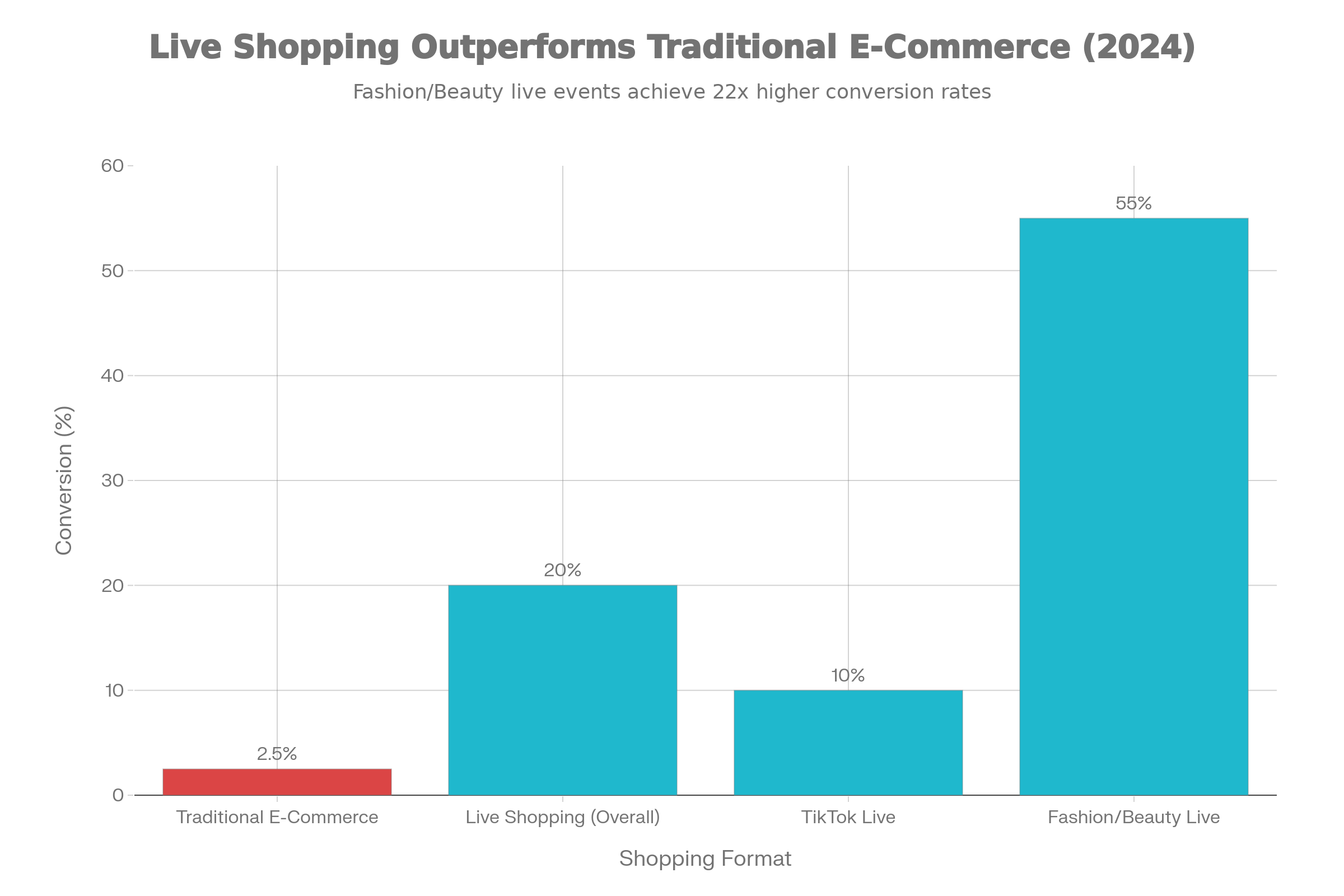
The chart above illustrates the dramatic conversion rate advantage of live shopping formats. While traditional e-commerce struggles to convert 2-3% of visitors, live shopping events achieve 9-30% conversion rates, with fashion and beauty categories reaching up to 70% [6][23].
Attribution Breakdown in a Fragmented Journey
Modern consumer purchase journeys have become impossibly complex to measure accurately. Consumers interact with brands across 9.5 touchpoints on average before converting [85], spanning social media, connected TV, podcasts, retail media networks, search, and traditional digital channels. Each platform operates within its own measurement ecosystem, creating attribution silos that prevent holistic campaign analysis.
The elimination of third-party cookies, GDPR-style privacy regulations, and platform-specific tracking limitations have further degraded attribution accuracy [79][88]. Brands can no longer follow individual users across the web, making it nearly impossible to understand which touchpoints genuinely influence purchase decisions versus merely correlating with conversions.
This attribution crisis forces brands into suboptimal decision-making. Without clear performance visibility, marketing budgets flow toward easily measured channels (typically bottom-funnel search) at the expense of unmeasured but potentially high-impact activities. Brands also struggle to optimize creative, messaging, and audience targeting when feedback loops are broken or delayed by weeks.
Live Commerce: The Performance Advantage
Conversion Rate Superiority
Live commerce delivers conversion rates that fundamentally change unit economics. While traditional e-commerce converts 2-3% of visitors, live shopping events achieve 9-30% conversion rates [6][23]. Fashion and beauty categories see even more dramatic results, with conversion rates reaching up to 70% during live events [6].
TikTok Live shopping specifically converts at 8-12%, compared to 2-4% for short-form videos and 1.5-3% for static shop tabs [24]. This represents a 4x to 6x improvement over standard video content and a 3x to 8x improvement over static product pages.
The conversion advantage stems from several factors:
Real-time interaction removes purchase friction. Viewers can ask questions and receive immediate answers, eliminating the hesitation that kills conversions on static product pages. When someone asks "Does this run small?" during a live event, they get an answer in seconds, not hours or days.
Social proof amplifies urgency. Seeing other viewers purchase in real-time creates FOMO (fear of missing out) that drives immediate action. Comments like "Just bought!" and "Sold out already?" create urgency that static pages cannot replicate.
Entertainment value increases engagement. Live shopping combines product demonstration with entertainment, keeping viewers engaged longer and building trust through personality and authenticity. Viewers who stay for 10 minutes are far more likely to convert than those who bounce after 30 seconds.
Trust building happens in real-time. Live hosts can demonstrate products, answer questions, share personal experiences, and build rapport that static content cannot match. This trust translates directly to higher conversion rates.
__CAGR_of_21.9%25.png)
The market growth trajectory shown above reflects the accelerating adoption of live commerce. With a 21.9% CAGR through 2030, live commerce is growing more than 3x faster than traditional e-commerce [7].
Average Order Value Advantages
Live shopping doesn't just convert more visitors. It also drives higher average order values (AOV) compared to traditional e-commerce channels. The interactive nature of live events enables hosts to bundle products, suggest complementary items, and create value-driven offers that increase basket size.
_Comparison_Across_E-Commerce_Channels.png)
The data shows that live shopping events consistently outperform traditional channels in AOV. This advantage compounds with higher conversion rates to create dramatically better unit economics. A brand that converts 10% of visitors at a $120 AOV generates $12 per visitor. A traditional e-commerce site converting 2.5% at $80 AOV generates just $2 per visitor. That's a 6x revenue advantage per visitor.
Want to explore funding options to invest in live commerce capabilities? Check out our unsecured funding programs that can provide up to $500,000 with no collateral required.
Customer Acquisition Cost Efficiency
Live commerce offers 50-80% lower customer acquisition costs compared to traditional digital advertising [6]. This cost advantage stems from several factors:
Organic reach through platform algorithms. Live events receive algorithmic boost from platforms like TikTok and Instagram, delivering organic reach that paid advertising cannot match. Brands that consistently host live shopping events build owned audiences that reduce dependence on paid acquisition.
Creator partnerships provide built-in audiences. Working with creators who have established audiences eliminates the need to build awareness from scratch. These partnerships often cost less than equivalent paid advertising while delivering higher engagement and conversion.
Word-of-mouth amplification. Live shopping events generate shareable moments that drive organic discovery. Viewers share exciting products, great deals, or entertaining hosts, creating viral loops that traditional advertising cannot replicate.
Lower competition for attention. While traditional advertising channels are saturated with competitors bidding for the same inventory, live commerce remains less crowded. Early adopters benefit from lower competition for viewer attention and creator partnerships.
The combination of higher conversion rates, higher AOV, and lower acquisition costs creates unit economics that are fundamentally superior to traditional e-commerce. Brands that master live commerce can scale profitably in ways that traditional digital advertising no longer supports.
Platform-Specific Opportunities
TikTok Shop: The Social Commerce Leader
TikTok Shop has emerged as the dominant force in live social selling. The platform grew 108% in 2025 to reach $15.82 billion in revenue, capturing 18.2% of social commerce market share [11][15]. This growth reflects TikTok's unique position at the intersection of entertainment, discovery, and commerce.
TikTok Live shopping converts at 8-12%, compared to 2-4% for short-form videos and 1.5-3% for static shop tabs [24]. The platform's algorithm prioritizes engaging content, meaning brands that create entertaining live shopping experiences receive organic reach that paid advertising cannot match.
The platform's user base skews heavily toward Gen Z and younger millennials, demographics that conduct 40% of product searches on TikTok rather than Google [81][84]. This shift in search behavior means brands that aren't present on TikTok are missing a significant portion of their potential customer base.
TikTok Shop's integration of commerce directly into the platform eliminates friction. Viewers can discover products, watch demonstrations, ask questions, and purchase without leaving the app. This seamless experience drives higher conversion rates than platforms that require external links or redirects.
Key strategies for TikTok Shop success:
- Host regular live shopping events (weekly or bi-weekly minimum)
- Partner with TikTok creators who have engaged audiences
- Create entertaining content that showcases products naturally
- Use TikTok's native shopping features for seamless checkout
- Engage with comments and questions in real-time during events
Instagram Live Shopping
Instagram offers live shopping capabilities through Instagram Live and Shopping features. While the platform doesn't publish conversion rate data as detailed as TikTok, brands report strong performance from Instagram Live shopping events.
The platform's strength lies in its visual nature and established shopping infrastructure. Instagram users are already accustomed to discovering products through the platform, making live shopping a natural extension of existing behavior.
Instagram Live shopping advantages:
- Access to Instagram's 2 billion+ monthly active users
- Integration with existing Instagram Shopping features
- Ability to tag products during live events
- Strong performance in fashion, beauty, and lifestyle categories
- Established creator ecosystem for partnerships
YouTube Shopping
YouTube has expanded its shopping capabilities, recognizing the platform's potential for commerce. The platform's long-form content format allows for deeper product demonstrations and educational content that builds trust and drives conversions.
YouTube Shopping integrates with live streams, allowing creators to showcase products during broadcasts. The platform's search functionality also drives discovery, with users searching for product reviews, demonstrations, and comparisons.
YouTube Shopping strengths:
- Long-form content allows detailed product demonstrations
- Search-driven discovery through product-related queries
- Strong performance for high-consideration purchases
- Established creator economy with shopping integrations
- Ability to build educational content that drives sales
Strategic Recommendations for E-Commerce Brands
Start with One Platform
Don't try to master every platform simultaneously. Choose one platform that aligns with your target audience and brand positioning, then build expertise before expanding.
For Gen Z and younger millennials: Start with TikTok Shop. The platform's growth, conversion rates, and audience alignment make it the highest-priority platform for brands targeting younger demographics.
For fashion and beauty brands: Instagram Live shopping offers strong performance and established infrastructure. The platform's visual nature and shopping features align well with these categories.
For high-consideration purchases: YouTube Shopping provides the long-form content format needed to build trust and demonstrate complex products.
Focus on consistency over frequency. A weekly live shopping event on one platform will outperform sporadic events across multiple platforms. Build an audience, refine your approach, and establish a sustainable rhythm before expanding.
Partner with Creators Strategically
Creator partnerships are essential for live commerce success, but they require strategic selection. Not all creators are created equal, and choosing the wrong partners wastes budget and damages brand reputation.
| What to Look For | Why It Matters |
|---|---|
| Authentic audience engagement | High comment rates indicate real followers who will convert, not fake followers |
| Brand alignment | Content and values must match your brand or partnerships feel inauthentic |
| Live commerce experience | Creators who've hosted live events understand the format and drive better results |
| Reasonable commission rates | Typical rates are 10-15%, but some demand 25-35% which destroys margins [58] |
| Red Flags to Avoid | Why It's a Problem |
|---|---|
| Suspicious follower growth patterns | Indicates fake followers that won't convert |
| Low engagement rates relative to follower count | Shows audience isn't actually engaged |
| History of brand partnership conflicts | Signals potential problems with your partnership |
| Unrealistic commission demands | Destroys unit economics and makes partnerships unprofitable |
Start with micro-influencers (10K-100K followers) who often deliver better ROI than mega-influencers. These creators typically have more engaged audiences, lower partnership costs, and greater availability for live events.
Build Owned Audiences
The biggest mistake brands make with live commerce is treating it like paid advertising. Live shopping events should build owned audiences that reduce dependence on paid acquisition over time.
| Strategy | How It Works |
|---|---|
| Consistent scheduling | Host events same day/time weekly so viewers know when to return |
| Series programming | Create themed series ("New Arrivals Tuesday," "Clearance Friday") that build anticipation |
| Email and SMS lists | Capture contact information during events to build direct communication channels |
| Community building | Create groups where viewers connect beyond live events |
| Exclusive offers | Provide special deals for repeat viewers to incentivize return attendance |
Owned audiences become increasingly valuable as paid marketing costs rise. Brands that build loyal followings for live shopping series enjoy lower customer acquisition costs, higher repeat attendance, and organic word-of-mouth promotion.
Optimize for Conversion
Live commerce success requires optimization, not just hosting events. Track metrics, test approaches, and refine your strategy based on data.
| Metric | What It Tells You |
|---|---|
| Viewer count | How many people watch your live events |
| Average watch time | How long viewers stay engaged |
| Conversion rate | Percentage of viewers who make purchases |
| Average order value | Revenue per transaction during events |
| Revenue per viewer | Total revenue divided by viewer count |
| Return viewer rate | Percentage of viewers who come back for future events |
| Optimization Strategy | What to Test |
|---|---|
| Time slots | Find when your audience is most engaged |
| Event length | Some prefer 30-minute events, others prefer 2-hour marathons |
| Product selection | Test which products perform best in live format |
| Host approach | Different hosts and presentation styles drive different results |
| Offers | Test different discount levels, bundles, and promotions |
The brands that treat live commerce as an optimization challenge, not just a new channel, achieve the best results. Continuous improvement based on data separates successful live commerce programs from those that fail.
Common Mistakes to Avoid
Mistake 1: Treating Live Commerce Like Traditional Advertising
Many brands approach live commerce with the same mindset they use for paid advertising: create content, pay for reach, measure results, repeat. This misses the fundamental advantage: building owned audiences.
Brands that treat live commerce like advertising host sporadic events, don't build relationships with viewers, and fail to capture the compounding benefits of owned audiences. Instead, approach live commerce as a channel for building direct relationships. Invest in consistent programming, engage with viewers beyond transactions, and focus on long-term audience value rather than short-term revenue per event.
Mistake 2: Choosing Creators Based on Follower Count Alone
Follower count is a vanity metric that doesn't correlate with conversion rates. Mega-influencers with millions of followers often have low engagement rates, fake followers, and audiences that don't align with brand target customers. These partnerships cost more and convert less.
Evaluate creators based on engagement rates, audience alignment, brand fit, and live commerce experience. Micro-influencers with 10K-100K engaged followers often deliver better ROI than mega-influencers with millions of fake followers.
Mistake 3: Inconsistent Programming
Live commerce requires consistency to build audiences. Inconsistent programming means viewers don't know when to return. Without a predictable schedule, brands must rebuild awareness for each event, eliminating the compounding benefits of owned audiences.
Establish a consistent schedule (e.g., every Tuesday at 7 PM) and stick to it. Create themed series that build anticipation. Communicate schedules clearly through all channels. Consistency builds habits that drive long-term success.
Mistake 4: Ignoring Platform-Specific Best Practices
Each live commerce platform has unique features, algorithms, and best practices. TikTok, Instagram, and YouTube have different content formats, audience behaviors, and shopping features. A strategy that works on one platform may fail on another.
Study platform-specific best practices. TikTok rewards entertainment and authenticity. Instagram emphasizes visual storytelling. YouTube values educational content. Tailor your approach to each platform's unique characteristics.
Mistake 5: Focusing Only on Revenue, Not Metrics
Revenue is important, but it's a lagging indicator. Without tracking viewer count, watch time, conversion rates, and other metrics, brands can't identify what's working and what needs improvement.
Track comprehensive metrics for every live event. Analyze which products, offers, hosts, and formats drive the best results. Use data to continuously improve your live commerce program.
What To Do Next
Step 1: Evaluate Your Current E-Commerce Performance
Before investing in live commerce, understand your current performance. Analyze your customer acquisition costs, conversion rates, average order values, and unit economics. This baseline helps you measure live commerce impact and make informed decisions.
| Question | Why It Matters |
|---|---|
| What are your current customer acquisition costs across channels? | Establishes baseline to measure live commerce impact |
| What are your conversion rates by traffic source? | Shows which channels already work best for your brand |
| What is your average order value? | Helps project revenue potential from live commerce |
| What are your unit economics after acquisition costs? | Determines if live commerce can improve profitability |
| Which products or categories drive the best margins? | Identifies what to feature in live shopping events |
Want help analyzing your business performance? Contact me for a consultation on your e-commerce metrics and growth strategies.
Step 2: Choose Your Starting Platform
Select one platform to focus on initially. Consider your target audience, brand positioning, and internal capabilities.
| Factor | Platform Recommendation |
|---|---|
| Target audience age | Gen Z/younger millennials: TikTok. Older demographics: Instagram or YouTube |
| Product category | Fashion/beauty: Instagram. High-consideration: YouTube. Trendy products: TikTok |
| Internal capabilities | Team on camera? Consistent scheduling? Budget for creators? |
Start with the platform that offers the best alignment with your audience and capabilities. Master one platform before expanding to others.
Step 3: Develop Your Live Commerce Strategy
Create a strategic plan for your live commerce program. Define goals, target metrics, content approach, and resource requirements.
| Strategy Element | What to Define |
|---|---|
| Goals | Revenue growth? Customer acquisition? Brand awareness? |
| Target metrics | Conversion rates? Revenue per viewer? Return viewer rate? |
| Content approach | New products? Educational content? Entertainment? |
| Resource requirements | Who hosts? Equipment needed? Budget for creators? |
| Success criteria | What results justify continued investment? |
A clear strategy provides direction and helps you make decisions when challenges arise. Document it and revisit regularly as you learn and optimize.
Step 4: Start with a Pilot Program
Don't commit to a full live commerce program immediately. Start with a pilot program to test your approach, learn what works, and refine your strategy before scaling.
| Pilot Element | Recommendation |
|---|---|
| Duration | 4-6 weeks minimum to gather meaningful data |
| Frequency | 1-2 events per week to establish consistency |
| Budget | Limited budget to test creator partnerships and content approaches |
| Metrics | Track all key metrics to identify what's working |
| Learning focus | Treat as learning opportunity, not just revenue driver |
Use the pilot to answer key questions: Which products perform best? What time slots drive the most viewers? Which creators deliver the best results? What content approach resonates with your audience?
Step 5: Scale Based on Results
After your pilot program, analyze results and make data-driven decisions about scaling. Double down on what works and eliminate what doesn't.
Scaling considerations:
- Increase frequency: If weekly events perform well, consider adding more events per week
- Expand platforms: Once you've mastered one platform, consider adding a second
- Invest in creators: Increase budget for creator partnerships that deliver results
- Build internal capabilities: Hire or train team members to host events internally
- Develop content systems: Create processes and systems to streamline content creation
Scale gradually based on results, not assumptions. Each scaling decision should be supported by data showing that increased investment will deliver improved results.
Ready to explore live commerce for your e-commerce brand? Contact me to discuss your situation and develop a strategic approach to live social selling.
Want to understand how live commerce might impact your business valuation? Use our free business valuation calculator to analyze your current performance and explore growth scenarios.
Conclusion
The e-commerce industry faces a fundamental reconfiguration. Traditional digital marketing channels that powered growth for the past decade are experiencing structural cost inflation, declining performance, and measurement breakdown. Simultaneously, live commerce has emerged as the most efficient customer acquisition and conversion channel available.
Key findings:
- Live commerce delivers 9-30% conversion rates versus 2-3% for traditional e-commerce
- Customer acquisition costs are 50-80% lower than Facebook and Google ads
- TikTok Shop grew 108% in 2025 to $15.82 billion, capturing 18.2% of social commerce market share
- Gen Z consumers conduct 40% of product searches on TikTok rather than Google [81][84]
- Live commerce is growing at 21.9% annually, outpacing traditional e-commerce by more than 3x [7]
The strategic imperative for e-commerce brands is clear and urgent. Companies that establish live commerce capabilities within the next 24-36 months will capture first-mover advantages in audience building, creator partnerships, and operational expertise. Those that delay entry will face higher costs, increased competition, and ceded market position to faster-moving rivals.
This is not a prediction about distant future trends. Live commerce is actively reshaping competitive dynamics today. Brands like PacSun, Maëlys, and Crocs are generating millions in incremental revenue through live shopping programming. The window of opportunity will close as more brands adopt live commerce, competition increases, and creator partnership costs rise.
The evidence is conclusive. Traditional e-commerce marketing strategies are under unsustainable cost pressure. Live social selling offers dramatically superior economics and competitive positioning. The question is not whether brands should adopt live commerce but how quickly they can execute to capture available opportunities before market saturation erodes advantages.
For business owners considering selling their e-commerce businesses:
- Businesses with established live commerce capabilities will command premium valuations
- Strategic acquirers recognize the channel's importance and pay accordingly
- Businesses dependent on expensive traditional marketing face valuation pressure from deteriorating unit economics
The brands that move first and fastest will define the next era of e-commerce competition. The time to act is now.
Ready to explore how live commerce can transform your e-commerce business? Contact me for a consultation on developing your live social selling strategy and building competitive advantages in this emerging landscape.
Want to understand what your e-commerce business might be worth with live commerce capabilities? Use our free business valuation calculator to analyze your current performance and explore growth scenarios.
Looking for funding to invest in live commerce infrastructure and creator partnerships? Explore our unsecured funding programs that can provide up to $500,000 with no collateral required.
Sources and References
[1] Business Wire. (2026). B2C Ecommerce Global Forecast Report 2025: Market Projected to Grow
[3] Shopify. (2025). Global Ecommerce Sales Growth Report (2026)
[6] Firework. (2025). Live Shopping Statistics: The $600 Billion Revolution Changing E-Commerce
[7] Next MSC. (2025). Live Commerce Market Size & Analysis: Forecast 2025-2030
[11] eMarketer. (2025). TikTok Shop Makes Up Nearly 20% of Social Commerce in 2025
[15] Beauty Matter. (2025). TikTok Shop Comprises Nearly 20% of Social Commerce in 2025
[16] Socially Powerful. (2025). 5 Biggest Influencer Marketing Challenges And Their Solutions
[23] Awisee. (2025). Live Shopping Statistics: Europe, US & Asia 2025
[24] Emplicit. (2026). TikTok Shop Sales Volume: What to Measure
[27] Deliberate Directions. (2025). Customer Acquisition Cost Benchmarks for Ecommerce in 2026
[37] Envive AI. (2024). 50 E-commerce Conversion Rate Statistics for 2025
[58] Viral Nation. (2025). Inside TikTok Shop: How Brands Are Turning Viral Moments Into Sales
[75] Twikit. (2024). What are the biggest challenges facing e-commerce businesses in 2026
[79] Dengun. (2025). Attribution Challenges in Digital Marketing: What's New for 2025?
[81] Sprout Social. (2025). How Gen Z uses social media and what that means for brands
[84] Statista. (2025). Gen Z online shopping behavior statistics & facts
[85] Direct Agents. (2025). Attribution Meltdown: How to Navigate Marketing Measurement in 2025
[88] Ruler Analytics. (2025). Ad Attribution in 2025: Models, Limitations and What's Changing
[97] Fuel Online. (2026). Facebook Ad Costs Surge In 2025, Outpacing Google Ads
[100] Fuel Online. (2026). Facebook Ad Costs Surge In 2025, Outpacing Google Ads
[109] WordStream. (2025). Google Ads Benchmarks 2025: Competitive Data & Insights
[115] Swydo. (2025). Google Ads vs. Facebook Ads (The Agency Playbook for 2026)
Related Articles

March 19, 2026
How to Build a Business That Runs Without You
A business that depends on you has a ceiling on its value. Here's the step-by-step process for building real owner independence over 18-24 months.

March 2, 2026
First 90 Days After Buying a Business: Your Transition Playbook
The first 90 days after buying a business determine whether your acquisition succeeds. Here's exactly what to do each week, and what to avoid.
December 7, 2025
Taking Over Your Laundromat: Transition Guide and Growth Strategies
Guide to taking over a laundromat: first 30 days plan, immediate improvements, revenue growth strategies, and key metrics.
About the Author
Jenesh Napit is an experienced business broker specializing in business acquisitions, valuations, and exit planning. With a Bachelor's degree in Economics and Finance and years of experience helping clients successfully buy and sell businesses, he provides expert guidance throughout the entire transaction process. As a verified business broker on BizBuySell and member of Hedgestone Business Advisors, he brings deep expertise in business valuation, SBA financing, due diligence, and negotiation strategies.
You might also be interested in
Free Business Calculators
Try our business valuation calculator and ROI calculator to estimate values and returns instantly.
How to Buy a Business Guide
Download our comprehensive free guide covering everything you need to know about buying a business.
Our Services
Explore our professional business brokerage services including valuations and buyer representation.
More Articles
Browse our complete collection of business brokerage insights and expertise.