
Sell Your HVAC Business in 2026: Record Multiples Won't Last
If you own an HVAC business and you have been thinking about selling, 2026 is your window. PE firms completed over 200 HVAC acquisitions in 2024 alone, and heat pump mandates sweeping across major states are creating a once in a generation valuation spike for businesses positioned on the right side of the transition.
Here is the situation. Heat pumps have outsold gas furnaces every year since 2021. In 2024, manufacturers shipped 4.1 million heat pump units versus 3.1 million gas furnaces, a 32% gap. California will ban new gas furnace sales by 2030. New York requires all electric heating in new low rise buildings starting this year. Maryland, Colorado, Washington, and Massachusetts are all on the same path.
HVAC business valuations are at historic highs right now because of this transition. PE backed add on acquisitions rose 88% year over year through mid 2025. PE firms accounted for over half of all HVAC deals in the first half of 2025, up from a third the year before. The multiples being paid, 3x to 10x+ EBITDA depending on your profile, reflect a market where buyers are competing aggressively for quality businesses.
But here is what most HVAC owners do not realize. This premium is driven by the transition itself, not by permanent market conditions. Once heat pump adoption reaches critical mass and the retrofit wave peaks, the urgency that is inflating multiples today will fade. The time to sell is while buyers are paying for the growth curve, not after it flattens.
I work with HVAC business owners every week. The ones getting top dollar in 2026 understand exactly what is driving these valuations and how to position for it. Here is everything you need to know.
Heat Pump Mandates Are Rewriting HVAC Economics State by State
The regulatory shift toward electrification is not a future risk. It is happening now. Multiple states have enacted or are advancing policies to phase out fossil fuel heating equipment, and the timelines are aggressive.
| State | Policy | Key Timeline |
|---|---|---|
| California | CARB ban on sale of new gas furnaces and water heaters | By 2030 |
| New York | All Electric Buildings Act, all electric heating in new buildings under 7 stories | 2026 (low rise), 2029 (all new buildings) |
| Washington | Building code updates requiring high efficiency electric heat pumps in new construction | Active as of 2025 |
| Massachusetts | Clean Heat Standard (delayed), 10 municipality fossil fuel free demo program | Clean Heat Standard delayed to 2028 |
| Maryland | Zero Emissions Heating Equipment Standard, bans new gas/propane/oil furnace installations | 2035 |
| Colorado | PUC Clean Heat Plan, 41% gas emission cuts in 10 years | 2035 (41% cut), 2050 (full elimination) |
| New England (CT, ME, MA, NH, RI) | $450M New England Heat Pump Accelerator, 580,000 heat pump installations target | By 2030 |
California's 2030 deadline and New York's 2026 requirement are the most immediate. But the trajectory is clear across every major coastal state. Even states that have delayed, like Massachusetts pushing its Clean Heat Standard to 2028, are still moving in the same direction.
For HVAC business owners, this creates two realities. If your business is positioned for the heat pump transition, with trained technicians and growing electrification revenue, buyers will pay a premium. If your business is still primarily gas furnace focused, the clock is ticking on your current revenue model, and buyers know it.
What HVAC Business Multiples Look Like in 2026
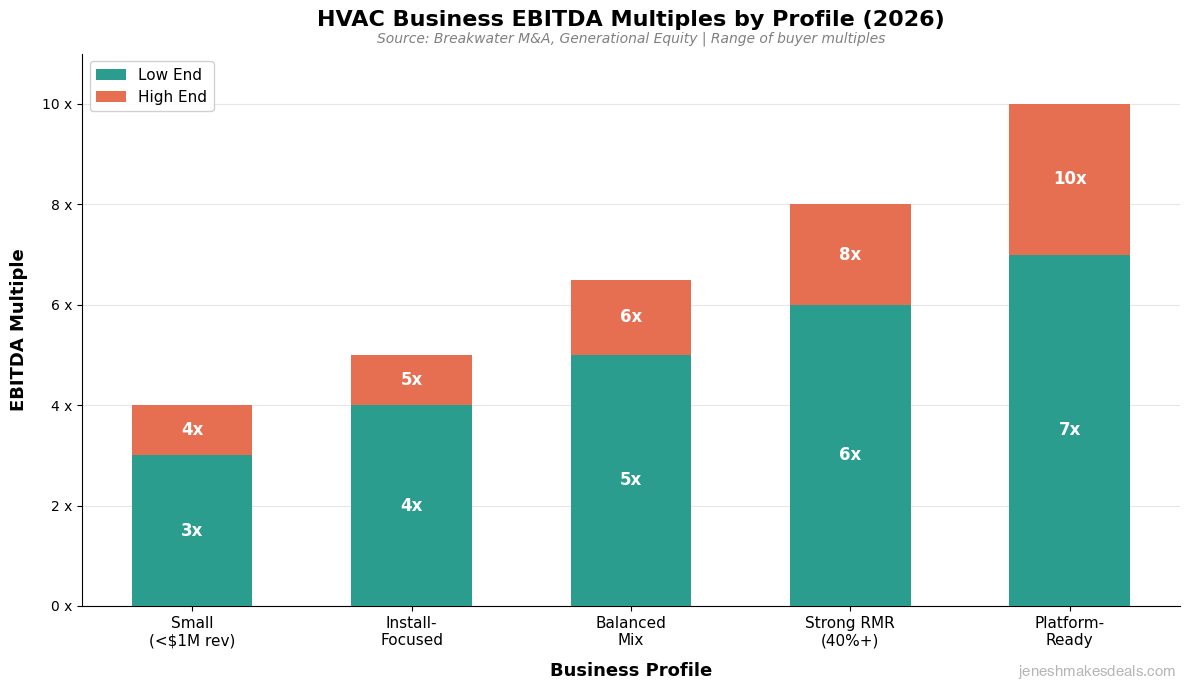
HVAC businesses are valued primarily on EBITDA multiples, and the range is enormous depending on your business profile.
| Business Profile | EBITDA Multiple |
|---|---|
| Small company (under $1M revenue), minimal recurring | 3x to 4x |
| Installation focused, limited service base | 4x to 5x |
| Balanced mix (install + service + inspection) | 5x to 6.5x |
| Strong recurring revenue (40%+ RMR), multi year contracts | 6x to 8x |
| Platform ready (high RMR, low attrition, scalable ops) | 7x to 10x |
| Commercial HVAC ($50M+ revenue) | 7x to 11x |
| High quality services businesses (PE targets) | 10x+ |
The spread between the bottom and top is 7x+ turns of EBITDA. That means the same fundamental business, HVAC service in the same market, can be worth $400K or $4M+ depending on how it is structured and positioned.
The key valuation drivers that push multiples higher.
Recurring revenue. Companies with 50%+ of revenue from service and maintenance contracts command multiples 1 to 2 turns higher than installation heavy businesses. Maintenance agreements are independently valued at 2x to 3x their annual recurring value, on top of the EBITDA multiple.
Heat pump capability. Businesses that can demonstrate heat pump competency, rebate navigation expertise, and a growing share of electrification work are seeing what industry analysts describe as a 1 to 2x multiple premium over traditional gas only shops.
Low owner dependency. If the business cannot run for 90+ days without you, expect a 1 to 2 turn discount on your multiple.
Deal structures typically include 65% to 75% cash at close, 10% to 20% seller note, and 10% to 15% earnout.
Want to see where your HVAC business falls? Use our free HVAC business valuation calculator to get an instant estimate based on your revenue and earnings.
PE Firms Are Flooding Into HVAC at Record Pace
Private equity interest in HVAC is at or near all time highs. The sector has become one of the most active consolidation plays in the middle market.
The numbers from the first half of 2025 tell the story.
- 77 HVAC M&A deals announced or completed, essentially flat with the prior year
- PE's share of those deals surged to 50.6%, up from 32.9% the year before
- PE add on acquisitions rose 88% year over year
- Three consecutive interest rate cuts in late 2024 fueled PE appetite
- Carrier Global is looking to deploy approximately $10 billion in acquisition capital
- Trane Technologies earmarked $150 million for 12 new hubs and 500 field technicians in January 2026
The major PE backed platforms actively acquiring HVAC businesses include Wrench Group, Apex Service Partners, Hoffman Family of Companies, Sila Services, HomeX Services, Cascade Services, and The SEER Group. These platforms are running the same roll up playbook seen in plumbing. Acquire a strong anchor company, bolt on 10 to 30+ additional acquisitions, build regional or national scale, and exit at a higher multiple.
Industry analysts describe the residential HVAC services segment as "midway through its consolidation cycle," while commercial HVAC is still in its early stages. That means there is still significant runway for both segments, but the easiest targets have already been acquired.
Carrier Global's acquisition of Viessmann Climate Solutions for $13.1 billion in December 2025, adding 8,000 technicians and significant heat pump expertise, was the largest HVAC deal in history. It signals where the market is heading. Heat pump capability is becoming table stakes for acquisition targets.
Heat Pumps Have Already Won the Sales Battle
This is not a prediction. Heat pumps have outsold gas furnaces in the US every single year since 2021. The data is unambiguous.
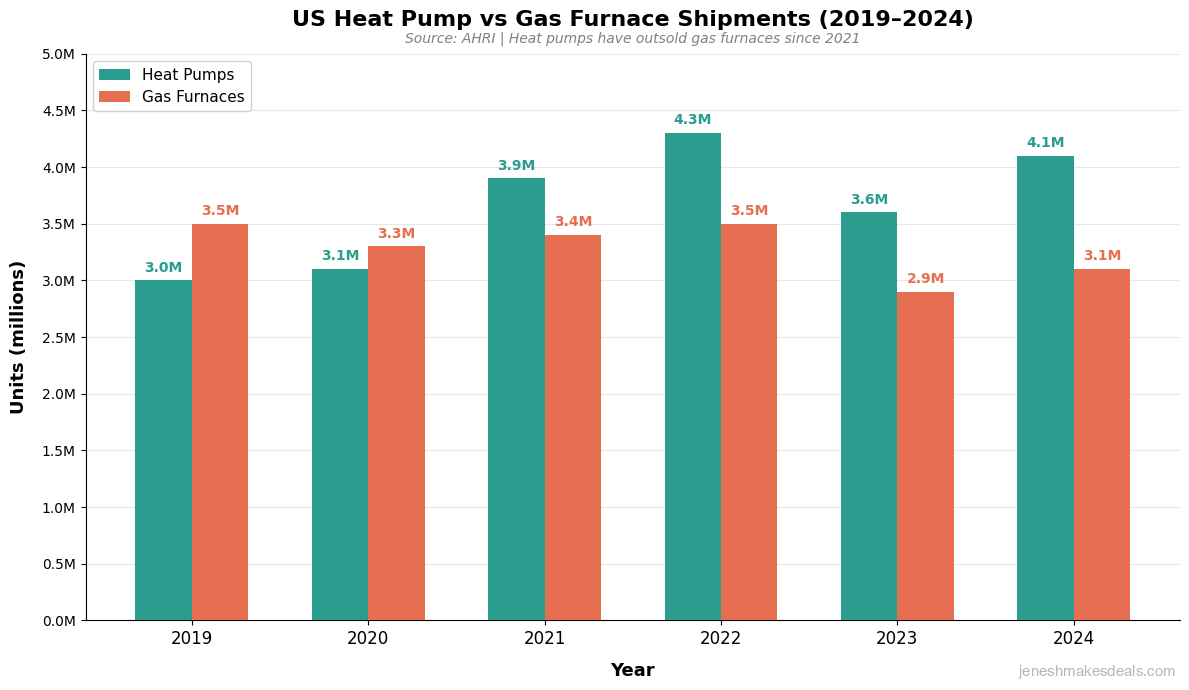
Over the past 20 years, heat pump sales have increased by 115%. Gas furnace sales have declined by 11%. In 2024, 4.1 million heat pump units shipped versus 3.1 million gas furnaces. In 2025, heat pumps shipped 12% more units than gas furnaces. September 2025 was the first month heat pumps made up a majority of all residential cooling equipment sales.
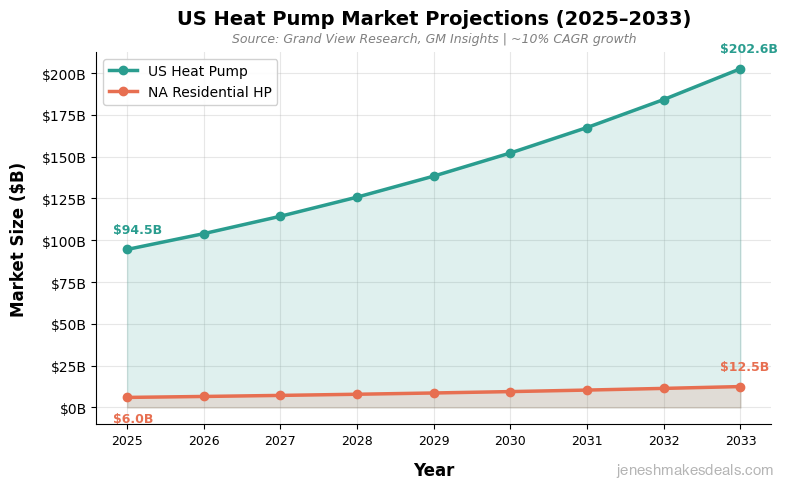
The market projections reinforce the trend.
| Metric | 2025 Value | Projected Value | CAGR |
|---|---|---|---|
| Global heat pump market | $94.5B | $200.6B by 2033 | 10.0% |
| US heat pump market growth | — | — | 10.6% (2026 to 2033) |
| North America residential heat pump | $6.0B | $15.0B by 2035 | 9.6% |
| Cold climate heat pumps | $764.8M | $2.02B by 2034 | 11.4% |
| US HVAC services market | $17.9B | $25.4B by 2031 | 5.9% |
The growth rate gap is stark. Heat pump market CAGR of roughly 10% versus traditional HVAC systems growth of 5.9% to 6.9%. Gas furnaces are in secular decline by unit volume.
For HVAC business owners, this means the revenue mix is shifting whether you are ready or not. The businesses that have already shifted toward heat pump work are riding a growth curve that buyers will pay a premium for. The businesses still built around gas furnace install and repair are selling a shrinking market.
The IRA Created Billions in Heat Pump Demand, But the Window Has Limits
The Inflation Reduction Act created the most significant federal incentive structure for HVAC electrification in US history. These incentives are driving demand right now, but they are not permanent.
25C Energy Efficient Home Improvement Credit. 30% tax credit on qualified heat pump installations, up to $2,000 per year. Note that this credit expired at the end of 2025. Future extension is uncertain.
25D Residential Clean Energy Credit. 30% tax credit on geothermal heat pump product and installation costs with no cap, available through 2034.
HEEHRA High Efficiency Electric Home Rebate Program. Point of sale rebates up to $14,000 per electrification project. $8,000 maximum for heat pump space heating and cooling. Low income households get 100% of costs covered. States are rolling out their programs through 2026.
HOMES Program. Rebates for 20% to 35% modeled energy savings of up to $2,000, and for 35%+ savings up to $4,000. Low income households can receive double amounts.
The ability to stack federal, state, and utility rebates, potentially reducing heat pump installation costs by $10,000 to $20,000 for qualifying households, has become a core sales skill for HVAC businesses. Contractors who can navigate rebate paperwork and qualify customers for these incentives have a significant competitive advantage.
But the 25C credit expiration and political uncertainty around future incentives mean this demand driver could weaken. The businesses benefiting most from IRA driven demand should be thinking about monetizing that positioning now, while the growth narrative is strongest.
Not sure how to position your HVAC business for buyers? Contact me for a free consultation to discuss what your business might be worth in today's market.
The Cost of Pivoting vs the Cost of Not Pivoting
If you plan to keep running your HVAC business, pivoting to heat pump capability is no longer optional. But the investment is real.
What It Costs to Retrain Your Team
| Certification | Cost | Duration |
|---|---|---|
| EPA Section 608 (Universal) | $20 to $100 | 1 day |
| NATE Heat Pump Specialty Exam | $150 to $300 per exam | 6 to 12 months prep |
| NATE Heat Pump Certified Technician Program (full) | $3,129 to $3,643 | 200+ hours |
| HVAC Excellence Heat Pump Certification | $200 to $400 | 3 to 6 months prep |
| A2L Refrigerant Safety Training | Varies by manufacturer | Required for post 2025 systems |
For an existing gas furnace technician transitioning to heat pump competency, the minimum viable path costs $500 to $1,000 per technician with 6 to 12 months of preparation. A full program runs $3,100 to $3,650 per technician.
For a 10 technician shop, budget $30,000 to $50,000 for heat pump retraining including lost productivity and wages during training. A pending federal bill could reimburse up to 50% of HVAC training costs, which would significantly reduce this burden.
The Real Calculation
Here is where the math gets interesting. If you spend $50,000 retraining a 10 person team and that investment takes 12 to 18 months to fully pay off through new revenue, you are looking at a significant commitment of time and capital.
Or you could sell the business today, at current peak multiples, and let the buyer handle the transition investment. A business with $1M EBITDA selling at 6x versus waiting two years to pivot and potentially selling at 5x represents a $1M difference. That $50,000 training investment could cost you far more than it saves if it delays your exit past the current valuation peak.
117,000 HVAC Businesses and a Retirement Wave
The HVAC market has structural characteristics that create both opportunity and urgency for sellers.
- 117,449 HVAC contractor businesses in the US as of 2025, employing 604,402 people
- The market is highly fragmented. No single company owns more than 2% of the market
- The vast majority are independently owned, family operated firms doing under $5M in revenue
- 70% of new HVAC businesses fail within their first year
The demographic reality makes the selling window even more urgent.
- Average age of HVAC business owners is over 51 years old
- 52.3% of all US employer businesses are owned by people aged 55 or older
- An estimated 4.4 million Americans reach retirement age (65) each year through 2027
- 74% of business owners with employees plan to sell or transfer when they retire
- Plumbing and HVAC ownership skews even older than average, as many companies were founded in the 1980s and 1990s
This demographic wave is a primary driver of PE activity. Many owners built businesses over 30+ years and are now seeking exits just as buyer demand is at historic highs. The combination of aging owners, succession gaps, and aggressive PE bidding has created a seller's market for quality HVAC businesses.
But here is the catch. As more owners retire and list their businesses simultaneously, buyer leverage increases. Selling while you are ahead of the wave is better than selling into it.
How to Position Your HVAC Business for Maximum Value in 2026
If you are considering selling in the next 12 to 24 months, here is what matters most to buyers right now.
1. Build and Document Recurring Revenue
Service agreements and maintenance contracts are the single biggest valuation driver. Target 40%+ of revenue from recurring sources. Companies with 50%+ service and maintenance revenue command multiples 1 to 2 turns higher. Even 6 to 12 months of growing recurring revenue significantly improves your story.
2. Demonstrate Heat Pump Capability
Get your technicians certified. Track and report your heat pump installation revenue separately. Document your ability to navigate federal and state rebate programs. Buyers want to see that your business is positioned for the electrification wave, not fighting against it.
3. Reduce Owner Dependency
Hire or promote a general manager. Build documented SOPs for every major process. If the business runs when you take a two week vacation, you are in good shape. If it does not, start building the management layer now.
4. Clean Up Your Financials
Organize three to five years of P&Ls, tax returns, and balance sheets. Remove personal expenses from the books. Messy financials either kill deals or cost 1 to 2 turns on the multiple. This is probably the easiest way to add $500K+ in value.
5. Retain Your Technicians
With 110,000+ unfilled HVAC technician positions nationally, your workforce is one of your most valuable assets. Offer retention bonuses, competitive wages, and clear career paths. Do not lose key people in the 12 months before a sale.
6. Invest in Technology
Modern field service management software like ServiceTitan, Housecall Pro, or FieldEdge signals operational maturity. CRM systems, GPS tracking, and documented SOPs all add value. PE buyers expect these systems as baseline.
7. Understand Your Position in the Market
Are you in a state with active heat pump mandates? Sun Belt or high growth metro? Those characteristics command premiums. PE platforms seek geographic gaps they need to fill. Understanding where you fit in a buyer's strategy helps you negotiate.
Ready to see what your HVAC business is worth? Use our free HVAC valuation calculator to get a baseline estimate right now.
Common Mistakes HVAC Business Owners Make When Selling
After working with business owners in the trades, here are the mistakes I see most often.
Not understanding the heat pump premium. If your business has heat pump capability and you are not marketing that to buyers, you are leaving money on the table. Buyers are specifically paying more for businesses positioned for the electrification shift.
Accepting the first offer without a competitive process. The difference between an unsolicited offer and a well run sale process can be 2 to 3 turns of EBITDA. On a business doing $1M EBITDA, that is $2M to $3M in additional value. If you are unsure whether to handle the sale yourself, read my guide on whether you should use a broker to sell your business.
Waiting to sell until mandates force the issue. By the time gas furnace bans take full effect, every HVAC business in that state will already need to have pivoted. The premium for being ahead of the transition exists now. It will not exist when everyone has caught up.
Ignoring the retirement wave. If you wait until 55+ year old HVAC business owners all try to exit simultaneously, you are competing with thousands of sellers for the same pool of buyers. Early movers get premium pricing.
Keeping messy books. I have seen deals lose $500K+ in value because financials were disorganized. Three to five years of clean, organized records is not optional.
Undervaluing your workforce. With the technician shortage this severe, a stable, tenured team of licensed HVAC technicians is worth more than most owners realize. Make sure buyers understand what they are getting.
What to Do Next
The HVAC market is at a unique inflection point. PE capital is flowing in at record rates. Heat pump mandates are creating urgency. The retirement wave is adding supply. And valuation multiples are at or near historic highs.
March 2026 update: The trends covered in this post have intensified since publication. New York's all electric buildings requirement took effect for new construction at the start of 2026, and California's timeline for phasing out gas furnace sales by 2030 is now under four years away. PE consolidation in HVAC shows no signs of slowing. If anything, the number of active acquirers has grown as new platforms form to capitalize on the electrification transition. For business owners with heat pump capabilities and recurring maintenance contracts, the premium over traditional gas only shops is now more pronounced than it was even two months ago. Owners without heat pump capabilities should be realistic about where their valuation falls and consider whether the cost of pivoting exceeds the value of selling at current market rates.
This is not a permanent condition. Multiples are high because of the transition itself, the growth narratives, the regulatory tailwinds, the consolidation economics. Once the industry stabilizes on the other side of the heat pump shift, those premiums will compress.
If you own an HVAC business and are considering an exit in the next one to three years, here is what I recommend.
-
Get a valuation. Use our free HVAC business valuation calculator to get a baseline estimate right now.
-
Talk to someone who understands this market. Schedule a free consultation with me and I will give you an honest assessment of your business's attractiveness to PE buyers, what you could realistically expect in a sale, and what steps would increase your value.
-
Explore your financing options. If you are on the buying side and looking to acquire an HVAC business while the transition creates opportunity, check out our funding options for business acquisitions.
The window is open. The multiples are historically high. The question is whether you are ready to take advantage of it.
Sources
- RMI, Tracking the Heat Pump and Water Heater Market
- Leads4Build, 2025 HVAC Industry Statistics
- AIS Heating and Air, CA Gas Furnace Phase Out
- Benesch Law, NY All Electric Buildings Act
- Advanced Energy United, States and Heat Pumps 2025
- Breakwater M&A, HVAC Business Valuation 2026
- Mordor Intelligence, US HVAC Services Market
- PKF O'Connor Davies, US HVAC M&A Update Summer 2025
- Capstone Partners, HVAC Services M&A Update
- Talk24.ai, PE Roll Up of HVAC
- Grand View Research, Heat Pump Market 2033
- GM Insights, NA Residential Heat Pump Market
- Precedence Research, Cold Climate Heat Pump Market
- Canary Media, Heat Pump Sales vs Gas Furnaces 2025
- Bosch, IRA Guide to HVAC Tax Credits
- Gallup, Small Business Owners Lack Succession Plan
- Forbes Partners, M&A in Commercial HVAC
- HVAC Dist, Succession Planning for HVAC Owners
Frequently Asked Questions
How much is my HVAC business worth in 2026?
HVAC business valuations in 2026 range from 3x to 10x+ EBITDA depending on your profile. You can use our business valuation calculator to get a quick estimate based on your earnings. Small companies with under $1M revenue and minimal recurring revenue typically sell at 3x to 4x. Businesses with a balanced service and installation mix sell at 5x to 6.5x. Companies with strong recurring maintenance revenue (40%+) command 6x to 8x. Platform ready businesses with scalable operations and high recurring revenue can reach 7x to 10x or higher. Commercial HVAC companies with $50M+ revenue average 7x to 11x.
Are heat pump mandates really affecting HVAC business valuations?
Yes. Regulatory tailwinds from electrification mandates are explicitly listed as a valuation driver by M&A advisory firms. Businesses positioned for the heat pump transition, with certified technicians, growing electrification revenue, and rebate navigation expertise, are seeing an estimated 1 to 2x multiple premium over traditional gas only shops. As mandates tighten in states like California (2030 gas furnace ban) and New York (2026 all electric new buildings), this premium is expected to grow.
Is private equity still buying HVAC companies in 2026?
PE activity in HVAC is at or near all time highs. PE backed consolidators completed over 200 acquisitions in 2024. In the first half of 2025, PE firms accounted for 50.6% of all HVAC M&A deals, up from 32.9% the prior year. Add on acquisitions rose 88% year over year. Major players like Wrench Group, Apex Service Partners, Sila Services, and others are actively acquiring. Carrier Global has $10 billion earmarked for acquisitions. Industry analysts describe residential HVAC consolidation as "midway through its cycle" with commercial HVAC still in early stages.
Should I pivot my HVAC business to heat pumps or sell now?
It depends on your timeline and goals. Pivoting requires $3,000 to $5,000 per technician for certification and 12 to 18 months to build meaningful heat pump revenue. For a 10 person team, budget $30,000 to $50,000 total including lost productivity. If you are planning to operate for 5+ more years, the pivot makes sense. If you are considering an exit within the next 1 to 3 years, selling now at current peak multiples may net you more than the value gained from pivoting. The key question is whether the time and cost of transition will be offset by higher multiples, or whether multiples will have already compressed by the time you complete the pivot.
What do PE buyers look for in an HVAC acquisition?
PE firms prioritize recurring revenue (40%+ from maintenance contracts), EBITDA size and margin quality, low owner dependency, a service heavy revenue mix, workforce stability, customer diversification, clean financial records, modern technology systems, and favorable geography. Heat pump capability is increasingly a baseline expectation, not a differentiator. Businesses in states with active electrification mandates are particularly attractive because replacement cycles will be policy driven rather than purely market driven.
Related Articles

April 30, 2026
How Long Does It Really Take to Sell a Business
Most sellers are shocked by how long it takes. Here's the honest timeline from listing to closing, and what actually speeds things up.

April 26, 2026
How to Structure an Earnout That Works for Seller and Buyer
Most earnouts fail because they're poorly structured. Here's how to build earnout terms that protect both sides of the deal.

April 24, 2026
How to Value Intellectual Property in a Business Sale
Your IP could be worth more than your equipment. Learn how patents, trademarks, and trade secrets affect your business valuation.
About the Author
Jenesh Napit is an experienced business broker specializing in business acquisitions, valuations, and exit planning. With a Bachelor's degree in Economics and Finance and years of experience helping clients successfully buy and sell businesses, he provides expert guidance throughout the entire transaction process. As a verified business broker on BizBuySell and member of Hedgestone Business Advisors, he brings deep expertise in business valuation, SBA financing, due diligence, and negotiation strategies.
You might also be interested in
Free Business Calculators
Try our business valuation calculator and ROI calculator to estimate values and returns instantly.
How to Buy a Business Guide
Download our comprehensive free guide covering everything you need to know about buying a business.
Our Services
Explore our professional business brokerage services including valuations and buyer representation.
More Articles
Browse our complete collection of business brokerage insights and expertise.