
If you own a car wash and have been thinking about selling, 2026 is the year to make your move. Private equity firms have poured over $750 million into the car wash sector in a single recent year, and the express tunnel model backed by subscription economics is fundamentally reshaping what it means to be an independent operator.
Here is the reality. Express tunnels now control over 50% of the North American car wash market, up from essentially nothing 15 years ago. Full service washes collapsed from 80% market share to roughly 15%. PE backed chains like Whistle Express (530+ locations), Mister Car Wash (~400), and Quick Quack (230+) are spending billions on acquisitions and new builds while independents compete with shrinking margins and rising costs.
Meanwhile, the ZIPS Car Wash bankruptcy, $654 million in debt across 260 locations, is a warning shot that even the biggest PE backed platforms are not immune to overleveraging. The industry is approaching a critical inflection point where PE exit pressure, market saturation, and rising construction costs are all converging.
For independent car wash owners, this creates a narrow but valuable window. PE firms still need add on acquisitions to build their platforms. They are still paying solid multiples for well run washes with strong locations and membership programs. But as saturation increases and distressed assets hit the market, that premium will compress.
I work with car wash owners who did not realize how much the competitive landscape had shifted until an express tunnel opened two miles away and started pulling their customers with $25 per month unlimited plans. By then, their options had already narrowed.
Here is what every car wash owner needs to know about selling in 2026.
Billions in PE Capital Have Flooded the Car Wash Industry
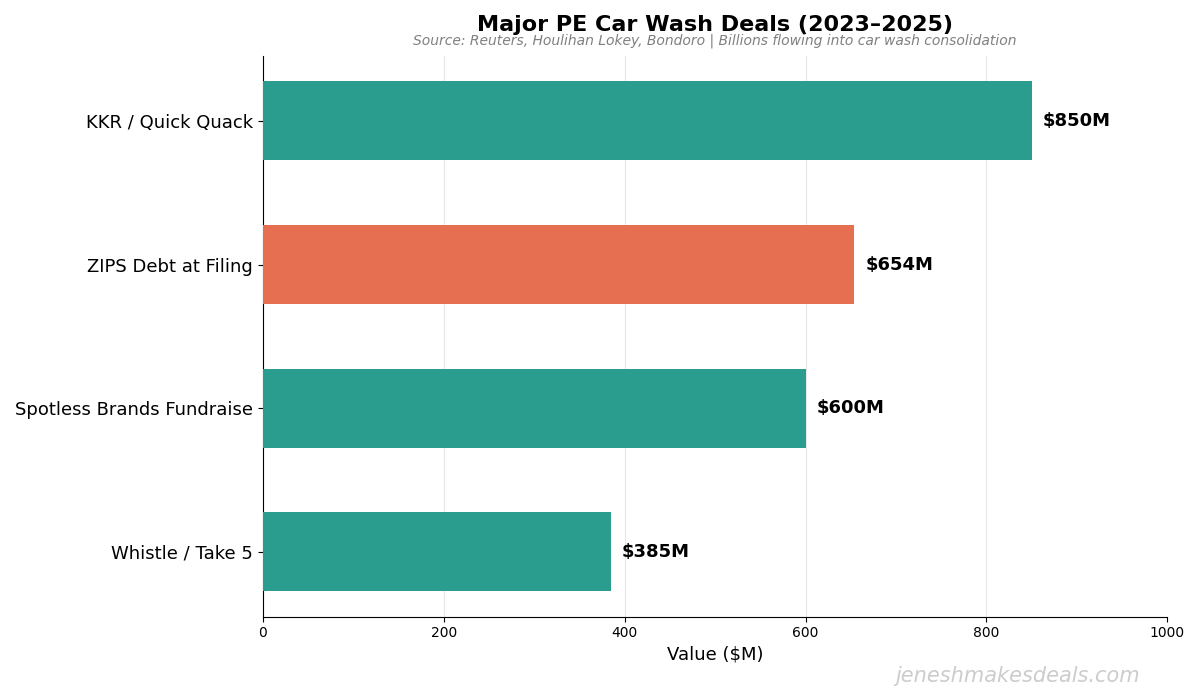
The car wash sector has attracted extraordinary amounts of private equity capital over the past five years. The scale of investment is difficult to overstate.
| Deal | PE Firm | Value | Details |
|---|---|---|---|
| KKR / Quick Quack minority stake | KKR | $850M | 230+ locations, implied $1B+ valuation |
| ZIPS Car Wash Chapter 11 debt | Atlantic Street Capital | $654M debt | 260 locations, $279M debt eliminated |
| Spotless Brands fundraise | Wafra Holdings / Access | $600M round | 205 sites, ~$3B target valuation |
| Whistle Express / Take 5 | Oaktree Capital | $385M | Creates largest US express operator (530+ sites) |
| Oaktree / Magnolia Wash | Oaktree Capital | Undisclosed | 118 locations acquired in 2023 |
| AEA / Splash Car Wash | AEA Investors | Undisclosed | 65+ locations in the Northeast |
U.S. PE firms currently hold approximately $1.4 trillion in dry powder, and with many car wash portfolio companies approaching exit timelines, transaction activity is expected to accelerate through 2026.
But here is the critical detail most independent owners miss. A PE exit wave is now expected over the next three years. Most 2020 to 2022 vintage car wash investments are reaching the end of their typical 4 to 7 year hold periods. Several platforms are already past the four year mark, with nearly a dozen more approaching it within 12 to 18 months.
This means PE firms need to sell their platforms, which requires showing growth, which means they need to keep acquiring add on locations. Your car wash could be exactly the add on they need to hit their exit targets.
What Car Wash Multiples Look Like in 2026
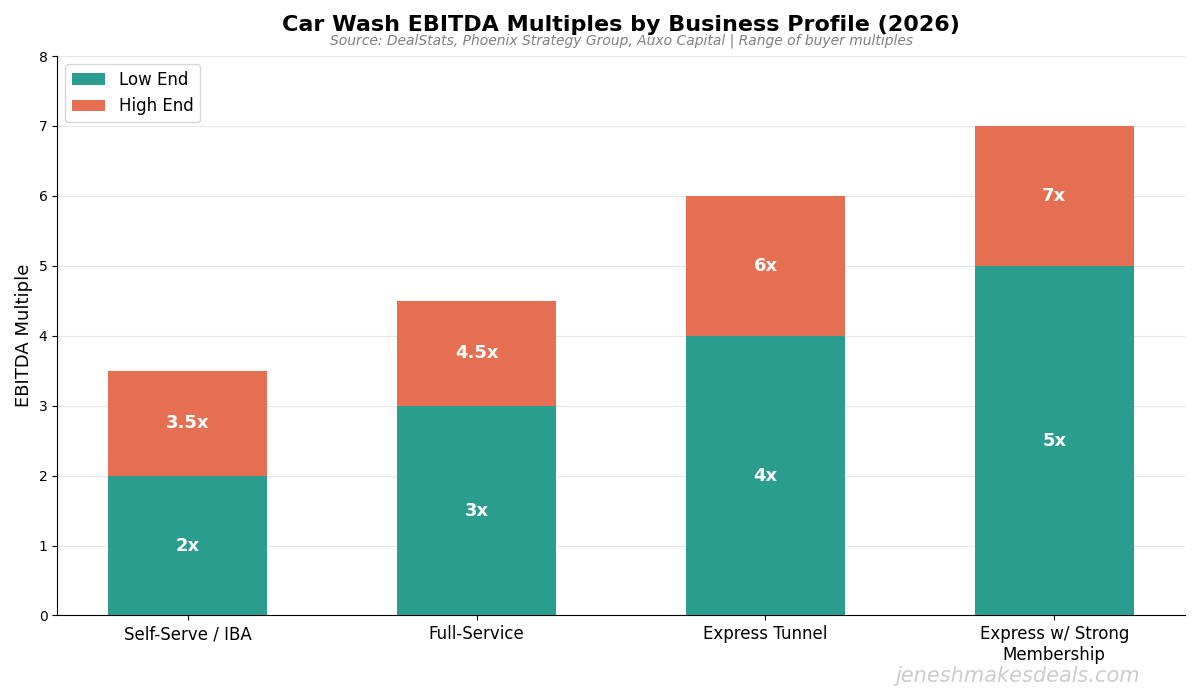
Car wash valuation multiples vary dramatically based on format, membership economics, and site quality.
| Metric | Range |
|---|---|
| SDE Multiple (industry average) | 2.39x to 4.23x |
| EBITDA Multiple (industry average) | 2.7x to 6.88x |
| Revenue Multiple | 0.47x to 1.4x |
| BizBuySell Average Earnings Multiple | 4.93x |
| Public Comps (Mister Car Wash, Driven Brands) | ~11.9x NTM EBITDA |
The format of your car wash matters enormously for valuation.
Express tunnel with high membership penetration. Commands the highest multiples. Institutional buyers are drawn to low labor requirements, high throughput, and recurring subscription revenue. Premium assets with proven membership cohorts, clean CAPEX histories, and clustered site density can trade at 5x to 7x+ EBITDA.
Full service. Trades at lower multiples due to labor intensity (payroll often 40% to 50%+ of gross), staffing variability, and margin fragility. Buyers underwrite more conservatively.
Self serve and in bay automatic. Often valued on cash flow yield and real estate value. Sites generating roughly $400K gross can produce 50% net operating income, making them attractive on a yield basis, but multiples tend to be lower given limited growth potential.
The median sale price for car washes on BizBuySell is $857,500 (median revenue of $710,000, median owner earnings of $200,000). Median revenue and earnings are up 73% and 24% respectively compared to 2021.
Multiples peaked in 2021, contracted through 2022 to 2024 as rates rose, and showed renewed firmness in 2025 with BizBuySell reporting multiples increasing again.
Want to see where your car wash falls? Use our free car wash valuation calculator to get an instant estimate based on your revenue and earnings.
Express Tunnels Have Completely Reshaped the Industry
The transformation of the car wash industry over the past 15 years is one of the most dramatic format shifts in any service sector.
| Format | Market Share (2008) | Market Share (2025) | Change |
|---|---|---|---|
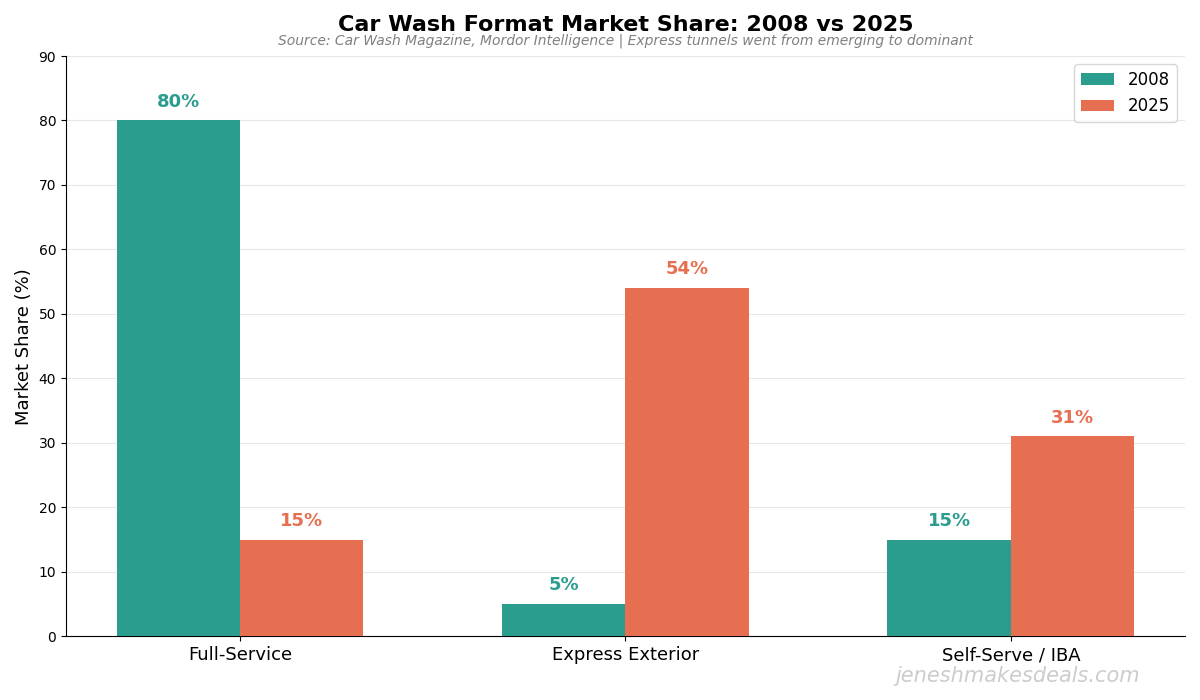
| Full Service | ~80% | ~15% | Severe decline |
| Express Exterior | Emerging (~5%) | 50%+ | Dominant format |
| Self Serve / In Bay Automatic | ~15% | ~31% combined | Stabilizing |
Full service car washes experienced a catastrophic decline from approximately 80% market share in 2008 to an estimated 15% today. Express tunnels offering $3 to $5 base washes (now $10+) gutted the $20 to $45 full service model.
The express tunnel segment now captures 50.88% of the North American car wash market and is growing at a 6.03% CAGR projected through 2031. The subscription car wash services market is growing even faster, at 9.9% CAGR from 2025 to 2035.
For independent owners who still operate full service or self serve formats, this data tells a clear story. Express tunnels with subscription models are where the market is heading, and competing against PE backed chains running this model is becoming increasingly difficult.
The Subscription Model That Makes Independents Obsolete
The subscription economics of express car washes are what make them so attractive to PE and so threatening to independents.
The math is elegant and devastating for competitors.
- Mean membership price is $25 per month, with members washing an average of 2.6 times per month
- That translates to roughly $300 per member per year in subscription revenue
- The marginal cost to wash each car is approximately $1.50 (water, chemicals, electricity)
- A $40 per month membership with a heavy user washing 10 times generates about $25 net profit per month after variable costs
- Even modest membership penetration (5% of unique customers) can increase total revenue by approximately 40% because fixed costs remain constant
- Express washes can achieve EBITDA margins of approximately 50% at well run sites
The membership benchmarks tell the competitive story.
- Most car washes with unlimited wash clubs never exceed 2,000 members per site
- A growing minority are reaching 3,000+ members per location
- Mister Car Wash averaged just under 3,000 members per site across 350+ locations before its IPO
- A few chains have crossed the 10,000 member mark per location
- Mammoth Holdings derives 60%+ of revenue from monthly membership charges
The "golden goose" of membership economics is converting light users, those who wash once every three months, into monthly subscribers. At a one wash price membership, annual lifetime value from that customer triples. Independent operators without sophisticated membership programs and the marketing budgets to drive conversion are fighting a losing battle against this model.
Considering your options? Contact me for a free consultation to discuss what your car wash might be worth to PE buyers in today's market.
Water Regulations Create Both Risk and Competitive Moats
Water regulation is an overlooked factor in car wash valuations, particularly in drought prone states.
California explicitly requires commercial car washes to recycle at least 50% of potable water used per cycle. During drought restrictions, operations without recycling systems may face shutdowns.
Multiple states have or are implementing water discharge regulations that restrict scaling, particularly in dense downtown areas.
The silver lining. Environmental regulations prohibiting residential car washing are actually expanding the professional car wash customer base, as home washing is increasingly restricted.
Professional car washes use 50 to 80 gallons per car versus 100 to 150 gallons for home washing. Modern express systems with reclaim technology can recycle up to 80% to 85% of water.
What Water Infrastructure Costs
| System | Cost | ROI |
|---|---|---|
| Basic water recycling/reclaim | $35,000 to $50,000 | 18 months typically |
| Comprehensive water treatment | $50,000 to $250,000 | Varies by jurisdiction |
| Water expense reduction with reclaim | ~85% | Ongoing savings |
Operators with advanced water recycling infrastructure are better positioned for drought prone markets in California, Arizona, Colorado, and Texas. This infrastructure also creates a competitive barrier against new entrants in water restricted jurisdictions.
For sellers, having water recycling systems in place is a tangible asset that reduces buyer risk and supports higher multiples, especially in western states.
The ZIPS Bankruptcy: A Warning for the Entire Industry
The most prominent cautionary tale in car wash PE is ZIPS Car Wash, which filed Chapter 11 in February 2025 with $654 million in debt and just $1 million in cash.
ZIPS scaled from 2 locations in 2004 to 260 at filing, funded by aggressive PE backed acquisitions. Revenue reached $345 million in 2022 but could not sustain the capital structure amid rising interest rates and intensifying competition. The restructuring eliminates $279 million in debt.
The broader implications for the industry are significant.
- M&A transaction count dropped approximately 46% in the first half of 2024 versus the same period in 2023
- The number of sites sold fell nearly 40%
- Deal concentration increased dramatically, with Whistle Express alone representing 43% of first half 2024 deals
- The express market is seeing more foreclosures and auctions than the industry has seen in decades
The ZIPS case shows what happens when PE backed platforms over leverage during a low rate environment and then face rate increases, saturation, and competition simultaneously. It is a cautionary tale for buyers, but it is also a signal for sellers. The fact that even large platforms can fail means PE firms acquiring your car wash need strong unit economics, not just scale. Well run independent sites with clean financials and strong membership programs are exactly what buyers need to avoid the mistakes that sank ZIPS.
The Cost of Converting vs Selling Now
If you are considering converting your existing car wash to compete with express tunnels rather than selling, here is what it costs.
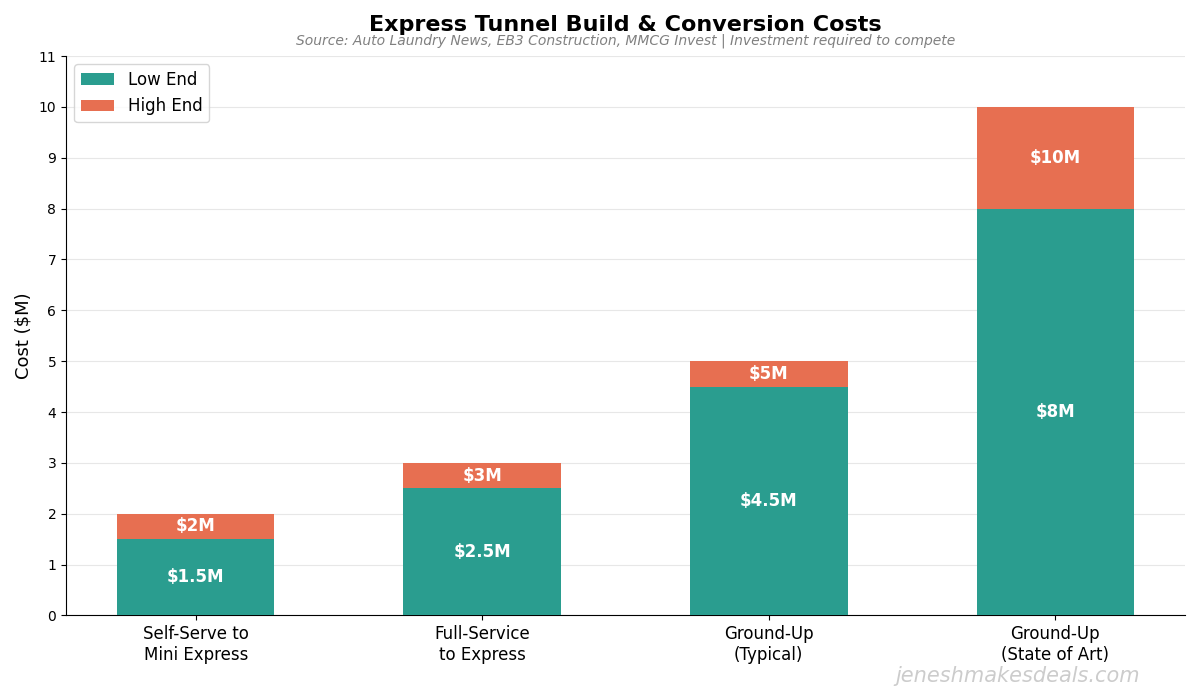
Full Service to Express Conversion
- Site acquisition: $1.5M to $2M (if purchasing existing full service with land)
- Renovation: approximately $200,000
- Additional equipment plus 12 to 15 vacuum bays: approximately $1,000,000
- Total: approximately $3 million with site included
Self Serve to Mini Express Conversion
- Total conversion cost: under $2 million including site acquisition
- Significant savings versus $3M to $3.4M ground up express cost
Ground Up Express Tunnel Construction
- 120 foot tunnel project: $3.5M to $8M+ depending on market conditions
- Industry standard: $3.85M to over $10M for state of the art facilities
- Typical greenfield per location including land: $4.5M to $5M
- Equipment alone for conveyor system: $1.4M to $2.1M before building and site prep
The math for most independent owners is clear. A $3M to $5M conversion investment with 12 to 18 months of construction and ramp up versus selling today at current multiples and walking away with cash. For owners approaching retirement or without the capital to fund a conversion, selling is the better financial decision.
What PE Buyers Specifically Look For in a Car Wash
PE firms evaluate car washes through a disciplined framework. Here is exactly what they prioritize.
1. Location and Traffic
High traffic roads, easy ingress and egress, commercial zone proximity, stacking capacity, and visibility. Sites with difficult turns or poor visibility underperform in membership conversion.
2. Membership Count and Retention
Not just how many members, but cohort behavior. Retention over time, churn drivers, and pricing architecture. Premium underwriting comes from measured retention, not marketing claims.
3. Land Ownership
Owned real estate significantly enhances value. Sale leaseback transactions are among the most attractive features for PE buyers, allowing operators to recoup investment through long term leases.
4. Equipment Age and Maintenance CAPEX
Buyers translate EBITDA into free cash flow by subtracting maintenance CAPEX. Clean maintenance logs, documented reinvestment history, and no deferred maintenance reduce underwriting risk.
5. Financial Reporting Quality
Three or more years of clean P&L statements, tax returns, bank statements verifying revenue, and defensible addbacks. Quality of Earnings readiness is critical.
6. Density and Clustering
Sites in geographic clusters enable shared staff, vendor leverage, brand awareness compounding, and lower customer acquisition costs.
7. Revenue Stability
Year over year consistency, membership penetration as percentage of revenue, and weather sensitivity are examined closely.
55,000 Car Washes and No One Owns More Than 4%
The US car wash and auto detailing industry generates over $18 billion in annual revenue in 2025, projected to reach approximately $31 billion by 2035 at a 5.5% CAGR.
The market structure creates the perfect conditions for continued consolidation.
- Roughly 55,000 to 60,000 car wash and detailing businesses operate in the US
- Over 80% are operated by less than five unit operators
- Approximately 3,000 companies own just one or two sites
- Roughly 200 companies operate 10 or more locations, collectively owning about 6,000 wash sites
- Even the largest operator, Mister Car Wash (~400 locations), controls only about 3% to 4% market share
- All PE backed platforms combined still do not own more than 25% of the express market
This extreme fragmentation is exactly why PE firms keep investing. There are thousands of potential acquisition targets, and consolidation creates immediate value through shared operations, marketing, vendor leverage, and multiple expansion.
But saturation is becoming real in specific markets. In some suburban areas, multiple express tunnels are now competing for the same membership eligible customers within overlapping trade areas. The 2026 forecast for express from industry analysts is cautious. Severe saturation, foreclosures, rising construction costs, and expensive debt service have all contributed to a downward trend in some markets.
Common Mistakes Car Wash Owners Make When Selling
After working with business owners across service industries, here are the mistakes I see most often from car wash sellers.
Not understanding your format's valuation ceiling. A self serve car wash and an express tunnel with 3,000 members are fundamentally different businesses with fundamentally different multiples. Know where your format falls before setting expectations.
Ignoring membership economics. If you have any kind of wash club or subscription program, document it thoroughly. Member count, retention rates, average revenue per member, and churn rates all directly affect your multiple. If you do not have a membership program, starting one 6 to 12 months before selling can meaningfully improve your valuation.
Deferring maintenance to save money before a sale. Buyers will hire inspectors who will find every deferred maintenance item. It comes out of your price either through lower offers or post inspection price reductions. Spend the money now.
Not highlighting your real estate. If you own the land, make sure that is clearly valued separately. Land ownership is one of the most attractive features for PE buyers.
Selling without a competitive process. With multiple PE platforms actively seeking add ons, there are likely several potential buyers for your car wash. Accepting the first offer without testing the market is how you leave hundreds of thousands of dollars on the table. A business broker who understands the car wash market can run a competitive process that surfaces multiple offers and drives up your final price.
Waiting for multiples to come back to 2021 levels. The 2021 peak was driven by near zero interest rates and unprecedented PE deployment speed. Those conditions are not coming back. Current multiples represent the realistic high water mark for the foreseeable future.
What to Do Next
The car wash industry is at a critical inflection point. PE capital is still flowing, but exit pressure is building. Express tunnels dominate, but saturation is creating cracks. Multiples have recovered from the 2022 to 2024 dip, but the ZIPS bankruptcy shows the limits of the PE playbook.
March 2026 update: Since this post was originally published, the consolidation trends have continued to accelerate. PE backed platforms are under increasing pressure to show returns before fund exit timelines arrive, which means they are still actively acquiring quality sites. At the same time, the fallout from the ZIPS Chapter 11 filing has made lenders more cautious about high leverage car wash deals, which is putting a ceiling on the most aggressive multiples. For independent owners with clean financials and strong membership programs, the market remains favorable. But the spread between premium and average sites is widening. If your operation is well run, now is the time to test the market while PE buyers still need your site for their growth story.
For independent car wash owners, this creates a specific and time limited opportunity. PE platforms still need add on acquisitions to build value before their exits. They will pay solid multiples for well located sites with clean financials, strong membership programs, and modern equipment. But as more distressed assets hit the market and saturation intensifies, that premium will compress.
If you own a car wash and are considering an exit in the next one to three years, here is what I recommend.
-
Get a valuation. Use our free car wash valuation calculator to get a baseline estimate right now.
-
Talk to someone who understands this market. Schedule a free consultation with me and I will give you an honest assessment of your car wash's attractiveness to PE buyers, what you could realistically expect in a sale, and what steps would increase your value.
-
Explore your financing options. If you are on the buying side and looking to acquire a car wash before PE prices everyone out, check out our funding options for business acquisitions.
The window is open. PE firms are still acquiring. But the math is changing fast. The best time to sell a car wash is while your business still represents growth potential for a buyer, not after the market around you has already been consolidated.
Sources
- Focus Bankers, Impending Exits in the Car Wash Industry
- Strategic Market Research, US Car Wash Services Market
- Houlihan Lokey, Convenience Store and Car Wash Industry Update Spring 2025
- MobilityPlaza, Whistle Express Acquires Take 5 for $385M
- Reuters, KKR to Buy $850M Stake in Quick Quack
- Car Wash Magazine, Managing Growth and Saturation
- Auxo Capital, Car Wash Valuation Multiples
- Phoenix Strategy Group, Understanding Car Wash Valuation
- BizBuySell, Car Wash Valuation Benchmarks
- Mordor Intelligence, North America Car Wash Market
- ICA, Car Wash Memberships Impact on Valuations
- Car Wash Magazine, Unlimited Wash Plan Economics
- Bondoro, ZIPS Car Wash Chapter 11 Case Summary
- Car Wash Advisory, 2025 M&A Report
- Future Market Insights, US Car Wash Services Market 2025 to 2035
- MMCG Invest, US Car Wash Industry Overview 2025
Frequently Asked Questions
How much is my car wash worth in 2026?
Car wash valuations in 2026 depend heavily on format and membership economics. You can estimate your business valuation using standard industry multiples. SDE multiples range from 2.39x to 4.23x, while EBITDA multiples range from 2.7x to 6.88x. Express tunnels with strong membership penetration command the highest end of that range (5x to 7x+). Full service washes trade at lower multiples due to labor intensity. Self serve sites are valued primarily on cash flow yield and real estate. The median sale price for car washes listed on BizBuySell is $857,500. Public comps like Mister Car Wash trade at approximately 11.9x NTM EBITDA.
Is private equity still buying car washes in 2026?
Yes, but the dynamics have shifted. PE firms are still actively acquiring car washes as add on acquisitions for existing platforms, and deal activity is expected to rebound in 2025 to 2026. However, the pace slowed in 2024, with M&A transaction count dropping 46% year over year. PE exit pressure is building as most 2020 to 2022 vintage investments approach the end of their hold periods, which means platforms need to keep acquiring to show growth before their own exits.
Should I convert my car wash to express or sell it?
Converting a full service wash to express costs approximately $3 million, while ground up express construction runs $3.5M to $10M+. For most independent owners approaching retirement or without significant capital reserves, selling at current multiples is the better financial decision. The conversion requires 12 to 18 months of construction and ramp up time, during which you have no revenue from the converted site, and you would be entering an increasingly saturated express market.
What happened to ZIPS Car Wash?
ZIPS filed Chapter 11 bankruptcy in February 2025 with $654 million in debt and just $1 million in cash. The company scaled from 2 locations in 2004 to 260 through aggressive PE backed acquisitions, reaching $345 million in revenue by 2022. Rising interest rates and intensifying competition made the capital structure unsustainable. The restructuring eliminates $279 million in debt. The case is a cautionary tale about overleveraged consolidation and a signal that not all PE car wash bets will pay off.
What do PE firms look for when buying a car wash?
PE firms prioritize location and traffic patterns, membership count and retention metrics, land ownership, equipment age and maintenance history, three or more years of clean financial records, geographic density for clustering benefits, and revenue stability. Sites that are membership enabled, well maintained, on owned real estate, and in strong traffic locations command the highest multiples and attract the most buyer interest.
Related Articles

April 30, 2026
How Long Does It Really Take to Sell a Business
Most sellers are shocked by how long it takes. Here's the honest timeline from listing to closing, and what actually speeds things up.

April 26, 2026
How to Structure an Earnout That Works for Seller and Buyer
Most earnouts fail because they're poorly structured. Here's how to build earnout terms that protect both sides of the deal.
April 24, 2026
How to Value Intellectual Property in a Business Sale
Your IP could be worth more than your equipment. Learn how patents, trademarks, and trade secrets affect your business valuation.
About the Author
Jenesh Napit is an experienced business broker specializing in business acquisitions, valuations, and exit planning. With a Bachelor's degree in Economics and Finance and years of experience helping clients successfully buy and sell businesses, he provides expert guidance throughout the entire transaction process. As a verified business broker on BizBuySell and member of Hedgestone Business Advisors, he brings deep expertise in business valuation, SBA financing, due diligence, and negotiation strategies.
You might also be interested in
Free Business Calculators
Try our business valuation calculator and ROI calculator to estimate values and returns instantly.
How to Buy a Business Guide
Download our comprehensive free guide covering everything you need to know about buying a business.
Our Services
Explore our professional business brokerage services including valuations and buyer representation.
More Articles
Browse our complete collection of business brokerage insights and expertise.