
If you own a plumbing business and you are thinking about selling, 2026 is the year to do it. Private equity firms have acquired more than 800 plumbing, HVAC, and electrical companies since 2022, and they are paying record multiples to get them.
PE backed add on acquisitions in plumbing and HVAC rose 88% year over year through mid 2025. There are now three times as many PE firms actively investing in home services compared to five years ago. Plumbing business valuations have jumped 46% since 2022, with median transaction values hitting $837,500.
If your plumbing company does $500K or more in revenue, there is a very real chance a PE backed competitor has already acquired one of your neighbors. Maybe two. Maybe five.
I work with plumbing business owners who had no idea this was happening until a competitor suddenly had new trucks, better marketing, and started offering their best technicians a 20% raise. By then, the market around them had already shifted.
Here is what every plumbing business owner needs to know about selling in 2026. What PE firms are paying, what they are looking for, and why this window will not stay open forever.
The PE Acquisition Wave in Plumbing Is Unprecedented
The numbers tell the story. Private equity firms are not just dabbling in plumbing. They are pouring billions into it.
The model is called a "roll up." A PE firm acquires one strong plumbing company as a "platform," then bolts on 10 to 30+ additional acquisitions to build regional or national scale. The major platforms active in plumbing right now include:
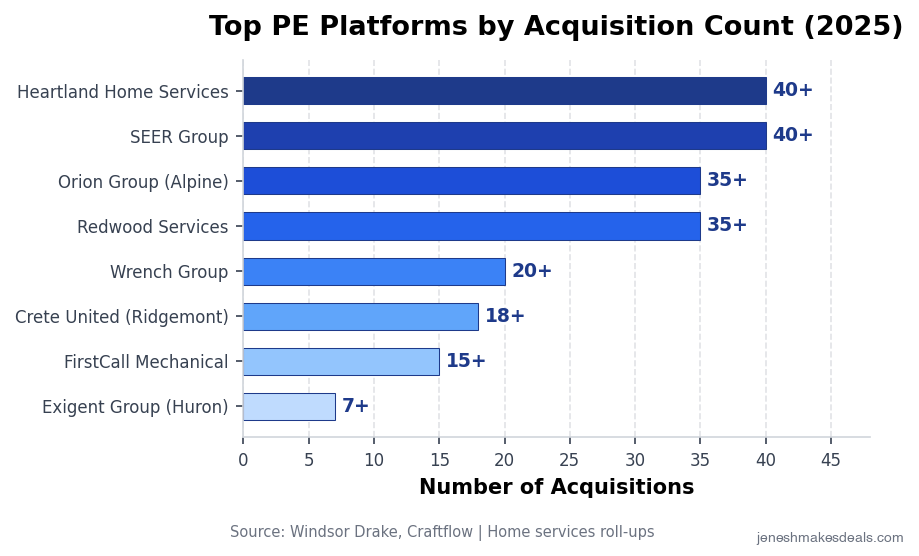
| Platform | PE Backer | Acquisitions | Notable Detail |
|---|---|---|---|
| Heartland Home Services | — | 40+ | Largest by deal count |
| SEER Group | — | 40+ | Multi trade platform |
| Orion Group | Alpine Investors | 35+ | HVAC, plumbing, electrical |
| Redwood Services | — | 35+ | Grew one brand from $30M to $70M revenue |
| Wrench Group | TSG/Oak Hill Capital | 20+ brands | Founded 2016 with Coolray, Berkeys, Abacus, Parker & Sons |
| Apex Service Partners | Alpine Investors | 8,000+ employees | $100M+ equity deployed |
| Crete United | Ridgemont Equity | 18+ | Multi trade |
| FirstCall Mechanical | SkyKnight Capital | 15+ | Regional focus |
Wrench Group is one of the most established, having started in 2016 with four anchor brands across Atlanta, Dallas, Houston, and Phoenix. It has since expanded to 20+ brands in major metros. Apex Service Partners, backed by Alpine Investors, launched in 2022 and has already grown to over 8,000 employees.
And these are just the platforms. There are dozens of smaller PE backed roll ups acquiring plumbing companies in regional markets across the country.
Windsor Drake, a sell side M&A advisory firm focused on home services, stated in February 2026 that this is "the most favorable seller environment in the history of the home services trades."
What Multiples Are PE Firms Paying for Plumbing Businesses?
This is where it gets interesting. The multiples PE firms pay vary dramatically based on the size of your business and how you position it.
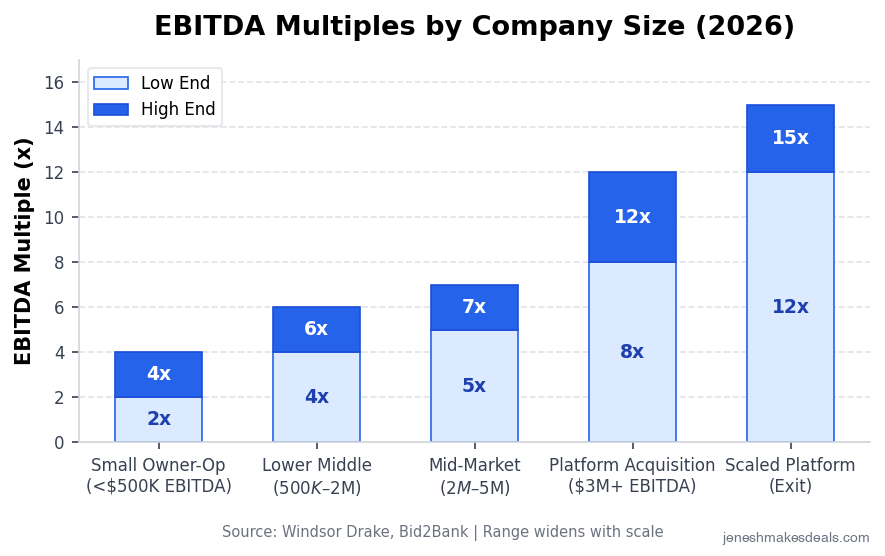
Multiples by EBITDA Size
| EBITDA Range | Multiple Range | Positioning |
|---|---|---|
| Under $500K EBITDA | 2x to 4x SDE | Small owner operated |
| $500K to $2M EBITDA | 4x to 6x EBITDA | Lower middle market add ons |
| $2M to $5M EBITDA | 5x to 7x EBITDA | Mid market quality add ons |
| $3M+ EBITDA (platform positioning) | 8x to 12x EBITDA | Platform anchor acquisitions |
| Scaled platforms (exit) | 12x to 15x+ EBITDA | Institutional exit or IPO |
The critical insight here is that the same company can see multiples differ by 3x to 4x depending on positioning. A plumbing company with $3M EBITDA positioned as a new platform anchor might trade at 10x. Positioned as a bolt on add on to an existing platform, that same company trades at 5x to 6x. That difference on $3M EBITDA is $12M to $18M in value.
For smaller plumbing businesses, BizBuySell data shows median transaction values have risen 46% since 2022 to $837,500. Profit margins for listed plumbing businesses hit 26.7% in 2025, the highest in the five year period.
Q2 2025 M&A data from Calder Group shows that for the $5M to $10M deal range, the median EBITDA multiple was 4.6x, with approximately 80% of deals attracting three or more offers. Services businesses including plumbing were the most active sector.
Want to see where your plumbing business falls? Use our free plumbing business valuation calculator to get an instant estimate based on your revenue and earnings.
The Multiple Arbitrage: How PE Firms Turn 5x Into 15x
Understanding the PE playbook explains why they are willing to pay you a premium. The entire model depends on multiple arbitrage at each stage.
Stage 1. Lower middle market PE firms buy individual operators at 4x to 7x EBITDA.
Stage 2. Regional platforms (5 to 15 acquisitions combined) sell to larger PE firms at 8x to 12x EBITDA.
Stage 3. Scaled national platforms are acquired by strategic buyers or go public at 12x to 15x+ EBITDA. Public comparables trade at a three year average of approximately 13x EBITDA.
Sila Services, backed by Morgan Stanley Capital Partners, is reportedly exploring a sale at approximately $1.5 billion, or roughly 15x EBITDA.
This means a PE firm that acquires 15 to 20 plumbing companies at an average of 5x EBITDA and builds them into a cohesive regional platform can exit at 10x to 12x. They effectively double the value through consolidation alone, before any operational improvements.
Your business is the building block that makes this math work. That is why they are willing to pay you a premium today.
Why the US Plumbing Market Is PE's Dream Target
The US plumbing market has characteristics that make PE investors drool.
| Metric | Figure |
|---|---|
| Total plumbing establishments | ~132,000 |
| Total industry revenue | $169.8 billion (2025) |
| Average employees per business | 5.8 |
| Market share of largest company | Less than 2% |
| Plumbing franchises | ~323 |
| National plumbing brands | 3 (commanding under 5% of market) |
The market is extremely fragmented. No single company holds more than 2% of national market share. Over 80% of operators remain small, regional, and founder led. For PE firms, this means virtually unlimited acquisition targets.
While PE has acquired 800+ companies since 2022, that represents less than 1% of the total establishment count. They are still in the early innings of consolidation.
But here is the catch. PE acquired companies tend to be the largest operators in their markets. Their revenue share and competitive impact is significantly outsized relative to the raw count. In many metros, PE backed plumbing companies already control 15% to 25% of the market, and they are growing.
The Labor Crisis That Makes Your Workforce More Valuable Than Your Revenue
The skilled labor shortage in plumbing is one of the most severe in any trade. It is also one of the primary reasons PE firms value staffed businesses so highly.
The numbers are stark.
- 550,000 plumber shortfall projected by 2027
- 55% labor shortage, new plumbers are not entering at the rate older ones retire
- 43,000 annual job openings projected through 2032
- ~60,000 plumbers retire annually as baby boomers age out
- The shortage costs the US economy approximately $33 billion annually
- 20%+ of the 635,000 plumbing workforce is 55 years of age or older
The average age of experienced plumbers is 54 years old, and roughly 60% of the current workforce is over 50. New apprentices are not replacing them fast enough.
This creates a paradox for business owners. Your workforce is aging, which creates succession risk. But that same workforce, if you still have it, is one of the most valuable assets you can sell. A plumbing company with a stable, tenured technician team is inherently worth more because that workforce is increasingly difficult and expensive to replicate.
PE firms know this. It is one of the top reasons they are paying premiums.
Thinking about your exit timeline? Contact me for a free consultation to discuss what your plumbing business might be worth to PE buyers in today's market.
What PE Firms Specifically Look For in a Plumbing Acquisition
PE firms evaluate plumbing acquisitions on a specific checklist, ranked by priority. If you are thinking about selling, this is exactly what you need to optimize.
1. Recurring Revenue (Highest Priority)
Service agreements and maintenance contracts signal predictable cash flow. The target is 30%+ of revenue from recurring sources. A company doing $5M with $1.5M in service agreements is dramatically more attractive than one doing $7M with zero recurring. Retention rates above 80% are ideal.
2. EBITDA Size and Margins
Higher EBITDA commands higher multiples, but margin quality matters as much as size. Three years of growing margins tells a compelling story. Industry average EBITDA is around 3%. Anything above 10% signals a well run operation. Above 15% is elite territory.
3. Low Owner Dependency
Buyers want a business that runs for 90+ days without the owner. If the owner is the top salesperson, chief estimator, and problem solver, the risk premium rises and the multiple drops.
4. Service Mix
PE firms rank revenue by risk. Service and repair work is the most desirable. New construction is the least. A company with 60%+ from service and repair commands the highest valuations.
5. Workforce Stability
Average technician tenure, turnover rate, training pipeline, licensing levels. Companies where key techs could leave after acquisition represent major risk.
6. Customer Diversification
No single customer should represent more than 10% of revenue.
7. Clean Financial Records
Three to five years of organized P&Ls, tax returns, and balance sheets. Messy financials either kill deals or cost 1x to 2x on the multiple.
8. Technology and Systems
Modern field service management software like ServiceTitan, Housecall Pro, or FieldEdge. Documented SOPs, CRM systems, and GPS tracking all add value.
9. Geography
Sun Belt and high growth metros command premiums. Route density creates competitive moats. PE platforms seek geographic gaps they need to fill.
What Is Really Happening to Your Plumbing Business Margins
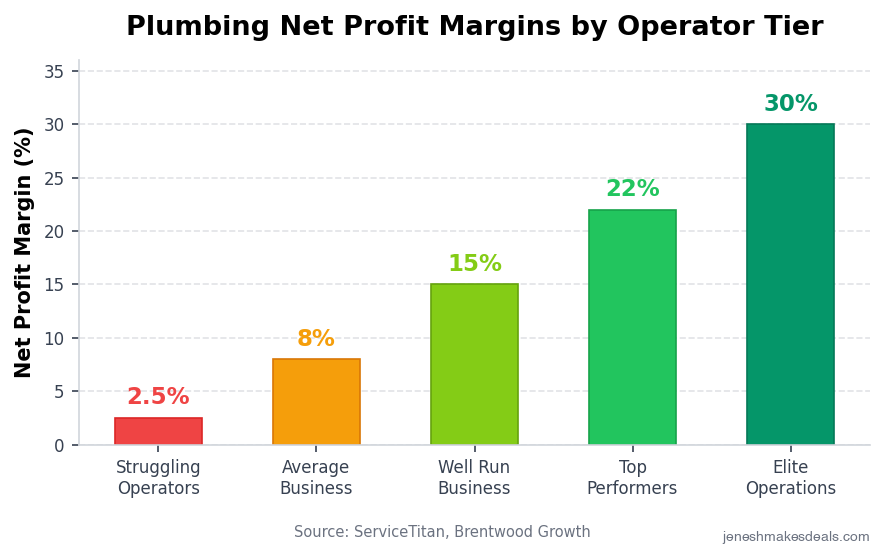
The performance gap between average and well run plumbing businesses is enormous.
| Operator Tier | Net Margin |
|---|---|
| Struggling operators | 2% to 3% |
| Average businesses | 2% to 8% |
| Healthy, well run | 10% to 20% |
| Profit leaders | 15% to 25% |
| Elite operations | 25%+ |
Industry experts recommend targeting 60% to 62% gross profit margins across all plumbing services, which generally allows for 17% to 20% net profit.
The median EBITDA margin for plumbing businesses in the $5M to $10M revenue range is 21.39%, according to Q2 2025 data from Calder Group. But the industry average EBITDA margin across all sizes is only about 3%.
This gap matters because PE firms are pricing based on margin quality, not just revenue. A $2M revenue plumbing business with 20% EBITDA margins ($400K EBITDA) at a 5x multiple is worth $2M. A $3M revenue plumbing business with 5% margins ($150K EBITDA) at the same multiple is worth only $750K. Revenue alone does not tell the story.
What Happens to Independents Once PE Consolidates Your Market
When PE firms consolidate a market, independent plumbing companies face competitive pressures that most owners have never experienced before.
Pricing Pressure
PE backed firms negotiate better pricing on supplies, equipment, and insurance through bulk purchasing power. They standardize pricing across brands. If you call three plumbing companies in a consolidated market, you will get prices within a few percentage points of each other. That makes it harder for independents to compete on price.
Talent Poaching
This one hurts the most. PE backed companies offer higher wages (20% average increase in the first year after acquisition according to Alpine Investors), better benefits packages, and structured career paths. With 110,000 unfilled technician positions nationally, the talent war disproportionately hurts smaller operators who cannot match those compensation packages.
Marketing Spend Disadvantage
Consolidated companies invest significantly more in marketing, SEO, paid advertising, and brand development. That increased visibility attracts more customers and creates cross selling opportunities that independents cannot replicate.
The Result
Some independent owners ultimately decide to sell because they feel outgunned by newly acquired competitors with better pricing, faster response times, and higher wages. The Wall Street Journal reported on this dynamic in October 2024, highlighting how PE investment transforms competitive landscapes in plumbing markets.
The operators who survive as independents typically pivot toward niches. Hospital plumbing, specialized retrofit work, commercial maintenance. Areas where the big platforms are less focused.
Is the PE Acquisition Window Closing?
As of early 2026, there are no clear signs of PE acquisition pace slowing. In fact, the opposite is true.
- Deal volume rebounded to record levels in 2024 and 2025 after a brief dip in 2023
- PE backed add on acquisitions in HVAC rose 88% year over year through mid 2025
- PHCC's 2026 industry outlook states consolidation is expected to persist
- Declining interest rates are expected to further support consolidation activity
- There are 3x more PE firms actively investing in home services compared to five years ago
But quality standards are rising. PE firms are increasingly selective, paying premium multiples for businesses with service agreements and stable workforces while discounting operators that lack these characteristics. The gap between what a premium plumbing business sells for and what an average one sells for is widening.
BizBuySell data also shows that median revenue of plumbing businesses listed for sale dropped 29% from 2024 peaks, suggesting some normalization at the lower end.
The window is open, but it favors prepared sellers. A well run plumbing company with recurring revenue, clean books, and a stable team will get multiple offers in today's market. A company with messy financials and high owner dependency may struggle to attract PE interest at all.
Not sure where your business stands? Contact me and I will give you an honest assessment of your plumbing business's attractiveness to PE buyers.
7 Steps to Maximize Your Plumbing Business Exit in 2026
If you are thinking about selling in the next 12 to 24 months, here is what you should be doing right now.
1. Build Recurring Revenue
Start or expand service agreements and maintenance contracts. Even 6 to 12 months of growing recurring revenue significantly improves your valuation. Target 30%+ of total revenue.
2. Clean Up Your Financials
Organize three to five years of P&Ls, tax returns, and balance sheets. Remove personal expenses from the books. This alone can add 1x to 2x to your multiple.
3. Reduce Owner Dependency
Hire or promote a general manager or operations lead. If the business cannot function without you for 90 days, start building systems and delegating now.
4. Retain Your Technicians
Offer retention bonuses, raise wages to be competitive, and document training programs. Your workforce is one of your most valuable assets. Do not lose key people in the 12 months before a sale.
5. Shift Your Revenue Mix
Grow service and repair work relative to new construction. PE buyers value recurring, predictable revenue streams over project based work.
6. Implement Technology
If you are still running on paper or spreadsheets, invest in ServiceTitan, Housecall Pro, or FieldEdge. Modern systems signal operational maturity to buyers.
7. Get a Professional Valuation
Before you enter conversations with any buyer, know exactly what your business is worth. This gives you leverage and prevents you from leaving money on the table.
Ready to find out what your plumbing business is worth? Use our free plumbing valuation calculator to get an instant estimate, or schedule a consultation for a detailed analysis.
Common Mistakes Plumbing Business Owners Make When Selling
After working with dozens of business owners in the trades, here are the mistakes I see most often.
Accepting the first offer. The difference between an unsolicited 6x offer and running a competitive process that yields 8x to 12x on $2M EBITDA is $4M to $12M in enterprise value. Never accept the first offer without understanding the market.
Waiting too long to prepare. The businesses that command the highest multiples have 12 to 24 months of intentional preparation. Starting to "think about selling" the month you want to list is too late to optimize.
Ignoring the labor risk. If two or three key technicians leave in the months before or during a sale, your valuation drops significantly. Retention planning should start well before you go to market.
Keeping messy books. I have seen deals die or lose $500K+ in value because financials were disorganized or had too many personal expenses mixed in.
Not understanding platform vs. add on positioning. The way your business is marketed to buyers matters enormously. The same company can be worth 5x or 10x depending on how it is positioned in the sale process.
What to Do Next
The plumbing PE roll up is not slowing down. If anything, it is accelerating. The combination of aging owners, skilled labor shortages, fragmented markets, and proven roll up economics means PE capital will continue flowing into this industry.
But the best time to sell is when you have options, not when you are forced to. The owners who get the highest multiples are the ones who prepare deliberately, understand what buyers want, and run a competitive process.
If you own a plumbing business and are even considering an exit in the next one to three years, here is what I recommend.
-
Get a valuation. Use our free plumbing business valuation calculator to get a baseline estimate right now.
-
Talk to someone who understands the market. Schedule a free consultation with me and I will give you an honest assessment of your business's attractiveness to PE buyers, what you could realistically expect in a sale, and what steps would increase your value.
-
Explore your financing options. If you are on the buying side and looking to acquire a plumbing business before PE prices everyone out, check out our funding options for business acquisitions.
The window is open. The multiples are historically high. The buyers are there. The only question is whether you are ready.
Sources
- Windsor Drake, Home Services M&A
- Talk24.ai, The PE Roll Up of HVAC
- Bid2Bank, What PE Looks For in Trade Contractors
- PHCC, 2026 Outlook for the P H C Industry
- Layer One Media, Contractor Consolidation
- Craftflow, Wrench Group Acquisitions
- HVAC Insider, Alpine Launches Apex Service Partners
- BizBuySell, Plumbing Valuation Benchmarks
- Peak Business Valuation, Plumbing Multiples
- Calder Group, Q2 2025 M&A Activity
- Revenue Memo, Plumbing Industry Statistics 2026
- ServiceTitan, Plumbing Industry Statistics
- IBISWorld, Plumbers Employment Statistics
- Wall Street Journal / AIC, PE Transforms Plumbing and HVAC Small Businesses
- PMM, 2026 Plumbing Industry Outlook
- League Park Advisors, Why Plumbing Owners Are Selling in 2025
Frequently Asked Questions
How much is my plumbing business worth in 2026?
Plumbing business valuations depend heavily on size, margins, and recurring revenue. Small owner operated businesses (under $500K EBITDA) typically sell at 2x to 4x SDE. Mid market companies ($2M to $5M EBITDA) with strong service agreements can command 5x to 7x EBITDA. Platform quality businesses with $3M+ EBITDA positioned correctly have sold for 8x to 12x. The median transaction value for plumbing businesses was $837,500 in 2025, up 46% from 2022.
Are private equity firms still buying plumbing companies in 2026?
Yes. PE acquisition activity in plumbing and home services is at record levels as of early 2026. PHCC's industry outlook confirms consolidation is expected to persist, and there are 3x more PE firms actively investing in home services compared to five years ago. Deal volume rebounded to record levels in 2024 and 2025, and declining interest rates are expected to further support activity.
What do PE firms look for when buying a plumbing company?
The top factors PE firms evaluate, ranked by priority, are recurring revenue (30%+ from service agreements), EBITDA size and margin quality, low owner dependency, service mix (service and repair over new construction), workforce stability, customer diversification, clean financials, modern technology systems, and favorable geography. Businesses that check most of these boxes command premium multiples.
How long does it take to sell a plumbing business?
The typical timeline from decision to close is 6 to 12 months. However, the businesses that get the highest multiples typically spend 12 to 24 months preparing before going to market. Preparation includes cleaning up financials, building recurring revenue, reducing owner dependency, and retaining key technicians.
Should I sell my plumbing business now or wait?
The current market favors prepared sellers. Multiples are historically high, PE capital is flowing freely, and the labor shortage makes staffed businesses especially valuable. However, quality standards are rising. Businesses with messy financials, high owner dependency, or no recurring revenue are seeing less interest. If your business is well positioned, 2026 represents a strong selling window. If it needs work, start preparing now so you are ready within 12 to 18 months.
Related Articles

April 30, 2026
How Long Does It Really Take to Sell a Business
Most sellers are shocked by how long it takes. Here's the honest timeline from listing to closing, and what actually speeds things up.

April 26, 2026
How to Structure an Earnout That Works for Seller and Buyer
Most earnouts fail because they're poorly structured. Here's how to build earnout terms that protect both sides of the deal.

April 24, 2026
How to Value Intellectual Property in a Business Sale
Your IP could be worth more than your equipment. Learn how patents, trademarks, and trade secrets affect your business valuation.
About the Author
Jenesh Napit is an experienced business broker specializing in business acquisitions, valuations, and exit planning. With a Bachelor's degree in Economics and Finance and years of experience helping clients successfully buy and sell businesses, he provides expert guidance throughout the entire transaction process. As a verified business broker on BizBuySell and member of Hedgestone Business Advisors, he brings deep expertise in business valuation, SBA financing, due diligence, and negotiation strategies.
You might also be interested in
Free Business Calculators
Try our business valuation calculator and ROI calculator to estimate values and returns instantly.
How to Buy a Business Guide
Download our comprehensive free guide covering everything you need to know about buying a business.
Our Services
Explore our professional business brokerage services including valuations and buyer representation.
More Articles
Browse our complete collection of business brokerage insights and expertise.